
Not every data analysis tool is suitable for addressing the specific challenges of the beauty industry. This article analyzes beauty trend analysis tools based on the different needs of product teams, making it easier to identify which type of tool is suitable for each challenge throughout the product development process.
What Should Product Teams Look for in a Beauty Trend Analysis Tool?
A trend analysis tool that product teams need should not only be able to detect growing beauty trends, but also provide a basis for assessing whether a trend is sustainable enough, relevant to the market, and valuable for the product development process.
Therefore, when selecting and using beauty trend analysis tools, product teams should pay attention to the following factors:
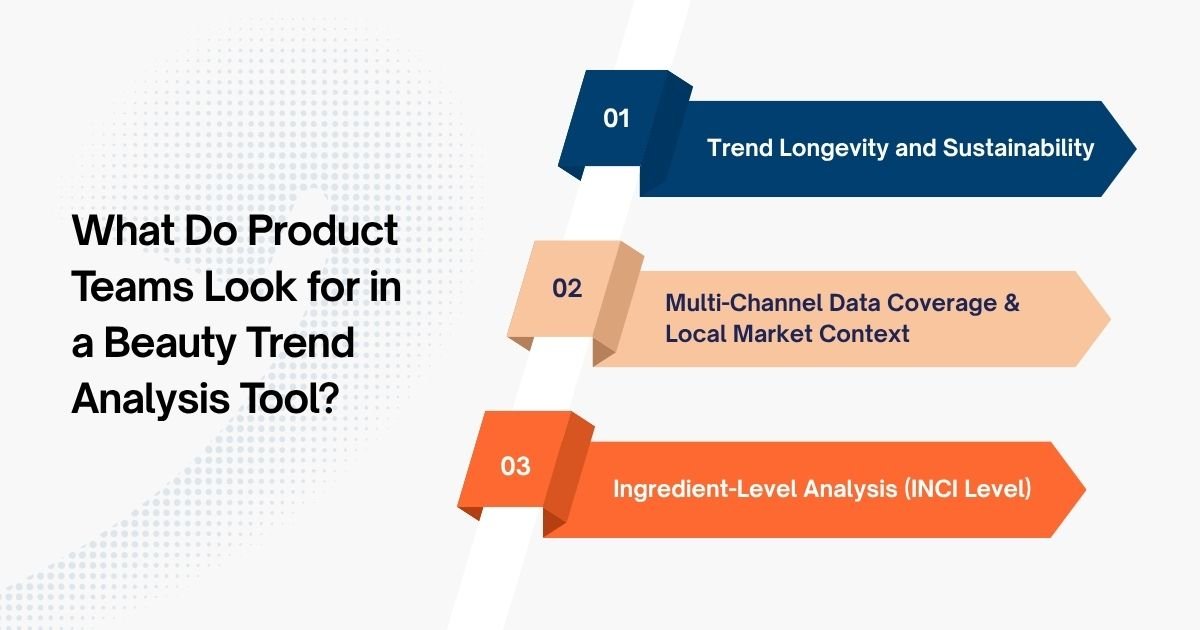
1. Measuring Trend Longevity
A trend that grows rapidly on social media is not necessarily a good opportunity for R&D, especially when the product development process requires significant time.
Therefore, the tool should be able to track the growth trajectory and longevity of a trend, helping distinguish between a short-term fad and a trend that is likely to last longer. This provides a basis for assessing which ingredients, product concepts, or consumer needs are worth researching further.
2. Multi-Channel Data Coverage and Local Market Context
A beauty trend may appear on Google Search, TikTok, Instagram, and Facebook before turning into purchasing demand on e-commerce platforms.
In Southeast Asia, data is also fragmented across different countries and languages. Users may use different slang, product names, or ways of expressing themselves even when referring to the same need. In addition, the same trend may be received differently by consumers in each market due to differences in climate, user characteristics, texture, and usage habits.
Therefore, the tool needs to provide multi-channel data coverage and market-specific data to not only reduce the risk of missing emerging demand signals but also help product teams understand how that trend is being expressed in the target market.
3. Data Detailed Down to the Ingredient Level
Data on a keyword such as “brightening serum” is not enough for R&D to conduct formulation research. Product teams need to understand more deeply the growing ingredients, commonly combined ingredients, products using those ingredients, and how they appear in the market.
Learn more: How to Discover Trending Skincare Ingredients Before Everyone Else
Therefore, a beauty trend analysis tool needs to provide analysis at the INCI level, rather than stopping at the keyword or product category level. This level of detail helps turn a trend signal into data that can be used for ingredient research, formulation, and product development.
Classifying Beauty Trend Analysis Tools
Each trend analysis tool typically has strengths in a specific type of data or supports a different stage of the analysis process. Therefore, classifying them into the following groups helps product teams choose the right tool for the challenge they need to address.
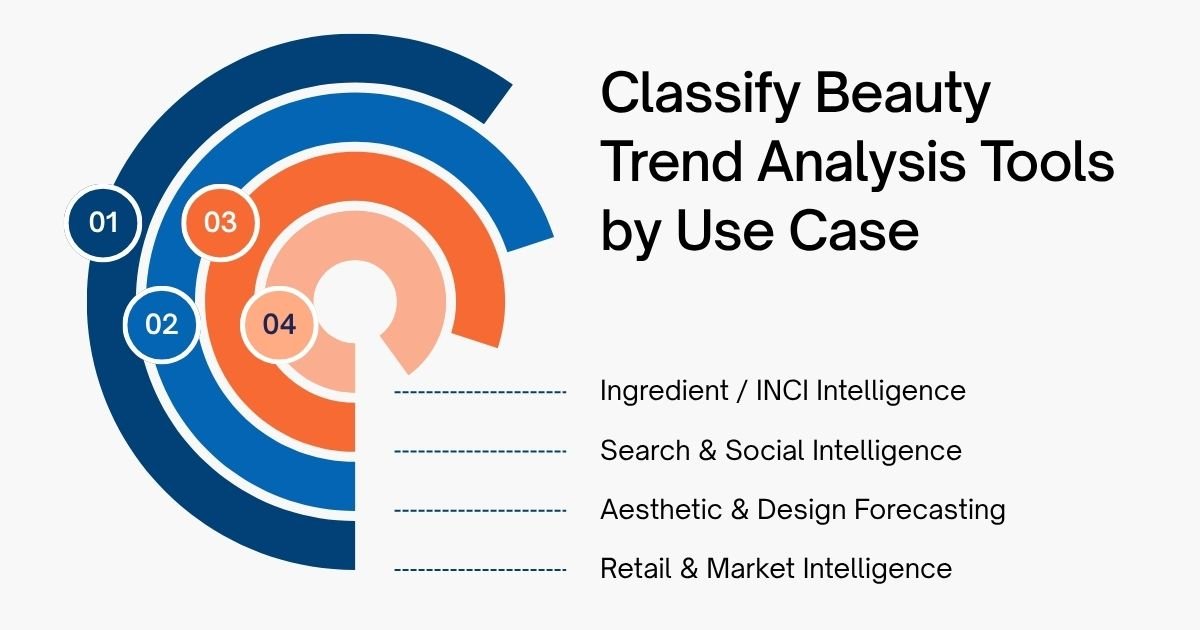
- Group 1 – Ingredient / INCI Intelligence: Goes deeper into ingredients, INCI, and product composition, making it suitable for ingredient research, formulation, and product development.
- Group 2 – Search & Social Intelligence: Tracks search behavior, social conversations, and consumer sentiment, helping identify consumer needs, emerging trends, and topics attracting attention.
- Group 3 – Aesthetic & Design Forecasting: Provides insights into color, texture, packaging, and aesthetics, making it suitable when teams need to define a product concept or visual/design direction for long-term planning.
- Group 4 – Retail & Market Intelligence: Focuses on retail, POS, and sales data, helping validate whether a trend or product signal has actually translated into real demand and purchasing behavior, while also tracking category, pricing, and market performance.
Beauty Trend Analysis Tools Product Teams Should Know
| Tool | Tool Category | Strongest Point | Data Sources | Best For |
| Spate | Search & Social Intelligence | Forecasting trend growth/decline | Google Search, TikTok, Instagram, Reddit | R&D, Concept Developer |
| WGSN Beauty | Aesthetic & Design Forecasting | Medium- and long-term macro trend forecasting | Social data, surveys, more than 2,800 third-party sources | Brand Director, color development team |
| BEAUTYSTREAMS | Aesthetic & Design Forecasting | Long-term aesthetic and product trend forecasting | Industry experts, supply chain, industry trade shows | Long-term strategy team, packaging design |
| Easy Data | Retail & Market Intelligence | Observed product, price and source-counter data | E-commerce platforms | Category Manager, Commercial Team |
| Ipsos Synthesio | Search & Social Intelligence | Large-scale multilingual social listening | Social media, forums, multi-channel reviews | Consumer Insights, claim validation |
| Gravel AI | Ingredient / INCI Intelligence | INCI analysis and finding related products, suppliers/OEMs | Product catalogs, INCI profiles | R&D, formulation, sourcing |
Spate
Spate is an AI platform specializing in beauty, personal care, and wellness, with a focus on search and social signals. The tool combines data from Google Search, TikTok, Instagram, and Reddit to track consumer interest in trends and topics.
One notable feature of Spate is its ability to forecast whether a trend will grow, stabilize, or decline over the next period. Its Whitespace Matrix also helps identify opportunities with high search growth but relatively low competition.
For product teams, Spate is suitable when they need to identify consumer demand signals and product opportunities before deciding to conduct deeper research.
WGSN Beauty
WGSN Beauty focuses on medium- and long-term macro trend forecasting. WGSN uses the STEPIC™ framework to analyze changes across society, technology, the environment, politics, industry, and creativity, and uses these insights to develop forecasts for the beauty industry.
WGSN also works with Coloro to provide a standardized color system for decisions related to color direction and product aesthetics.
Therefore, WGSN is more suitable for decisions that require a long-term perspective, such as brand direction, seasonal color, and product design, rather than tracking short-term trend fluctuations.
BEAUTYSTREAMS
BEAUTYSTREAMS focuses on beauty industry intelligence, with data supporting various areas from strategy and R&D to packaging and ingredient sourcing.
Through its Trend Funnel Methodology, the platform tracks the shift from macro changes to emerging aesthetic and product trends. Data from major industry trade shows also helps product teams monitor products, ingredients, and innovations emerging across the beauty supply chain.
This provides a useful perspective for teams building a long-term trend direction, particularly for product concepts, packaging, and strategic planning.
Easy Data
Easy Data focuses on e-commerce market data in Southeast Asia, with data from Shopee, TikTok Shop, and Lazada.
Product, price and displayed source-counter observations help teams compare marketplace offers and identify questions for further research. A documented sales-estimation method or authorized transaction records are needed to assess completed purchases; public listing observations alone do not establish them.
Teams can use these observations to frame product-demand research across Southeast Asian markets, then combine them with the supporting data and validation method appropriate to the decision.
Ipsos Synthesio
Ipsos Synthesio is an enterprise social intelligence platform that combines social listening with Ipsos’ market research methodologies.
The platform collects and analyzes data from social media, forums, and multi-channel review sources, supporting multiple countries and languages. AI is used to analyze sentiment and the topics users are discussing.
For product teams, Synthesio is suitable when they need to understand consumer sentiment, product feedback, and user acceptance of product claims.
Gravel AI
Gravel AI focuses on beauty product and ingredient intelligence, particularly at the INCI level, with its INCI List Scanner allowing product teams to enter an ingredient list to find products with similar formulations or ingredients in the market.
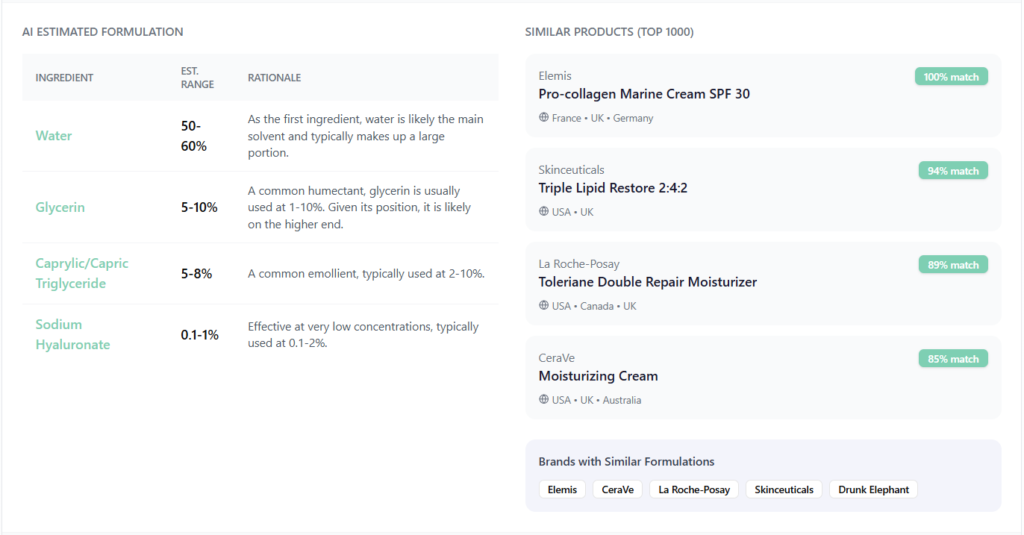
For R&D and formulation, this data can be used to compare product composition; sourcing teams can also use it to learn more about related suppliers and OEMs.
How to Use Beauty Trend Analysis Tools Effectively
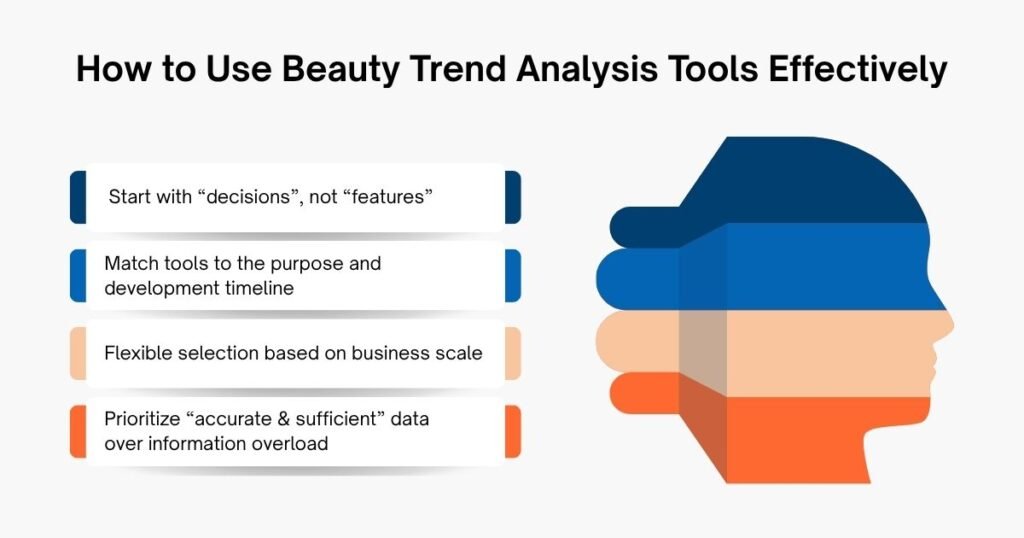
When selecting a beauty trend analysis tool, product teams should not start with the list of features offered by each platform. Instead, start with the decision the team needs to make, then identify the type of data needed to support that decision.
- If the team needs to build a long-term product direction, such as defining ingredient, packaging, or investment plans, it should prioritize data sources covering trend forecasting and long-term market changes, such as WGSN Beauty or BEAUTYSTREAMS.
- If the team needs to monitor signals currently developing in the market, such as consumer demand, seasonal products, or product messaging, search, social, and e-commerce data sources such as Spate, Synthesio, or Easy Data will be more suitable.
- For small teams or new brands, there is no need to start with multiple tools at once. One or two data sources that directly support the current decision may be sufficient, rather than investing in features the team does not currently need.
- For large enterprises operating across multiple markets, teams may need to combine multiple layers of data to view the issue from different perspectives, from long-term trend forecasting and consumer signals to e-commerce performance.
Final Thought
A beauty trend analysis tool is only truly useful when the insight it provides helps the product team answer a specific question during the product development process.
Teams do not necessarily need to choose a tool with a large number of features or one that provides a huge amount of insight. More importantly, the tool should provide the right type of data that the team actually needs.
This approach not only helps teams avoid investing in features they do not actually use, but also allows data to go directly into decision-making instead of creating a large amount of information that needs to be analyzed.
Leave a Reply