

Behind a leading skincare product is often a process that starts much earlier: a brand identifies a trending skincare ingredient before it becomes a mainstream trend, then invests in R&D to turn that ingredient into a product opportunity.
The advantage of leading skincare brands is not simply that they find a new ingredient, but that they recognize the signal early enough to have time to research, test, and bring the product to market before competition starts to intensify.
Why Tracking Emerging Skincare Ingredients Matters
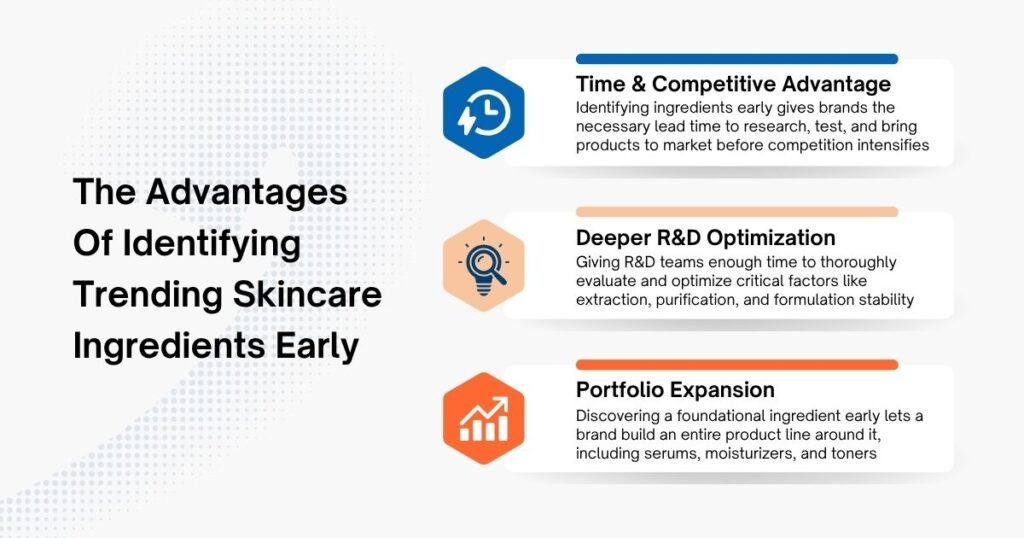
The biggest advantage a brand gains from identifying a trending skincare ingredient early is time.
- More time to get ahead: When a brand identifies an ingredient early, it can begin researching, evaluating evidence, testing formulations, and working with suppliers before market demand rises sharply. This time is especially valuable when multiple brands start looking for the same ingredient.
- Deeper investment in R&D: Identifying an ingredient early gives R&D teams more time to understand extraction, purification, stability, and formulation for the product. These factors need to be researched and optimized through multiple rounds and cannot easily be shortened by simply looking at a product that is already on the market.
- Turning one ingredient into multiple product opportunities: A new ingredient can become the foundation for multiple products if it fits the brand’s formulation, benefits, and positioning. What starts as an R&D direction can be developed into serums, moisturizers, toners, or other products within the same portfolio.
What Makes Skincare Ingredient Trends Different from General Beauty Trends?
Methods for spotting beauty trends early by combining signals from search, communities, and shopping behavior on e-commerce platforms can still be applied when tracking trending skincare ingredients. However, when going deeper into the ingredient level, brands need to pay attention to several specific factors.
1. Skincare Ingredients Have Multiple Names
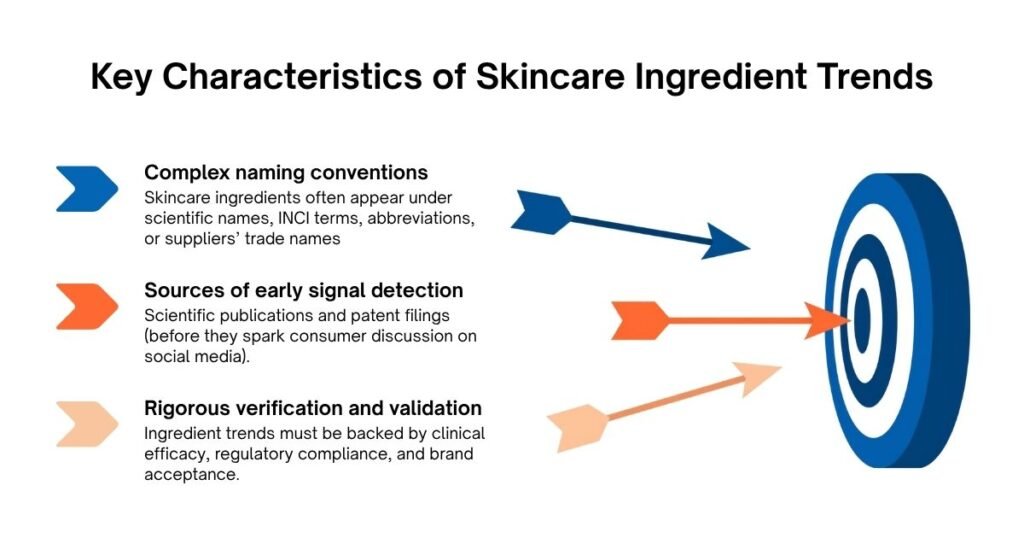
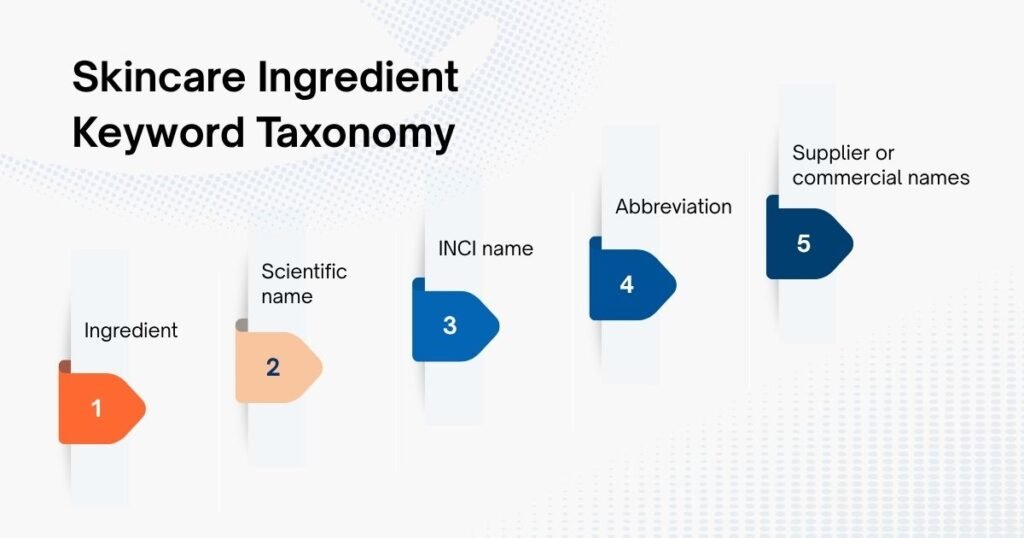
For a product or trend, setting up tracking keywords is usually simpler because the market tends to have one commonly used name. But with an emerging skincare ingredient, the situation is more complex: the same skincare ingredient may appear under its scientific name, INCI name, abbreviation, or trade name used by suppliers.
If a brand tracks only one common name, it may miss signals appearing under other names. Therefore, an ingredient keyword list should cover multiple related names to capture more complete data, especially when the ingredient is still new and naming conventions in the market have not yet become standardized.
2. Scientific Evidence and Patent Data Can Reveal Signals Earlier
Social media can be where consumers first start paying attention to a beauty product trend, but for skincare ingredients, early signals can emerge from sources such as scientific research and patents.
Before an ingredient is widely applied in commercial formulations, its properties, safety, efficacy, and application potential often need to be researched and evaluated. Therefore, research and patent activity can provide additional context on the level of interest in an ingredient, even when consumers are not yet talking about it extensively.
When tracking skincare ingredient trends, brands can monitor these signals simultaneously:
- Scientific publications: The number of studies related to an ingredient and how that volume is changing.
- Patent activity: Patent filings related to the ingredient and its applications.
- Consumer signals: Search volume, social discussions, and other signals from users.
However, a single signal does not mean that an ingredient has already become a trend. Scientific evidence and patent activity mainly help brands determine whether research and technology interest in an ingredient is increasing.
3. Brand Adoption Is a Validation Signal From the Industry
Beyond consumer signals, brands can also track whether other brands have started incorporating an ingredient into new products. This information can be monitored through industry product and SKU databases.
When more brands begin including the same ingredient in new product launches, it indicates that the ingredient is moving from research interest toward commercial adoption.
The development of a trending skincare ingredient can be tracked through the following layers of signals:
| Signal | Question to Answer |
| Search & social | Are consumers starting to show interest in this ingredient? |
| Scientific research | Is this ingredient being researched more extensively? |
| Patent activity | Is there more technology or application development related to it? |
| Brand adoption | Are brands starting to include the ingredient in new products? |
| E-commerce performance | Is the ingredient generating actual demand and sales? |
When an ingredient begins to show actual demand and sales on e-commerce platforms, brands can move on to analyzing supply and demand, competitive intensity, and market opportunities at the product level.
How to Prioritize Trending Skincare Ingredients
When a skincare ingredient starts appearing more frequently across different data sources, brands need to determine which signals deserve priority for further monitoring and R&D investment.
Search and social signals can indicate growing interest, but to assess whether an ingredient has the potential to become a product opportunity, brands need to consider these signals in the context of scientific evidence, regulatory requirements, supply, and the level of adoption by other brands.
One approach is to assign priority levels as follows:
| Signal | Priority |
| Scientific evidence & patent data | 25% |
| Regulatory & supply | 20% |
| Brand adoption | 20% |
| Search & social signals | 20% |
| Retail & e-commerce signals | 15% |
In addition to the rate of growth, the persistence of a signal over time should also be monitored. A short-term spike driven by a few KOLs means something different from a growth signal that continues consistently across multiple periods.
Common Risks When Evaluating Emerging Skincare Ingredients
Even when a skincare ingredient shows several positive signals, there are still risks that need to be checked before incorporating it into a formulation or communicating it in product marketing:
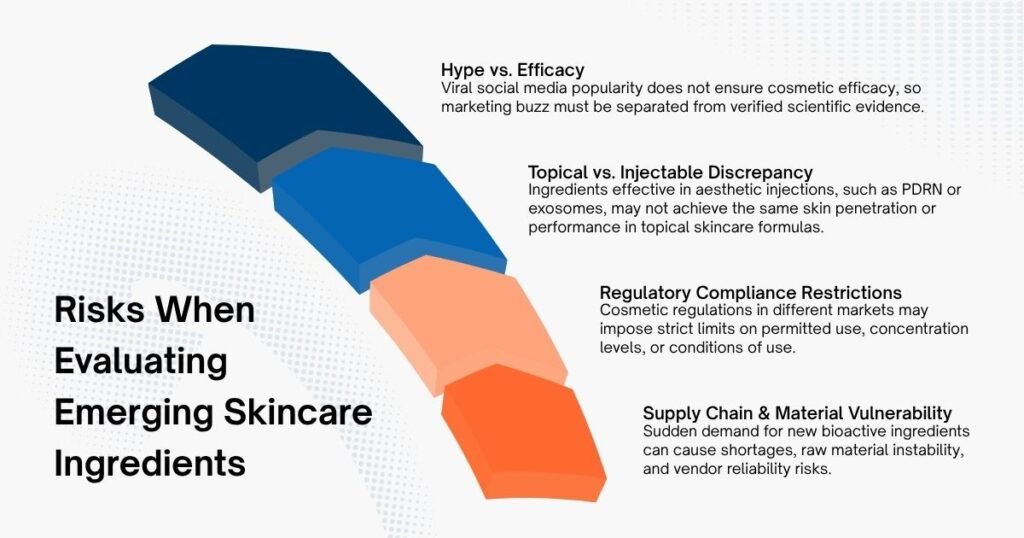
- Hype vs. Efficacy: An ingredient going viral on social media does not necessarily mean it is effective when used in cosmetics. Brands need to distinguish between social buzz and evidence of efficacy.
- Topical vs. Injectable: Some ingredients that are prominent in aesthetic applications, such as injectable PDRN or exosomes, may not have equivalent penetration or efficacy when used in topical products. This needs to be verified before incorporating the ingredient into a formulation or communicating it in product marketing.
- ASEAN Cosmetic Regulations: Brands need to check the requirements of the ASEAN Cosmetic Directive and regulations in each market to determine whether an ingredient is permitted or subject to restrictions on conditions of use or concentration. These requirements may vary across countries.
- Supply Risk: For new bioactive ingredients, supply can become an issue when demand increases rapidly. Brands should therefore also consider supply availability, raw material stability, and backup supplier options.
Conclusion
Not every trending skincare ingredient represents a potential opportunity for a brand. Beyond identifying a signal early enough to have time for research and evaluation, brands need to determine whether the ingredient has sufficient evidence, application potential, and market potential to be developed into a product.
Tracking trending skincare ingredients is not simply about finding out which ingredients are attracting attention. It is about capturing signals early, filtering for promising trends, and identifying which ingredients are truly worth investing in.
Leave a Reply