

When a beauty product starts flooding social media, most brands are only beginning to look for suppliers, but by then, the market is already close to saturation. Spotting beauty trends before they go viral is not just a matter of luck. A beauty trend usually goes through a process of development before becoming a mainstream trend. The question is: can you recognize the small signals that are changing before the market as a whole starts to see them?
Why Spotting Beauty Trends on Social Media Alone Is Too Late
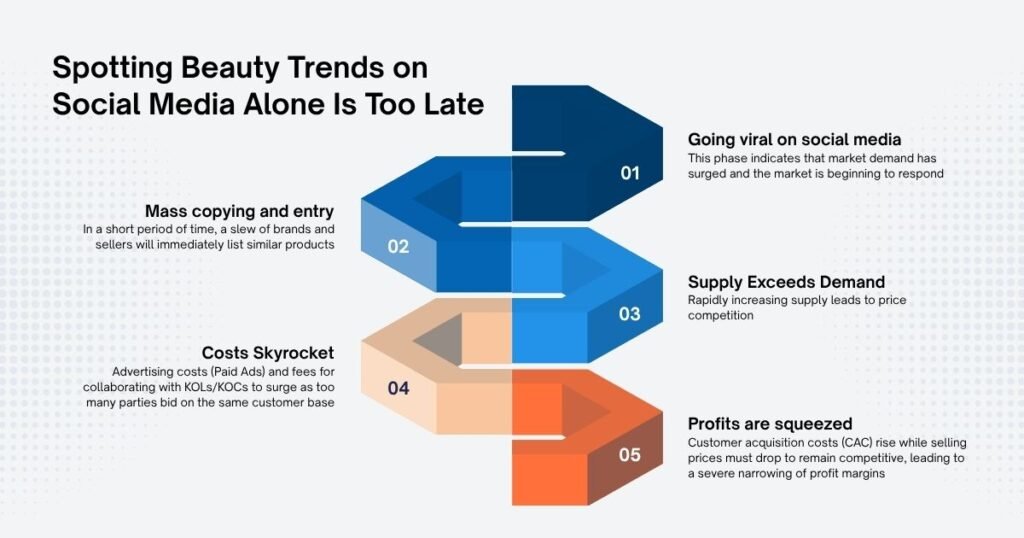
A familiar pattern in Southeast Asia’s beauty industry often starts like this: a product suddenly becomes “hot” on social media platforms such as TikTok, Instagram, or Facebook, followed by a wave of videos and review posts. Within just a few weeks, dozens of other brands have already launched similar versions. If you are monitoring social media to find ideas for your next product, you are looking in the right place but at the wrong time.
A product appearing on a best-seller list or a piece of viral content is no longer an early trend signal. It shows that demand has become strong enough for the market to start responding.
And on Southeast Asian e-commerce platforms, a trend that has just gained attention can quickly attract a wave of sellers listing similar products. Supply increases, price competition begins, and the cost of attracting customers rises as well.
- Paid ads become more expensive as more brands compete for the same customer segment.
- KOL/KOC collaboration costs increase as booking demand rises.
- CAC increases while profit margins come under pressure from price competition.
→ High sales do not necessarily mean high opportunity.
If a product is selling very well but the surrounding market is already crowded, a brand needs to determine whether it is looking at an emerging beauty trend or has already entered an oversaturated beauty category. More importantly, is there still enough whitespace in the market to support further growth?
The Framework for Spotting Beauty Trends Early
To recognize a beauty trend while it is still forming, you need to look at multiple data sources before it appears on social media. The first three beauty trend signals below help identify demand while it is still developing, while the final layer helps determine whether that demand has become a real market opportunity.
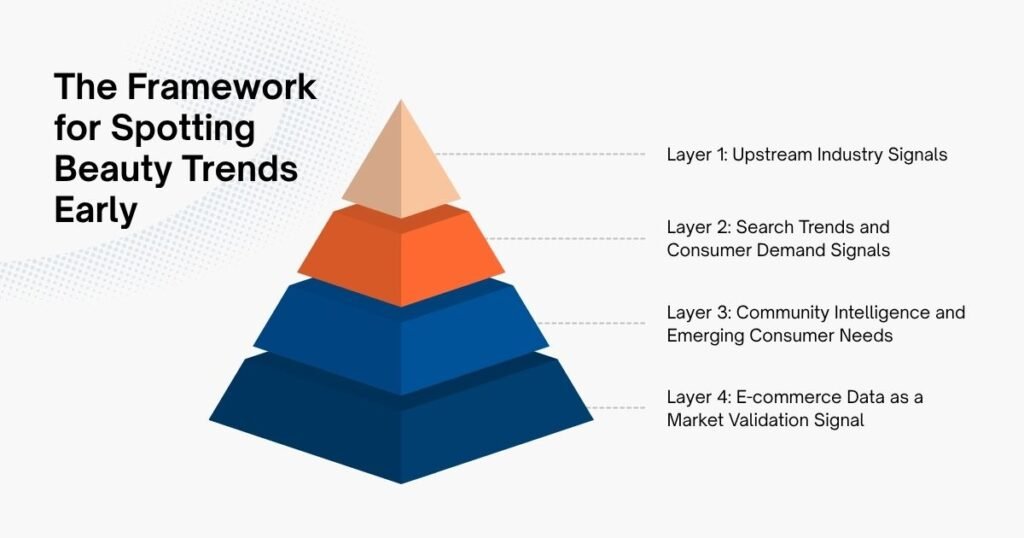
Layer 1: Upstream Industry Signals
One of the places where you can spot emerging beauty trends earliest is the B2B market: R&D teams at ingredient suppliers and industry trade shows such as in-cosmetics and Cosmoprof. This is where new ingredients, formulation concepts, and technologies are introduced before they become widely available in the consumer market.
For R&D and product development teams, pay attention when the same ingredient, benefit, or formulation concept starts appearing across multiple suppliers. This repetition can indicate that multiple suppliers are responding to the same emerging consumer need or innovation direction.
Cosmetics regulators in the region, such as NPRA (Malaysia), BPOM (Indonesia), and HSA (Singapore), can also provide additional context when a brand needs to check requirements or changes related to ingredients.
Layer 2: Search Trends and Consumer Demand Signals
When consumers start actively researching, new demand often leaves traces in search engines. Google Trends can be used to track search interest, search trends, and search momentum over time and across regions. Tools such as Exploding Topics and Spate can also help identify topics, products, or keywords that are gaining momentum before they become widely popular.
For example, a keyword with high volume but little change over time may represent a relatively established need. Meanwhile, a keyword with lower volume but steady growth is more worth monitoring if you are looking for emerging demand.
| Search signal | What it may indicate |
| High volume but largely flat | A relatively mature demand |
| Low volume but steady growth | A new need may be emerging |
| Search momentum rising quickly | Demand is accelerating; further validation is needed |
Marketplace autocomplete and search suggestions can also show what shoppers are searching for and which keywords they are combining, providing additional signals of purchase intent before the market has too many products addressing that need.
Layer 3: Community Intelligence and Emerging Consumer Needs
A new need sometimes appears in discussions before it becomes clearly visible through search volume.
Subreddits such as r/AsianBeauty and r/SkincareAddiction, Facebook groups, specialized forums, and niche communities are places where users often share problems, ask questions, and look for specific solutions.
For example, if the same beauty concern, ingredient, or routine keeps appearing in discussions, it may be a sign of an emerging consumer need. If the number of participants and the level of discussion are also increasing, the signal becomes even more worth monitoring.
Rather than looking only at a video that is being widely shared, look at what users keep asking about and which problems still lack satisfactory answers. Conversations like these can reveal the real demand behind a topic that is attracting attention.
Micro-creators are also worth monitoring because they are often close to these niche communities and may talk about a need before it appears on larger accounts.
Layer 4: E-commerce Data as a Market Validation Signal
The three layers above show that a need is emerging and attracting consumer interest. But interest does not equal business opportunity. To validate whether a beauty trend has started to show up in the market, you also need to look at e-commerce data.
Data from Shopee, Lazada, and TikTok Shop provided by Easy Data can help track products, sellers, prices, and changes in supply, showing how the market is responding to a new demand.
Specifically, you can look for answers to questions such as:
- Which products are appearing or growing quickly?
- How many sellers have started entering the market?
- Are prices increasing or decreasing?
- How is supply responding as demand increases?
If social media is “hot” but search demand, community discussions, and e-commerce activity remain largely unchanged, there is not yet enough evidence to conclude that it is a sustainable trend. On the other hand, when multiple layers of signals point in the same direction, it becomes more reliable evidence that a real consumer need is growing.
But even when multiple signals are increasing at the same time, you still need to check whether that demand is sustainable enough to become a trend or is simply a short-lived fad.
Beauty Trend vs. Fad: How to Validate an Emerging Trend
Not every early trend signal leads to a sustainable trend. Some fads last only a few weeks and then disappear completely. Therefore, distinguishing trend vs. fad before investing in R&D, production, or marketing can help brands avoid putting their budget into a temporary need.
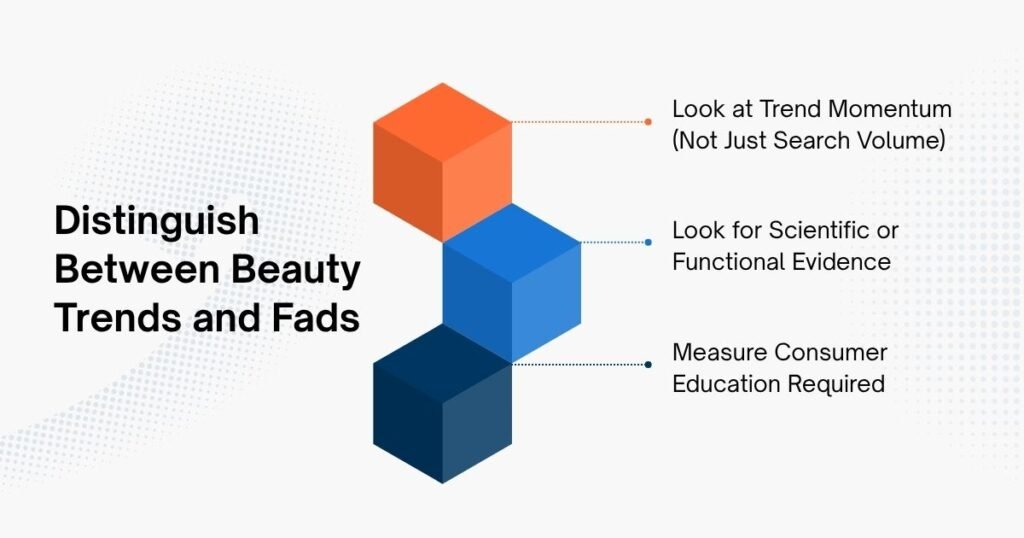
1. Look at Trend Momentum, Not Just Search Volume
At the trend discovery stage, search data helps you identify which needs are growing. When you need to determine whether it is a sustainable trend, look more closely at momentum.
A sustainable trend typically has search momentum that grows steadily and continues across multiple cycles. A fad, on the other hand, often spikes over a short period, potentially driven by an influential person or a viral moment, and then drops sharply as social media attention fades.
Looking at momentum also helps you recognize whether an emerging beauty trend is growing or whether you are simply seeing an already mature demand.
See the detailed guide on measuring Search Momentum and finding growing products in Finding Trending Beauty Products Before Your Competitors.
2. Look for Scientific or Functional Evidence
Is there scientific evidence or a functional benefit behind the trend?
Trends based on a researched mechanism of action, even if they are still at an early experimental stage, often have a stronger foundation than trends driven mainly by personal experiences shared online.
For example, bakuchiol has attracted sustained interest as an ingredient often mentioned in products targeting people who want an alternative to retinol, while more research continues to explore the ingredient’s properties and potential applications.
Therefore, ingredient trends should be evaluated based on both consumer interest and the credibility of the ingredient or benefit the product provides.
3. Measure Consumer Education Required
How much “education” do consumers need to understand and trust the product?
This is an easy-to-overlook factor when evaluating the commercial potential of a trend.
If the concept is still too new and buyers do not understand why they need the product, the brand will need to invest more in educational content, product trials, and marketing to explain and persuade customers. Conversely, a trend based on a concept that consumers are already familiar with typically has lower adoption barriers and lower market entry costs.
Finding the Beauty Trend Entry Window: When Should Brands Act?
Entering the market too early or too late is costly; the difference is the type of cost involved.
If you enter too early, when most consumers do not yet understand the problem the product solves, the brand will have to bear most of the cost of educating the market (from explanatory content and product trials to convincing customers) before generating significant sales.
If you enter too late, when the beauty trend has become mainstream, most of the buyers’ attention has already been captured by the brands that arrived first. At that point, advertising competition increases while pricing flexibility also becomes more limited.
The “entry window” lies between these two stages: consumer awareness has started to form, consumer demand is increasing, but supply has not yet caught up with the gap. At this stage, a brand can take advantage of rising demand without having to build the entire market from scratch.
The most practical way to identify this stage is to track three factors in parallel:
- How quickly are demand signals increasing?
- How quickly are product listings and supply increasing?
- How are price competition and advertising competition changing?
When demand is still growing but supply and competition have not yet caught up, that is when it may be time to consider taking action instead of continuing to “wait and see”.
Conclusion
Spotting beauty trends early is not about trying to guess which product will go viral next. It is about building the ability to see demand while it is still forming, validating it through multiple data sources, and knowing when to act.
With a systematic approach, brands can reduce their reliance on intuition and short-lived viral moments. Beauty trend analysis tools can also make monitoring more convenient and accurate when you need to combine search, consumer behavior, and marketplace data.
Leave a Reply