

Most price monitoring software on the market is designed for e-commerce ecosystems like Amazon or Shopify. But for beauty brands in Southeast Asia, where Shopee, Lazada, and TikTok Shop play a crucial role in sales, monitoring beauty product prices isn’t simply a matter of recording the prices currently displayed on listings. A suitable software must reflect how prices fluctuate on the platforms where the brand actually operates.
So what is the best price monitoring software for beauty brands when each market has its own unique characteristics, and data monitoring needs depend on the scale and operations of each brand?
What to Look for in Price Monitoring Software for Beauty Brands
Before comparing features, identify the data your brand actually needs to track. Even a price monitoring software with many features will struggle to meet your needs if it doesn’t support the marketplaces where you operate or can’t distinguish between important product variants.
Here are seven factors you should consider when making your choice.
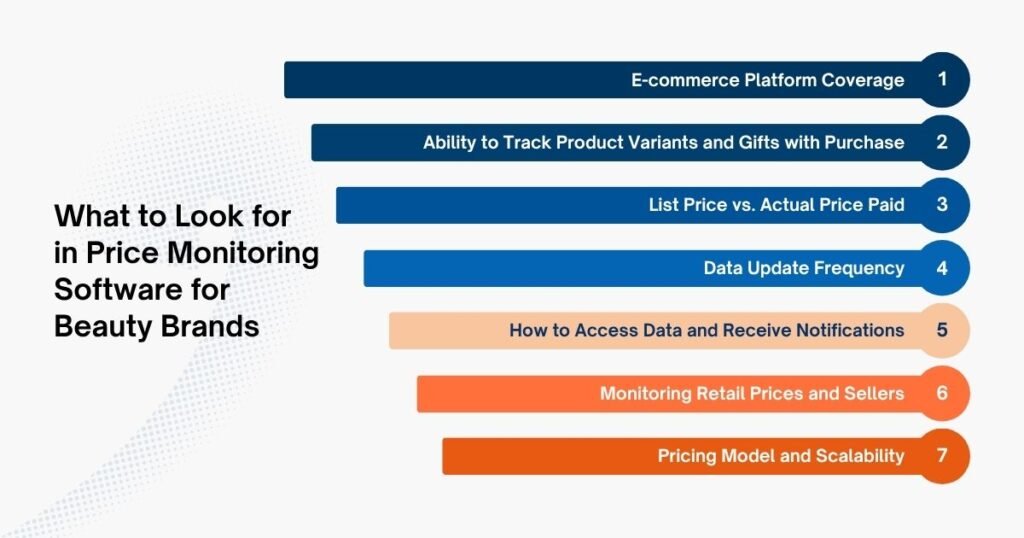
E-commerce Platform Coverage
Some providers tout the ability to track prices across multiple websites, but not every tool performs well on every marketplace. Each platform has its own way of displaying products, prices, and promotions. Therefore, test the tool with actual product URLs on the marketplaces you’re interested in, rather than relying solely on the platform list on the provider’s website.
Ability to Track Product Variants and Gifts with Purchase
A cosmetics listing may include multiple colors, sizes, formulas, or bundles. Brands may also offer a “Gift with Purchase” (GWP) instead of directly reducing the selling price. If the tool only records the overall price of the listing, the data may not accurately reflect the differences between variants or the promotions customers actually see.
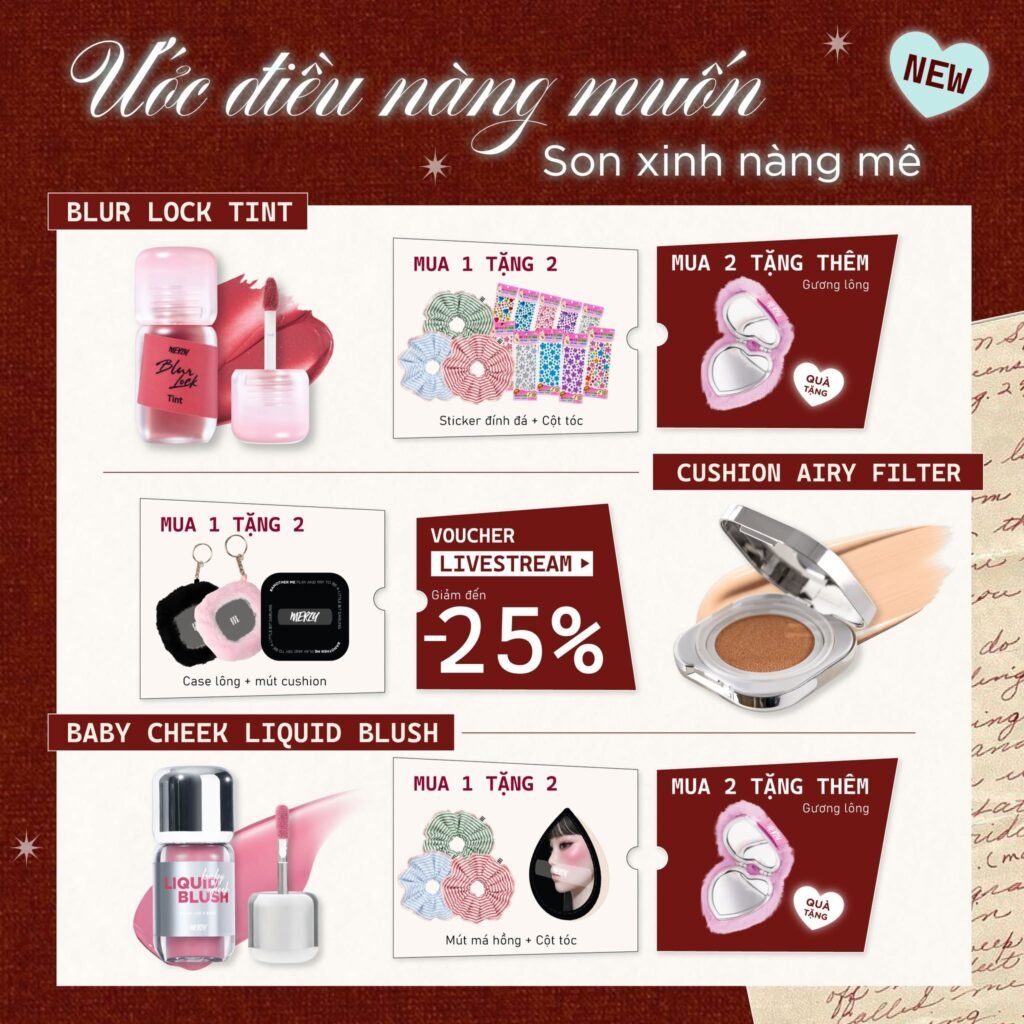
Therefore, determine whether you only need to track prices at the listing level or need to distinguish prices by product variant. If GWPs are a key part of your promotional strategy, how the tool tracks these gifts is also worth noting, especially when you want to compare the value of offers across brands.
List Price vs. Actual Price Paid
The price displayed on the product page isn’t necessarily the amount customers pay after applying for a voucher or promotion. Depending on your analysis objectives, you may need data on list prices, prices after direct discounts, or prices after applying vouchers.
When comparing prices across brands, ensure the data uses a consistent basis for comparison (such as list prices or prices after discounts). Otherwise, the results may not accurately reflect price differences.
Data Update Frequency
If the tool only checks prices once a day, you might miss out on short-term discounts like Flash Sales. For tracking long-term trends, daily reports may be sufficient; however, if you need to monitor short-term campaigns, data updated more frequently will be more useful.
How to Access Data and Receive Notifications
How your team uses the data also influences tool selection. If you only need to view price fluctuations, a built-in dashboard may suffice. If you need to incorporate the data into internal reports or a Business Intelligence system, the ability to export files, access APIs, and integrate with existing workflows becomes more important.
Notifications via email, Slack, or other channels are also helpful if you want to be alerted when prices change without having to constantly open the dashboard to check. However, be sure to verify whether these notification options are included in the service plan you intend to use.
Monitoring Retail Prices and Sellers
For brands that distribute products through multiple retailers or distributors, detecting unusually low prices and monitoring unverified sellers can be a critical part of channel management.
However, price monitoring does not equate to identifying unauthorized sellers. If the brand needs to monitor compliance with Minimum Advertised Price policies, check whether the software supports this functionality or if a separate, specialized solution is required.
Pricing Model and Scalability
Costs may depend on the number of products, the number of URLs, the frequency of checks, or the scope of the project. As the product catalog and the number of competitors to monitor grow, this pricing structure can significantly impact total costs.
Instead of focusing solely on the starting price, consider costs at your current scale and as your needs grow. Also, review the limitations of each plan to avoid choosing a solution that seems cost-effective initially but becomes inadequate as your brand expands.
6 Price Monitoring Solutions Worth Considering for Beauty Brands
Not every solution is comprehensive price monitoring software. Some provide dashboards for managing competitor prices, while others focus on data collection or provide the infrastructure for businesses to build their own analytics systems.
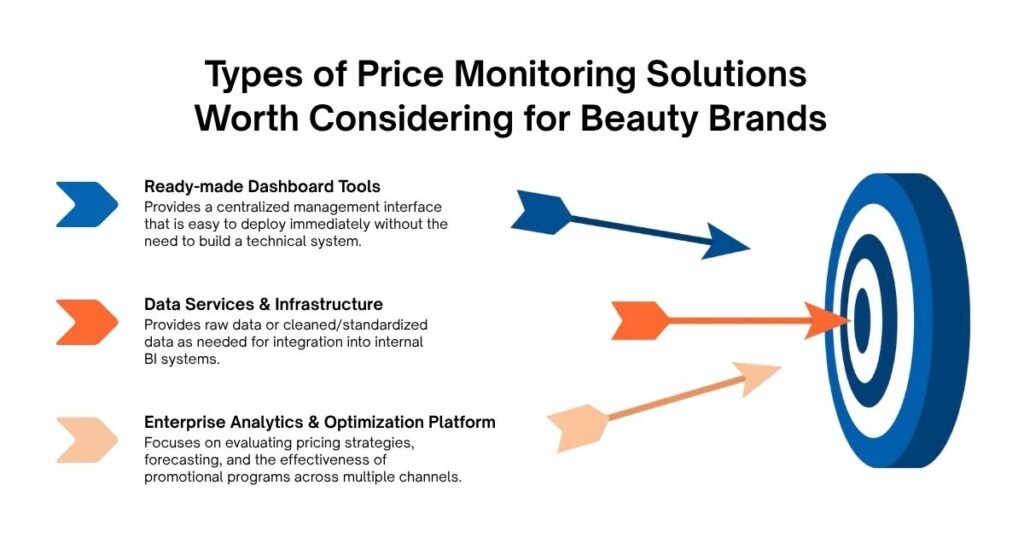
The six options below represent different models. The best fit will depend on the platforms you need to monitor, the data you want to collect, and your team’s available resources.
Solution |
Type |
Key Features |
Easy Data |
Custom data service |
Data scope and structure tailored to your needs |
Bright Data |
Data collection infrastructure and data products |
Suitable for in-house analytics systems |
Prisync |
Price monitoring software |
Dashboard for managing competitor prices |
Price2Spy |
Price monitoring software |
URL tracking and scheduled checks |
Beaconmon |
Competitor website monitoring tool |
Tracks changes on e-commerce websites |
Hypersonix |
Retail pricing analysis and optimization platform |
Enterprise-scale pricing and promotion analysis |
1. Easy Data: Custom Data Services
Easy Data provides data-as-a-service, focusing on data collection from e-commerce platforms such as Shopee, Lazada, and TikTok Shop. Businesses can specify the product categories, keywords, or competitors they need to track, then receive data that has been collected, cleaned, and standardized according to the project scope.
- Data and Usage: Depending on requirements and implementation capabilities, the data may include list prices, prices after voucher discounts, variant information, and promotions. Results can be delivered as files or via API for integration into Business Intelligence (BI) systems or internal dashboards.
- Suitable for: Brands that need market data in a custom structure, have an analytics team or internal systems to analyze the data, but do not want to manage the entire data collection and maintenance process themselves.
- Requires verification: Before implementation, agree on the marketplaces to monitor, the data fields to collect, the update frequency, and the delivery format. These factors will determine whether the data meets your analytical objectives.
2. Bright Data: Data Collection Infrastructure for Technical Teams
Bright Data provides infrastructure and data products to support web data collection needs. This is an option worth considering if a business wants to build its own price analysis workflow, rather than relying entirely on a pre-built dashboard.
Depending on the product used, businesses can access e-commerce data in a structured format or collect data for processing according to their own workflows.
- Suitable for: Businesses with a technical team that want to proactively build an analytics system, combining price data with other data sources.
- Considerations: The extent of additional processing depends on the product type and the format of the received data. If the data does not directly meet analytical needs, businesses may need to develop additional processes for standardization, product matching, and reporting. Therefore, factor in both technical and operational costs, not just data collection costs.
3. Prisync: Price Monitoring Software with a Built-in Dashboard
Prisync offers a solution for tracking competitor prices and inventory, with a centralized management process via a dashboard. This model is suitable for teams that want to monitor product lists without having to build an entire analytics system from scratch.
- Suitable for: Brands that need a ready-made interface to manage competitor prices and track fluctuations by product list.
- Considerations: For cosmetics catalogs with many colors, sizes, or formulas, test actual product URLs to evaluate how the tool handles each variant.
4. Price2Spy: Price Monitoring by URL and Scheduled Checks
Price2Spy allows businesses to monitor competitors’ prices using a list of URLs and set up a monitoring schedule based on their needs. The provider states that monitoring frequency can be set up to eight times per day and offers a 14-day free trial.
- Suitable for: Brands that want to manage price monitoring on a set schedule and need to track multiple product pages.
- Considerations: Before making a decision, test product pages within your intended monitoring scope to determine whether the tool can collect the necessary data. The actual monitoring frequency and support for e-commerce platforms should also be verified based on the service plan.
5. Beaconmon: Track Changes on Competitors’ Websites
Beaconmon focuses on monitoring competitors’ e-commerce websites, such as price changes, new products, or out-of-stock status. The tool supports catalog tracking via Shopify’s product feed; for WooCommerce and other websites, tracking may require configuration based on URLs and on-page elements.
- Suitable for: Brands selling on their own websites, especially when key competitors also operate on platforms that the tool can monitor.
- Considerations: Setup methods may vary across platforms. Verify compatibility and test on specific pages before implementation.
6. Hypersonix: A Platform for Price and Promotion Optimization for Businesses
Hypersonix focuses on analyzing and optimizing prices, promotions, and retail business performance. For businesses with large product catalogs and operations across multiple channels, its enterprise-level analytics capabilities can support the evaluation of pricing strategies and the effectiveness of promotional programs.
- Suitable for: Businesses that need large-scale pricing and promotion analysis, have complex operational processes, and want to incorporate data into business decisions.
- Considerations: Before making a selection, verify the actual features, platform support capabilities, implementation time, and total cost against the business’s needs.
Which Price Monitoring Solution Is Right for Your Brand?
The right solution depends on what your brand needs the data for, which platforms you’re selling on, and what resources you have available to analyze the data. Instead of choosing based solely on the size of your business, start by identifying the specific needs you need to address.
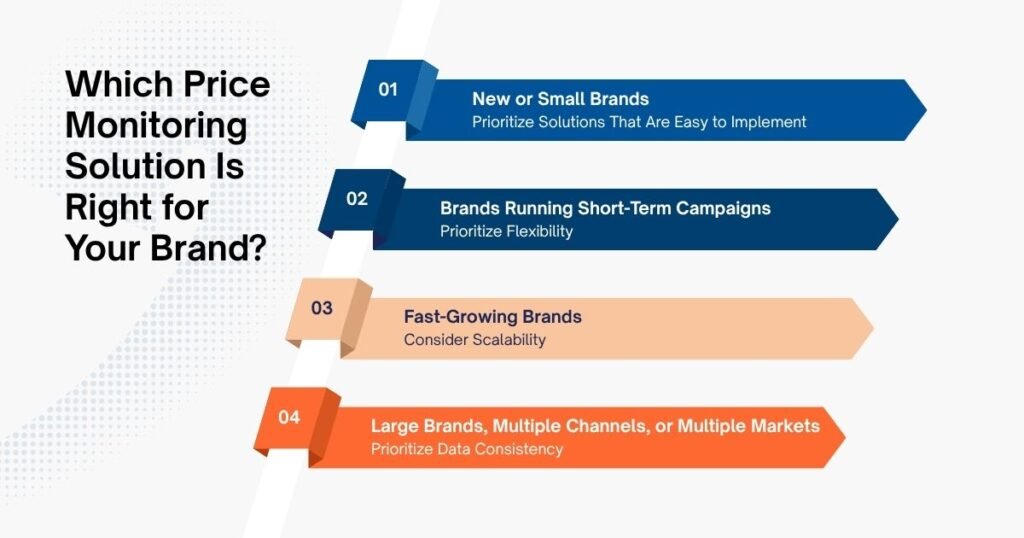
New or Small Brands: Prioritize Solutions That Are Easy to Implement
If you’re just starting to track competitor prices and don’t yet have an in-house data team, software with pre-built dashboards (such as Prisync or Price2Spy) can be a practical starting point. Your team can manage product lists on a centralized interface without having to build an analytics system from scratch.
Brands Running Short-Term Campaigns: Prioritize Flexibility
If you only need to track competitors during a product launch, Flash Sale, or seasonal promotion, a custom data service like Easy Data may be a good fit for a project-based approach. Brands can define the product groups, competitors, and data fields to collect for each campaign, rather than maintaining a long-term software subscription.
Learn more: How to Track Competitor Promotions Without Manual Research
Fast-Growing Brands: Consider Scalability
As the number of products and competitors increases, managing individual URLs can become time-consuming. Software with a built-in dashboard may suffice if the scope of tracking remains within the service plan’s limits.
If needs go beyond standard tracking processes (such as requiring data in a custom structure or wanting to integrate multiple data sources into an internal reporting system) businesses may want to consider Easy Data or a data collection infrastructure like Bright Data. In that case, compare not only the costs but also the technical resources required to put the data to use.
Large Brands, Multiple Channels, or Multiple Markets: Prioritize Data Consistency
As product catalogs and the number of channels grow, price comparison becomes more complex if each data source records products, variants, or promotions differently. Businesses need to clearly define product-matching rules and data standardization methods before comparing prices across retailers or markets.
If you need an enterprise-scale price analytics and optimization platform, Hypersonix is an option worth exploring. If your business already has its own analytics system and requires data from Southeast Asian marketplaces in a specific format, Easy Data may be a better fit for your custom data collection needs.
Final Thought
Every beauty brand has different price monitoring goals, and these goals may also change as the brand grows. At one point, a business may only need to track the prices of a select group of competitors; as it expands its product portfolio or enters new markets, monitoring needs may become more complex.
Therefore, the most suitable price monitoring software isn’t necessarily the one with the most features, but rather the solution that provides businesses with the data they need to make decisions without having to pay extra for unnecessary features or maintain a system that’s more complex than necessary.
Leave a Reply