

For sellers on Shopee, Lazada, and TikTok Shop, tracking competitor promotions involves more than just checking prices every day. You also need to know what kinds of promotions they’re running, what the terms and conditions are, and when these promotions appear or change.
This article guides you on how to track competitor promotions without having to constantly check each shop individually: from identifying the information you need to track and setting up a tracking process to determining which changes warrant a response.
Why Manual Competitor Promotion Tracking Falls Short
Manual tracking can be effective when you have only a few competitors and promotions change infrequently. But when you have to monitor multiple shops across multiple marketplaces, promotions can appear in various places, change throughout the day, or disappear before your next check.
If information is stored in a disjointed manner, it’s also difficult to know when competitors typically run promotions and what strategies they use. The problem isn’t just the time spent checking, it’s also the lack of historical data needed to identify significant changes.
What’s the Difference Between Tracking Prices and Tracking Promotions?
Competitor price monitoring and competitor promotion tracking are related but not the same.
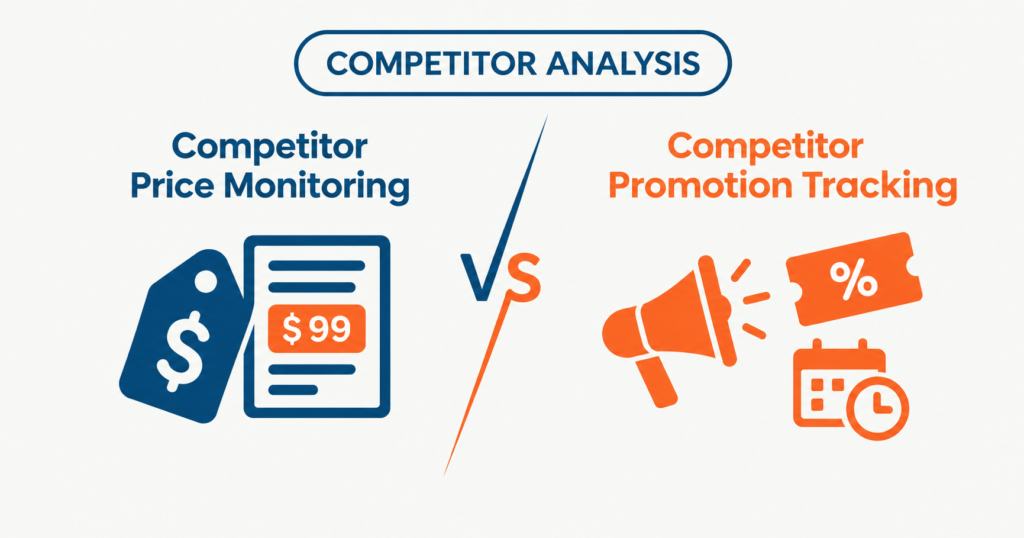
Price tracking records the price at each check, while promotion tracking focuses on the type of offer, eligibility criteria, and duration.
Criteria |
Price Tracking |
Promotion Tracking |
What is recorded? |
Product prices at each check |
Type of offer, discount amount, conditions, and duration |
Where does the information appear? |
Primarily on the product page |
Product page, shop page, vouchers, campaign pages, livestreams, or ads |
How are changes tracked? |
Compare prices across tracking instances |
Record when a promotion appears, changes, or ends |
Limitations |
Publicly listed prices are usually easier to check |
Some promotions are only visible in the app, after logging in, or during a livestream |
What if you miss something? |
You might not catch a price change in time |
You might miss the entire promotion and not fully understand how the offer played out |
For example, a product might maintain its listed price but be eligible for a shop voucher or a special offer during a livestream. If you only track prices, you might miss these promotions.
Is Manual Tracking Still Enough for You?
If you frequently encounter the situations below, your current tracking process may no longer be adequate:
- You only discover competitor promotions when sales drop or customers mention another shop’s offers.
- Screenshots of promotions are scattered across chat groups, with no clear dates recorded.
- You don’t know what types of promotions competitors typically run or when they run them because you haven’t kept a history.
- Everyone records information in their own way, making it difficult to compare data across weeks or months.
In that case, you should establish an automated competitor promotion tracking process to automatically collect reliable information while also regularly checking for promotions that the system hasn’t been able to fully monitor.
What to Capture About a Promotion, Beyond the Discount
Two promotions offering a 20% discount may not provide the same benefits. One promotion may apply to all orders, while the other is limited to orders that meet a minimum spending threshold or is available only to the first few buyers. If you only note the discount amount, you’ll miss important conditions.
Promotion Mechanics You’ll Keep Running Into
On Shopee, Lazada, and TikTok Shop, you’ll encounter various promotion mechanics. Identifying the correct type of offer helps you track and compare promotions across shops more consistently.
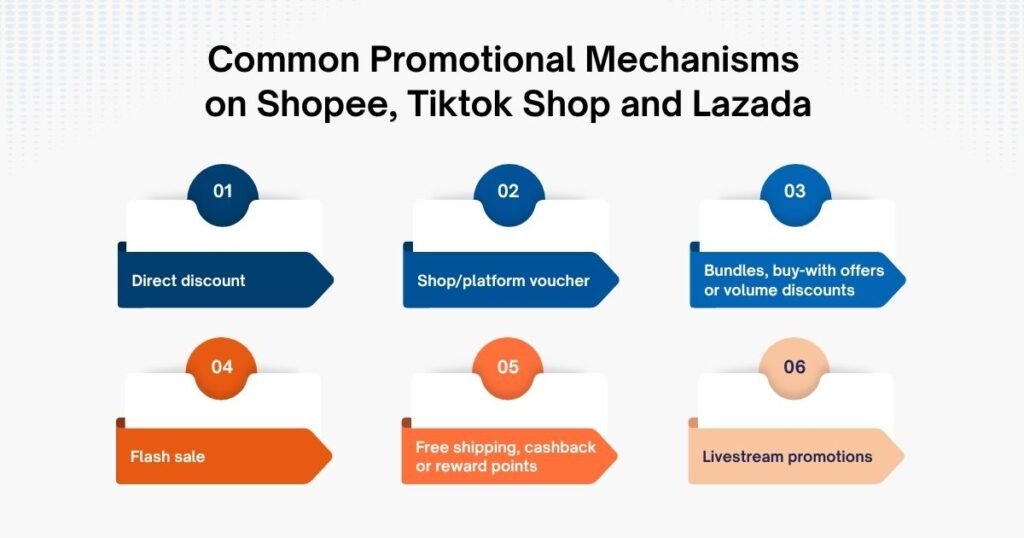
Promotion Mechanism |
When Do Customers Qualify? |
What Does It Indicate?* |
Direct discount |
Product price reduced by a percentage or fixed amount |
Attracts orders or clears inventory |
Shop or platform voucher |
Customers obtain a code or meet conditions, such as a minimum spend |
Encourages customers to increase order value |
Bundles, buy-with offers, or volume discounts |
Customers purchase the required quantity or specified products |
Increases the number of items in an order or drives bundled sales |
Flash sale |
Offers valid for a limited time, sometimes with quantity limits |
Drives quick purchasing decisions |
Free shipping, cashback, or reward points |
Customers meet program conditions |
Reduces costs or barriers to purchase |
Livestream promotions |
Customers purchase or use codes during the livestream, subject to program conditions |
Encourages interaction and purchases during the broadcast |
These are merely inferences based on promotional mechanisms; they are not evidence of competitors’ actual business objectives or profit margins.
Promotions may also appear in different locations. For example, Shopee’s help center mentions promotional labels on search results and major campaigns on the app’s homepage. Some offers on TikTok Shop may be tied to livestream times, so they’re easy to miss if you only check the product page.
Separate Platform-Wide Incentives from Competitor Promotions
Not every offer appearing on the platform is actively created by a competitor’s shop. Platform-sponsored vouchers and platform-wide sales campaigns are part of the broader context; what you need to monitor is how each shop participates.
Note whether competitors are participating in the campaign, which products are eligible, the discount amount, and whether the shop offers its own additional vouchers. This allows you to distinguish between the platform’s general programs and competitors’ individual initiatives.
Attributes to Record for Every Promotion
To compare promotions later, record each one using the same template. The five essential pieces of information are:
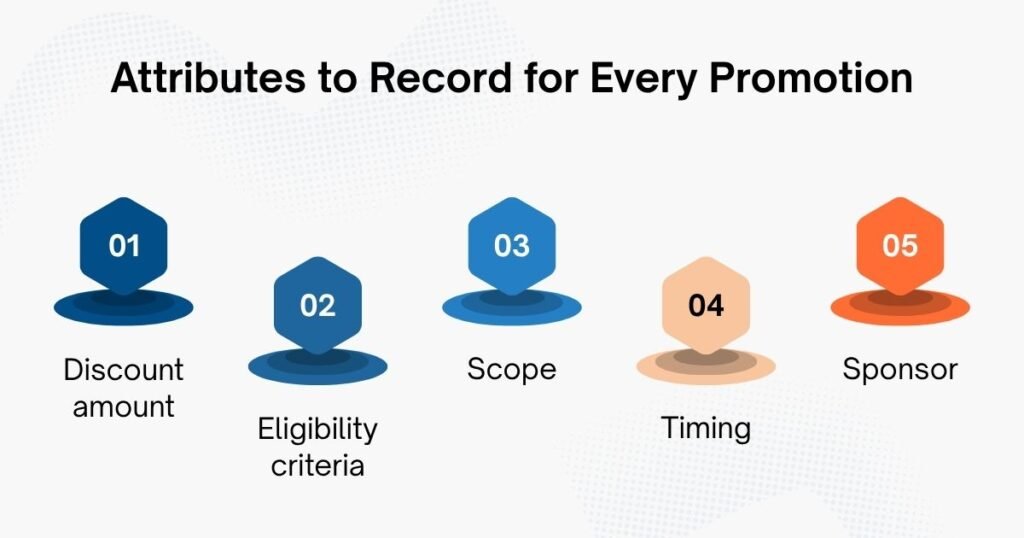
- Discount amount: Percentage or fixed amount discounted.
- Eligibility criteria: Minimum spend, eligible customer segments, quantity limits, and code redemption requirements.
- Scope: A single product, a product category, or the entire shop.
- Timing: Date of discovery and start and end dates, if available.
- Sponsor: Shop, marketplace, or undetermined.
If you need to analyze actual prices after applying vouchers and combo deals, refer to the article Monitor Beauty Product Prices Like Top Brands.
Where Promotions Appear on Marketplaces and What You Can See
Before automating competitor promotion tracking, you need to know which sources are observable and the limitations of each source. Publicly available information does not always fully reflect the offers that every customer sees.
The Visibility Ladder
Promotional information can be divided into four tiers based on visibility and practical tracking methods.
Tier |
Visibility |
Examples |
Tracking Methods |
1. Public |
Displayed on pages accessible to general visitors |
Voucher labels, combo offers, bundled purchases, or flash sales on product pages and campaign pages |
Can be automated if the data sources and tools support it |
2. Conditional |
Displayed only in the app, after logging in, or in the shopping cart |
Certain vouchers or promotional conditions appear only at checkout |
Check on a scheduled basis under normal access conditions; accept the possibility of incomplete data |
3. Time-sensitive |
Observable only while the program is active or still displayed |
Discount codes in livestreams or active ads |
Monitor on a schedule and log information upon detection |
4. Cannot be verified externally |
Not publicly displayed or no reliable source for verification |
Personalized offers, campaign budgets, profit margins, or actual usage counts |
Do not treat as known data; avoid turning speculation into conclusions |
Tier 1 is typically best suited for automation. Tiers 2 and 3 may require scheduled checks or verification under specific conditions, while Tier 4 cannot be verified using public data alone.
For ads, Meta Ads Library is a public source for finding and reviewing ads displayed by Meta. However, do not assume it is a comprehensive archive of every competitor’s ad history. If you need to track changes over time, log the ads you observe on a schedule and check the library’s current search limitations.
Can Two People See Different Promotions?
Yes. Depending on the platform and program, the promotions displayed may vary based on login status, region, device, or applicable conditions. Therefore, the data collected during a single session reflects only the view at that specific moment and does not necessarily represent the experience of every customer.
For easier comparison, record the observation conditions with each promotion entry, such as whether it’s on the app or website, login status, and region, if identifiable. This helps you distinguish between differences in how promotions are displayed and actual changes to the program.
A Ground Rule: Use Publicly Accessible Information Responsibly
When monitoring competitors’ promotions, start with information that regular visitors can view and adhere to each platform’s terms of use. Do not attempt to bypass security measures or use fake accounts to access exclusive offers. If you cannot verify information from an authorized source, clearly state those limitations rather than drawing conclusions.
How to Track Competitor Promotions Automatically
You don’t need to build a complex system right from the start. Begin with a small group of competitors, select appropriate data sources, store information in a standardized format, and set up alerts for notable changes.
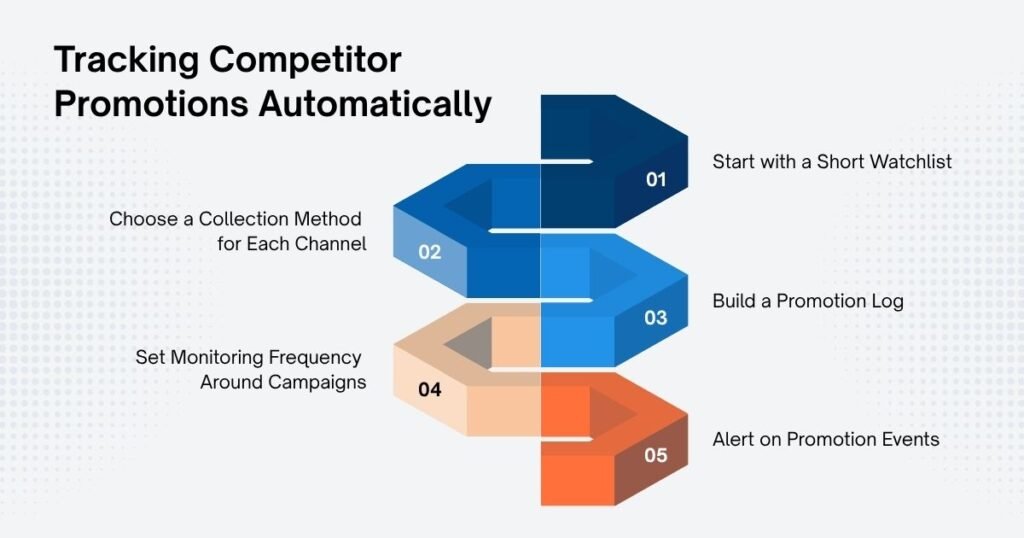
Start with a Short Watchlist
Select around 5 direct competitors and product categories where promotions could affect your sales. Monitoring a small list first makes it easier to review the data during the first week and identify errors before scaling up.
Refer to Analyzing Beauty Competitors on Shopee for guidance on selecting the right competitors and comparable product categories.
For products that are similar across multiple shops, standardize how you match products before comparing promotions.
Choose a Collection Method for Each Channel
Your tracking method depends on where you can view the promotions. Automate the collection of publicly available information if your data sources and tools support it, schedule checks for promotions that appear only under specific conditions, and clearly note any data that cannot be verified.
AI can also help extract information from screenshots, banners, or livestream commentary to populate the log. However, be sure to double-check critical conditions such as minimum spending requirements, expiration dates, and quantity limits. If a condition is misread, you may misclassify the entire promotion.
Build a Promotion Log to Track Changes Over Time
To determine when competitors typically run promotions, you need to record these campaigns in a single promotion log. Each entry should document a specific promotion or event, rather than simply recording the price at a single point in time.
Field |
What to Record |
Example |
Competitor |
Shop name |
Shop A |
Platform and market |
Platform and country |
Shopee, Vietnam |
Product category |
Affected product or category |
Serum |
Promotion mechanism |
Type of offer applied |
Voucher |
Discount amount |
Percentage or fixed amount |
10% |
Conditions |
Minimum spend, eligible customers, or quantity limits |
Orders meeting the minimum spending requirement |
Scope |
A single product, a product category, or the entire shop |
Entire shop |
Time of observation |
First and last times the offer was detected |
Two times during the week |
Observation conditions |
App or website, login status, and region, if identifiable |
Website, not logged in |
Evidence |
Saved link or screenshot |
Screenshot taken at the time of observation |
Confidence level |
Direct observation or inference |
Direct observation |
One field worth including is the confidence level. For example, if you suspect a competitor is running a promotion because sales are rising rapidly, note that this is an inference rather than a confirmed promotion. This allows the team to distinguish observed data from hypotheses during later analysis.
Set Monitoring Frequency Around Campaigns
You don’t necessarily have to collect data at the same frequency every day. Maintain an appropriate monitoring schedule under normal conditions, then increase the frequency around major sales events or flash sale time slots if the tools and platform policies allow it.
After the campaign, check one more time to see if the offer is still active. Note that the time of the first and last detections may not necessarily coincide with when the promotion actually starts and ends, especially if you aren’t monitoring continuously.
You can refer to the e-commerce calendar to schedule monitoring around major sales events.
Alert on Promotion Events, Not Just Price Changes
Alerts like “price dropped by more than X%” are better suited to tracking price fluctuations. For promotions, compare records across data collection intervals and only send alerts when there are notable changes:
- A new promotion appears.
- The discount or offer changes.
- The promotion ends or is extended.
- A competitor joins a marketplace campaign.
Minor changes can still be logged without triggering a notification. If alerts appear too frequently, your team will struggle to identify which events actually require action.
Choose an Approach That Fits Your Team
There are two common implementation approaches: setting up the process yourself using existing or no-code tools, or using data collected from an external provider. The appropriate approach depends on the number of shops to monitor, the data sources, and the team’s resources.
Whichever approach you choose, check the following four requirements:
- Track changes over time: Record when promotions appear, change, and end (if sufficient data is available) rather than just showing the current status.
- Collect data from multiple sources: Monitor relevant pages such as product pages, shop pages, and campaign pages.
- Store history and evidence: Allow for reviewing recorded information, such as promotions from the previous week.
- Link promotions to the appropriate products: Determine whether a promotion applies to a specific product, a product group, or the entire shop.
If you only need to track a few public pages, a self-managed process may meet your initial needs. As the number of shops and data sources increases, you should consider maintenance costs, stability, and the ability to review historical data before selecting a solution.
Which Competitor Promotions Deserve a Response?
Not every promotion requires a response. Once you have a history of monitored promotions, use the following four questions to assess the relevance of each one.
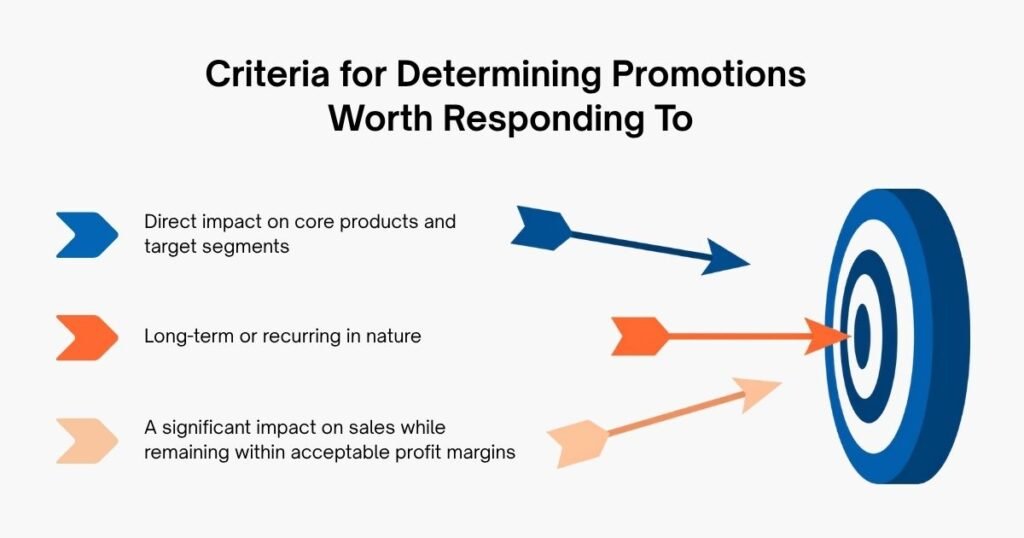
- Does the promotion target your specific products and customer segments? If a competitor is offering a discount on product categories you don’t sell or where you don’t compete directly, take note but don’t act immediately.
- Is the offer limited to a short period, or does it extend over multiple phases? A flash sale during a shopping festival may be part of the marketplace’s broader campaign. If the offer continues to appear after the sale ends, monitor the situation further before concluding that the competitor is maintaining that discount level.
- Can you compete while still maintaining your profit margin? Before lowering prices to match a competitor, factor in your own cost of goods, marketplace fees, shipping costs, and advertising expenses. If the price you’d need to offer prevents you from reaching your minimum profit threshold, matching that promotion may not be the right choice.
- Does the competitor frequently repeat this promotion? A single instance isn’t enough to draw a conclusion. Compare data over several weeks to see whether competitors frequently use the same promotional mechanism during specific occasions or time frames.
After evaluating the promotion, you can choose one of four approaches:
- Match the promotion: When a competitor’s offer directly affects your product and you can still maintain your profit margin.
- Create a differentiated offer: Instead of direct discounts, you can consider bundles, spending-tiered vouchers, or complimentary gifts.
- Maintain your current strategy: When the promotion does not significantly affect your customer base or matching it exceeds your financial capacity.
- Plan proactively: If historical data shows that competitors typically run promotions on specific occasions, you can prepare your own campaign in advance.
These are options for your consideration. The appropriate decision depends on your product, profit margin, and business objectives.
Conclusion
Tracking competitor promotions doesn’t necessarily mean you have to react to every discount they offer. The key is to identify which promotions truly affect your business, collect enough information to spot recurring trends, and make decisions based on data rather than reacting on impulse.
With an appropriate tracking process in place, you can reduce the time spent on manual checks while remaining more proactive in responding to changes in your competitors’ promotional activities.
Leave a Reply