
If your business wants to leverage data for growth, do you really need to invest hundreds of thousands of dollars in infrastructure, technology, and technical teams?
Not necessarily. The rise of data as a service (DaaS) has introduced a completely different approach. Instead of building an entire data collection, processing, and storage infrastructure from scratch, businesses can access ready-to-use data provided by a specialized service provider. This allows organizations to start using data for business decisions without having to build and maintain a complex data infrastructure themselves.
So, what exactly is Data as a Service, how does it work, and why are more businesses adopting this model?
What Is Data as a Service (DaaS)?
Data as a Service (DaaS) is a service model that allows businesses to access and use data on demand without having to build or operate the underlying data infrastructure themselves.
The service provider handles the entire process, from collecting, cleaning, standardizing, and updating data to delivering it to users. Businesses simply subscribe to the service, access data through dashboards, reports, or APIs, and focus on solving business problems instead.
How Does Data as a Service (DaaS) Work?
While every platform has its own implementation, most data as a service solutions follow four core steps.
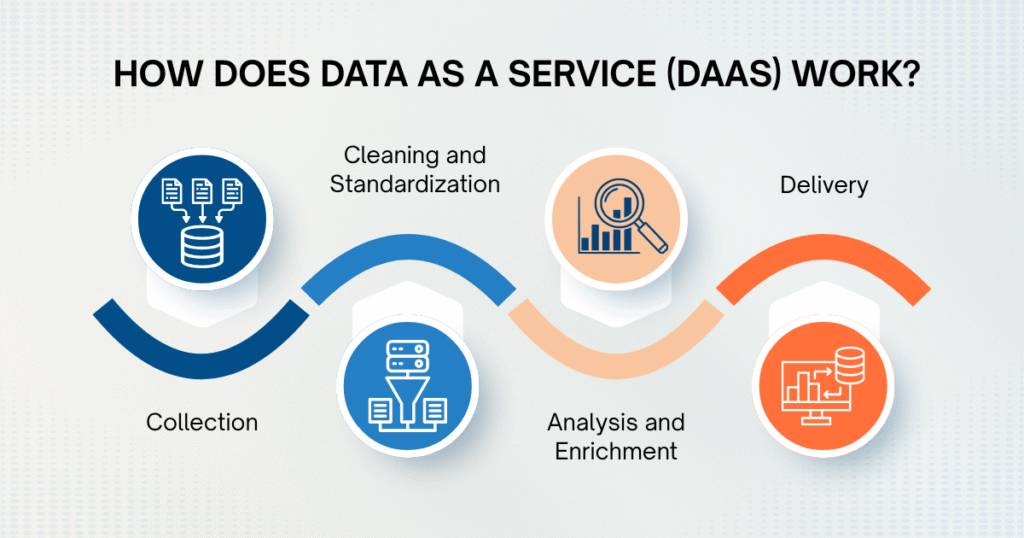
1. Data Collection
Data is collected from multiple sources, including ecommerce marketplaces, websites, CRM systems, ERP platforms, POS systems, social media, advertising platforms, and third-party market data providers. Bringing together information from different systems creates a more complete view of customers, markets, and business performance.
2. Data Cleaning and Standardization
Raw data often contains duplicate records, missing information, or inconsistent formats across different sources. Before being delivered to users, the data is automatically cleaned, standardized, and quality-checked to ensure reports and analyses are reliable.
3. Data Analysis and Enrichment
The value of data as a service goes beyond simply providing data, it also lies in transforming data into actionable insights. Many platforms enrich datasets with additional layers of analysis, such as product category classification, price segmentation, brand performance, consumer trends, or competitor market share. This helps businesses understand not only what is happening, but also why those changes matter.
4. Data Delivery
Once processed, data can be delivered through interactive dashboards, scheduled reports, APIs, or industry-specific datasets. When every department works from the same trusted data source, collaboration becomes easier and decision-making becomes faster and more consistent.
Why Do Businesses Choose DaaS Instead of Building Their Own Data Infrastructure?
In theory, building an in-house data infrastructure provides greater control. In reality, however, it also requires significant investment, long implementation timelines, and experienced technical teams to operate, maintain, and continuously improve the system. That’s why many businesses choose DaaS as a faster way to bring data into their decision-making process.
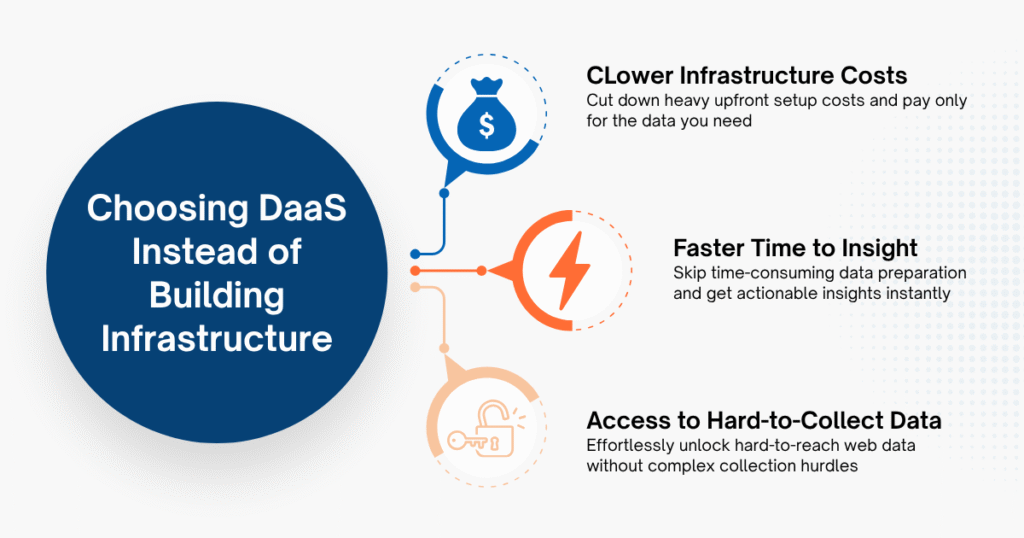
Lower Infrastructure Costs
The cost of building a data infrastructure goes far beyond purchasing servers or paying for cloud services. Businesses also need to invest in data collection tools, storage systems, processing pipelines, security, monitoring, and operations teams.
With DaaS, much of that upfront investment is replaced by a flexible subscription model. Companies pay only for the data and services they actually need, helping optimize budgets while reducing investment risk.
Faster Time to Insight
When building a data infrastructure internally, businesses may spend months collecting, cleaning, and standardizing data before they can begin analyzing it.
In contrast, DaaS provides pre-processed data. Users can start analyzing it almost immediately after subscribing, allowing them to focus on generating insights instead of processing raw data.
Access to Data That Is Difficult to Collect
Not all valuable data exists inside a company’s own systems. Information such as market trends, competitor pricing, brand market share, or marketplace data is often difficult to collect at scale.
Specialized DaaS platforms deliver the most value here. Instead of building complex data collection processes, businesses can tap into data that has already been aggregated, standardized, and continuously updated. This gives them a more complete view of the market and helps them make faster, more informed decisions.
How Is Data as a Service Used in Practice?
DaaS is used across industries including finance, logistics, and healthcare. However, it delivers particularly strong value in ecommerce, where data changes by the hour and businesses constantly need to make decisions about products, pricing, and competitive strategy. With the right data, companies can answer practical business questions much more quickly.
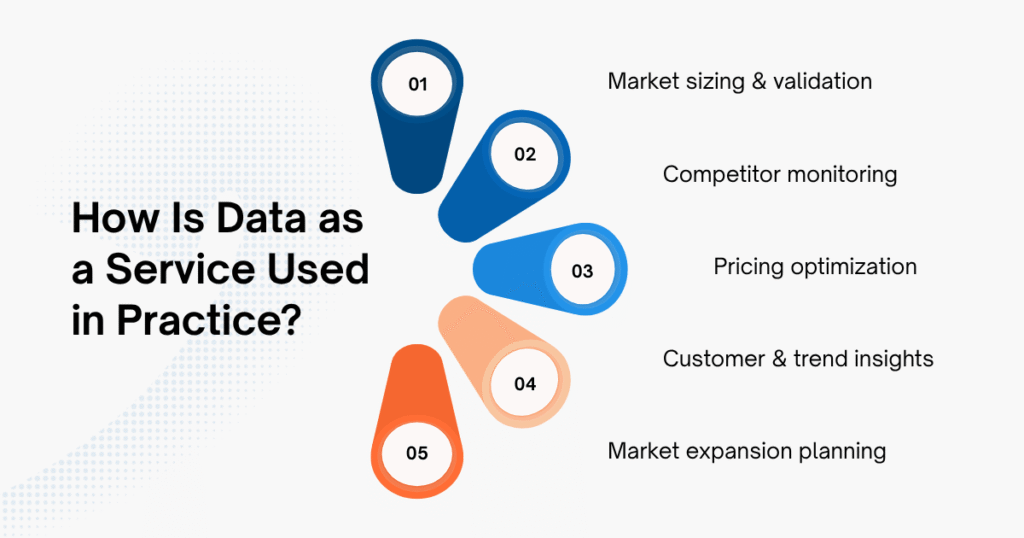
Understand the Market Before Making Decisions
Before launching a new product or expanding into a new segment, businesses need to know whether the market opportunity is large enough.
A DaaS platform helps monitor market size, growth rates, category trends, and shifts in consumer demand, providing an objective foundation for investment decisions instead of relying solely on intuition or experience.
Monitor Competitors and Respond Faster
In ecommerce, competitors can change prices or launch promotions within hours. Without timely visibility, businesses risk missing opportunities or reacting too late.
A DaaS platform enables businesses to monitor price changes, promotional strategies, market share, and competitor performance. This allows companies to build competitive strategies based on real data rather than assumptions.
Build Better Pricing Strategies
Listed prices on ecommerce marketplaces do not always reflect what customers actually pay. Flash Sales, vouchers, discount codes, and platform subsidies can significantly change transaction prices.
DaaS platforms standardize pricing data to better reflect actual market prices. Businesses can use this information to develop more effective pricing strategies and monitor how competitors adjust prices over time.
Better Understand Customers and Consumer Trends
Beyond revenue and pricing data, DaaS also helps businesses track search trends, best-selling products, and changes in consumer purchasing behavior.
These insights help identify emerging growth opportunities, optimize product portfolios, and develop marketing campaigns that better match market demand.
Support Market Expansion
For brands planning to expand into Southeast Asia, understanding local markets is essential.
Through DaaS, businesses can access data on market size, competitors, consumer behavior, and category trends across different countries. This significantly reduces the risks associated with entering new markets while supporting more informed expansion strategies.
Things to Consider Before Using Data as a Service
Data as a service offers many advantages, but not every platform delivers the same level of quality. Before choosing a provider, consider these three factors.
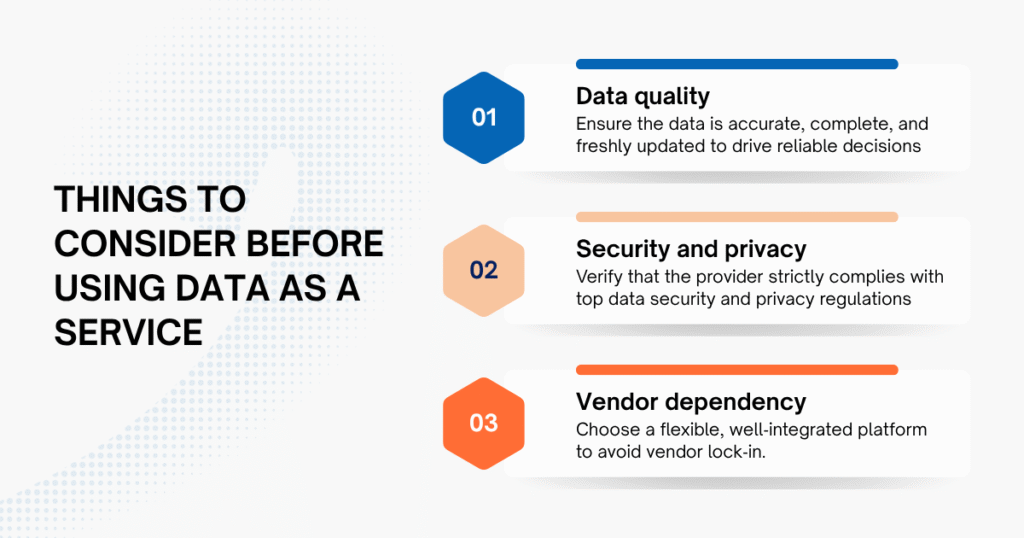
- Data quality: Data is only valuable if it is accurate, complete, and updated regularly. If the data does not reflect reality, every report, analysis, and business decision built on top of it can become unreliable.
- Security and privacy: For organizations handling sensitive information, security should be a top priority. Make sure the provider complies with relevant security standards, regulatory requirements, and access control policies before implementation.
- Vendor dependency: Over time, businesses may become dependent on a provider’s data structure, APIs, or dashboards. Choosing a platform with strong integration capabilities, flexibility, and scalability will make future changes much easier.
How Do You Choose the Right DaaS Provider?
All DaaS platforms provide data, but they don’t necessarily provide the same value. The real differences lie in data quality, analytical capabilities, and how well the platform fits your business needs.
When evaluating a DaaS provider, start by asking these questions.
- Do they provide data for your target markets and industries? If your business operates in Southeast Asian ecommerce, the platform should offer deep coverage of local marketplaces and regional markets rather than only global datasets.
- How frequently is the data updated? Reports built on outdated data rarely reflect current market conditions. Understand how often the provider refreshes its data and how it ensures ongoing accuracy.
- How is data quality maintained? Data should be cleaned, standardized, and quality-controlled before it reaches users. This improves the reliability of analysis while reducing internal data preparation work.
- Can it integrate with your existing systems? If your organization already uses BI, ERP, or CRM platforms, verify that the provider supports APIs or other integration methods. Strong integration enables automated data synchronization and reduces manual work.
- Is the data easy for business users to access? Not everyone in an organization is a data specialist. Platforms with intuitive dashboards and ready-made analytical reports allow marketing, sales, and operations teams to use data without depending heavily on technical teams.
- Does the provider understand your industry? Every industry has unique data requirements. Providers with domain expertise are often better positioned to deliver the metrics and insights that matter most to your business.
The Future of DaaS: Data Intelligence Platform
If businesses once needed only a reliable source of data, that is no longer enough. Today, they also need tools that help transform data into insights quickly enough to support timely decisions. This shift is driving the evolution of data as a service toward data analytics platform.
These platforms combine standardized data, dashboards, analytical reports, and insight-generation tools within a single ecosystem, helping businesses make faster, more informed decisions.
Lean more: The Growth of the Data as a Service Market in 2026
Easy Data is evolving in this direction as well through its Ecommerce Data Analytics Platform, built specifically for ecommerce businesses across Southeast Asia. The platform helps companies shorten the path from data to decision by combining standardized data, interactive dashboards, and analytical reports in one place.
Conclusion
Data as a service has changed how businesses access data by removing many infrastructure barriers and making useful data available to organizations of all sizes. But as data volumes keep growing, competitive advantage no longer comes from simply having more data, it depends on how effectively you use it.
In response, modern data platforms are moving toward integrated ecosystems that bring data, analytics, dashboards, and reports together in one place, helping businesses move faster from observing the market to making decisions.
If your business is looking for a data solution for ecommerce, focus on platforms that make it easy for your teams to access data, turn it into insights, and apply those insights to better day-to-day decisions.
Leave a Reply