

The Data as a Service market is entering a phase of rapid expansion as businesses increasingly rely on external data sources, artificial intelligence (AI), and real-time analytics. This is driving the rapid expansion of the DaaS market across various industries and regions. So what is driving this growth, how far has the market developed, and what does this trend mean for businesses, particularly in ecommerce?
Data as a Service Market Overview in 2026
Reports from multiple research organizations show that Data as a Service (DaaS) is no longer an emerging model but has become a key part of enterprise data strategies worldwide. Although different firms use different methods and forecasts, they all agree on one main point: the market is growing quickly in size, use cases, and the number of businesses adopting DaaS solutions.
| Market Metric | 2026 Forecast |
| Market size | $25.5 billion – $32.09 billion (Mordor Intelligence estimates approximately $29.72 billion) |
| Growth rate (CAGR) | 15.53% – 22.8% during the forecast period |
| Leading revenue region | North America (approximately 43.87% market share) |
| Fastest-growing region | Asia-Pacific (APAC), with a CAGR of around 17.09% |
| Key application industries | BFSI, Healthcare, Retail & Ecommerce, Manufacturing, IT & Telecom |
The DaaS Market Size Continues to Expand
According to market research organizations, the global Data as a Service market size in 2026 is estimated to range from $25.5 billion to more than $32 billion, depending on each organization’s research methodology. Although the exact figures vary, these reports reflect the same overall trend: the demand for accessing data as a service is growing rapidly across industries.
Strong Growth Momentum Continues
Beyond expanding in market size, DaaS is also becoming one of the fastest-growing markets in the data and cloud computing sectors. Most reports forecast that the market will maintain a CAGR ranging from approximately 15% to more than 22% over the coming years, with expectations that the market size could approach $200 billion by 2036.
North America Leads While APAC Becomes a New Growth Driver
From a regional perspective, North America remains the largest DaaS market, driven by its mature cloud ecosystem, high level of digital transformation, and the presence of many leading data service providers.
Meanwhile, Asia-Pacific (APAC) is becoming the fastest-growing region. The rapid expansion of ecommerce, AI adoption, digital payments, and cross-border business opportunities is encouraging companies in China, India, and Southeast Asia to invest more heavily in data platforms. This region is also expected to contribute significantly to the future growth of the DaaS market.
DaaS Is Expanding Across Multiple Industries
Initially, Data as a Service was mainly adopted in data-intensive industries such as banking, financial services, and insurance (BFSI). However, by 2026, the application scope of DaaS has expanded to various industries, including healthcare, manufacturing, technology, and especially retail and ecommerce.
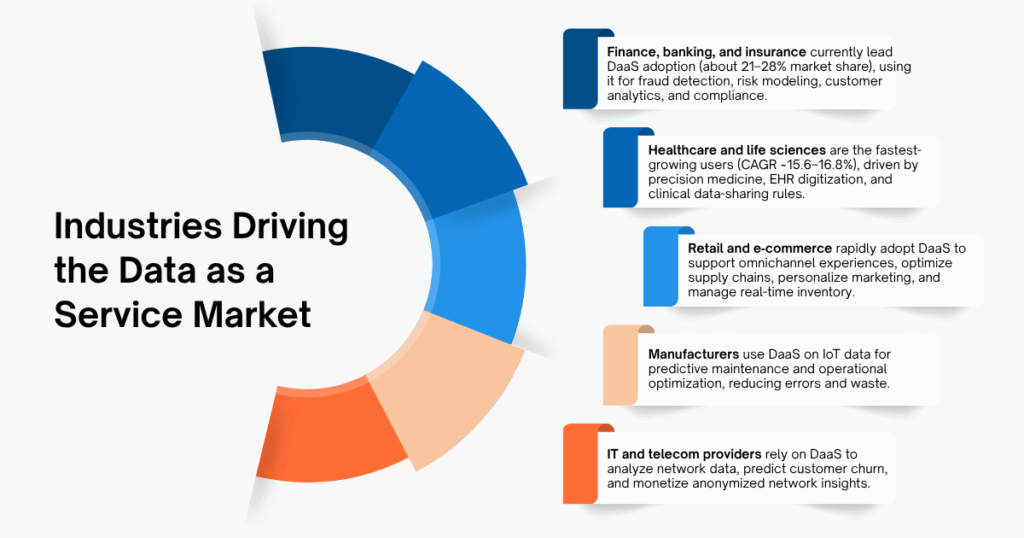
In ecommerce, the demand for DaaS continues to grow as businesses need to access market data, analyze customer behavior, and optimize multi-channel operations in an increasingly competitive environment.
Learn more: Data as a Service Use Cases for Ecommerce Brands
How Has the Data as a Service Market Evolved From the Past?
If the period from 2021 to 2025 was when businesses began becoming familiar with the Data as a Service model, then by 2026, the DaaS market has entered a more mature stage. The transformation is not only reflected in market size but also in how data is delivered, accessed, and integrated into daily business operations.
| 2021–2025 | 2026 |
| Businesses primarily purchased individual datasets and stored them within internal systems. | Data can be accessed flexibly through platforms and APIs, ready to support multiple business systems. |
| Data was mainly processed through batch processing methods. | Data is synchronized closer to real time, enabling businesses to respond faster to market changes. |
| DaaS was mainly used for Business Intelligence and traditional reporting. | Data has become the foundation for AI, Retrieval-Augmented Generation (RAG), and advanced analytics applications. |
| Pricing models were mainly based on fixed subscription packages. | Consumption-based pricing models are becoming more common, allowing businesses to optimize costs more flexibly. |
| Mainly adopted by large enterprises with significant resources. | Small and medium-sized businesses can also access DaaS solutions thanks to cloud infrastructure and lower implementation barriers. |
What’s Driving the Growth of the Data as a Service Market in 2026?
The rapid growth of Data as a Service in 2026 is driven by a fundamental shift in how businesses access and utilize data. Below are the key factors driving the global expansion of the DaaS market.
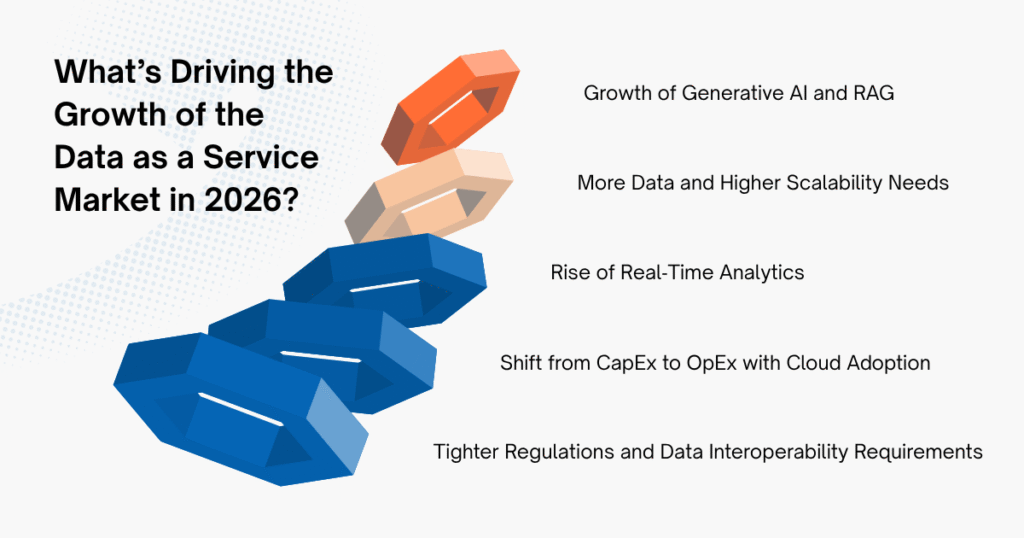
Generative AI Is Increasing the Demand for High-quality Data
The rise of generative AI is changing the role of data in businesses. Large language models (LLMs) only deliver accurate results when they use reliable, complete, and continuously updated data. This is driving higher demand for DaaS, as businesses can access data through APIs or data platforms without building complex data pipelines themselves.
More businesses are also adopting Retrieval-Augmented Generation (RAG) applications and AI agents to combine internal data with external data sources. DaaS acts as a bridge, allowing AI systems to access new information while improving accuracy and reducing the risk of AI-generated misinformation.
Businesses Need Real-time Data to Make Faster Decisions
In a constantly changing business environment, data only creates value when it accurately reflects current market conditions. Waiting for periodic reports or manually collecting data is no longer enough to support the speed of decision-making modern businesses need.
Data as a Service allows businesses to access data that is updated closer to real time, helping them monitor market trends, price changes, customer behavior, and business performance more effectively. This is one of the main reasons DaaS adoption is growing quickly in industries that require fast responses, such as finance, retail, and ecommerce.
Cloud Infrastructure and Flexible Pricing Models Make DaaS More Accessible
In the past, building data infrastructure required large investments and dedicated technical teams. Today, the growth of cloud computing has made it easier for DaaS platforms to scale and has significantly lowered deployment barriers for businesses.
At the same time, many providers are moving to consumption-based pricing models, allowing businesses to pay based on actual usage instead of making large upfront investments in infrastructure or fixed data packages. This helps both large enterprises and smaller businesses access high-quality data with more cost flexibility.
The Growth of Unstructured Data Creates Demand for Professional Data Platforms
Videos, images, audio, IoT data, and other digital sources are growing at an unprecedented rate. The huge volume and complexity of these data types make it harder for businesses to collect, standardize, and manage data on their own.
Instead of building their own systems to process data from many sources, businesses are increasingly using DaaS platforms that provide standardized data through APIs or dashboards. This helps reduce implementation time and operating costs, and lets businesses focus on extracting insights rather than managing data processing.
Data-sharing Policies Are Supporting the Development of the DaaS Ecosystem
Beyond technology, many countries are creating regulatory frameworks that encourage secure and transparent data sharing. Regulations such as the EU Data Act create opportunities for data from organizations, connected devices, and digital ecosystems to be shared more openly, expanding the data sources available to DaaS platforms.
As data becomes more accessible and governed by clearer standards, businesses have more opportunities to use it for market analysis, product development, and operational optimization.
How the Growth of the DaaS Market Is Changing Ecommerce
The growth of the Data as a Service market is changing how ecommerce businesses access and use data. In the past, data was mainly used to analyze past performance, but now it has become a foundation that helps ecommerce businesses respond faster to market changes.
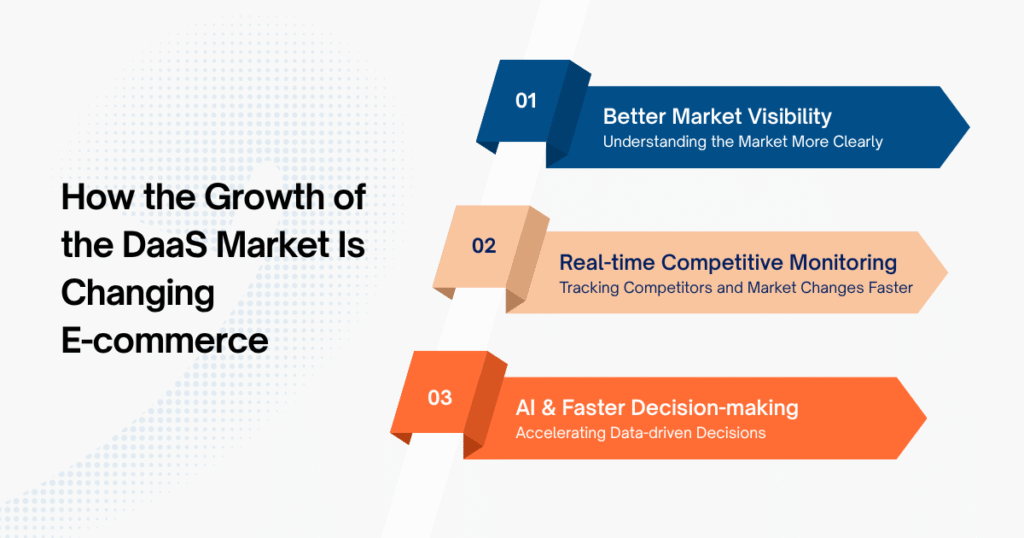
Better Market Visibility: Understanding the Market More Clearly
DaaS platforms let businesses access valuable market data, including category size, product trends, demand changes, and brand performance. By combining external market data with internal business data, companies can better understand their competitive position and spot new growth opportunities.
Real-time Competitive Monitoring: Tracking Competitors and Market Changes Faster
The ecommerce market is constantly changing, with frequent shifts in pricing, promotions, product assortments, and competitor strategies.
DaaS enables businesses to automatically collect and update key market signals, so they can track competitor moves and category trends closer to real time. This helps sales and marketing teams make faster decisions instead of relying on manual reports or outdated data.
AI & Faster Decision-making: Accelerating Data-driven Decisions
The growth of AI is increasing the demand for high-quality data in ecommerce. AI systems such as demand forecasting, market analysis, and marketing optimization only work well when they use complete, accurate, and continuously updated data.
With DaaS, businesses can access standardized data sources without making large investments in data collection and processing systems. This lets companies focus more on extracting insights and making faster, more accurate business decisions.
How Ecommerce Businesses Should Leverage the Growth of the DaaS Market
The growth of the DaaS market creates new opportunities for ecommerce businesses to improve key business decisions. However, to get real results, businesses need to understand how to use DaaS effectively and apply it in the right way.
Access External Market Data Without Building Infrastructure
One of the biggest advantages of DaaS is that businesses can access market data through APIs or dashboards without building their own systems for data crawling, storage, and processing. This helps reduce implementation time, lower initial investment costs, and allows businesses to focus more on analyzing insights instead of spending resources on data collection and management.
Improve Competitive Intelligence
Data from DaaS platforms helps businesses track pricing, products, promotions, market share, and competitor trends at scale. Instead of manually tracking only a few competitors, businesses can build continuous competitive intelligence systems to spot opportunities and respond faster to market changes.
Enable Faster Data-driven Decisions
The value of DaaS is not only in providing data but also in delivering the right information to the right people at the right time. With intuitive dashboards and standardized APIs, teams such as marketing, sales, and operations can quickly access actionable insights, shorten decision-making processes, and improve overall operational efficiency.
Conclusion
The rapid growth of the Data as a Service (DaaS) market is opening a new way to use data. Businesses no longer need to invest large resources to build and maintain their entire data infrastructure. Instead, they can flexibly access specialized data sources through existing platforms.
For ecommerce, this trend creates opportunities to understand markets faster, monitor competition more effectively, and make more accurate decisions when used in the right way. The true value of DaaS is not only in providing data, but in turning data into useful insights that support growth strategies.
Leave a Reply