

In the beauty industry, brands can easily track competitors’ products, prices, messaging, and promotional campaigns on e-commerce platforms such as Shopee and TikTok Shop. However, the real challenge for marketing teams lies in how to leverage this information and turn it into useful insights for their marketing efforts.
Common Mistakes When Using Competitor Data for Beauty Marketing
Competitor data can support many marketing decisions. But if the data is misunderstood or misinterpreted, brands can easily make unfounded choices. Here are three common mistakes.
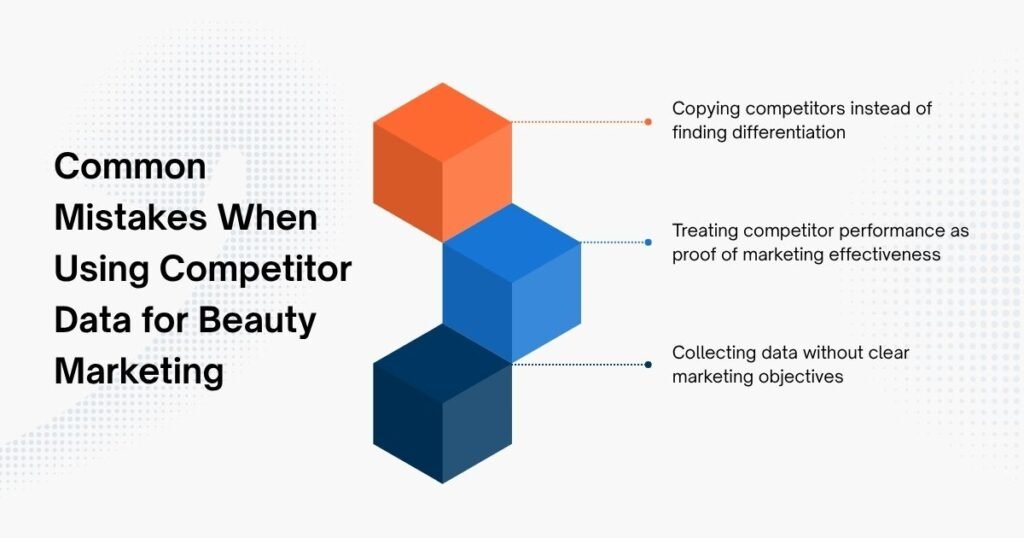
Copying Competitors Instead of Finding Differentiation
For example, when a brand sees a product selling well thanks to messaging like “suitable for sensitive skin” or “controls oil for hours,” it may want to adopt a similar communication strategy.
However, when many brands emphasize these same benefits, they gradually become commonplace messaging within the industry, rather than helping a product stand out (according to Michael E. Porter’s classic strategic principles). Promotions work the same way: if every brand competes by offering discounts, customers may only care about where they can find the best deal.
Treating Competitor Performance as Proof of Marketing Effectiveness
Just because a product has high sales or frequently appears in prominent positions on an e-commerce platform doesn’t mean a brand can simply copy that marketing approach and achieve the same results.
Publicly available data on competitors may reveal estimated sales, popularity, selling prices, or promotion frequency. But this information often doesn’t fully disclose the underlying factors, such as advertising budgets, the effectiveness of influencer campaigns, conversion rates, or profit margins.
Collecting Data Without a Clear Marketing Objective
Analyzing competitors may contain a wealth of information on products, prices, reviews, and promotional programs. However, without clearly defining what you need to learn, brands can easily become overwhelmed by data and struggle to identify what information is truly useful.
For example, if you want to improve the advertising message for a tinted sunscreen, compiling a list of all the best-selling products in the beauty industry may not be as helpful as understanding what customers commonly complain about (such as how the product feels on the skin, its color-matching ability, or its compatibility with makeup) by analyzing review data or social media comments.
Identify the Right Competitors and Data Signals
Not all competitors in the beauty industry provide the same insights. Identifying the right group of competitors will help brands know who to monitor, what data to collect, and how to use that information for marketing purposes.
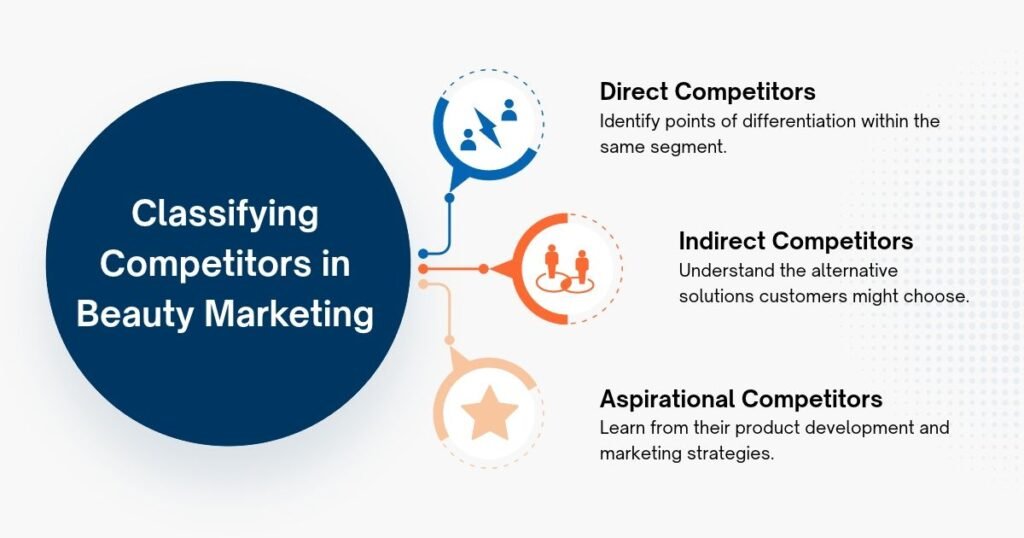
Competitors can be divided into three main groups:
Competitor Type |
Identifying Characteristics |
Data to Track |
Purpose of Analysis |
Direct competitors |
Brands that offer similar products, target the same customer group, and operate in a price segment close to yours. |
Product listings, customer reviews & Q&A, pricing & promotion data. |
Compare products, messaging, prices, and promotional programs to identify points of differentiation. |
Indirect competitors |
Brands offering different products but addressing the same customer need. For example, moisturizers and hydrating serums may both target people with dry skin. |
Product benefits, customer reviews & Q&A, product positioning, alternative product categories. |
Identify alternative solutions customers are considering and unmet needs. |
Aspirational competitors |
Brands whose product development, brand-building, or communication strategies you want to emulate. |
Product positioning, marketing messages, product launches, content strategies, campaign messaging. |
Look for ideas on positioning, product development, and customer engagement. |
Make Competitor Data Your Marketing Advantage
Once you’ve identified the right competitors and the data to track, the next step is to leverage this information to refine your messaging, identify positioning opportunities, and build more effective marketing campaigns.
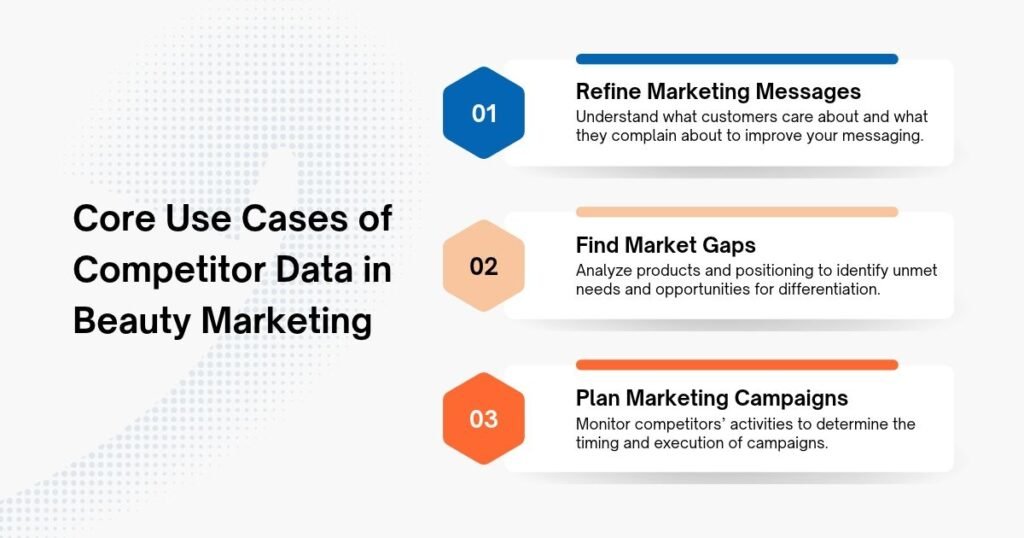
Use Competitor Data to Refine Beauty Marketing Messages
Customer reviews and questions on e-commerce platforms can help brands better understand what buyers care about, what they’re dissatisfied with, or what makes them hesitate before choosing a product.
Instead of just looking at the average rating, pay attention to recurring feedback. For example, when analyzing reviews of tinted sunscreens, a brand noticed that many customers complained about a sticky feeling after application. This could serve as a basis for testing a marketing approach that emphasizes a lightweight feel, rather than just highlighting the skin-tone-correcting benefits.
However, competitors’ reviews only help the brand identify needs and generate ideas; they do not prove that its own product can deliver a similar experience. Therefore, use customer feedback to understand buyer needs and language, do not copy reviews verbatim or use them as evidence to support claims about your own product. All claims regarding benefits and effectiveness must be verified through the product itself before being used in advertising.
Find Market Gaps to Differentiate Your Beauty Brand
While analyzing reviews helps a brand understand what customers need, analyzing competitors’ products and positioning helps identify which benefits the market is focusing on and what options are missing.
Data from product listings can help brands compare ingredients, benefits, textures, shades, and the specific skin concerns that products are designed to address. For example, if most products in a segment emphasize oil control or skin-brightening, this may indicate that those benefits have become common selling points.
Brands can continue their research in two directions:
- Unmet customer needs: Identify customer needs that are frequently mentioned but not well addressed by existing products. For example, a group of users may struggle to find products suited to their specific skin conditions or skincare needs.
- Positioning opportunities: Identify positioning angles that few brands have tapped into. For example, if brands primarily compete on functionality, an alternative approach could focus on the user experience or alignment with the skincare routines of a specific customer group.
However, a gap in the market is not necessarily a genuine business opportunity. Before choosing a development direction, brands should review customer feedback, questions on product pages, and search trends to determine whether that need actually exists. At the same time, they should assess the capabilities of their current products before investing in a new positioning strategy.
Refer to the guide for identifying opportunities in the beauty market.
Plan Beauty Marketing Campaigns Based on Competitor Activity
Monitoring competitors’ promotional activities helps brands identify periods of increased competition and how brands run sales campaigns on platforms such as Shopee and TikTok Shop.
In addition to discount levels, brands should also track the launch dates, duration, terms and conditions, and frequency of these campaigns. This information helps identify when competitors typically focus on boosting sales activities.
For example, during major sales events like 11.11, many beauty brands simultaneously ramp up promotions and product marketing. If a brand only begins its marketing efforts once the sale begins, it may have to compete with a flood of similar messages.
One approach worth testing is to build brand awareness and introduce products in advance, then leverage the sale period to drive purchase decisions among customers who have already shown interest. However, this is merely a hypothesis regarding campaign allocation. Brands need to monitor their own traffic, advertising costs, and conversion rates to assess actual effectiveness.
In addition to the timing of the campaign, selling prices and promotional terms are also key factors to consider. If a competitor offers a significant discount, a brand does not necessarily have to match that discount. Instead, compare post-discount prices, product volume, and product value to choose the most appropriate competitive strategy.
See also: How to Monitor Competitor Prices Without Checking Every Day
Test Competitor-Informed Marketing Ideas Before Scaling
Competitor data helps brands develop marketing ideas, but it does not guarantee that those ideas will yield similar results with their own customers. Therefore, before increasing their budget or rolling out a campaign on a large scale, brands need to validate their hypotheses with real-world data.
This can be done in three steps:
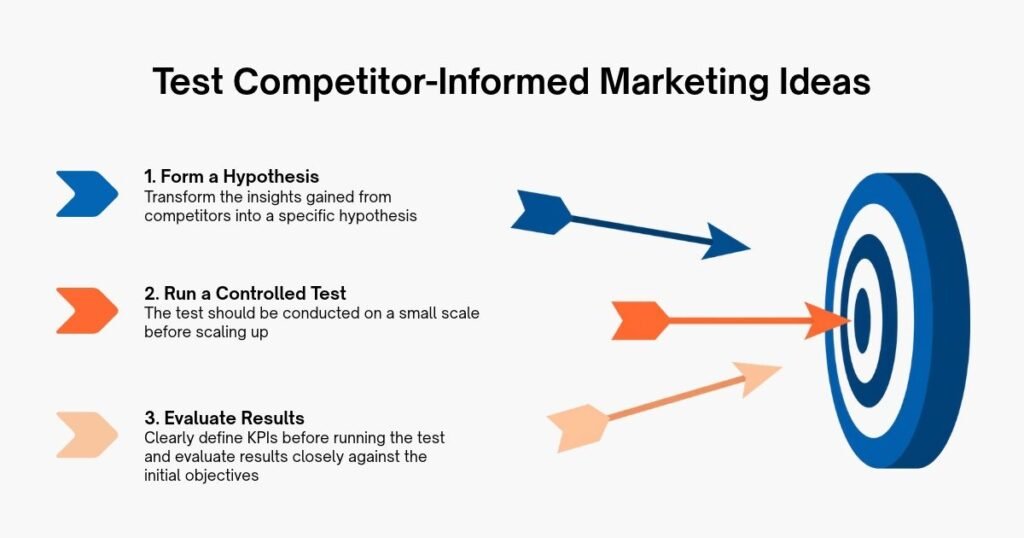
1. Form a Hypothesis
Turn insights gained from competitor data into a specific hypothesis. For example, if reviews show that customers often complain about a sticky feeling when using tinted sunscreen, the brand could test a message emphasizing a lightweight feel to see if this approach resonates better with customers.
2. Run a Controlled Test
Test on a small scale before scaling up. If comparing two advertising messages, keep other factors (such as the target audience, budget, and campaign duration) consistent, while changing only the main message.
This helps the brand more accurately assess the impact of the message being tested, rather than struggling to identify the cause when multiple factors change simultaneously.
3. Evaluate Results
Define KPIs before rolling out the campaign and evaluate results based on the initial objectives. If the goal is to increase engagement, the brand can track engagement metrics; if the goal is to drive sales, it should focus more on conversion rates, revenue, and cost per order.
After the test, the brand can decide to continue, adjust, or discontinue the idea. Even if the results fall short of expectations, the test is still valuable if it helps the marketing team recognize that the initial hypothesis was flawed and avoid continuing to allocate resources toward an ineffective direction.
Learn more about the metrics for evaluating beauty e-commerce performance
Final Thoughts
When brands have access to virtually the same data sources, competitive advantage does not lie in how much information is collected, but in how each brand understands and applies that data to its own business operations.
Therefore, don’t treat competitor data as a marketing formula to be applied. Instead, view it as a foundation for understanding the market, asking the right questions, and finding a path that aligns with your products and customers. After all, what ultimately makes customers choose your brand isn’t what you’ve learned from your competitors, but the unique value you truly deliver.
Leave a Reply