


The Beauty category on Shopee is becoming increasingly competitive as the number of sellers continues to grow, while market share is gradually concentrating among leading brands and major Shopee Mall stores. In this environment, relying solely on intuition or heavily investing in advertising without proper performance tracking and measurement can quickly put pressure on both costs and profitability.
In reality, the difference between a store experiencing short-term growth and a beauty brand achieving sustainable success often comes down to its ability to understand and leverage data effectively. Below are 10 ecommerce analytics metrics that every beauty brand on Shopee should monitor to make more informed and effective business decisions.
What Are Ecommerce Analytics Metrics?
Ecommerce analytics metrics are quantitative measurements used to evaluate business performance across online selling platforms. These metrics are derived from various data sources, including customer behavior, sales performance, marketing activities, and store operations.
For beauty brands on Shopee, ecommerce analytics metrics serve as a foundation for evaluating performance and making data-driven decisions rather than relying on assumptions.
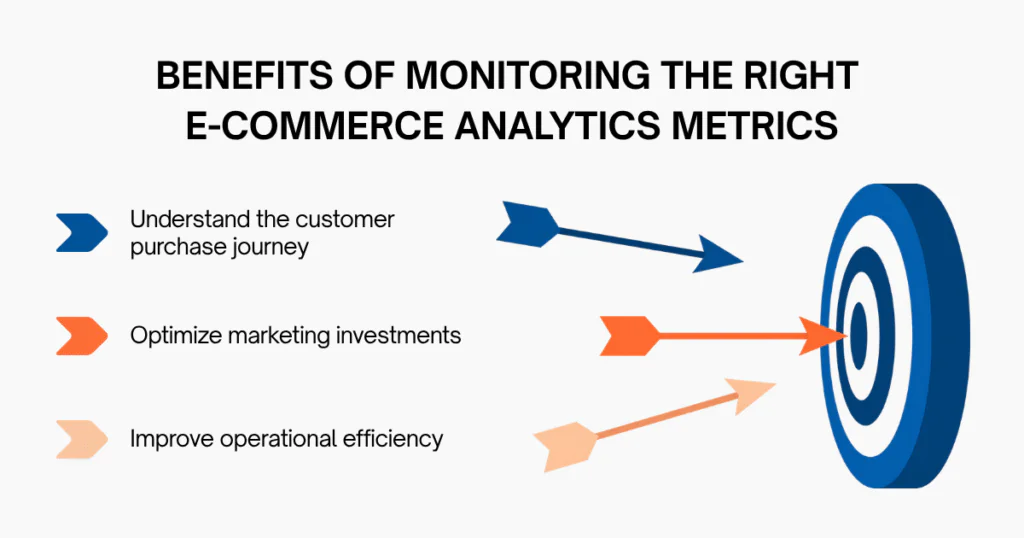
Regularly monitoring the right metrics helps businesses:
- Understand the customer purchase journey: Identify how customers interact with products and where they tend to drop off during the buying process.
- Optimize marketing investments: Accurately evaluate the performance of advertising channels, affiliates, and KOL/KOC campaigns to allocate budgets more effectively.
- Improve operational efficiency: Monitor inventory levels, product quality, and operational performance indicators to minimize business risks.
Ecommerce Analytics Metrics Affecting the Growth of Beauty Brands on Shopee
To make these ecommerce analytics metrics easier to understand and apply, they can be grouped into four key categories that mirror the main stages of customer acquisition, conversion, and long-term growth on Shopee.
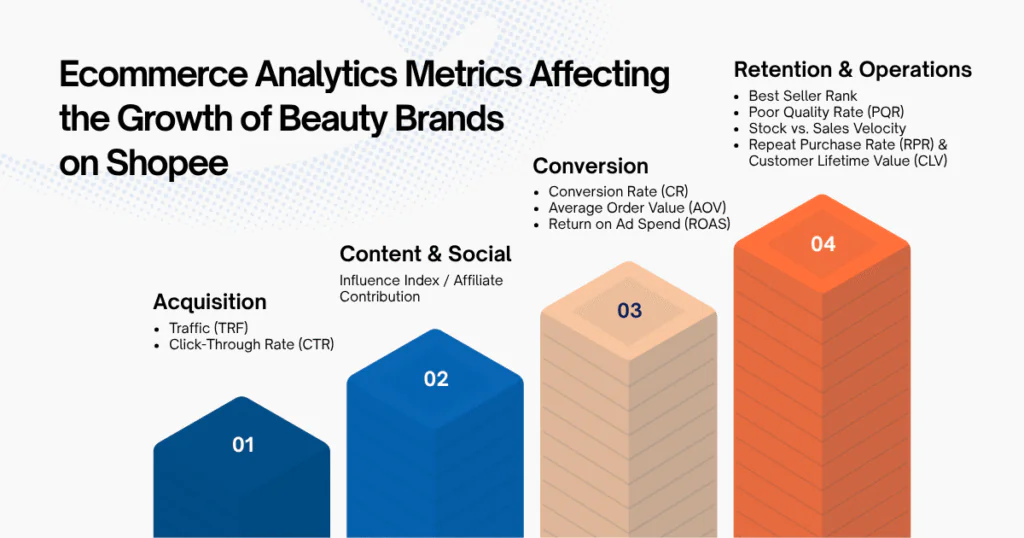
This framework helps beauty brands focus on the most relevant ecommerce analytics metrics for their goals: from driving traffic and improving conversion rates to streamlining operations and strengthening customer retention.
| Metric Group | Metrics | Strategic Impact |
| Acquisition |
1. Traffic (TRF) 2. Click-Through Rate (CTR) |
Reflects a brand’s ability to attract potential customers and how compelling its products appear across search results, ads, and platform recommendations. |
| Content & Social | 3. Influence Index / Affiliate Contribution | Measures how effectively content, livestreams, and affiliate activities reach customers and drive orders. |
| Conversion |
4. Conversion Rate (CR) 5. Average Order Value (AOV) 6. Return on Ad Spend (ROAS) |
Evaluates the ability to turn visitors into buyers, grow revenue per order, and maximize advertising efficiency. |
| Retention & Operations |
7. Best Seller Rank 8. Poor Quality Rate (PQR) 9. Stock vs. Sales Velocity 10. Repeat Purchase Rate (RPR) & Customer Lifetime Value (CLV) |
Supports operational excellence, inventory control, store reputation, and long-term customer value growth. |
One key principle of ecommerce analytics is that no metric should be evaluated in isolation. Each metric shows only part of the picture and must be analyzed alongside others to generate meaningful insights. In most ecommerce businesses, revenue is driven by three core factors:
Revenue = Traffic × Conversion Rate (CR) × Average Order Value (AOV)
Metrics should also be tracked consistently (weekly or monthly, and after major campaigns) to spot real trends and minimize the impact of short-term fluctuations.
1. Traffic (TRF)
Traffic is one of the most fundamental ecommerce analytics metrics. However, traffic volume only becomes valuable when businesses understand where visitors are coming from and which traffic sources contribute most effectively to revenue.
- Required Data: Total number of clicks on products or the shop.
- Data Source: Seller Centre > Business Insights.
- Optimization Note: Clearly distinguish between Organic Traffic (SEO, returning customers) and Paid Traffic (Shopee Ads, KOL/KOC, Affiliate) to evaluate each channel and optimize marketing budgets.
Learn more: Ecommerce Traffic Statistics – What High-Performing Stores Do Differently
2. Click-Through Rate (CTR)
In a highly competitive marketplace like Shopee, shoppers are exposed to countless products before making a purchase decision. CTR measures how attractive your product image, title, and listing information are to potential customers.
- Formula: CTR=(Clicks/Impressions)×100%.
- Data Source: Shopee Ads reports or Business Insights.
- Benchmarks: In the Beauty industry, Organic CTR usually reaches 3% – 5%, while Ads CTR reaches about 1% – 2%. Low CTR suggests a need to optimize display content or product positioning strategies
3. Influence Index / Affiliate Contribution
Product reviews, livestreams, and affiliate marketing have become increasingly important in the Beauty industry. Tracking these metrics helps brands identify which channels generate the highest engagement and revenue.
- Measurement Data: Total livestream hours, views, average watch time, engagement (likes/comments), and orders generated from content.
- Data Source: Shopee Live & Video Analytics page.
- Optimization Note: Beauty brands should closely monitor the order contribution rate from KOLs/KOCs to evaluate investment efficiency and allocate affiliate budgets appropriately
4. Conversion Rate (CR)
Conversion Rate is one of the most important ecommerce analytics metrics because it reflects how effectively traffic is converted into actual orders.
- Formula: CR=(Confirmed Orders/Total Visits)×100%.
- Data Source: Business Insights.
- Benchmarks: The average CR for the Beauty category on Shopee is approximately 2% – 3%
5. Average Order Value (AOV)
AOV measures the average value of each order and is a key metric for increasing revenue from existing customers.
- Formula: AOV=Total Revenue/Total Orders.
- Data Source: Business Insights or Trading reports.
- Optimization Note: Beauty brands often improve AOV by building need-based product combos or implementing Add-on Deals (e.g., a “Cleanse – Treat – Protect” routine combo)
6. Return on Ad Spend (ROAS)
ROAS helps businesses evaluate advertising efficiency by measuring how much revenue is generated for every dollar spent on advertising.
- Formula: ROAS=Ad Revenue/Ad Spend.
- Data Source: Marketing Centre campaign reports (Shopee Ads or GMV MAX).
- Benchmarks: Cosmetics/Skincare brands should maintain a minimum ROAS target of 2.5 to ensure the campaign is profitable after COGS and platform fees
7. Best Seller Rank
This ecommerce analytics metric reflects a product’s competitive position within its category and indicates how well it is performing in the market.
- Measurement Data: Ranking position within a specific category (e.g., Facial Care, Lipsticks).
- Data Source: Displayed directly on the Product Detail Page or via third-party market analysis tools.
- Optimization Note: A high rank enhances buyer trust and supports the product’s organic visibility on the platform
8. Poor Quality Rate (PQR)
PQR is one of the most important product quality metrics monitored by Shopee. It is particularly critical in the Beauty category, where customer experience significantly impacts product ratings and reviews.
- Formula: PQR=1-2 Star Review Orders per week/Total Reviewed Orders per week.
- Data Source: Seller Centre > Product Management > Violation/Suspended.
- Benchmarks: Data is updated every Monday. If PQR ≥ 10%, the product receives a warning; more severe violations can lead to permanent deletion and Shopee Penalty Points for the shop
9. Stock vs. Sales Velocity
Effective inventory management is essential for maintaining stable revenue growth. Stockouts can interrupt sales momentum, while excessive inventory creates pressure on cash flow and storage costs.
- Measurement: Days of Cover=Current Inventory/Average Daily Sales Velocity.
- Data Source: Inventory Management combined with SKU-level sales reports.
- Optimization Note: Helps the supply chain accurately forecast restock needs, preventing stockouts that kill SEO momentum or overstocking that ties up capital
10. Repeat Purchase Rate (RPR) & Customer Lifetime Value (CLV)
In the Beauty industry, long-term growth depends not only on acquiring new customers but also on retaining existing customers and encouraging repeat purchases.
- RPR Formula: RPR=(Customers with 2+ orders/Total Customers)×100%.
- CLV Formula: CLV=AOV×Average Annual Purchase Frequency×Customer Lifespan.
- Data Source: Brand Membership reports on Shopee Mall or internal CRM systems.
- Benchmarks: The Beauty industry leads the market with a 21.5% return purchase rate. Understanding CLV helps determine an appropriate Customer Acquisition Cost (CAC)
Automate Ecommerce Analytics with Easy Data
Tracking the ecommerce analytics metrics above helps businesses evaluate store performance and growth. However, internal data only tells part of the story. To make better decisions, brands also need visibility into market share, pricing trends, category performance, and competitor activities.
As data volume continues to grow, manually collecting and consolidating information from multiple sources can slow down both analysis and decision-making. To solve this challenge, Easy Data offers two complementary solutions:
Ecommerce Data Scraping Service: Provides clean, standardized raw data collected from ecommerce platforms, ideal for businesses with BI teams or existing analytics systems.
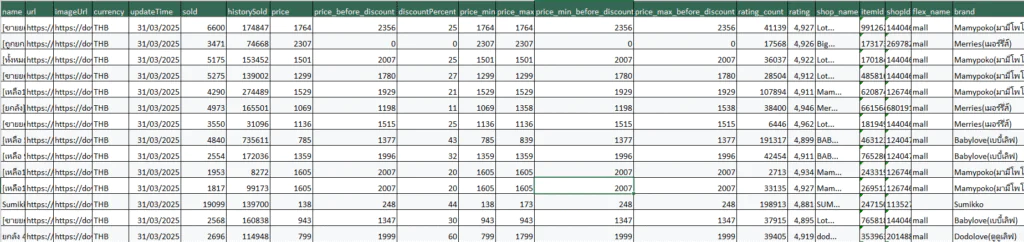
Easy Data Platform: A visual dashboard solution that enables brands to monitor market data, store performance, affiliate activities, and competitor insights from a single platform.
Final Thought
As competition on Shopee intensifies, the ability to measure and analyze data has become a key advantage for beauty brands. Consistently tracking the right ecommerce analytics metrics helps evaluate performance, surface growth opportunities early, and optimize budgets.
Instead of monitoring every data point, brands should prioritize the metrics most closely tied to their growth objectives. When measured and analyzed correctly, these ecommerce analytics metrics form a solid foundation for smarter decisions and sustainable long-term growth on Shopee.
Leave a Reply