

Introduction: Planning a Shopee Data Collection
A Shopee data project should begin with a business question and a permitted source, not a tool purchase. For example, comparing offers for a defined set of product variants requires a consistent market, currency, observation time and price definition. This guide explains how to scope web scraping Shopee, check a trial delivery and distinguish usable observations from missing or incomplete data. It does not promise unrestricted access or a complete marketplace dataset.
What is Web Scraping Shopee?
Web scraping Shopee means extracting selected information from an authorized web source into structured records. Depending on the source and permissions, a project may instead use a seller export, an approved integration or a licensed dataset. Identify which route supplies the required fields; visible product information and private seller operations are different data sources.
A collection is current only as of its successful observation time. Store that timestamp and report failed or delayed runs. Increasing the schedule frequency does not by itself produce real-time coverage, complete results or accurate values.
Key Benefits of Web Scraping Shopee for E-commerce Businesses
-
Repeatable Data Collection
Automate a defined task after checking a representative sample. Keep the requested scope, attempted records, accepted records and failures together so automation does not hide missing coverage. Include maintenance and review effort when estimating time saved. -
Comparable Pricing Observations
Match market, seller, product and variant before comparing prices. Retain the displayed amount and currency, with shipping and voucher conditions stored separately. A scheduled snapshot can inform a pricing review; it does not guarantee a live feed or improved margins. -
Product and Market Research
Track a defined sample across observation dates. Changes in filters, ranking, availability or collection success can change the sample itself. Use the series to form research questions, then validate demand assumptions with suitable sales or customer evidence. -
Review Themes and Sentiment
Ratings and text describe the reviews collected, not every buyer. Shopee’s review-quality guidance also explains that visible content is moderated. Separate product, delivery and seller-service themes, and check automated labels against manually reviewed examples. Our Shopee review-analysis guide includes a tested local exercise. -
Seller and Partnership Research
Permitted seller-directory observations may help identify businesses for further research. A displayed shop name does not establish verified contact details, commercial success or permission for outreach. Keep business research separate from collecting personal identifiers or sending unsolicited messages.
How to Scrape Shopee for Product Data
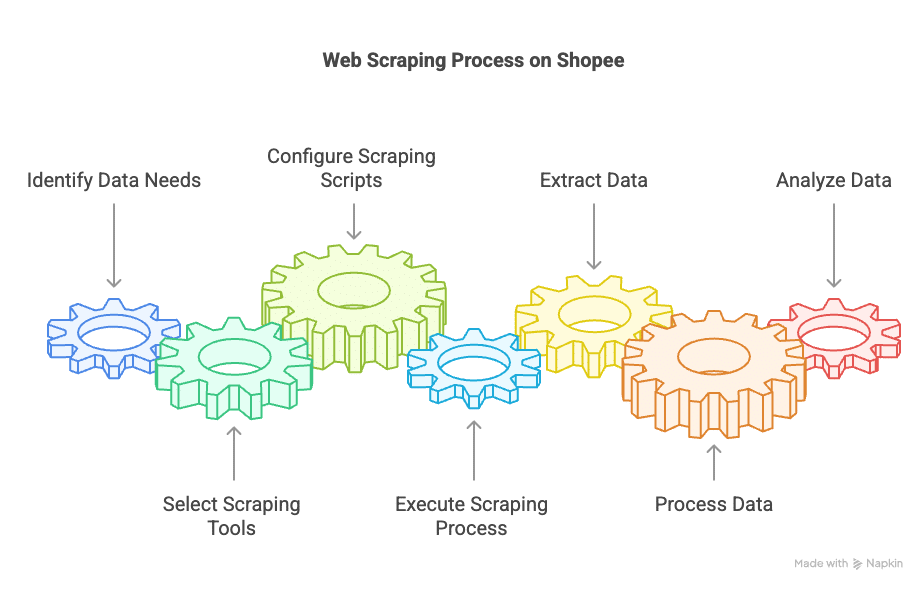
Use the five steps below as an acceptance workflow. Confirm permission and source suitability first, test a bounded sample, then expand only when the records meet the agreed requirements.
1. Choose a Web Scraping Tool
Choose a tool based on the actual authorized source and workload. The following are different kinds of software, not a ranking or a guarantee that a current Shopee page is supported:
- ParseHub: Evaluate the publisher’s current workflow, export and workload limits against your own representative sample. Do not assume that a tool name establishes access to every field or page.
- Scrapy: A Python framework for requests, extraction and pipelines. Its dynamic-content guidance explains the additional work needed when required data is absent from the initial response; it does not automatically render every JavaScript page.
- Octoparse: A visual workflow tool with cloud execution options. Confirm current plan capabilities with the publisher and test missing values, variants, pagination and failure reporting before relying on a template.
- Beautiful Soup: A library for parsing supplied HTML or XML. It does not retrieve pages or execute JavaScript. The official documentation explains searching the parsed tree; source retrieval is a separate concern.
2. Define What Data You Need to Scrape
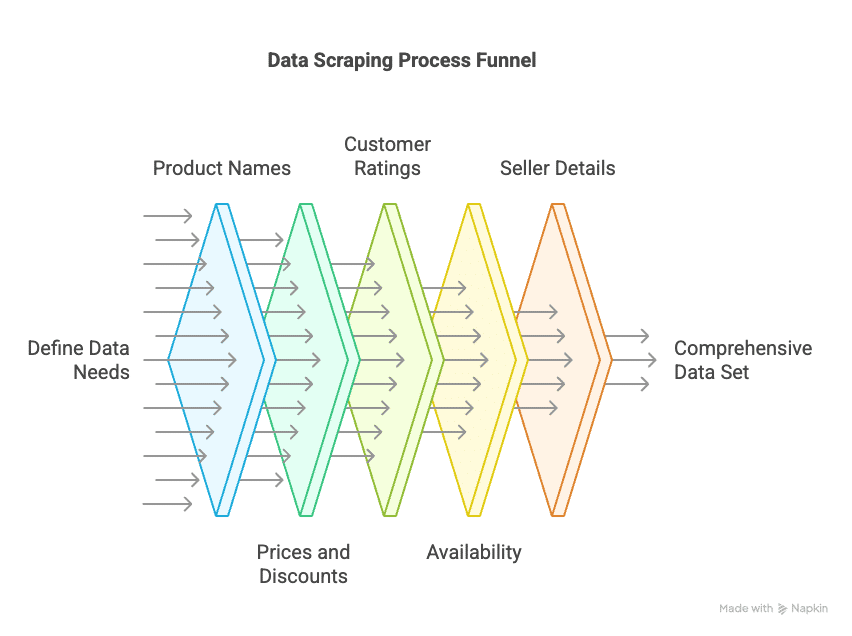
Define one row before collecting anything. For a product-offer dataset, a useful starting identity is market, seller, product, variant and observation time. Add only fields that the permitted source can actually provide:
- Product and variant identifiers, names and the source URL; a title alone is not a reliable identity.
- Observed price, original currency and promotion conditions; distinguish a starting price from a selected variant price.
- Rating, review count or review text within the agreed scope; keep review date separate from collection time.
- Observed availability state; treat exact stock quantity as unknown unless an authorized source explicitly supplies it.
- Required seller identifiers and displayed business attributes, with definitions for ratings or location labels.
For a concrete example of a starting price that cannot be assigned to a named variant, see the April 2024 Thailand TV archive example. It also shows why televisions and accessories need separate classification. Use it to plan validation checks; the historical captured prices are not current quotes.
Write a small acceptance brief before implementation. For example: “Compare selected variants from 20 supplied product URLs in one market, once per day for seven days; retain displayed price and currency, report missing fields, and deliver a CSV plus a failure log.” This is an illustrative scope, not a claim that those URLs or fields are accessible. Confirm the source and permissions before running it.
3. Set Up Scraping Parameters
Set limits that make a partial run visible. A useful configuration includes the following:
- Schedule and time: Choose the interval the business decision needs. Record a timezone-aware observation timestamp for each successful record, and distinguish a scheduled run from a completed one.
- Pagination and stopping: Set a permitted page or record budget, detect repeated page tokens or identities, and record why collection stopped. Do not assume that visiting every visible page means complete marketplace coverage.
- Export contract: Specify column names, identity fields, currency, timestamp format and missing-value rules. Deliver errors separately from accepted rows. Our ecommerce extraction guide demonstrates a local parser and structured export.
4. Run the Scraper
Run a bounded trial and reconcile its results before scheduling recurring collection. As a fictional example, suppose 20 supplied URLs produce 15 accepted records, two unavailable listings, one timeout and two responses missing required prices. Report 15 accepted out of 20 requested (75% coverage), with five classified failures or exclusions. Do not label the export complete, fill missing prices with zero, or treat failed fetches as proof that a product was removed. See our scraping troubleshooting guide for parsing and failure-handling checks.
5. Clean and Analyze the Data
Check identity, field meaning and sample coverage before analysis. Retain different variants and observations from different times; duplicate titles alone are not duplicate records. Preserve original currency and text alongside normalized values, and document any dropped records. Compare like-for-like observations rather than treating a change in the sample as a market trend. The Shopee analysis guide explains how to separate observed data from derived conclusions.
Legal and Ethical Considerations for Web Scraping Shopee
Treat access and data handling as requirements of the project. The following checks support a scoped review; they are not a blanket claim that scraping is permitted in every market:
- Check the applicable terms and permission: Shopee Malaysia’s Terms of Service, for example, restrict automated or manual monitoring/copying of content without prior written consent, subject to the stated search-engine exception. Verify the terms and authorization for your exact market and source before collection.
-
Respect crawler instructions: Follow relevant
robots.txtrules, but do not treat an allowed path as access authorization. RFC 9309 makes that distinction explicit. - Bound load and failures: Use the agreed rate, timeout and retry limits. Stop and investigate persistent errors or access challenges; do not turn retries into an unbounded collection loop.
- Minimize personal data: Review the privacy rules applicable to the people, markets and intended processing. Collect only necessary fields, restrict access and define retention. Removing a display name alone may not make review text anonymous; see the European Commission’s data-protection guidance.
Conclusion: Validate the Collection Before Using It
A useful Shopee collection delivers traceable observations with known limits. Define the permitted source, row identity and price meaning; test a small sample; reconcile accepted records with failures; and validate the interpretation before acting. Automation helps repeat that process, but it does not establish data completeness, demand or commercial results by itself.
To discuss an authorized collection, bring the market, representative URLs, required fields, refresh interval and intended use to our Shopee data scraping service page. Keep a reviewed sample and acceptance criteria with the project brief.
Further Reading
Leave a Reply