

Introduction
Shopee comment crawling means collecting permitted product-review observations for analysis. A useful project starts with a defined market, product set, date range and business question, such as whether buyers repeatedly mention battery performance or packaging. It should not begin with an assumption that more comments automatically mean better insights.
Published reviews are a selected, moderated sample. Shopee Malaysia’s review guidance describes eligibility, separate rating dimensions and coin rewards. Its review-quality guidance also describes removal of non-compliant reviews. These regional rules explain why visible comments should not be treated as unfiltered feedback from every buyer.
- Introduction
- 1. What is Shopee Comment Crawling?
- 2. How Analyzing Customer Feedback Can Drive Business Growth
- 3. Key Benefits of Shopee Comment Crawling
- 4. How Shopee Comment Crawling Works
- 5. Tools and Methods for Crawling Shopee Comments
- 6. Use Cases of Shopee Comment Crawling Across Industries
- 7. Legal and Ethical Considerations
- 8. Step-by-Step Guide to Implementing Customer Feedback Analysis on Shopee
- 8.1 Prepare the Local Example
- 8.2 Define the Collection Contract
- 8.3 Validate Review Records
- 8.4 Summarize and Store Results
- 8.5 Evaluate Sentiment Labels
- Conclusion
1. What is Shopee Comment Crawling?
The process extracts fields such as published review text, displayed rating, product identifier and review date from an authorized source. It complements surveys and support records; it does not automatically provide a richer or more representative sample. Some reviews may contain only media or very little useful text.
Automation can organize observations, but source access and completeness must be verified separately. Use an authorized seller export, documented API, licensed dataset or permitted page access where available. Do not assume an endpoint or selector works across every Shopee market.
2. How Analyzing Customer Feedback Can Drive Business Growth
Collecting customer feedback from Shopee is highly valuable for several reasons:
- Published Feedback: Reviews can surface product or service issues, but moderation, incentives and who chooses to post affect the sample.
- Trend Monitoring: Compare the same product cohort and review-date windows; record changes in collection coverage before interpreting a trend.
- Comparative Research: Compare permitted reviews for similar variants and periods. Differences in review volume or rating do not by themselves establish product quality or market share.
- Enhanced Customer Support: Analyzing recurring complaints helps businesses improve customer service and resolve common issues proactively.
- Product Development: Feedback from comments highlights pain points, enabling companies to refine or innovate their products.
For example, repeated battery complaints could justify a product test or support investigation. This is an illustrative use case, not a verified customer outcome. Separate comments about product performance from delivery or seller service before assigning an owner.
3. Key Benefits of Shopee Comment Crawling
Here are specific advantages businesses can gain from this practice:
- Product-Use Themes: Analyze needs that reviewers explicitly describe. Do not infer age, gender, income or other personal attributes from a username or writing style.
- Demand Hypotheses: Frequent themes can suggest questions to investigate. Review counts and keyword mentions are not verified sales volume or market demand.
- Reputation Management: Tracking positive and negative comments allows brands to manage their online reputation proactively.
- Content Marketing Inspiration: Recurring topics and keywords can inform content creation for blogs, ads, and social media posts, improving engagement with the target audience.
Report both useful themes and the limits of the sample. For broader decision-making, combine permitted review observations with appropriately authorized sales and support evidence. See our Shopee analysis guide for separating observations from estimates.
4. How Shopee Comment Crawling Works
Shopee comment crawling involves several steps, from data collection to actionable insights:
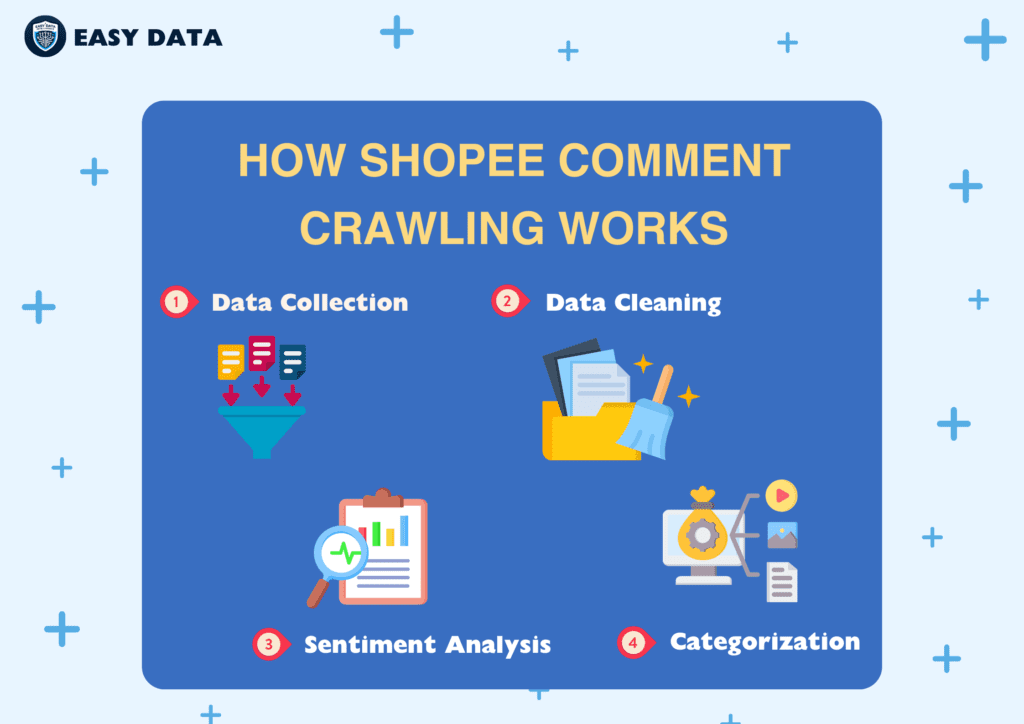
- Data Collection: Define the authorized source, market, product IDs, date window, rating filter and sort order. Log pagination boundaries and denied or failed requests.
- Data Validation: Retain a protected raw copy, validate required fields and deduplicate using source identifiers. Identical text from different reviews is not automatically a duplicate.
- Sentiment Analysis: A model estimates labels; it can misread negation, sarcasm and mixed languages. Evaluate it against a manually reviewed sample before reporting results.
- Categorization and Tagging: Comments are grouped by topics or keywords for detailed analysis (e.g., “battery life,” “durability,” “design”).
Keep review date separate from collection time, and product-quality ratings separate from delivery or service ratings. Preserve the original text alongside any normalized or translated version so reviewers can audit a classification.
5. Tools and Methods for Crawling Shopee Comments
Tools serve different parts of the workflow. Their availability does not establish permission to collect a particular source:
-
Python Libraries:
- Beautiful Soup: Parses HTML/XML already obtained; it does not run JavaScript or fetch reviews by itself.
- Scrapy: A powerful web crawling framework for scraping data.
- Selenium: Automates browser interactions. For permitted collection, use explicit waits, a finite page limit and cleanup; dynamic-page support does not guarantee Shopee access.
-
Web Crawling Software:
- Octoparse: A visual extraction tool. Verify the current task/template against the intended market and source before relying on its output.
- ParseHub: User-friendly software for automating scraping tasks without coding.
-
Sentiment Analysis Tools:
- MonkeyLearn: Its former website now redirects to Medallia. Verify the current product and availability instead of relying on older MonkeyLearn setup instructions.
- Text Analysis Tools: Evaluate language coverage, topic labels, export options and errors on your own authorized sample; a vendor label is not an accuracy guarantee.
Start with a small, auditable sample and a manual coding guide. Check Beautiful Soup’s documentation, Scrapy’s documentation and Selenium’s explicit-wait guidance for their respective technical roles.
6. Use Cases of Shopee Comment Crawling Across Industries
Crawling customer comments on Shopee is versatile and beneficial for various sectors:
- E-commerce: Enhances product listings and identifies customer satisfaction trends.
- Consumer Electronics: Addresses specific concerns like battery life and durability based on user feedback.
- Fashion and Beauty: Review fit, shade or packaging themes for matched variants; validate any resulting inventory decision with sales evidence.
- FMCG (Fast-Moving Consumer Goods): Reveals quality and usability feedback for refining packaging or introducing new variants.
These use cases illustrate the flexibility and impact of Shopee comment crawling.
7. Legal and Ethical Considerations
When implementing Shopee comment data collection, businesses must prioritize legal and ethical compliance:
- Shopee’s Terms of Service: Ensure methods align with Shopee’s policies to avoid violations.
- User Privacy: Minimize collection of usernames, profile links and other personal details. Free text can identify a person even after a username is removed; redact unnecessary details before sharing.
- Data Security: Restrict access, define a retention period and preserve a controlled audit trail for authorized records. Do not expose raw customer text in a public report by default.
These are project controls, not a legal determination. Check the applicable regional terms and requirements for the intended data and use. If access is denied or authorization is unclear, pause collection and seek a permitted source.
8. Step-by-Step Guide to Implementing Customer Feedback Analysis on Shopee
The exercise below validates and summarizes a fictional local CSV sample. It makes no request to Shopee, requires no account credentials and does not demonstrate live extraction. Use it to agree on record fields and acceptance checks before adapting an authorized export or collector.
8.1 Prepare the Local Example
Use Python 3.9 or newer. This example uses only the standard library, so no scraping or NLP package is required. Save the code in section 8.3 as review_demo.py and run python review_demo.py. It prints a summary and does not overwrite a file.
8.2 Define the Collection Contract
For a real project, document the permitted source and access method; market; product and variant IDs; review-date interval; sort/rating filters; maximum pages; and collection time. Record failures as failures, not as zero reviews. Do not claim complete coverage when pagination, filters or access limits leave gaps.
8.3 Validate Review Records
The fixture uses market, product_id, review_id, rating, reviewed_at and text. Its ratings are integers from 1 to 5, and dates include a timezone. The deduplication key combines market, product and review IDs; a conflicting duplicate stops the run rather than silently choosing a version.
Copied!import csv import io import json from collections import Counter from datetime import datetime, timezone # Entirely fictional records, not a Shopee dataset. SAMPLE = """market,product_id,review_id,rating,reviewed_at,text DEMO,p1,r1,2,2025-01-01T10:00:00+00:00,Battery needs frequent charging DEMO,p1,r2,5,2025-01-02T10:00:00+00:00,Delivery was quick DEMO,p2,r3,4,2025-01-03T10:00:00+00:00,Fit is comfortable DEMO,p2,r4,3,2025-01-04T10:00:00+00:00, DEMO,p1,r1,2,2025-01-01T10:00:00+00:00,Battery needs frequent charging """ FIELDS = ["market", "product_id", "review_id", "rating", "reviewed_at", "text"] def read_reviews(csv_text): reader = csv.DictReader(io.StringIO(csv_text)) if reader.fieldnames != FIELDS: raise ValueError("Unexpected CSV header") unique, input_rows, duplicates = {}, 0, 0 for raw in reader: input_rows += 1 if None in raw or any(value is None for value in raw.values()): raise ValueError("Unexpected field count") row = {key: value.strip() for key, value in raw.items()} key = (row["market"], row["product_id"], row["review_id"]) if not all(key): raise ValueError("Missing source identity") if row["rating"] not in {"1", "2", "3", "4", "5"}: raise ValueError("Rating must be an integer from 1 to 5") date = datetime.fromisoformat(row["reviewed_at"]) if date.tzinfo is None or date.utcoffset() is None: raise ValueError("Review date requires a timezone") row["reviewed_at"] = date.astimezone(timezone.utc).isoformat() row["rating"] = int(row["rating"]) if key in unique: if unique[key] != row: raise ValueError("Conflicting duplicate; review source versions") duplicates += 1 continue unique[key] = row if not unique: raise ValueError("No review records") return list(unique.values()), input_rows, duplicates def summarize(csv_text): rows, input_rows, duplicates = read_reviews(csv_text) return { "input_rows": input_rows, "unique_reviews": len(rows), "duplicate_rows": duplicates, "with_text": sum(bool(row["text"]) for row in rows), "without_text": sum(not row["text"] for row in rows), "rating_counts": dict(sorted(Counter(row["rating"] for row in rows).items())), } if __name__ == "__main__": print(json.dumps(summarize(SAMPLE), ensure_ascii=False, indent=2))
8.4 Summarize and Store Results
Expected summary: 5 input rows, 4 unique reviews, 1 duplicate, 3 reviews with text and 1 without text. Ratings 2, 3, 4 and 5 each appear once. The low-rating share (ratings 1–2) is 1/4 = 25% in this fictional sample only; it is not a sentiment score or a Shopee market statistic.
8.5 Evaluate Sentiment Labels
Before automating sentiment, manually label a separate sample by product topic, delivery/service topic and sentiment (positive, negative, neutral, mixed or unclear). Keep low ratings separate from text labels: “delivery was quick” says little about product quality. Include relevant languages, slang and negation, and report disagreements and errors instead of claiming a model is universally accurate. For a worked example of measuring missed and incorrectly flagged reviews, see our Shopee review evaluation guide.
Store source provenance and collection time alongside accepted records; keep rejected rows in a restricted error log. Preserve original text and any edited-review versions rather than dropping them solely because the words repeat. Python’s CSV documentation and Counter documentation explain the parsing and counting primitives used here.
Conclusion
A useful review-analysis deliverable states the authorized source, product cohort, time window, rating dimensions, validation results and known gaps. Use the findings to prioritize questions for product or support teams, then validate the business effect separately. Our Shopee data service can be discussed against that brief; the ecommerce data guide explains how to keep observed listing data separate from first-party analytics.
Ready to start scraping Shopee data? Visit easydata.io.vn to learn more about our data scraping solutions and book a demo today!
Leave a Reply