


Introduction
Shopee reviews can help Southeast Asian businesses investigate recurring product and service complaints. A useful review dataset records which listings, markets and dates it covers, how reviews were selected, and what could not be collected. Reviewers are a self-selected group, so their comments should not be treated as a representative survey of every buyer.
This guide explains how to scope a Shopee review-data project with Easy Data, evaluate a sample, and distinguish recorded review fields from inferred sentiment. The practical goal is a documented dataset that supports a specific decision, with access, coverage and quality limits visible to the reader.
- Introduction
- 1. The Power of Shopee Review Data for SEA Businesses
- 2. The Challenges of Crawling Shopee Reviews
- 3. How Easy Data Excels in Shopee Review Crawling
- 4. Easy Data’s Shopee Review Crawling Process
- 5. Benefits of Partnering with Easy Data for Shopee Review Crawling
- 6. Practical Applications of Shopee Review Data
- 7. Advanced Technology Used by Easy Data
- 8. Why Choose Easy Data as Your Shopee Review Crawling Partner in SEA?
- 9. Worked Example: Evaluating Review Labels
- Conclusion
1. The Power of Shopee Review Data for SEA Businesses
Review analysis can support the following decisions when the sample and its limitations are documented:
- Competitive comparison: Compare similar products within the same market, period and rating filters. Differences in the collected reviews may reflect selection or product mix, so validate a suspected competitor weakness before acting on it.
- Product development: Group recurring comments about size, durability, packaging or usability. Treat them as hypotheses to check against support tickets, returns and product testing rather than proof that a design change will improve sales.
- Local market context: Keep the marketplace and detected language separate. A review’s language does not establish the reviewer’s location or nationality; mixed-language and translated reviews need explicit handling.
The value comes from a repeatable comparison and a traceable source record, not the number of comments collected. For collection-level checks, see our Shopee comment analysis guide.
2. The Challenges of Crawling Shopee Reviews
A pilot should establish whether the agreed review data can be accessed and interpreted consistently. Common failure modes include partial pagination, changing page structures, mixed dates and language-model errors.
- Access restrictions: A rate limit, CAPTCHA or denied request is a collection constraint. Pause or stop the affected task, record the failure and review the permitted access route; do not describe a proxy or user-agent change as permission or guaranteed access.
- Dynamic content and pagination: Loading a product page does not prove that every review was captured. Record the selected sort/filter, successful pages or batches, expected counts where available and any gaps. A sample may exclude older or inaccessible reviews.
- Language and text variation: Preserve the original text separately from translations and model labels. Evaluate slang, spelling variants, emojis and mixed-language reviews with human reviewers familiar with the relevant language.
Before scheduling a larger collection, agree on acceptable coverage, missing-field thresholds, failure reporting and refresh intervals. A successful pilot does not guarantee that access or page structure will remain unchanged.
3. How Easy Data Excels in Shopee Review Crawling
A review project should begin with an explicit specification and a sample delivery. Use the following criteria to assess whether the proposed method and output meet your needs:
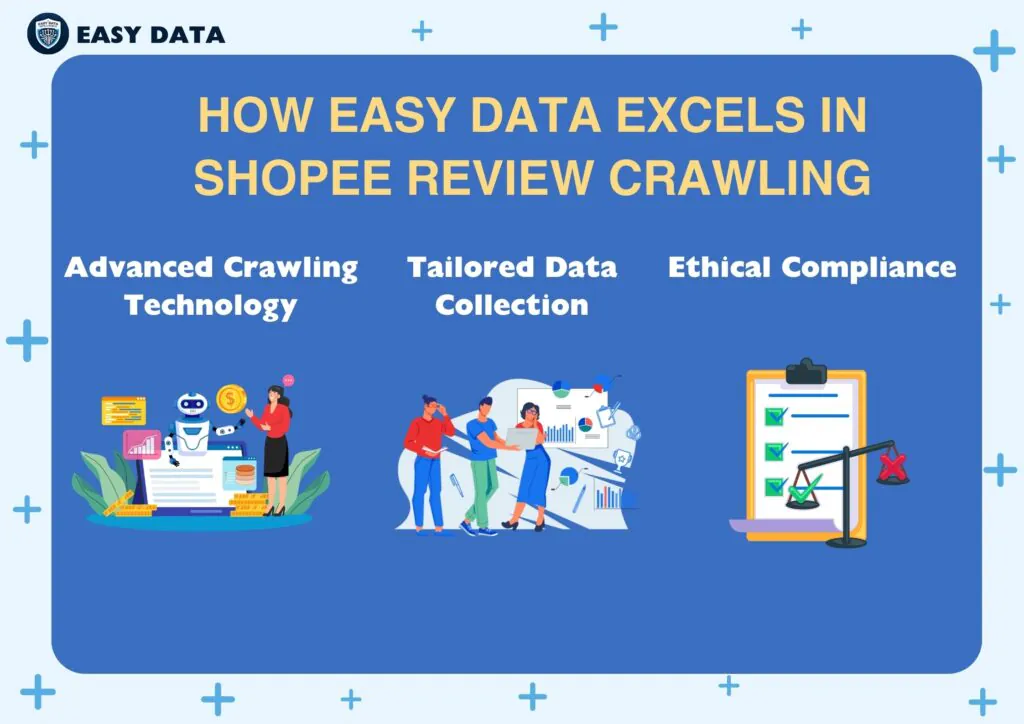
- Collection method: Confirm the permitted source and review fields before implementation. Where an authorized export or API provides the required data, assess that route first. Access to one seller account does not imply access to every competitor’s reviews.
- Project scope: Specify marketplace, shop/item identifiers, review date range, sort/filter rules, fields and delivery format. Separate raw observations from translations, topic labels and sentiment scores so later analysis can be audited.
- Access and privacy review: Review the relevant market’s platform terms and applicable data obligations. Public visibility alone does not establish unrestricted reuse. Shopee Singapore’s terms are a starting reference for that market, not a blanket authorization for all SEA projects.
4. Easy Data’s Shopee Review Crawling Process
Use four checkpoints to turn a proposed review project into a deliverable that can be evaluated:
- Requirements and acceptance: Define the business question, permitted sources, fields, date range and excluded data. Agree on sample size, deduplication rules, supported languages and how incomplete coverage will be reported.
- Pilot and access limits: Collect a bounded sample using the agreed route. Record request failures and throttling, set a retry limit, and stop when access is denied. Measure completion and freshness before committing to a recurring schedule.
- Extraction and validation: Check rating values, timestamps, item/shop identity and duplicate records. Treat absent text, unavailable dates and translation failures as missing values. Reviewer profile URLs, names and images should be excluded unless a specific, reviewed purpose requires them.
- Delivery and retention: Agree on CSV, spreadsheet, database or API delivery, access controls, retention period and deletion process. Include a data dictionary, observation time, source identifiers and a collection summary alongside the records.
5. Benefits of Partnering with Easy Data for Shopee Review Crawling
Assess a service proposal by the evidence in its sample and delivery specification:
- Traceable insights: Require counts and denominators for each reported topic or rating group. Keep a way to trace an aggregate back to the permitted source records, while restricting unnecessary personal information.
- Language-specific evaluation: Report results separately by language and market when samples permit. Document unsupported languages, translation steps and uncertain labels rather than pooling them into a single unexplained score.
- Comparable benchmarks: Use matched product groups and consistent date/rating filters. Show sample sizes, gaps and label definitions; a larger review count alone does not prove a stronger product or service.
6. Practical Applications of Shopee Review Data
The following are possible uses to evaluate in a pilot, rather than guaranteed business outcomes:
- Product improvement: Identify recurring feature or packaging complaints, then check them against product tests and operational records before prioritizing a change.
- Customer support: Use repeated questions and complaints to propose support articles or escalation categories. Measure the effect using your own support records after the change.
- Sales and marketing: Use recurring themes to inform messaging research. Review permissions and context before reusing an individual review as a testimonial, and test messaging rather than assuming conversion gains.
- Reputation monitoring: Compare successive collections made with the same selection rules. State the collection interval and delay; a scheduled snapshot is not continuous real-time monitoring.
7. Advanced Technology Used by Easy Data
Choose processing tools after defining the data and the evaluation criteria. A technology label alone does not establish accuracy or coverage:
- Sentiment and topic models: Treat model labels as estimates. Check the tool’s supported language and feature combinations; for example, Google Cloud Natural Language documents support by feature. Test your own labels against a held-out, human-reviewed sample rather than treating a model score as customer satisfaction.
- Processing capacity: Benchmark representative file sizes, languages and refresh intervals. Report runtime, failed records and resource limits before expanding the job; infrastructure capacity does not establish access permission or complete collection.
- Monitoring and reports: Keep raw data, derived labels and dashboards versioned separately. Report the last successful collection time, missing batches and model version so a dashboard does not silently present stale or partial results as fresh.
8. Why Choose Easy Data as Your Shopee Review Crawling Partner in SEA?
When assessing Easy Data or another provider, ask for evidence tied to the proposed project rather than relying on broad service claims:
- Regional review: Ask how the team will evaluate the actual languages and marketplace variants in scope, and who will review ambiguous samples.
- Demonstrated scale: Ask for a pilot using representative volume, a documented delivery cadence and a clear response to failures. Define expansion criteria instead of assuming every project size is supported.
- Data handling: Agree on purposes, access controls, retention and any cross-border processing before sharing data. For Singapore projects, the PDPC’s obligations overview describes purpose, protection, retention and transfer requirements. Other jurisdictions and project circumstances require their own review.
9. Worked Example: Evaluating Review Labels
The following is a fictional evaluation exercise, not a client case study or an Easy Data performance result. A held-out sample contains 100 reviews. Human reviewers identify 24 as packaging complaints. A model flags 20 reviews, of which 18 match the human labels.
- Precision: 18 correct flags ÷ 20 total flags = 90%. Two flagged reviews are false positives. Precision answers how many of the model’s positive labels were correct in this sample.
- Recall: 18 correctly flagged complaints ÷ 24 human-labelled complaints = 75%. Six complaints were missed. Recall answers how many of the labelled complaints the model found.
- Decision: Review the two false positives and six missed complaints, refine the labelling rules, and evaluate on another held-out sample. These results do not establish marketplace-wide accuracy, buyer satisfaction, sales uplift or return-rate reductions.
The definitions above follow the standard precision and recall formulas. A different topic, language or selection method requires a new evaluation; keep the test set separate from examples used to tune the model.
Conclusion
A useful Shopee review project delivers documented scope, traceable records and measured analysis quality. Agree on access and privacy requirements, validate a sample, and report coverage and uncertainty before making a business decision. The Shopee collection guide provides further scoping and validation checks.
Ready to discuss a review-data project? See our Shopee data scraping service and use the demo form below to describe your marketplace, listing selection, date range and intended analysis.
Leave a Reply