


It is not easy to know exactly which products will become best-sellers. For an SKU to become a core product, it usually takes a process of observation and testing based on real-time data, starting with very small signals such as a sudden increase of a few hundred searches or a video that suddenly gets much higher engagement than usual. When these signals are spotted early enough, ecommerce teams can test quickly and only scale once demand has been confirmed.
So, how are ecommerce teams doing this in practice? Let’s look at how they track market signals, test products at a small scale, and scale the products that are showing clear results.
How Teams Track Real-Time Demand Signals
The biggest challenge is distinguishing real demand signals from noise. A well-founded trend often appears across multiple sources at the same time: search volume, social media discussions, or sales metrics may all point to growing demand. In contrast, a temporary spike may only take off on one channel before quickly disappearing.
Therefore, teams often compare signals from multiple sources instead of relying on just a few initial numbers. A group of around 5–7 key signals is usually enough for teams to keep track of notable changes in product performance:
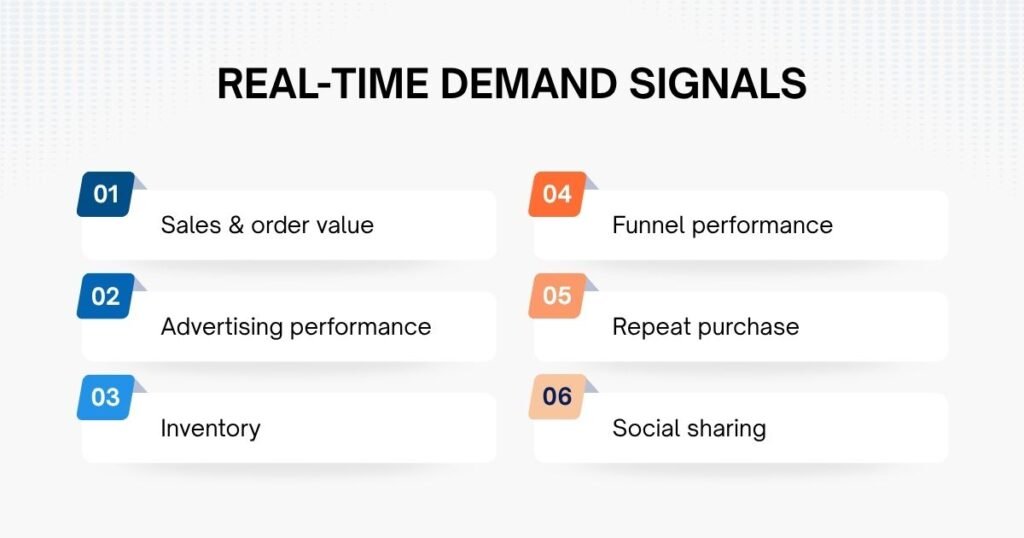
- Sales & order value: Sales and order value across each sales channel.
- Advertising performance: ROAS and CPC to track advertising performance.
- Inventory: Inventory levels for each SKU, especially products with rapidly increasing sales velocity.
- Funnel performance: Add-to-cart rate and cart abandonment rate.
- Repeat purchase: In the beauty industry, repeat purchase rate can indicate a product’s appeal more clearly than initial sales.
- Social sharing: Social media sharing is also a notable signal when a product starts gaining attention.
Turning Signals Into a Fast, Low-Risk Test
Spotting a new signal does not mean a product will definitely sell well. That is why many teams start with a small-scale test to see how the market actually responds. This could be a small production batch, a limited advertising campaign, or flexible models such as pre-orders. This approach gives the team more real-world data before deciding whether to make a larger investment.
From the beginning, ecommerce teams often set a few thresholds to evaluate the test, such as conversion rate, cost per order, or add-to-cart rate. Once real-world data comes in, they compare the results against these thresholds to decide what to do next.
- If performance is significantly below expectations: the team may stop or adjust the test early.
- If the metrics exceed expectations: advertising budgets and production volume can be increased while demand is still strong.
For products where conditions change quickly, real-time data from the first few hours can sometimes be enough for a team to decide whether to continue, adjust, or stop a test. Waiting for more data to get a more certain answer does not always offer an advantage, especially when market demand can change very quickly.
Scaling What Works: Pricing and Inventory in Real Time
When a product starts selling well, real-time data is no longer just something to monitor. It starts driving decisions around pricing, inventory, and advertising budgets. These decisions are often adjusted almost at the same time to maintain growth momentum.
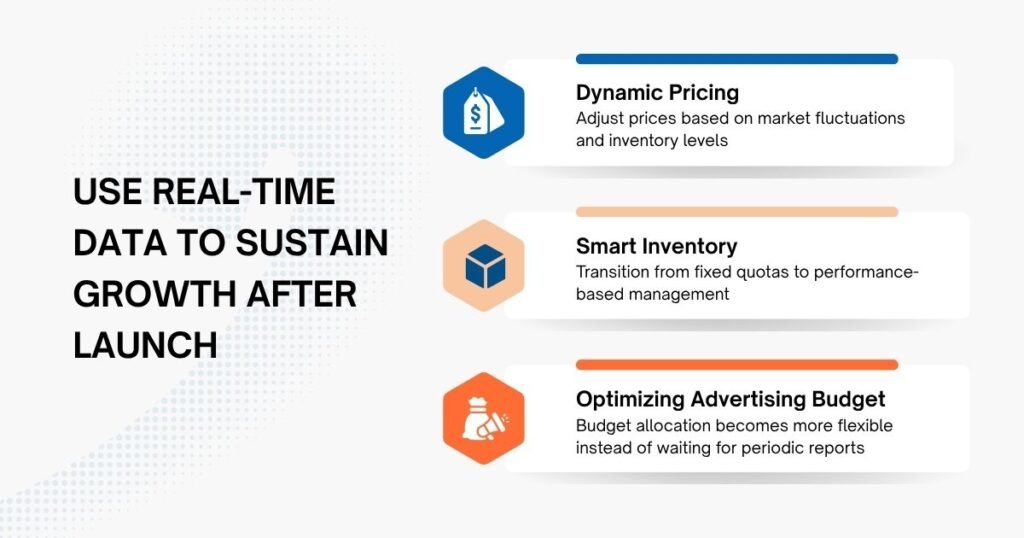
Dynamic Pricing
Prices are often adjusted based on demand and remaining inventory. When demand increases and inventory becomes limited, prices may be raised slightly. Conversely, when sales slow down, prices are lowered to stimulate demand.
But price changes also need a clear reason behind them. If prices jump too quickly without any context, customers can easily feel that they are being “price-gouged.” That is why many teams tie price adjustments to specific milestones, such as a campaign, flash sale, or inventory levels, while keeping price changes within a certain range to avoid losing customer trust.
Smart Inventory
Inventory is no longer managed based on a fixed threshold such as “reorder when there are 10 products left.” Instead, teams track the sales velocity of each SKU in real time to see when inventory is approaching a risk level.
Sales and inventory tracking systems can automatically send alerts or even trigger orders when sales velocity exceeds a safe threshold. This is particularly important during periods of sudden sales growth, such as after a strong campaign or when a video unexpectedly goes viral.
Ad Budget Reallocation
Advertising budgets are often shifted based on the performance of each SKU. Products with high ROAS and low cost per order receive more budget, while less effective SKUs receive less.
Instead of waiting for periodic reports, many teams set up simple rules to adjust budgets almost immediately. For example, if an SKU exceeds its target by 20% within 24 hours, its budget can be increased right away, as long as major changes are still subject to human oversight.
A Real-Life Example: Redchef
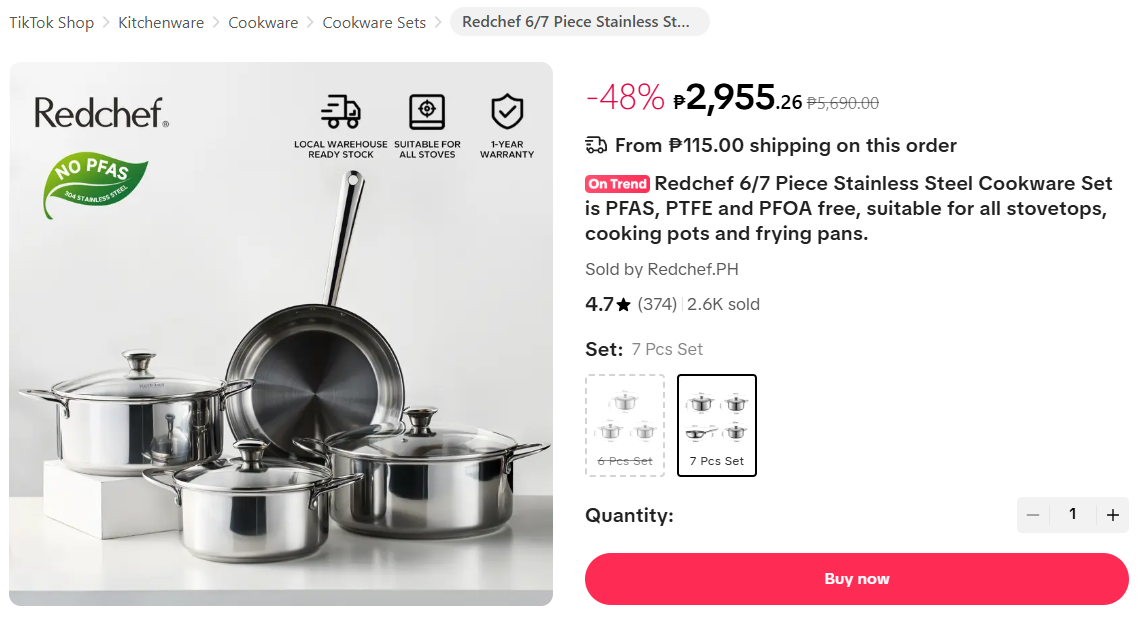
Redchef, a Chinese ceramic cookware brand founded in 2022, is a clear example of how this approach can be applied at scale in Southeast Asia. According to an analysis of the brand’s growth journey, Redchef identified a gap in Southeast Asia’s cookware market: a mid-range segment combining attractive design, health safety, and reasonable pricing. This gap was confirmed through market data before the brand began production.
Identify the Market Gap
Redchef did not launch across multiple markets at once or pour a large budget into advertising. Instead, the brand started with small-scale video content. The team filmed themselves cooking familiar dishes from each market, such as nasi goreng in Indonesia, bak kut teh in Malaysia, and phở in Vietnam, to see how users in each market responded.
Test Market Response
As positive signals became clearer, the brand quickly expanded into localized livestreaming across four countries and built a network of mid-tier creators rather than focusing on high-profile celebrities with higher costs.
Scale When the Signal Is Clear
According to the figures reported in the analysis, Redchef had sold more than 2 million products, reached 500,000 kitchens across Southeast Asia, and ranked among the top 9 cross-border brands on TikTok Shop during the 11/11 sale, with around $110,000 in sales in a single day.
Final Thought
What stands out in the Redchef case is not only that the brand found a market gap, but also how quickly it responded once the first signals appeared. That kind of response depends on having continuously updated data on products, prices, and orders across ecommerce marketplaces; the signals that can show when demand is starting to emerge or change.
Compared with traditional market research, relying on real-time market data can help reduce product launch risks by giving teams a clearer view of demand before they commit to a full-scale launch.
Leave a Reply