

A beauty product may have a formula that is ready but still fail to launch as planned. If R&D, Marketing, Regulatory, or Operations get involved at the wrong time, or if the teams are not properly aligned, the product development process can be delayed and affect the launch plan.
That is why Product Management (PM) needs to know when each team needs to be involved, what needs to be completed first, and what conditions need to be confirmed before the product moves to the next step.
The Validate Beauty Products Process Overview for a Product Team
During the development of a beauty product, an issue in one team can also affect other teams. For example:
- A formula may meet requirements but still not fit within the COGS.
- A claim may be appealing from a marketing perspective but may not have enough technical support.
- A product may be commercially ready while the regulatory documentation is still incomplete.
If each team focuses only on its own responsibilities, the Product Team may have to go back to earlier steps, rework completed tasks, or push back the launch timeline.
The table below shows the five main stages of validating a beauty product, the team leading each stage, and what needs to be confirmed before moving forward.
| Stage | Focus | Primary Lead | What Needs to Be Confirmed |
| 1. Product Concept & Market Need | Define the need, positioning, and product feasibility | PM | The product meets the target need, fits the COGS, and is suitable for the intended markets |
| 2. Formula & Product Experience | Finalize the prototype and evaluate the product experience | R&D | The formula meets sensory benchmarks and the claims have technical support |
| 3. Safety & Production Readiness | Confirm safety and scale-up readiness | Regulatory | The formula meets safety requirements and pilot production is stable |
| 4. Regulatory & Commercial Readiness | Complete documentation and prepare for commercial activities | Regulatory + Marketing | The documentation is compliant and commercial activities can move forward |
| 5. Launch & Market Monitoring | Monitor product performance after launch | PM + Marketing | Commercial, quality, and post-market signals remain within target thresholds |
These are not 5 steps that each department completes one after another. Multiple teams are involved at each stage, but there is a primary lead and a set of conditions that need to be confirmed before the product moves to the next stage.
1. Start with the Product Concept and Market Need
From the beginning, Product Management, Marketing, R&D, and Regulatory need to be involved together, rather than having PM decide on the concept first and inform the other teams afterward.
- Product Management identifies the target customer, defines the price positioning, and builds the business case.
- Marketing outlines the messaging and key claims the product is intended to support.
- R&D assesses technical feasibility within the COGS set by PM. A formula may be good from a product perspective, but if it exceeds the target COGS, it may still be difficult to make the product commercially viable.
- Regulatory reviews the INCI list (ingredients) against the list of restricted active ingredients in each intended export market before the team begins developing the final formula.

Before Moving Forward
- R&D confirms that the formula is feasible within the target COGS.
- Regulatory approves the key active ingredients for all target markets.
At this stage, PM’s work in identifying the right customer profile and price positioning should be based on real-time data reflecting actual market demand rather than internal assumptions. A beauty market intelligence platform can help collect and track this type of data.
2. Validate the Formula and Product Experience
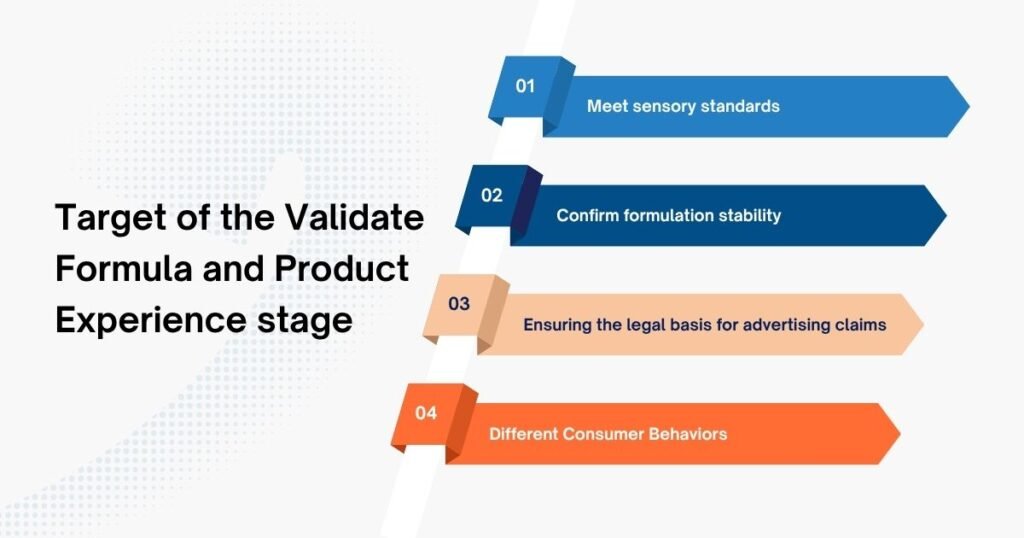
Once the concept is clear, R&D needs to develop a stable product sample along with initial accelerated test results. A sensory panel then evaluates the texture, absorption, and skin feel using a standardized process. The goal is to determine whether the product meets the established experience benchmarks, rather than relying only on the impressions of a few people in the lab.
At the same time, Marketing starts developing preliminary artwork and claims. Regulatory checks whether these claims have enough technical support before Marketing invests further in messaging that may need to be changed later.
Before Moving Forward
- The sensory panel score meets or exceeds the target benchmark.
- The 4-week accelerated stability results show no signs of phase separation or color change.
If Marketing finalizes the messaging before Regulatory confirms that the claims have sufficient support, the brand may have to redo a large part of its marketing materials later.
3. Confirm Product Safety and Production Readiness
Once the prototype is confirmed, R&D finalizes the formula and hands over the technical specifications for pilot production.
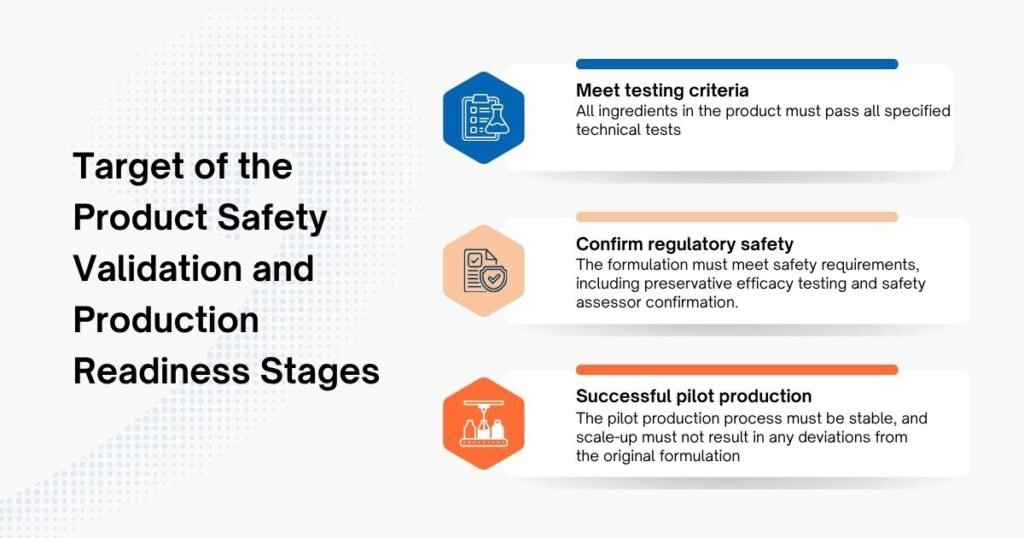
Regulatory oversees the safety testing required at this stage, including preservative efficacy testing and obtaining a safety confirmation from a safety assessor.
The Operations team checks the parameters during production scale-up to ensure that the pilot batch does not deviate from the sample approved in the previous stage.
Before Moving Forward
- 100% of the testing criteria are met for all ingredients.
- Pilot production successfully scales up without deviating from the original formula.
R&D and Regulatory often need to work through multiple rounds at this stage. One handoff does not mean that everything is finished. PM therefore needs to actively track progress, and the overall timeline should include enough buffer rather than assuming everything will go smoothly on the first attempt.
4. Align Regulatory and Commercial Readiness
Once the product is ready in terms of formula and safety, Regulatory completes the Product Information File (PIF) and submits the product notification in each country (for example, BPOM in Indonesia or HSA in Singapore).
Meanwhile, Marketing can start seeding the product to a small group to collect reviews and content from creators. PM also approves the final P&L before allowing mass production to begin.
Before Moving Forward
- There is a valid product notification receipt from the relevant regional regulatory authority.
- The seeding campaign reaches the target conversion rate.
Seeding does not necessarily have to wait until the entire regulatory documentation has been approved. Once the formula has been locked at the previous stage and is no longer changing, Marketing can run seeding in parallel while Regulatory waits for a response from the relevant authority. The condition is that the claims used in the seeding content have already been approved by Regulatory during the formula evaluation stage.
Many teams still wait for one task to be completed before starting the next. This approach can push back the launch date even when there is nothing wrong with the product itself.
5. Monitor Product Performance After Launch
After the official launch, the focus shifts from “preparation” to “monitoring.”
- PM and Marketing track sales velocity, conversion rate, and advertising spend efficiency during the initial period.
- Regulatory records post-market surveillance data and monitors adverse event reports if any occur.
- R&D continues to monitor the stability of subsequent mass-production batches rather than stopping once the first batch meets the required standards.
Before Moving Forward
- The product defect rate and Net Sentiment Score meet the set targets.
- The adverse event rate remains within the acceptable threshold.
At this stage, the three teams are monitoring three different groups of signals. What matters, however, is that the Product Team can compare these signals to understand what is actually happening with the product.
For example, a sudden drop in sales velocity could be caused by a quality issue that R&D has just identified, rather than simply being an advertising problem.
Continuously tracking sales data and reviews across e-commerce platforms through data-as-a-service solutions helps PM see these signals in one place, instead of having to combine data from separate reports from each department.
Final Thought
Validating a beauty product is not just about checking whether the product meets the requirements. More importantly, the Product Team needs to know when the product is ready enough to move forward and when it needs to stop and address an issue before launch. A clear process helps the team make decisions at the right time, reduce rework, and keep the launch plan on track while ensuring that the necessary conditions are not overlooked.
Leave a Reply