

Introduction: Why Web Scraping Ecommerce is Key to Business Success
Web scraping ecommerce turns information displayed on product and review pages into structured observations. It can support competitor-offer monitoring, catalog research and feedback analysis when the sources and fields fit the question. This guide explains how to plan a small collection, validate product variants and prices, and separate failed requests from changes in the market. A scheduled scrape is a snapshot, not a guarantee of complete or real-time coverage.
- Introduction: Why Web Scraping Ecommerce is Key to Business Success
- What is Web Scraping Ecommerce?
- Key Benefits of Web Scraping Ecommerce for Your Business
- How to Scrape Ecommerce Data for Business Growth
- Legal and Ethical Considerations for Web Scraping Ecommerce
- Conclusion: Leveraging Web Scraping Ecommerce for Business Success
What is Web Scraping Ecommerce?
Web scraping ecommerce means extracting information from e-commerce pages, such as product titles, displayed prices, visible availability labels and accessible reviews. The fields available depend on the website, selected variant, location, account state and observation time. Exact orders, net revenue and warehouse inventory often require authorized seller reports or a suitable API; they should not be inferred from a public listing or a rounded sales label.
Keep three layers separate: the value displayed by the source, your normalized value, and any estimate or interpretation made later. Preserve the source URL and collection timestamp so a reviewer can trace a result. Before building a scraper, check whether an authorized export, API or licensed dataset already provides the required fields and reuse rights. Collection automation still needs manual validation and maintenance when a source changes. If you are new to HTML extraction, the beginner Python exercise shows how to parse a small sample and report missing fields before using a live source.
Key Benefits of Web Scraping Ecommerce for Your Business
-
Competitive Price Monitoring
Compare the same product, seller, variant and pack size over time. Store currency, displayed price, delivery charges and conditional discounts separately. An advertised price change is useful evidence for review, but a crawl schedule determines when you observe it. Check the effective offer and your own margin constraints before changing a price; scraping does not identify an automatically optimal selling price. -
Market Trend Analysis
Track a defined sample of listings, visible availability and review activity using consistent category, geography and pagination rules. Report the sampling window and missing observations. Listing counts, review counts and rounded public sales labels measure different things; none automatically establishes exact demand, completed orders or net revenue. For interpretation limits, see the e-commerce data measurement guide. -
Customer Sentiment and Feedback
Use a stated review sample to identify topics such as sizing or packaging problems. Preserve product, rating, language and date context when available, and check automated labels against a human-reviewed sample. Reviews are self-selected and affected by sorting and moderation. The review-analysis guide explains why sample topic counts are not the opinions of every customer or proof of improved retention. -
Lead Generation
Permitted company and supplier directories can support a business shortlist. Define relevant company-level fields and deduplicate organizations before considering outreach. Public visibility of an email address or profile does not establish permission to reuse it or contact the person. Personal-data collection and marketing require their own applicable privacy and access review. -
Product Sourcing and Supplier Analysis
Compare advertised specifications, minimum quantities, delivery terms and visible availability across candidate suppliers. Treat reliability as a separate verification task involving suitable checks and, where appropriate, sample orders. A supplier listing cannot guarantee actual stock, fulfillment quality or future availability. Keep a failed page fetch separate from an observed out-of-stock label.
How to Scrape Ecommerce Data for Business Growth
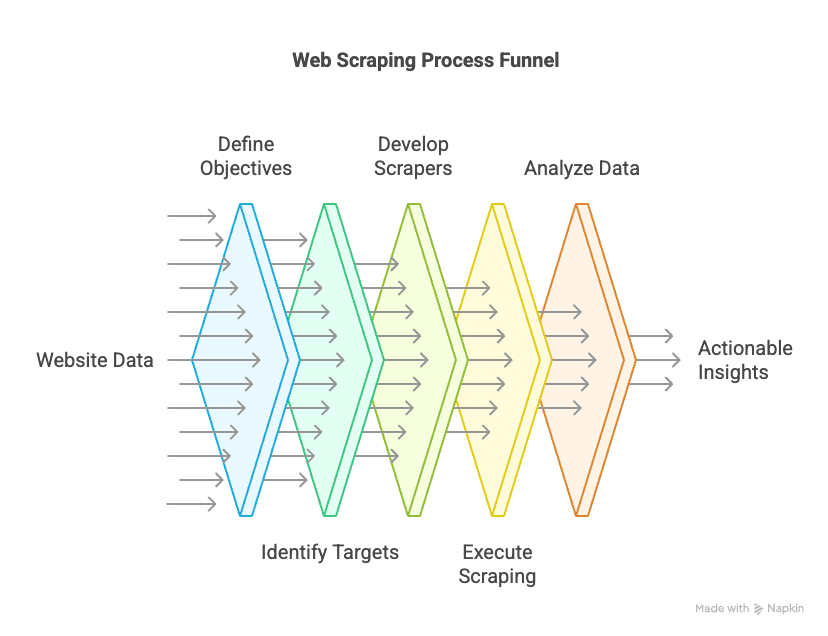
Begin with a decision and a small, permitted sample. The steps below produce a traceable observation dataset; they do not assume that every marketplace exposes the same fields or that a tool can access every page. For an Indonesian marketplace example, the Tokopedia collection guide separates public offer observations from seller-authorized records.
1. Choose the Right Scraping Tool
Select a tool after confirming which pages and fields the project needs. These tools serve different roles; their inclusion here is not a claim that they have been benchmarked against your target site:
- Scrapy: A Python crawling and extraction framework with request scheduling, selectors and feed exports. Suitable when a developer needs control over the workflow; page-specific extraction and validation still need to be implemented.
- Octoparse: A visual, no-code collection option. Test its workflow against your actual pages and required fields, and check current export, scheduling and plan limits before choosing it.
- ParseHub: A visual workflow tool whose click commands support interactions such as AJAX loading. Dynamic-page support does not guarantee complete extraction; test pagination, selected variants and missing values on the actual source.
- Beautiful Soup: A Python library for parsing HTML and XML. It processes the document supplied to it; fetching pages and handling browser interactions are separate parts of the workflow.
Compare the same small set of permitted pages across candidate methods. Check field accuracy, failed-request reporting, pagination coverage, export fidelity and the effort required after a page layout changes. Use an authorized API or export when it supplies the needed data more reliably. Do not choose a tool solely from its advertised speed or a successful first page.
2. Identify Your Data Sources
Define the target country, category, sellers, product types and observation window. Then confirm the meaning and accessibility of each required field on representative pages:
- Competitor websites: Advertised offers, promotion terms and accessible reviews. Record delivery destination and variant selection where they affect the result.
- Marketplaces: Listings and displayed fields vary by marketplace and market. Keep shop, item and variant identifiers where available. For Shopee, the collection scope guide separates visible observations from seller-only records and unsupported inventory assumptions.
- Social media: Only use sources and access methods appropriate to the project. A visible post or review is not complete audience analytics, and public personal information still requires a privacy assessment. Prefer permitted exports or documented APIs when suitable.
Write down the inclusion rules and known exclusions before collection. A search-results sample may be affected by ranking, personalization, geography and pagination limits. Retain the seed list or filters so that a later run can be compared with the same scope. If a required field is unavailable, change the source or question rather than filling it with an invented value.
3. Set Up Scraping Parameters
Agree on a field contract and the conditions under which a row is usable. A practical starting point is one row per seller-product-variant observation, with the collection time included in its identity:
- Data points: Define each field, its unit and whether it is required. Preserve raw price text alongside normalized amounts and an explicit currency. Keep product and variant identifiers as text; do not merge different pack sizes.
- Frequency: Choose an observation schedule the source permits and the business decision needs. Record the actual collection timestamp, missed runs and acceptable data age. A daily schedule does not guarantee every daily observation succeeds.
- Output format: Agree on CSV, JSON or spreadsheet delivery, including encoding, time-zone convention, missing-value representation and duplicate rules. Preserve identifiers exactly and keep an error report beside the accepted data.
For a first pilot, use a field contract such as the one below. It is an illustrative design, not a promise that every source supplies every field. Add or remove fields only after checking the source and the intended analysis.
| Field group | Validation rule |
|---|---|
| Source and identity | Keep source URL, market, seller, product and variant identifiers. A different variant or pack size is a different offer. |
| Observation time | Use an explicit time zone, such as UTC. Distinguish collection time from a review or listing publication date. |
| Price and currency | Keep the raw displayed value, normalized amount and currency. Reject ambiguous ranges or symbols for single-price comparisons. |
| Delivery and discounts | Keep shipping, tax treatment and voucher conditions separate. Mark unknown charges as unknown, not zero. |
| Availability | Preserve the displayed label. A missing label or failed request is not a verified stock quantity. |
| Row status | Distinguish accepted, missing required field, ambiguous value and collection failure. Retain reasons and counts for review. |
Keep a small reference set of pages with manually checked expected values. Include a single-variant offer, a multi-variant offer, a price range, a missing shipping charge and an unavailable item if the source provides them. Re-run these checks after extraction rules change; do not silently publish a partial or misaligned column as a successful delivery.
4. Run Your Scraper
Run the small reference set before scheduling a larger collection. Record attempted URLs, successful responses, usable rows, missing required fields and duplicate observations separately. Follow source request limits, use bounded retries for transient failures and pause when access is restricted. Scrapy’s AutoThrottle documentation describes delay and concurrency controls, but throttling does not itself grant permission or guarantee a source will accept requests. On repeated failures, investigate the cause instead of increasing request volume.
5. Clean and Analyze the Data
Validate the raw observations before analysis. Preserve original values, normalize units and currencies explicitly, and remove duplicates only according to the agreed observation key. Distinguish a repeated capture from a legitimate later observation of the same offer. Compare matched variants and the same delivery conditions; keep missing or ambiguous values out of calculations until resolved. The coverage and price-review example shows why a successful response is not automatically a usable comparison.
Illustrative check: the lower displayed price costs more. For the same seller, product variant and delivery destination, suppose an earlier offer is VND 120,000 plus VND 15,000 shipping, and a later offer is VND 115,000 plus VND 22,000 shipping. With no other charges or conditional discounts in this fictional example, the totals are VND 135,000 and VND 137,000. The displayed item price falls by 4.17%, but the comparable total rises by about 1.48%. A monitor that stores only the item price would produce a misleading cheapest-offer alert.
Calculate the change as (new value − old value) / old value × 100. Record which value the calculation uses: item price or comparable total. If shipping is unknown, tax treatment differs or a voucher is conditional, label the comparison incomplete rather than replacing the missing charge with zero. Check several accepted and rejected examples with a reviewer before connecting the dataset to a dashboard or pricing process.
Legal and Ethical Considerations for Web Scraping Ecommerce
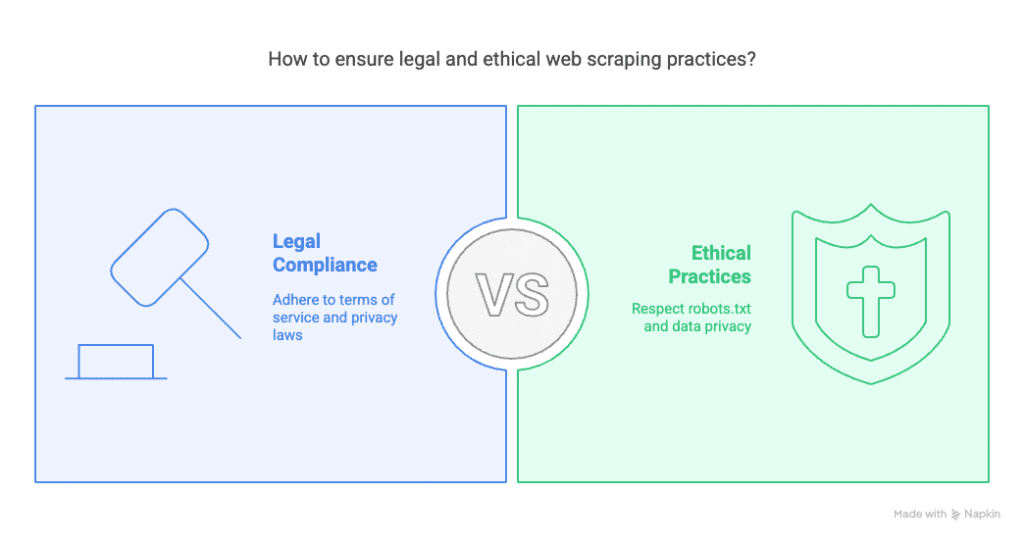
Access conditions, permitted reuse and privacy obligations must be checked for the actual source and project. Technical visibility alone does not determine permission. Seek appropriate advice where rights, personal-data use or jurisdictional requirements are unclear.
- Review Website Terms of Service: Review the source’s terms, API or export agreement and applicable reuse conditions. Obtain needed permission and respect access controls; do not treat an accessible page as permission to bypass a login or restriction.
- Respect Robots.txt: Honor crawler rules and request limits. RFC 9309 distinguishes robots rules from access authorization. Following robots.txt is one part of responsible collection, not proof that all collection and reuse is permitted.
- Data Privacy: Minimize personal information and document the collection purpose, retention and access arrangements. The joint statement from privacy authorities explains that public personal information remains subject to privacy laws in most jurisdictions. Review collection and outreach separately; the requirements depend on the project.
Conclusion: Leveraging Web Scraping Ecommerce for Business Success
Web scraping ecommerce is useful when a defined, traceable observation can support a business decision. Start with suitable access and a small checked sample, preserve identities and timestamps, and report coverage and failures alongside the dataset. Scale only after the fields, maintenance effort and validation results meet the project’s agreed requirements. Collection alone does not establish demand, supplier reliability or business growth.
For a project brief, use the Easy Data service overview and specify the marketplace, country, target pages, required fields, schedule and delivery format. Confirm which fields can actually be supplied and how exceptions will be reported before agreeing to a recurring collection.
Technical references
Leave a Reply