

The Southeast Asian beauty market is still growing. But if you’re finding it harder to sell and the cost of acquiring a new customer keeps rising, the problem may not necessarily be your product or how you run your store. The category you’re selling in may have become oversaturated.
So how can you tell whether this is a market-level problem or an issue specific to your business? Easy Data breaks down 7 common signs of an oversaturated beauty category so you can compare them with your own business performance and identify where the problem lies.
What Does Beauty Category Saturation on E-commerce Actually Mean?
Beauty market saturation does not mean consumers have stopped buying beauty products. It means more and more brands and products are entering the market while customer demand is not growing at the same pace.

When a niche has too many sellers, launching new products also becomes easier with the help of OEM/ODM manufacturers. More products start to have similar formulas, benefits, and positioning. Brands therefore have to compete for the same customer base through advertising, promotions, and pricing, making it increasingly expensive to sell.
The result is that the same product becomes harder to stand out, selling costs increase, and profit margins shrink.
Signs Your Beauty Category Is Becoming Oversaturated
You can identify an overcrowded category through more than just the number of competitors. Competitive pressure also shows up in the beauty KPIs and customer behavior your business sees every day.
Compare your business against the 7 signs below. If you’re seeing most of them, it may be time to reassess the level of competition in your category instead of continuing to optimize individual campaigns or products.
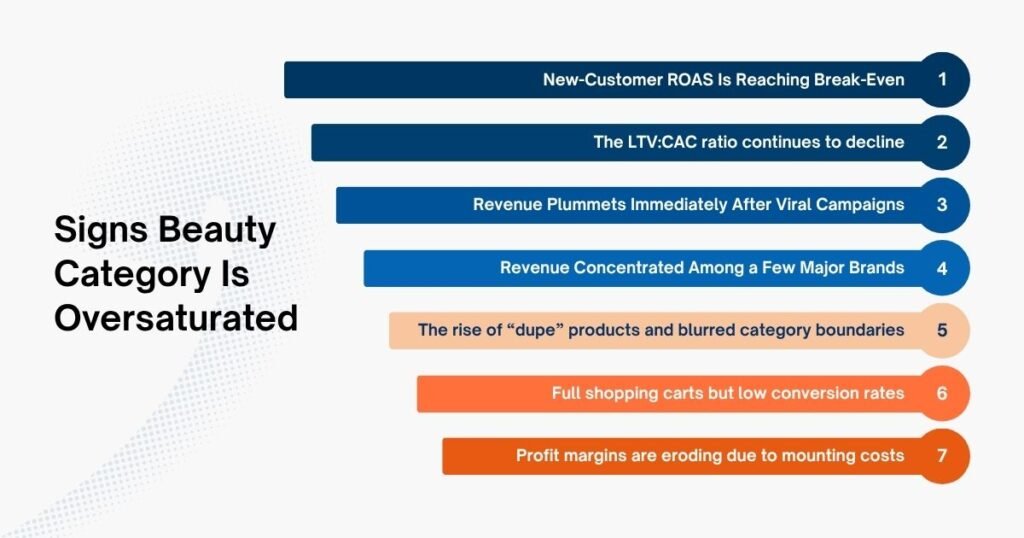
Sign 1: New-Customer ROAS Is Reaching Break-Even
What it looks like: The cost of acquiring a new customer is increasing, but revenue from these customers is not growing at the same rate.
When multiple beauty brands target the same customer base on Meta, TikTok, or Google, advertising competition can increase and drive up acquisition costs. This is where you should check your Break-even ROAS:
Break-even ROAS ≈ 1 ÷ Gross Margin
| Gross Margin | Break-even ROAS |
| 50% | 2.0x |
| 55% | ~1.8x |
| 60% | ~1.7x |
If ROAS from cold traffic consistently reaches or falls below your break-even threshold, even after you’ve optimized your campaigns, creative, and targeting, the problem may no longer be limited to advertising. Customer acquisition costs may be rising because the category itself has become more competitive.
At the same time, check your Marketing Efficiency Ratio (MER) to assess marketing performance across all channels. If channel-level ROAS remains relatively stable while overall MER continues to decline, you’re spending more to generate the same amount of revenue. This could be a sign that more brands are competing for the same customer base.
Sign 2: Customers Are Becoming Less Loyal to a Brand
Customers are increasingly likely to switch from one brand to another because of TikTok trends, KOLs, or deals. A product may sell extremely well while it’s trending, but a few weeks later, customers may have moved on to another product or brand.
More importantly, demand for beauty products may also decline as trends such as de-influencing and underconsumption-core become more prevalent.

If these behaviors are becoming more noticeable in your niche, try comparing RPR across two groups:
- Trend-driven products: Treatment serums, seasonal makeup…
- Products with regular usage demand: Facial cleansers, sunscreens…
If the RPR of trend-driven products is significantly lower and the gap is widening, customers may be buying because of a trend or a specific product, rather than coming back because they want to continue buying from the brand.
You should also check LTV:CAC to understand how much value a new customer generates over time relative to the cost of acquiring them.
There is no single LTV:CAC benchmark that works for every business because each brand has different margins, retention, and CAC. What matters more is the direction the metric is moving. If LTV:CAC keeps declining while CAC rises, the cost of acquiring a new customer is becoming increasingly difficult to recover.
Sign 3: Sales “Hit Bottom” After Every Viral Campaign
Many brands see GMV spike through livestreams or affiliate marketing and assume they’re experiencing real growth. But if sales quickly return to their previous level once the campaign ends, it may only be a short-term growth spike.
How to check: Track your customer return rate after cutting seeding budgets or affiliate commissions. If the rate drops sharply almost immediately (faster and more deeply than a normal seasonal decline), customers may be buying because of deals and FOMO rather than genuine brand loyalty.
Sign 4: Revenue Is Increasingly Concentrated Among a Small Group of Large Brands
As the Beauty category becomes saturated, a large share of revenue may gradually concentrate among a few major brands, making it harder for smaller sellers to gain market share. Look at your category across e-commerce marketplaces: how much revenue do the top brands account for? Is that share increasing over time?
How to check: Compare the market share of the top brands with the rest of the category across different periods. If market share is becoming increasingly concentrated among a small number of large brands while organic traffic for indie brands remains largely unchanged, this is a sign that you’re competing in a category where traffic and revenue are already concentrated among a small group of sellers.
Sign 5: Products Are Becoming Increasingly Similar
As OEM/ODM manufacturing becomes more accessible, more brands can launch products with fairly similar formulas, ingredients, and benefits.
For shoppers, this contributes to dupe culture – the behavior of actively looking for products with similar ingredients or benefits at a lower price. When customers start comparing your product with dupes instead of focusing only on the brand, pricing power can also be affected.
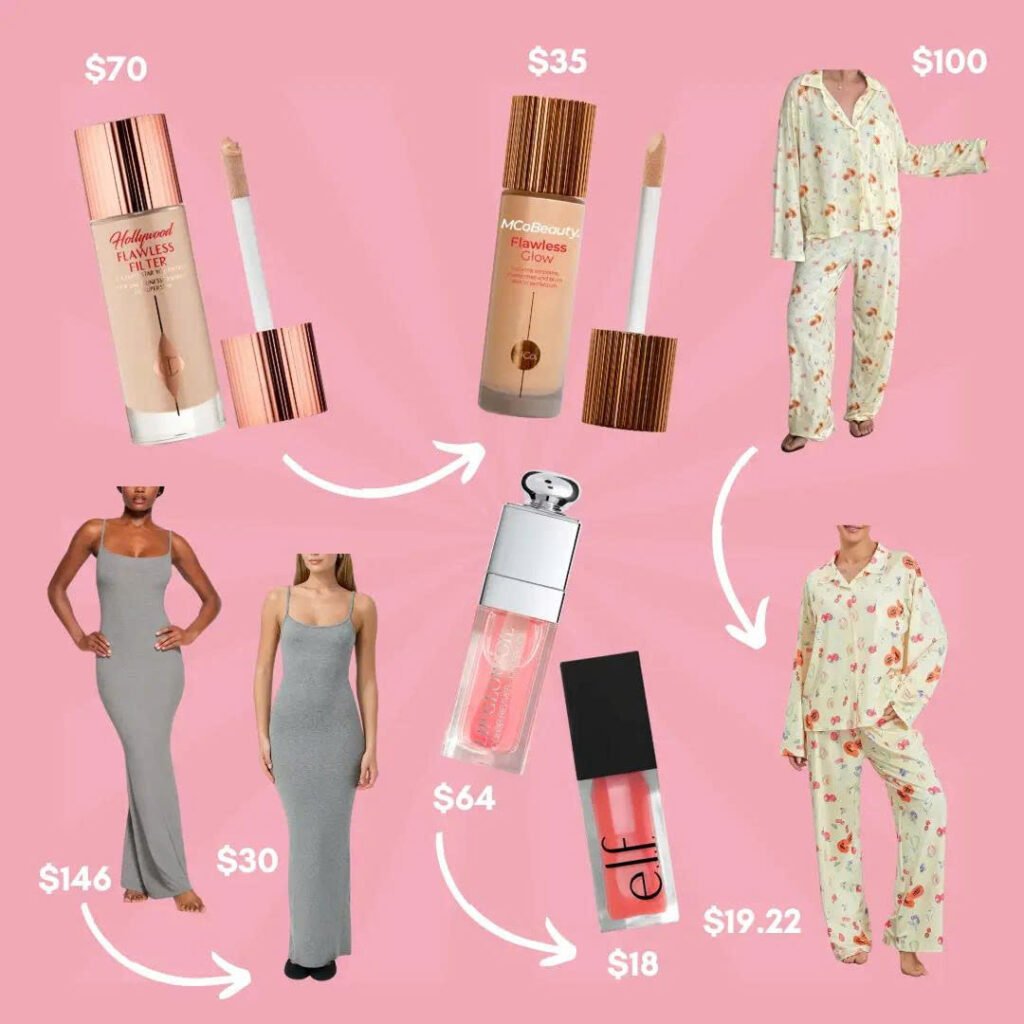
Another form of competition comes from skinification: categories outside skincare are starting to use language and positioning traditionally associated with skincare. For example:
- Shampoo talking about “scalp barrier protection”
- Body wash emphasizing “pH-balanced” formulas
- Lip balm highlighting “lip skin repair”
As more categories use similar messaging, the boundaries between niches become less distinct, making differentiation more difficult.
How to identify it: Look at your own hero product. If a Niacinamide serum or Centella facial cleanser has an ingredient list and benefits that are difficult to distinguish from dozens of other products on the same marketplace, your product may have become easier to replace. In that case, better quality alone may not be enough to maintain a higher price, and pricing power will depend more on your brand, positioning, and other values beyond the formula.
Sign 6: Carts Are Full, but Orders Aren’t
When there are too many products that are almost identical, customers have plenty of reasons to add products to their carts without necessarily deciding to buy right away.
What it looks like: the Add-to-Cart rate remains relatively high, but a large share of carts does not convert into orders. If the gap between these two metrics keeps growing, it’s a sign worth paying attention to.
One common reason is that customers use their carts to compare prices across marketplaces, then look for vouchers or the best available price before making a purchase. If this happens more frequently, the problem may not only be the checkout experience. When customers have too many similar choices and can easily compare prices across sellers, moving from “want to buy” to “placing the order” also becomes harder.
Sign 7: Profit Margins Are Disappearing Under Layered Costs
As products become harder to differentiate, brands may increasingly have to compete through pricing, affiliate commissions, and promotions to maintain sales.
In this situation, try adding up the costs per order: platform fees, affiliate commissions, marketplace advertising, shipping subsidies, and operating costs. Depending on the category and marketplace, these costs can account for a significant share of an order’s revenue.
If you have to keep adding more vouchers or deeper discounts to stay competitive, Net Contribution Margin can quickly shrink toward zero or even turn negative. Revenue can still increase, but each order brings in less and less profit. If this continues across the category, it may be a clearer sign of market saturation.
Is the Category Saturated or Is It an Operational Problem?
A business performing poorly does not necessarily mean the market is saturated. You may be blaming the market when the real issue lies in how your store is operated, such as slow page load times, creatives that aren’t engaging enough, or uncompetitive pricing.
To distinguish between the two, compare your business’s e-commerce analytics with those of competitors in the same niche. The key is to see whether the problem is specific to your business or happening across the category.
| Measurement | Warning Sign: Market Saturation | Warning Sign: Internal Execution Issue |
| Acquisition Cost (CAC/CPM) | CPM and CPC are increasing across the category, not just for your business; competition for the same advertising keywords is also higher than before. | CAC is increasing, but your CTR is significantly lower than competitors in the same niche → the issue may be with creative or targeting. |
| Conversion Rate (CVR) | CVR is declining across multiple channels, including high-intent channels such as direct search. | Overall CVR is being pulled down by a specific channel, such as Paid Social bringing in low-quality traffic or an under-optimized landing page. |
| Funnel Drop-off Point | ATC remains high, but cart abandonment is also unusually high → customers may be using their carts to compare prices across marketplaces. | Customers leave the page almost immediately, sometimes without adding to cart → check page load speed and the mobile experience. |
If your metrics lean toward “Internal Execution Issue,” don’t rush to change products or leave the niche. Optimize your store first, from traffic and creative to the buying experience.
Read more: Why Your Beauty Products Aren’t Selling on Shopee (And How to Fix It)
If the problem is genuinely “market saturation,” the pressure won’t only show up in sales. Pricing power and profit margins can also be eroded over time.
As brands become increasingly dependent on inventory clearance, vouchers, and discounts, they may gradually lose pricing power and weaken brand equity. Customers may also develop a habit of buying only during flash sales or mega-sale events.
Revenue can still increase, but profit per order declines. To maintain the same level of sales, the business will have to spend more on promotions and advertising.
How to Compete in an Oversaturated Beauty Category
If you’re selling in an oversaturated beauty category, your brand doesn’t necessarily need to leave the category. What may need to change is how you identify demand, build loyalty, and create differentiation. Here are 4 approaches to consider.
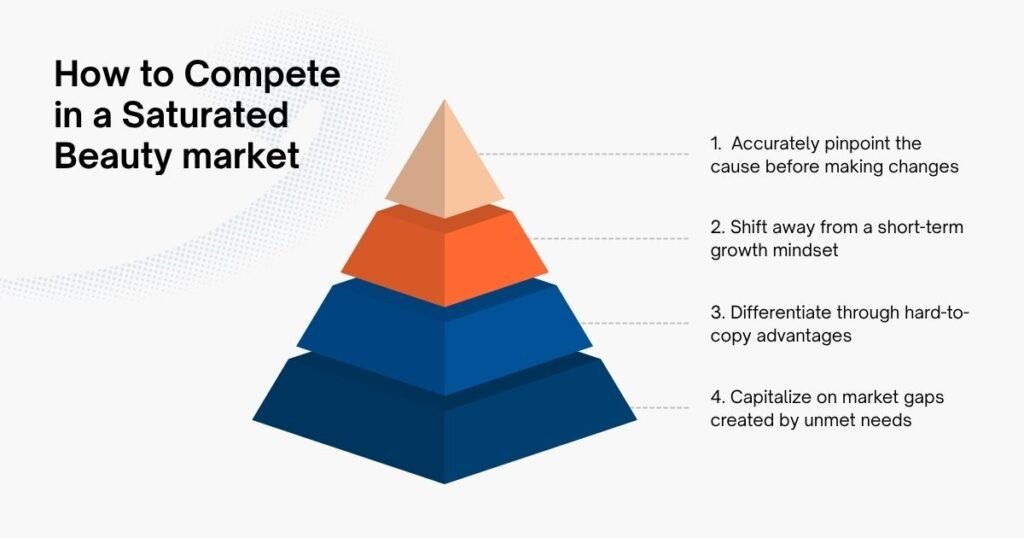
1. Find Underserved Needs Using Market and Review Data
As products within the same category become increasingly similar, start with what customers are still unhappy about. Analyzing e-commerce market data and review data from marketplaces can reveal recurring complaints, unmet needs, and market gaps that competitors haven’t focused on.
For example, if many customers complain about the same issue but existing products still don’t address it well, that could be a gap worth researching further.
Read more: Guide to Identifying Beauty Market Opportunities Using Data
2. Build Customer Loyalty Instead of Chasing Reach
The more brands selling the same type of products, the easier it is for customers to switch to another option. If your product doesn’t have a clear difference in price, benefits, or experience, a better deal from a competitor can also pull customers away.
At this point, brands should track customer retention, repeat purchase, and brand loyalty to understand whether customers are actually coming back or simply buying once and leaving. A group of customers who return regularly can also help the brand gradually reduce its dependence on promotions and paid traffic to generate sales.
3. Build Your Brand Around a Signature or Hero Product
If your portfolio contains too many products similar to those of competitors, your brand can easily end up competing on price, promotions, and visibility. Every product needs advertising, deals, and a fight for visibility on the marketplace.
A hero product can help your brand focus its resources on one product that truly represents the brand. From there, the brand can build more consistent positioning, content, and identity instead of splitting its budget and resources across too many products at once.
4. Differentiate Through Advantages Competitors Can’t Easily Copy
In a commoditized beauty category, differences in formulas or product features may no longer be enough to protect a brand if competitors can quickly create similar products. At this point, competitive advantages need to be built around things that are harder to copy.
These could include brand positioning, product philosophy, sourcing, sustainability, or customer experience. These factors may not necessarily make the product look different on an ingredient list, but they can give customers a clear enough reason to choose your brand over a similar product.
Final Thought
Operating in an oversaturated beauty category means that growing through similar products, paid traffic, and promotions is becoming increasingly difficult and expensive.
Before changing products or leaving the category, identify whether the pressure is coming from execution or the market itself. If competition is already too high, brands can differentiate, reposition, or look for an underserved market segment. Unmet customer needs may be the gap that helps a brand find a new path to growth.
Leave a Reply