

Orders are slowing down, traffic is declining, or traffic is still coming in but conversion rates are lower than before. These are situations many beauty sellers are facing on Shopee. The cause may not necessarily lie in product quality. This article will help you understand the market changes that are making beauty products harder to sell on Shopee, while also narrowing down the actual problem your shop is facing so you know where to start fixing it.
Why Are Beauty Products So Hard to Sell on Shopee?
Not every reason why your beauty products aren’t selling on Shopee comes from the products themselves. The beauty market on Shopee is highly competitive and changes quickly. The pressure sellers face can come from how customers are shopping for beauty products, the competitive structure on Shopee, and the level of trust a shop creates.

Beauty Shopping Is Changing From Search-Led to Discovery-Led
For many years, Shopee has primarily operated on a search-led model: customers have a need, type in a keyword, compare prices and reviews among the top results, and then decide what to buy. This model still works well for many categories, but in beauty, this way of shopping is gradually revealing its limitations, especially for new brands that have not yet built strong awareness.
High-intent keywords in the beauty category are becoming increasingly competitive as large brands with strong budgets are willing to pay higher CPCs to secure visibility. For smaller brands, continuing to compete this way can push advertising costs to a point where they are no longer effective.
At the same time, shopping behavior is shifting toward a discovery-led model. Instead of starting with an existing need, customers may come across a product while consuming entertainment content, then be persuaded by a demo video, livestream, or brand story. TikTok Shop is a typical example of this model. But even Shopee is increasingly promoting Shopee Video and Shopee Live to accommodate this way of shopping.
For beauty, discovery-led shopping is particularly suited to product characteristics that a static product image struggles to convey, such as how a product looks on the skin, the smoothness of its texture, or the actual experience of using it.
More Competition and Stronger Official Stores
Alongside changes in shopping behavior, the competitive structure on Shopee is also creating more advantages for verified stores.
Shopee Mall and Official Store have advantages in visibility, recognition, and trust signals directly on the listing. These are advantages that standard or unverified shops can find difficult to obtain, even when their products are high quality.
In return, Shopee Mall has a different commission structure from standard shops, and these fees vary across markets in the region. For example:
- Singapore: Shopee Mall commission rates for the Beauty & Personal Care category can reach around 15%, higher than the standard rates for regular shops, at around 7.6–12%.
- Vietnam: In some cases, the relationship can be reversed. Mall fees for beauty products can be lower than standard fees, around 6–8% compared with 10% for regular shops, when Shopee applies preferential policies to encourage official brands to move to Mall.
Therefore, there is no single commission rate that applies across the region. Brands operating across multiple markets need to check the fee structure for each country. Platform fees can also change through periodic adjustments, making it increasingly risky to price products based only on product cost.
Trust Is a Bigger Barrier for Beauty Sellers
Beauty products are applied directly to the body, so buyers are generally more sensitive to issues around safety, product origin, and counterfeit products. On Shopee, this is reflected through different signals of how trustworthy a shop is.
Shopee’s Three Trust Tiers:
- Shopee Mall (blue badge): Shopee Mall requires a registered legal entity and a commitment to product authenticity. In return, these stores have advantages in visibility and trust signals throughout the customer’s search and purchase journey.
- Preferred / Preferred+ (orange badge): These are shops that generally meet higher operational standards, such as chat response rates, shop ratings, and late delivery or cancellation rates. Specific thresholds can vary by market. For example, Singapore requires a minimum chat response rate of around 85%, while the equivalent program in Indonesia, known as Star Seller, only requires around 55%, along with a minimum rating of 4.3 stars.
- Standard (no badge): Most new or independent shops may fall into this group. Traffic can still be high through advertising, but conversion can be affected by a trust barrier: customers see the product but may still hesitate because the shop does not have many verification signals.
Regulatory Enforcement Is Raising the Bar for Trust
Alongside competition for visibility and trust on the platform, regulators in many SEA markets are also increasing controls on cosmetics with unclear origins or products that have not completed the necessary declaration requirements.
This has a two-sided impact: it helps protect official shops from unfair competition from unregulated products, while also meaning that a brand’s own products may be subject to review if its documentation is incomplete.
Each country has its own regulatory authorities, requirements, and procedures, and regulations can change over time. Therefore, when selling in a new market, brands need to consider the requirements of that specific market.
How to Diagnose Why Your Beauty Products Aren’t Selling on Shopee
Market changes can explain why selling beauty products on Shopee has become more difficult. But to know exactly where your shop is facing problems, you need to look at the data to narrow down the possible causes. The fastest way is to start with the beauty ecommerce KPIs that are deviating from normal levels, then work backward from symptoms to causes.
1. Traffic Is Coming In, But It Isn’t Efficient
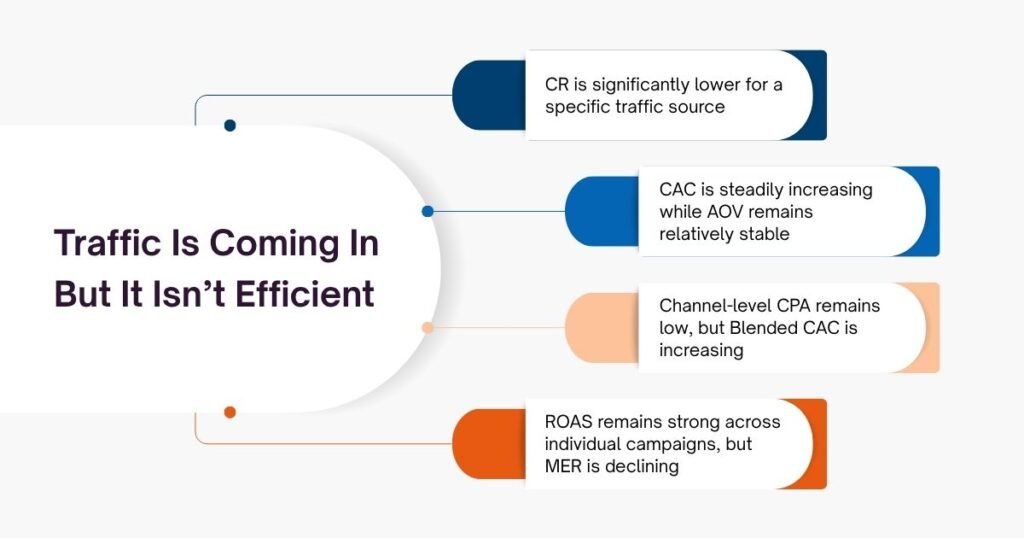
If you are still getting traffic and continuing to put in budget but orders are not increasing proportionally, start with these four metrics:
- Conversion Rate by Traffic Source: If Conversion Rate is significantly lower from one specific source, such as CR from Shopee Ads being much lower than organic search, the issue may lie in targeting, creative, or the quality of traffic from that source, rather than the entire shop.
- CAC: If CAC increases month after month while AOV remains relatively unchanged, the cost of acquiring a new customer is getting higher. In a search-led environment that is becoming increasingly competitive, this may be a sign that you are paying more to reach the same customer group.
- CPA vs. Blended CAC: If CPA remains low on individual channels but Blended CAC increases, check for costs that are not included in the CPA of each platform, such as KOC, agency, or content production costs. The difference can also occur when organic traffic declines, forcing the business to rely more heavily on paid traffic to generate orders.
- Blended MER: If you check individual campaigns and still see good ROAS but Blended MER is declining, the issue may lie in marketing efficiency at the overall business level. A common situation is that the same order is recorded as a conversion by multiple platforms, while the business only has one actual revenue transaction. In this case, the ROAS of each platform may look better than the actual marketing efficiency of the business as a whole.
2. You Have Traffic, But Customers Aren’t Converting
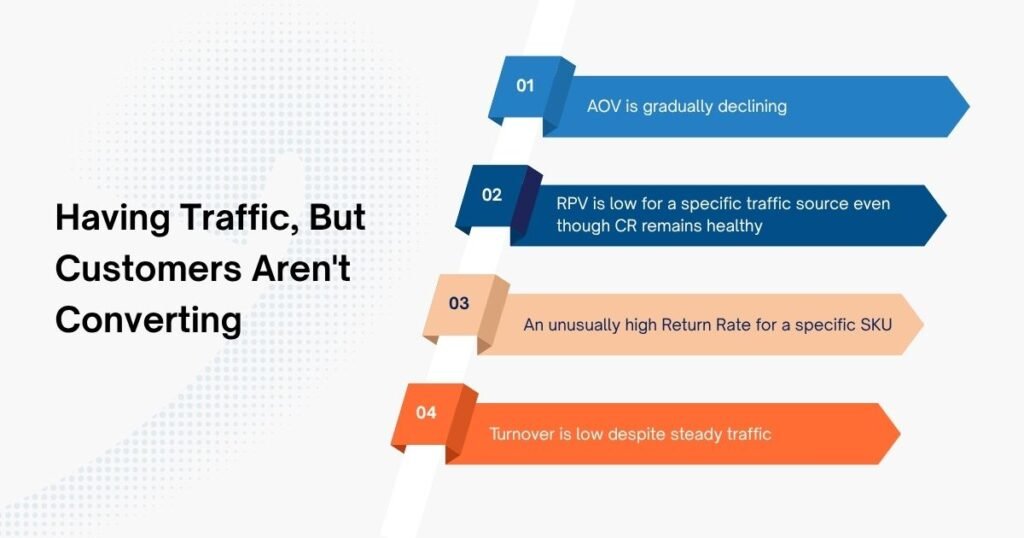
If traffic remains stable but conversion rates are declining, move on to KPIs that reflect order value, product experience, and the ability to sell existing inventory.
AOV
If AOV is declining over time, check whether vouchers, discounts, or promotional programs are pulling down the average order value. Discounts can help conversion in the short term, but if AOV declines while customer acquisition costs do not, the margin on each order will come under greater pressure.
Revenue per Visit
If Revenue per Visit is low for a specific traffic source even though Conversion Rate remains stable, the issue may not be conversion. Customers are still buying, but each visit is generating less value. In that case, look further into AOV and the product mix being purchased by customers from that traffic source.
Return Rate by SKU
If Return Rate is unusually high and concentrated in one SKU, check that SKU specifically instead of looking only at the Return Rate for the entire shop. The issue may come from insufficient product information, such as missing swatch images or incomplete shade information. But it may also be directly related to the product experience.
This is an important point in deciding whether to optimize the listing, adjust the product, or reconsider continuing to push that SKU.
Inventory Turnover
If Inventory Turnover is low while traffic remains steady, do not immediately conclude that customers have no demand. Check inventory status by SKU and variant. Customers may still want the product, but your shop could be out of popular sizes, shades, or tones, while less-preferred variants remain in stock.
3. You Are Selling, But the Business Isn’t Sustainable
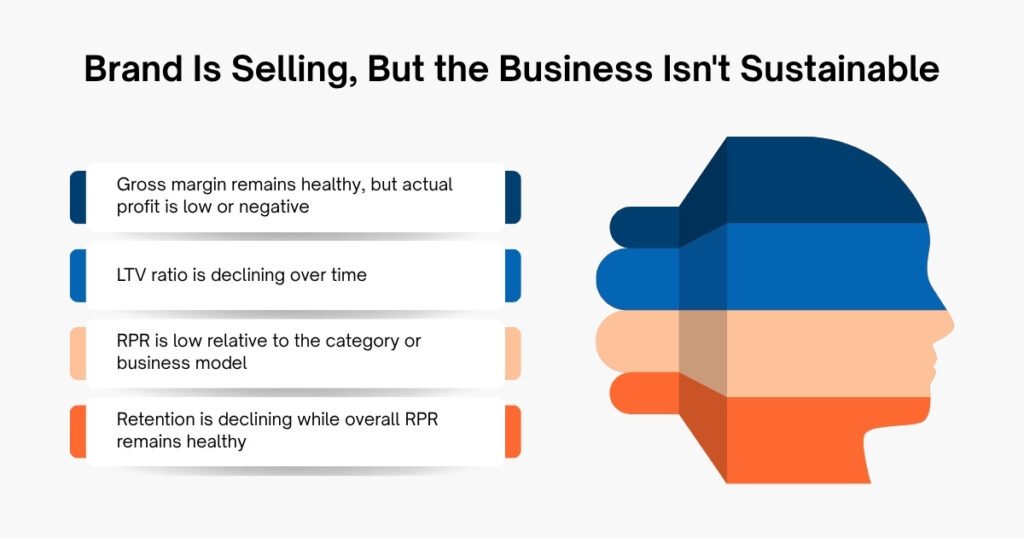
This is the hardest situation to recognize. The shop is still getting orders and revenue is still growing, so everything may look fine on the surface. But if acquisition costs are increasing, fewer customers are returning, or margins are getting thinner, higher revenue does not necessarily mean sustainable growth.
Gross Profit Margin
If Gross Profit Margin is still healthy but actual profit is close to zero or negative, review the entire cost stack. Platform commissions, payment fees, advertising costs, and the costs of participating in platform programs can continue to eat into gross margin, depending on the market and the level of participation of each shop.
This is why pricing based only on product cost can cause sellers to misjudge actual profitability. Before changing prices or continuing to scale, map out all costs associated with each order.
LTV Ratio
If LTV Ratio declines, the ability to recover acquisition costs is weakening. Don’t just look at CAC; also check whether customers return and how much value they generate throughout their relationship with the shop.
If CAC increases but LTV does not increase accordingly, continuing to scale acquisition can put greater pressure on unit economics.
Repeat Purchase Rate (RPR)
If RPR is significantly lower than what is appropriate for the category and business model, check the likelihood of customers returning to purchase.
For beauty, the cause does not necessarily lie in traffic or price. It may be related to the post-purchase experience, how the product is used, customer expectations, or the brand’s ability to stay connected with customers after their first purchase.
Customer Retention Rate
If Customer Retention Rate is gradually declining while overall RPR still looks healthy, this may indicate that the quality of new customers is changing.
RPR calculated across the entire customer base can remain healthy because of accumulated loyal customers. Meanwhile, Retention Rate by period provides a clearer view of whether customers acquired more recently continue to return.
Therefore, these two metrics should be read together to better understand whether the issue lies in repurchase ability in general or the quality of the new customer group.
What Should You Do After Finding the Problem?
Each problem requires a different approach. Once you have identified the problem area from the KPIs, the next step is to look deeper to understand where the actual cause lies and how significantly it is affecting the shop.

If Trust Is the Problem
Shops that are not yet eligible for Mall can start by adding more evidence of authenticity directly to their listings. For example, in Singapore, Shopee requires sellers to enter the HSA (Health Sciences Authority) notification number in the product attributes before selling cosmetics. Similar requirements also exist in other markets, but the procedures and regulatory authorities may differ.
At the listing level, shops can add more signals that help customers verify the product themselves:
- Clearly display the product notification/registration number if permitted by the platform and the market’s regulations.
- Use videos or real product images showing the anti-counterfeit label, batch number, and product packaging.
- Encourage customers to leave reviews with real photos/videos after receiving the product.
These signals can help reduce customer hesitation, especially for products applied directly to the skin and body.
In the long term, shops should also aim for seller tiers such as Preferred/Preferred+, as platform badges create an additional layer of trust that shops may find difficult to build through listings alone.
If Competition Is the Problem
Data may also show that the problem lies in direct competition, such as competitors offering better prices, stronger listings, or capturing more traffic. In this case, instead of focusing only on optimizing your own shop, you should analyze Beauty competitors on Shopee to understand where you are falling behind and how large the gap is.
If Your Category Is Oversaturated
In some cases, the problem is not specific to your shop but comes from an oversaturated Beauty category, with too many sellers and increasingly intense competition. In that situation, you need to expand the scope of analysis to the broader market to examine the number of competitors, traffic concentration, price levels, and the brands that are dominating the category.
If Your Price Is Being Undercut
Consistently lower selling prices can also be a sign that needs to be investigated, especially when a category has many parallel-import products or unofficial resellers. Don’t just adjust your own selling price. Combine competitor and seller price tracking for the same or comparable products to understand where your current price sits in the market.
If You Need Continuous Benchmarking
A one-time analysis can tell you where your shop stands at a given point in time. But if you only check when sales start declining, it will be difficult to know how the gap with competitors has changed over time.
For brands that need to monitor the market over the long term, benchmark regularly against a fixed group of competitors. When data is tracked across multiple points in time, you can identify changes that a single analysis may not reveal: whether competitors are accelerating or slowing down, whether the price gap is widening or narrowing, and how the brand’s position in the category is changing.
Final Thought
There are many reasons why Beauty products aren’t selling on Shopee. The problem may lie within the shop itself, come from market changes, or result from competitive pressure.
To understand where the actual problem lies, internal data needs to be viewed in the context of market and competitor data. Looking at all three perspectives gives brands a clearer basis for identifying the cause and knowing where to start fixing it.
Leave a Reply