

Most beauty brands find their next best-selling product through luck rather than a structured analytical process. They come across a trend going viral on social media or see a competitor selling a particular product category successfully, then quickly try to replicate it. By the time the product officially launches, that market gap has often already been filled.
In this article, Easy Data will walk you through a process for using real-world data from Shopee, Lazada, and TikTok Shop to identify market opportunities. The process can be applied across different categories, helping turn data into validated opportunities rather than ideas based only on observation or intuition.
What Really Counts as a “Market Opportunity” in Beauty?
Many product teams see a Beauty market opportunity as an ingredient that is getting a lot of attention, a new product format, or a KOL who has just sparked a wave of interest. These are all useful early signals to monitor, but they are not enough to make an investment decision for R&D and production.
To determine whether a signal is truly a market opportunity, you need to validate it with data. The goal is to assess whether purchase demand actually exists, whether it is large enough, and whether there is still enough room for it to develop into a successful product.
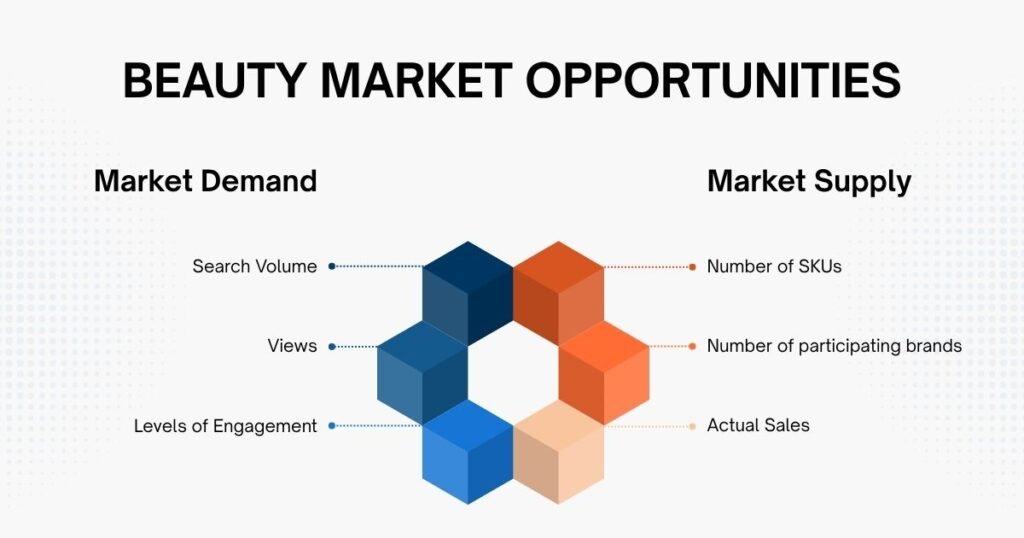
This assessment is always based on two groups of data:
- Market demand: search volume, views, or levels of engagement.
- Market supply: number of SKUs, number of participating brands, and actual sales.
When demand grows significantly faster than supply, there is still room for a new brand to enter the market. Conversely, when both grow at a similar rate, the market has usually entered a stage where competition is primarily driven by price and advertising budgets.
4-Step Process for Using Data to Identify Beauty Market Opportunities
After identifying noteworthy signals in the Beauty market, the next step is to validate them with data. The process below consists of four steps to help you assess whether a signal truly reflects a market opportunity or is simply a short-term trend, reducing risk before bringing a product to market.
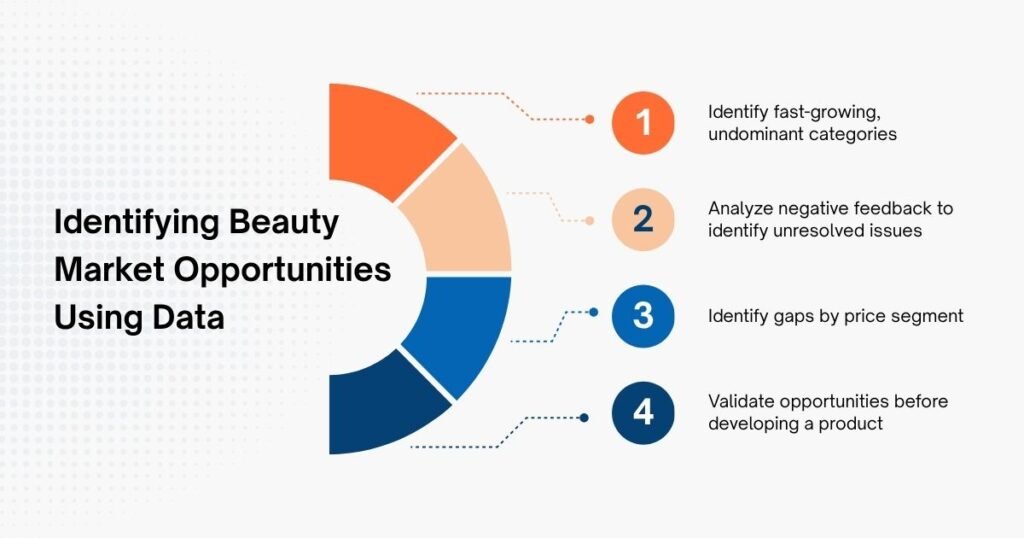
Step 1 – Screen for Fast-Growing Categories That Are Not Yet Dominated
The goal of the first step is not to find a product, but to identify the right category. Start by screening subcategories on Shopee, Lazada, and TikTok Shop that have higher GMV growth rates than the overall market. Then, assess market concentration by looking at what percentage of the subcategory’s sales is held by the leading brands.
If just a few brands already hold most of the market share, the opportunity for a new business is fairly limited, even if the category is still growing quickly. On the other hand, subcategories with high growth rates but fragmented market share are often worth watching more closely, as no single brand has yet become the clear preferred choice among consumers.
At this stage, you should track three groups of data at the same time:
- Google, Shopee Search, and Lazada Search data.
- Trend and reach data from TikTok and Instagram.
- Actual GMV and sales volume data from e-commerce marketplaces.
Relying on just one data source can easily lead to a distorted assessment. For example, a sharp increase in search volume does not necessarily mean that actual purchase demand is also increasing. In Southeast Asia, the beauty shopping journey often starts with content on social media but ends with a transaction on an e-commerce marketplace. Only by combining trend data with actual sales data can you accurately assess the potential of a market opportunity.
Step 2 – Analyze Negative Reviews to Find Unresolved Market Problems
Analyzing 1–3-star reviews of the best-selling products in your industry is another way to identify potential market opportunities. You can do this manually if the number of reviews is manageable, or use natural language processing tools when you need to analyze data at scale.
Many brands overlook this step because it can be time-consuming. However, negative reviews are one of the most valuable sources of insight because they directly reflect the problems customers experience after purchasing and using a product.
For example, some common issues found in the beauty industry in Southeast Asia include:
| Customer Problem | Product Improvement Opportunity |
| Sunscreen leaves a white cast, feels sticky, or makes the skin feel congested | Develop a texture that is better suited to hot and humid climates |
| Vitamin C serum oxidizes, changes color, and becomes less effective | Improve formula stability |
| Packaging leaks or gets damaged during transportation | Optimize packaging design and product protection |
These reviews do more than show where customers are dissatisfied. They also help businesses identify areas for improvement during R&D, from product texture and active ingredient stability to packaging design. These are also the gaps that competitors may not have solved well yet.
Alongside analyzing customer feedback, you should also compare how competitors are positioning their products in the market. If you want to explore this process in more detail, you can refer to Analyzing Beauty Competitors on Shopee.
Step 3 – Find Gaps by Price Segment
After identifying unresolved market problems, the next step is to assess which price ranges still have room for new product opportunities.
Divide the entire category into different price segments, then compare the total GMV of each segment with the number of SKUs competing within the same price range. A market gap typically appears when:
- High GMV but a limited number of competing SKUs: this indicates that demand has already been proven, but supply has not fully met it.
- Many competing SKUs but low sales: this often indicates that the market is already saturated or difficult to differentiate in.
In many markets such as Vietnam, Thailand, and the Philippines, this gap often appears in the mid-range segment. This is a price point where consumers can afford the products and expect reliable quality, but there are still relatively few brands that truly meet their needs well.
Step 4 – Validate the Opportunity Before Developing the Product
When many Beauty brands identify a potential opportunity, they are eager to move quickly into product development. However, not every signal that grows rapidly is sustainable enough to become a long-term business opportunity.
Before making a decision, check the following four factors one by one:
1. Is the trend truly sustainable?
Track the search trend over a period of 6–12 months.
- Sustainable trend: Search volume grows steadily or remains consistently high.
- Short-term trend: Search volume spikes and then drops sharply, often by more than 70%, after media campaigns end.
2. Are customers actually coming back to buy?
Alongside views or virality, track how often the phrase “repurchase” appears in customer reviews. Products that solve core needs, such as repairing damaged skin or reducing hair loss, tend to have higher repurchase rates than products purchased mainly because they are trending.
3. Is the market large enough?
Before confirming the opportunity, make a quick estimate of:
- The size of the category on e-commerce marketplaces in the countries where you want to operate.
- The percentage of market share the business can realistically capture during its first 1–2 years.
Then, compare this figure with the gross profit margin after deducting marketplace fees and affiliate marketing costs, which can account for 20–30% of revenue across many beauty categories on Southeast Asian e-commerce platforms.
4. Will the signal still be “hot” when the product launches?
Another factor to consider is the time required to complete regulatory procedures.
For example, if Indonesia is your target market, the BPOM registration process together with the mandatory Halal certification under BPJPH typically takes around 4–9 months, depending on the complexity of the product. This means the signal you observe today needs to be sustainable enough to remain valuable when the product officially enters the market.
Southeast Asian Beauty Market Signals Worth Learning From
The examples below show how several brands in the region have used data to identify and capitalize on market opportunities in practice.
PDRN – A Signal Validated by Long-Term Demand
PDRN, an active ingredient derived from salmon DNA or available in vegan versions, has been gaining popularity. Initially, PDRN was mainly used in aesthetic clinics before expanding into at-home skincare products such as serums and ampoules.
Korean brand d’Alba is one of the brands that has leveraged this signal effectively by combining PDRN with White Truffle extract in its Spray Ampoule and hydrogel mask lines. d’Alba’s international sales grew 210% in 2024, reaching approximately $100 million, bringing international revenue to 45% of total revenue. Southeast Asia was also one of the brand’s key growth markets, alongside Japan, Europe, and North America.

This is an example of a sustainable signal, as discussed in Step 4: PDRN is not a short-term trend but one that has continued to be validated across multiple markets over several years.
Skintific – Turning Negative Feedback Into Product Development Opportunities
Another example is Skintific in Indonesia. Instead of copying formulas already available in the market, the brand focused on addressing common consumer problems: skin that becomes easily damaged after exfoliation, and existing skin-repair products that are often too thick and sticky in hot and humid conditions. This is also exactly the type of feedback that Step 2 aims to uncover.
As a result, Skintific has consistently ranked among the skincare brands with the highest GMV in Indonesia, competing directly with many Korean and global brands. This success comes from continuously monitoring consumer behavior data rather than stopping after seeing the initial results.
Scalp Care – An Emerging Market Gap
On a broader scale, Scalp Care is becoming one of the fastest-growing subcategories in Indonesia and Malaysia.

Consumers are gradually moving from traditional shampoos toward more specialized products such as scalp scrubs and hair-loss serums. This is another example of how the climate and hair-care habits in Southeast Asia can create distinct product needs, opening up opportunities for brands to develop product lines that better fit the market.
Tools for Building an Opportunity Discovery Process
The four-step process above can still be carried out manually. However, as the volume of data increases, collecting and cross-checking information at each step can become very time-consuming.
A suitable toolkit typically consists of three groups:
| Tool Group | Purpose |
| Trend and Search Tracking | Track changes in consumer interest over time and identify emerging ingredients or product benefits early. |
| Social Listening | Monitor mention volume, hashtag growth rates, and KOL and KOC engagement on TikTok and Instagram. |
| E-commerce Marketplace Data | Track product data, selling prices, orders, and reviews to validate actual purchase demand. |
Of the three groups above, e-commerce marketplace data is the most important in Southeast Asia. Trend tracking and social listening tools only show what consumers are interested in, while marketplace data reflects what they actually buy, at what price, and how they rate the products after using them.
Easy Data is built to support this stage, with continuously updated product, pricing, order, and review data from Shopee, Lazada, and TikTok Shop. By focusing on the Southeast Asian market, businesses can track data that closely reflects actual shopping behavior in the region and significantly reduce the time needed to collect and consolidate information when evaluating market opportunities.
Conclusion
Market opportunity is not about finding a category with no competition. It is about finding a category where demand is growing, customers still have unmet needs, and the economics make sense for your business.
However, identifying a market opportunity does not automatically provide the answer to which product should be developed. If multiple opportunities show similar potential, businesses still need to consider which segment is the best fit for their production capabilities, budget, and growth objectives.
Leave a Reply