


The beauty & personal care industry in Southeast Asia continues to expand, with e-commerce becoming one of the key channels for brands to reach consumers. At the same time, data from marketplaces such as Shopee, TikTok Shop, and Lazada can help beauty brands better understand market demand, competition, and consumer behavior.
If you have already identified a range of potential beauty market opportunities, the next step is the more difficult one: choosing a specific niche to focus your resources on. Growth in the beauty market does not mean every niche within it is profitable. Therefore, validating a profitable beauty niche before investing is essential.
Why Choosing a Beauty Niche Based on Intuition Can Lead to Losses
You may decide to enter a beauty niche for many reasons: you have experienced a skin problem yourself and want to create a product that solves it, you see a trend going viral on social media, or you simply have a passion for the beauty industry.
These reasons can be the motivation to get started. But once you decide to turn that idea into a business, it needs to be validated for feasibility: is market demand large enough, is competition too high, and can the niche generate profit?
If the niche you are considering has too many sellers, high advertising density, high price competition, and declining profit margins, this could be a sign of beauty market saturation rather than an opportunity.
On the other hand, having fewer sellers does not necessarily mean there is good demand. A common pattern on TikTok Shop is for a beauty product to experience a sudden sales surge through continuous affiliate activity, livestreaming, and deep discounts. GMV can increase sharply within just a few weeks. But when seeding budgets and affiliate commissions decline, the rate of repeat purchases may also fall. A sharp increase in sales over a short period is not enough to conclude that the niche is profitable.
What Makes a Profitable Beauty Niche?
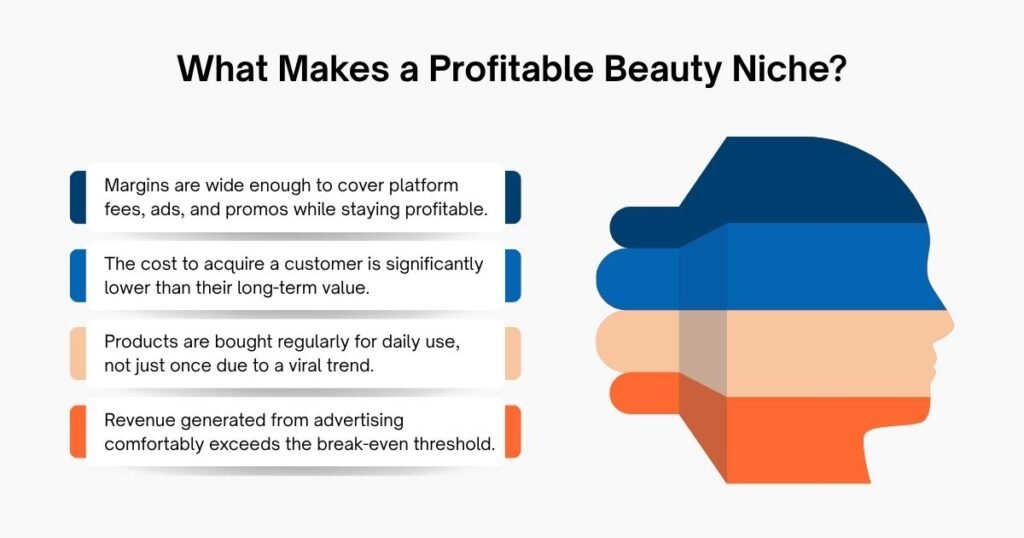
A profitable beauty niche needs more than just demand. It also needs healthy margins, reasonable customer economics, repeat demand, and sustainable acquisition costs.
Healthy Margins Leave Room for Growth
There is no fixed industry benchmark for every beauty business. Profit margins depend on the product, sourcing, private label, market, and business model. When gross margin is too thin, the niche has less room to absorb marketplace fees, affiliate commissions, advertising costs, and promotions while still maintaining profitability.
Customer Acquisition Costs Should Match Customer Value
A niche with high CAC but low repeat purchase will struggle to have attractive economics, even if sales are performing well in the short term. On the other hand, if customers are likely to return and generate revenue through multiple purchases, a higher acquisition cost may still make economic sense.
Repeat Purchase Should Support Recurring Demand
For consumable products such as serums, facial cleansers, or sunscreen, check repeat purchase rate, customer retention, and purchase frequency. If customers mainly purchase once when a product goes viral or is heavily discounted, sales may not yet reflect the niche’s true recurring demand.
Advertising Costs Should Be Sustainable
Do not use an industry-average ROAS to determine whether a niche is viable. Instead, calculate the minimum ROAS based on the economics of the product itself. In a simple case that only considers gross margin:
Break-even ROAS ≈ 1 ÷ Gross Profit Margin
For example, with a 60% gross margin, break-even ROAS would be around 1.67x (this is only a simplified calculation. In a real-world evaluation, you also need to account for contribution margin, shipping, marketplace fees, returns, discounts, and other variable costs).
Guide to Using Market Data to Choose a Profitable Beauty Niche
These criteria can be validated using market data. Start by looking at the level of competition within the niche, then go deeper into customer feedback, demand, and product economics.
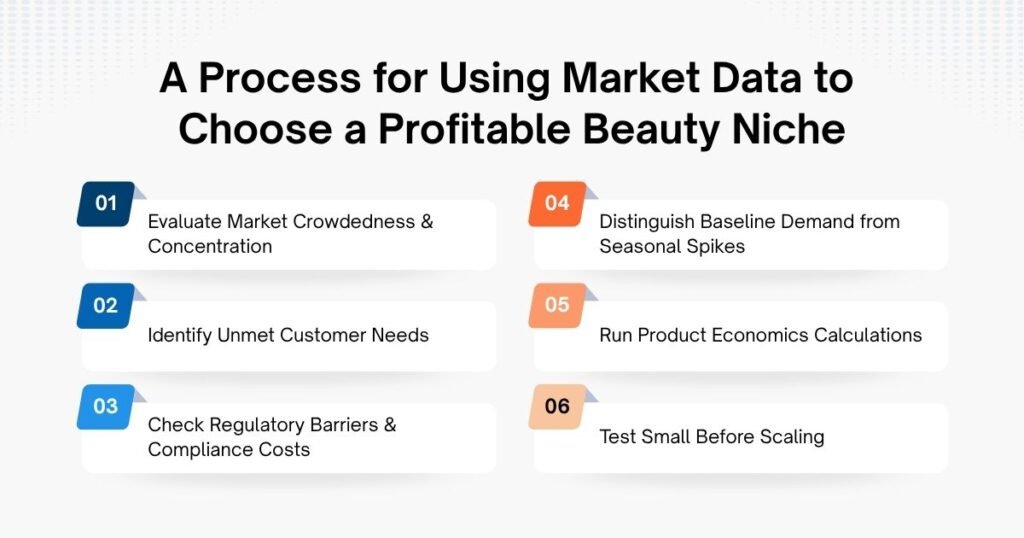
Step 1: See How Crowded the Niche Is
Start with the core keywords for the niche on Shopee, TikTok Shop, or Lazada. Record the sellers and products appearing among the top results, then see whether these positions are concentrated among a few major brands.
Next, check how frequently ads appear and look at the search trend for these keywords. Rising demand does not necessarily mean a niche is easy to enter. If traffic and sales are concentrated among a few major sellers, you will have to compete for the same pool of customers with sellers that already have established advantages.
Step 2: See Where Customers Are Still Unsatisfied
Once you understand how competitive the niche is, look at what is still leaving customers unsatisfied about the products that are already selling well.
Choose a group of best-selling products and read their 2–3-star reviews. Note down complaints that appear repeatedly, such as texture, absorption, scent, packaging, or product effectiveness. Group similar complaints together to see which issues occur most frequently.
If the same issue appears across multiple products and is mentioned by many customers, it could be a market gap worth researching further.
Step 3: Check Regulatory Barriers Before Choosing a Niche
For each market where you plan to sell, check three things:
- Whether the product is legally allowed to be marketed.
- What procedures or documents are required.
- How much it will cost and how long it will take to complete them.
Southeast Asia does not have a single cosmetics license that applies across the entire region. The ASEAN Cosmetic Directive helps harmonize certain cosmetic requirements, but businesses still need to check regulations in each target market.
In particular, check active ingredients, product claims, and certification requirements where applicable. These factors can increase costs and extend the time needed to bring a product to market, so they should be included in the profitability calculation from the beginning.
Step 4: Check Whether Demand Is Seasonal or Baseline
Use monthly sales data or search data and compare them across multiple periods. If you have data covering a long enough period, also compare it with the same period of the previous year to see whether demand spikes are recurring.
For example, if sales only increase sharply during a campaign or shopping season and then quickly return to their previous level, this may indicate seasonal demand rather than a stable growth trend. When estimating market potential, these peaks should be considered separately instead of being used as a representation of the niche’s typical demand level.
Step 5: Bring Data Into the Profitability Calculation
Use the selling price, product cost, marketplace fees, promotion, and marketing cost of the product group you are researching to calculate its actual economics.
Then check:
- Gross profit margin: after product cost and direct costs, how much is left from each order?
- Customer economics: compare CAC with the economic value generated by a customer across multiple purchases to determine whether the acquisition cost is reasonable.
- Repeat purchase: do customers come back, and is their purchase frequency sufficient to support the economics of the niche?
- Break-even ROAS: the minimum ROAS required for advertising costs not to make an order unprofitable.
Finally, compare these figures with the current selling price and level of competition. A niche with strong demand but very thin margins or a very high break-even ROAS may still not be economically suitable.
Step 6: Test Small Before Scaling
When market data indicates that a niche has potential, validate it with a small product assortment instead of investing everything from the start.
Choose a few SKUs that represent the customer problem you want to solve and set a specific testing period and budget. During this stage, track conversion, sell-through, response to pricing, customer feedback, and reliance on promotions.
If the product only sells well with heavy discounts or continuous advertising, the initial profitability assumptions need to be reconsidered. The results from the testing phase will provide a basis for deciding whether to expand the SKU range and marketing budget.
Some Beauty Niches Worth Considering in Southeast Asia
Below are 4 notable beauty niches compiled by Easy Data from market signals, industry research, and publicly available data on the Southeast Asian market. These are only initial suggestions from beauty market intelligence and are not sufficient to conclude that any of these are profitable beauty niches. Before investing, you still need to validate demand, competition, and economics using data from each target market.
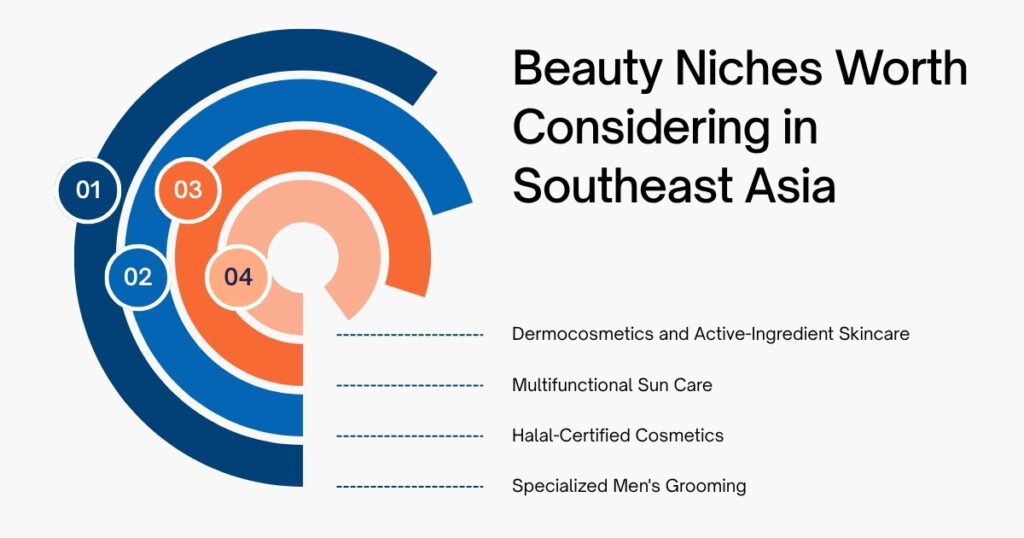
1. Dermocosmetics and Active-Ingredient Skincare
Consumers are increasingly interested in specific benefits and ingredients, rather than choosing products based only on lifestyle or brand image as they did in the past. This trend is also more evident among younger consumers, particularly Gen Z.
Dermocosmetics has recorded double-digit growth in Thailand and the Philippines in recent years. Products focused on active ingredients such as PDRN, ceramide, niacinamide, and vitamin C are also attracting attention.
But demand is only one part of the equation. To determine whether this is a profitable beauty niche, you also need to look at market pricing, the ability to maintain margins, and the level of competition across each product group.
2. Multifunctional Sun Care
In Southeast Asia, sun protection can generate recurring demand due to year-round usage needs.
In addition to sun protection, consumers are also looking for products that offer skincare benefits, improve skin tone, or have lightweight textures suitable for hot and humid weather. In Indonesia, demand for multifunctional sun care products is also reflected in search behavior on e-commerce marketplaces.
Therefore, hybrid sun care is a direction worth researching further: products that meet sun protection needs while also addressing a specific skincare need.
3. Halal-Certified Cosmetics
In Indonesia, Halal is becoming an increasingly important factor as certification requirements for cosmetics come into effect. For brands looking to enter or expand in Indonesia, Halal certification requirements need to be included in the market entry calculation from the beginning. Preparing early can also help businesses better manage documentation, compliance timelines, and costs.
This niche is not limited to skincare. Hair care and body care are product categories that can be further researched as demand for Halal beauty expands.
4. Specialized Men’s Grooming
Men in Southeast Asia are becoming increasingly interested in skincare, particularly in markets such as the Philippines and Indonesia. However, instead of building a broad men’s skincare portfolio from the beginning, businesses can start with specific concerns such as oiliness, acne, or dull skin.
A few SKUs focused on 1–2 clear problems can make it easier to validate demand. You can then analyze sales data and customer feedback to see which products actually have potential and whether you should continue investing and expanding.
Conclusion
A product that is selling well, a rapidly rising keyword, or a viral trend can all be good signals, but they do not necessarily mean it will be a profitable beauty niche for you. Before investing, you need to understand where that demand actually comes from, whether customers will still have the need when the trend cools down, and how competition will change when you enter the market. Market data can help you assess these factors and provide a more reliable basis before investing in a new niche.
Leave a Reply