

Traditional market research often takes several weeks to several months to complete. For the beauty industry on Shopee and TikTok Shop, that amount of time is enough for buying behavior and product trends to change. As a result, businesses can miss out on many valuable opportunities.
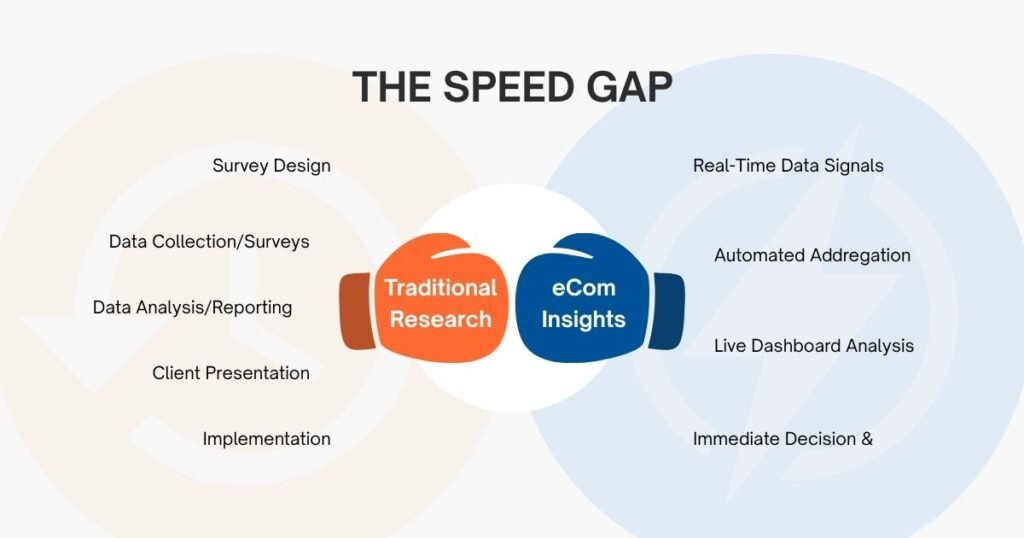
The Speed Gap Between Traditional Market Research and Ecommerce
A traditional market research study typically goes through several steps: designing the survey, recruiting respondents, collecting data, and completing the report. This process can take anywhere from several weeks to several months. If you operate in the Beauty industry on Shopee, Lazada, and especially TikTok Shop, this time lag can put you at a significant disadvantage because the market changes faster than the traditional research cycle.
Beauty Trends Move Faster Than Research Cycles
A beauty trend on social media platforms such as Facebook, Instagram, or TikTok often peaks after around 4–8 weeks. From the time it appears until it is replaced, a trend may only last for a few months. Therefore, by the time the research is completed, the trend being studied may have already lost its appeal or may no longer appear as frequently in users’ newsfeeds.
This creates a gap between the insights in the report and actual sales data. The marketing team may still be planning advertising campaigns for a product category that is no longer growing as it used to, while ecommerce data is already showing that another product line is selling better and attracting growing demand.
The issue is not whether the report or the marketing team is right or wrong. The report reflects the market at the time the research was conducted, while the marketing team has to make decisions based on what is happening now. If the market has changed during that period, a plan built from the report may no longer fit the actual situation.
The Gap Between What Shoppers Say and Do
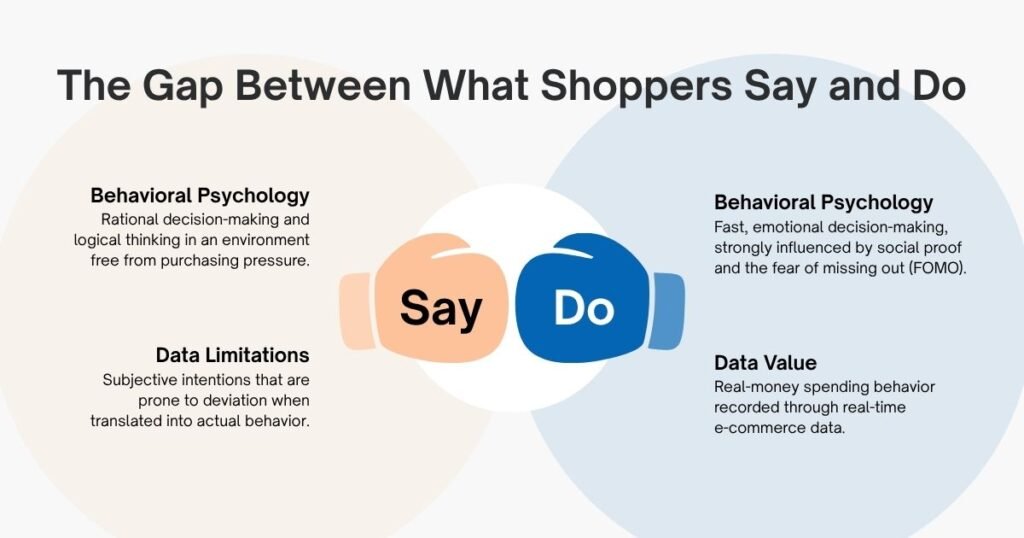
Survey questions often ask respondents to recall or predict things such as “how likely are they to buy this product?” or “what would make them consider it?” This is a deliberate thought process that takes place in a static setting, separate from the actual moment of purchase.
But actual beauty buying behavior in ecommerce can be very different. A shopper may make a decision during a livestream, right after the host demonstrates a product, when a promotion has only a few minutes left, and when the comments are constantly filled with people saying they have already placed an order. This is a fast, emotional decision-making process that is strongly influenced by social proof at the moment of purchase. A static survey question can hardly fully replicate this context.
Because beauty is currently the largest product category by GMV on TikTok Shop, this is not a small exception. It represents a significant part of the actual buying journey that traditional research methods were not designed to observe.
Traditional market research is still useful for understanding what consumers think, believe, and value. But with beauty — where purchase decisions are closely tied to self-image and personal values — what shoppers say in surveys and what they actually do do not always match.
The reason is that when answering surveys, shoppers tend to give answers that reflect the image they want others to see. Not many people will openly say that they buy because the price is cheap, because they are afraid of missing a trend, or because they see too many other people buying it. Reasons such as ingredients, product effectiveness, or how well the product fits their personal needs are usually easier to talk about and less likely to make them feel judged.
But in an actual buying situation, these less openly acknowledged factors can still play an important role. Someone may say they chose a product because of its ingredients or effectiveness, but ultimately decide to buy because the price is discounted, because the livestream is about to end, or because they see many other people continuously placing orders.
A recent experiment by Orchard Insights among women aged 18–45 illustrates this quite clearly. When directly asked what made them choose a purchase, only 4% mentioned how closely they identified with the brand. But in an actual behavioral test, where no statements were made about the brand’s values or mission, as many as 16% actually responded to that factor.
Why Small Samples Miss Fragmented Beauty Markets
A traditional research study often relies on a sample of around 200–500 respondents, which is not enough to represent the entire beauty consumer market.
The reason is that shoppers belong to many different groups: people with acne-prone oily skin, sensitive skin, concerns about pores, people looking for a specific ingredient such as niacinamide or centella, people with different budgets, or people who only shop on a particular platform. As a result, in a sample of 300 people, the customer group a brand actually wants to understand may consist of only a few respondents.
For example, a brand may be targeting people with sensitive skin who are looking for a product containing centella and have a price limit below a certain threshold. The number of people who meet all three conditions in the survey sample may be very small.
When the number is too small, the answers from this group are not enough to form a separate conclusion. The overall results will mainly reflect the larger groups, while the needs of the specific segment the brand is targeting are almost completely overlooked.
The Cost of Keeping Up With a Fast-Moving Market
Traditional market research works well for questions that do not change often, such as brand awareness or brand positioning. For these questions, conducting research every few months can be reasonable. But beauty trends can change every 4–6 weeks. If brands want to keep up with the market at that pace, they have to continuously conduct new research – a costly and difficult process to maintain, even for brands that are growing well.
As a result, brands usually have to:
- Conduct research less frequently: save costs but risk missing new changes in the market.
- Reuse old data: save time but risk making decisions based on insights that are no longer accurate.
By the time sales or advertising performance starts to decline, the brand may only then realize that the data it has been using has failed to keep up with the market.
Why These Challenges Are Greater in Southeast Asia
In Southeast Asia, beauty brands are not just researching one market. They have to monitor multiple countries at the same time.
If a brand wants to understand beauty shoppers in Vietnam, Indonesia, Thailand, the Philippines, and Malaysia, it often has to conduct separate research in each country: recruit separate panels, collect separate data, and run the research at different times. Only then can the results be combined for comparison across markets.
This approach takes a lot of time and money. More importantly, by the time research is completed across all countries, some of the data collected first may no longer accurately reflect the market.
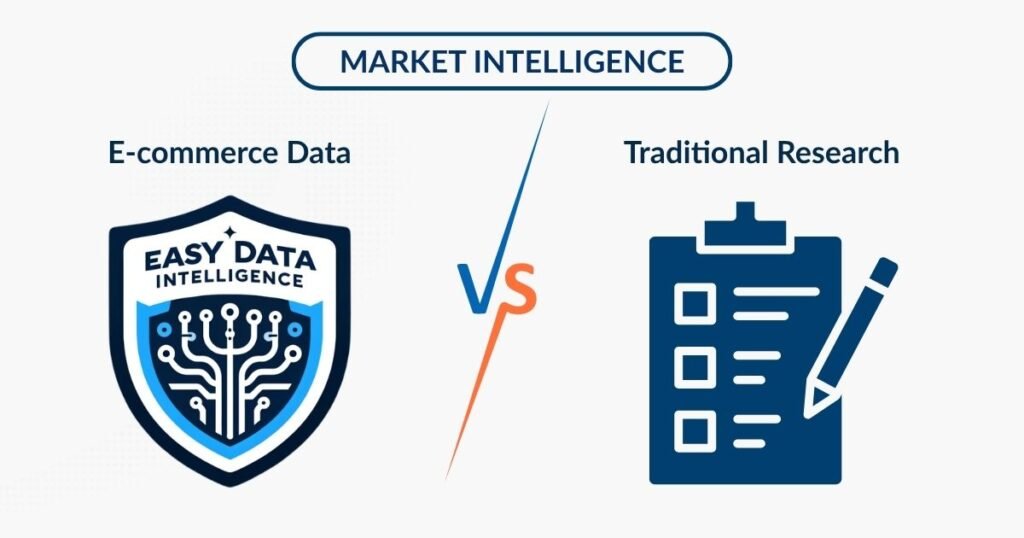
Meanwhile, scraping data from Shopee, TikTok Shop, and Lazada can help beauty brands track which products are attracting attention, what price levels the market is accepting, and how demand is changing across countries in the region without having to conduct a separate research study for each country.
Therefore, the problem is not that brands lack data; it is that traditional market research is often slower than the pace at which the market changes.
Final Thought
Traditional market research is still useful when brands need to understand brand awareness, attitudes, or how much consumers like a brand. But to track continuous changes in ecommerce, brands need to supplement it with actual customer buying behavior data. At this point, Data as a Service solutions are becoming worth considering for ecommerce brands that want data that is updated quickly enough to keep up with changes in the market.
Leave a Reply