


Mobile commerce (m-commerce) means shopping and transacting through mobile devices. For a retailer, the practical question is whether a customer can find the right product, understand the total price and complete an order on a phone. This guide explains mobile web, apps, payments and measurement, with a fictional checkout example. Originally published in 2025, it retains that date and cover; the discussion below evaluates capabilities rather than treating old forecasts as current results.
What is M-Commerce?
M-commerce is part of ecommerce, not its opposite. Ecommerce includes online transactions across devices; mobile commerce describes the mobile portion. A purchase in a phone browser can be mobile commerce just as a purchase in a shopping app can. Mobile banking and in-store wallet payments are related mobile financial activities, but should not automatically be added to a retailer’s online-sales total.
| Term | Scope |
|---|---|
| Ecommerce | Online commercial transactions across devices. |
| Mobile commerce | The mobile-device portion, including browser and app purchases. |
Before comparing market estimates, check geography, year, currency and whether the measure covers retail goods, services, payment value or all online commerce. Distinguish recorded sales from forecasts and mobile website traffic from purchases. A visitor using a phone does not establish that an order was placed on that device.
The Advantages of M-Commerce
The following benefits are possibilities to evaluate, not automatic advantages over desktop shopping. Each depends on usability, network conditions, implementation cost and the customer’s task.
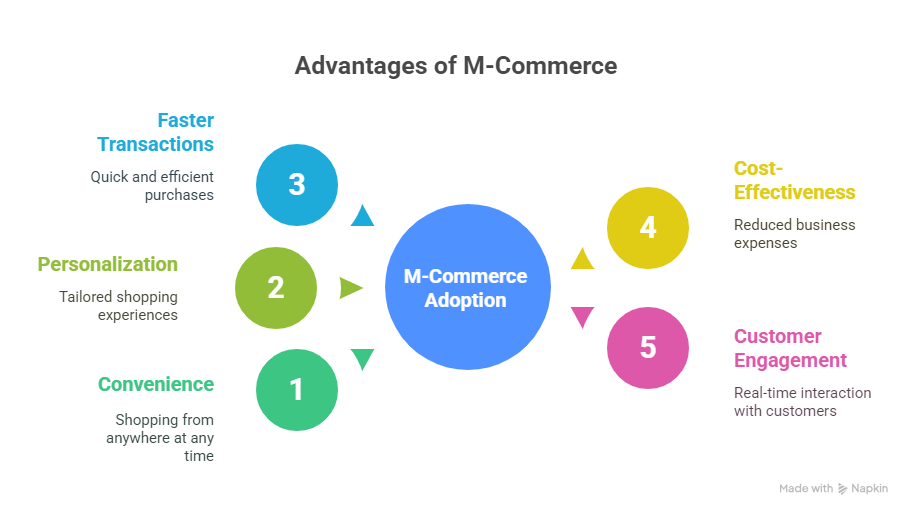
1. Convenience and Accessibility
A phone lets customers browse and order without a desktop computer, but small screens, unreliable connections and difficult input can prevent completion. Test address entry, variant selection, zoom, error recovery and checkout with keyboard and assistive technology as well as touch. A mobile layout is not automatically accessible.
2. Personalized Shopping Experiences
Recommendations can use permitted purchase or browsing history, but a simple relevant assortment may work better than a complex model. Compare completed orders, returns and contribution margin with a defined baseline. Do not assume that collecting more personal information or inferring a demographic group will improve the experience.
3. Faster Transactions
Wallets and saved details can reduce typing where supported; mobile hardware does not inherently process checkout faster than a desktop. Apple’s compatibility guidance documents device and merchant conditions for Apple Pay. Test eligible and ineligible customers, payment failures and fallback methods before claiming a conversion improvement.
4. Cost-Effectiveness for Businesses
Compare the total cost of a responsive website, a progressive web app and a native app: implementation, payments, integration, releases, support and ongoing maintenance. A native app also needs a reason for customers to install and return to it. A mobile website can be a useful starting point, but no architecture guarantees lower operating cost.
5. Enhanced Customer Engagement
Notifications and location features are optional capabilities, not permission to message or track every visitor. MDN documents permission and browser restrictions for push; the web Geolocation API asks for permission and requires a secure context. Provide a useful experience when permission is declined, and measure opt-outs as well as engagement.
The Growth of M-Commerce
Mobile reach, mobile internet use, visits and sales are different measures. For example, GSMA’s September 2025 connectivity report announcement reports 4.7 billion people using mobile internet on their own device. That is neither a count of mobile shoppers nor mobile retail revenue. Use dated, like-for-like measures when assessing an addressable market.
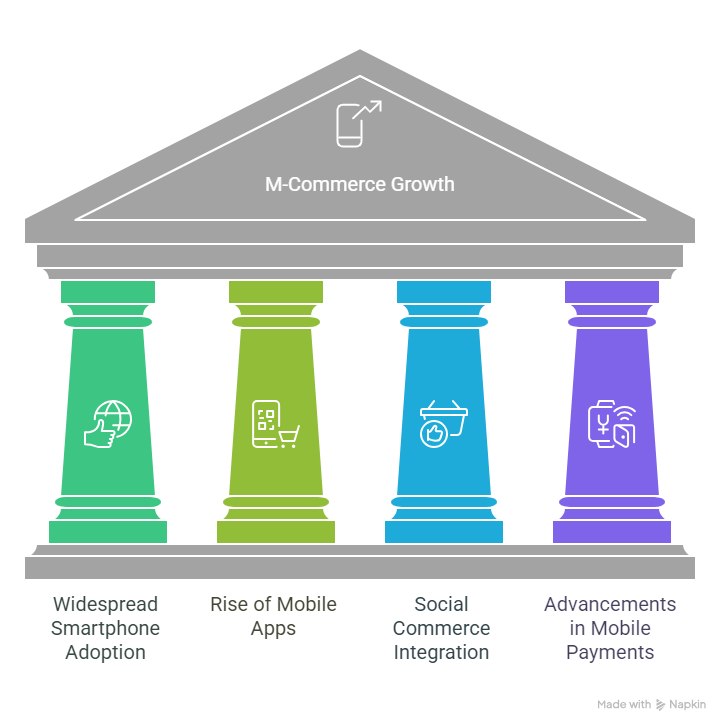
For a store-level decision, examine these four factors in the target market:
1. Widespread Smartphone Adoption
Check whether the intended customers can access the store on devices and connections they actually use. Unique subscribers, smartphone connections and people using mobile internet are not interchangeable counts. GSMA’s connectivity research also identifies a usage gap: network coverage alone does not mean everyone uses mobile internet.
2. Rise of Mobile Apps
An app may help repeat shoppers with account access or recurring tasks; a browser avoids an installation step and supports links from search or campaigns. Compare similar customers, acquisition sources and periods before interpreting app-versus-web conversion. Loyal customers choosing an app can create selection bias, so an observed difference does not prove the app caused it.
3. Social Commerce Integration
Social platforms can support discovery, catalogues or checkout, depending on the country, account and integration. Shopify’s standard Instagram Shopping guidance describes a redirect to the Shopify checkout. Do not generalise that flow to every Meta product or assume every social sale completes inside the social app. Map the actual product-to-payment journey for your integration.
4. Advancements in Mobile Payments
Choose payment methods available to your merchant account and target customers. A wallet, QR payment and card payment are not equivalent integrations; confirmation, refunds, fees and failure recovery depend on the provider. Count an order only after the store’s agreed payment or order-success condition is met, not when the wallet or QR screen opens.
The Future of M-Commerce
These six areas are options to investigate, not a prediction that every retailer should adopt them. Start with a customer problem, check platform support and compare a small pilot with the existing experience.
| Option | Check before a pilot |
|---|---|
| AI recommendations | Reliable product facts, relevant suggestions and a baseline. |
| AR or visualisation | Device support, accurate models and a non-AR fallback. |
| Voice | Supported actions, confirmation and an alternative input route. |
| Live commerce | Seller eligibility, checkout route and order attribution. |
| PWA | Installation support, stale-cache handling and reconnection. |
| Crypto payment | Provider eligibility, settlement, refund and support process. |
1. AI-Driven Personalization
Recommendation models can rank products, while generative systems can draft content that needs review. Verify product facts, availability and prices before showing generated claims to shoppers. Our ecommerce data evaluation guide explains how to compare a candidate with a baseline and why a technology label does not establish business value.
2. Augmented Reality (AR) Shopping
AR and room visualisation can help customers explore products in context. IKEA’s Kreativ room-scanning instructions provide a concrete example. Device support, model quality and accurate dimensions matter. The existence of the feature does not prove that it reduces returns or that a particular share of a generation uses it.
3. Voice Commerce
Distinguish speaking a search query from authorising a purchase. Voice features depend on the assistant, merchant integration and supported actions. If a voice workflow suits the audience, test ambiguous product names, price confirmation, authentication and cancellation. Keep an accessible text or touch route available instead of assuming every assistant can complete an order.
4. Live Commerce
A live demonstration can answer product questions, but viewing a stream is not a purchase. Confirm seller eligibility and the supported checkout route, then record orders, cancellations and refunds against an explicitly defined attribution window. Read our social-commerce planning guide for channel and measurement checks.
5. Progressive Web Apps (PWAs)
A PWA is a web application that can add capabilities such as installation and offline handling. Installation support varies by browser and platform; offline behaviour must be designed and tested. Cached product information can be stale, and offline browsing does not establish current stock or a successful payment. Test reconnection and avoid duplicate order submission.
6. Blockchain and Cryptocurrency
Blockchain or cryptocurrency is not a prerequisite for mobile commerce and does not automatically secure a checkout. If a payment provider offers this option, examine merchant eligibility, settlement, refunds and support for the exact product. For example, Stripe documents an approval process for its stablecoin payment method. That is a provider-specific capability, not evidence that conventional payments are being replaced.
Building an Effective M-Commerce Strategy
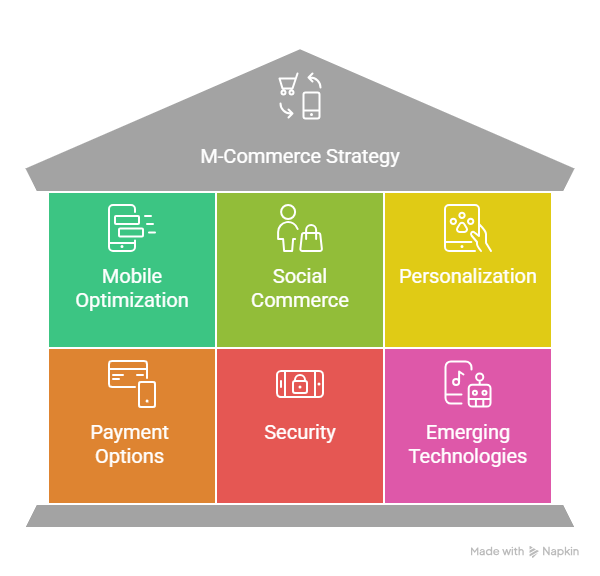
Choose one customer journey and write down its baseline before adding features. For each change, record the target device/browser, customer need, completion measure, cost, owner and rollback condition. The six steps below form a practical review; the worked example shows why an earlier funnel improvement can leave orders unchanged.
1. Optimize for Mobile-First Design
Test responsive layouts, legible text, labels, error messages and usable touch targets. WCAG 2.2’s target-size criterion uses a 24-by-24 CSS-pixel minimum with specific exceptions; it is not a complete accessibility checklist. For performance, Google’s Core Web Vitals guidance uses LCP at most 2.5 seconds, INP at most 200 milliseconds and CLS at most 0.1 at the 75th percentile, assessed separately for mobile and desktop. Lab tests help diagnose problems but do not replace real-user evidence.
2. Leverage Social Commerce
Verify catalogue, variant, price, stock and checkout behaviour for each selected social integration. Open the customer journey on a real phone, including its in-app browser and any redirect. Keep clear contact and returns information, and check that campaign parameters survive where appropriate without exposing personal data in URLs.
3. Invest in Personalization
Use only the data and identity links appropriate to the stated purpose and customer choices. A logged-in cross-device experience needs a reliable account relationship; do not assume two devices belong to the same person. Test recommendations against a control and include complaints, irrelevant suggestions and latency alongside completed orders.
4. Enhance Payment Options
Offer methods that fit the customer and merchant context, with clear total price and terms. Test cancellation, timeout, failed authorisation, retry and refund handling. BNPL availability or a market forecast alone is not a reason to add credit at checkout; assess the exact provider, customer needs and applicable terms before offering it.
5. Prioritize Security
Protect account access, sessions, payment integrations and sensitive data; keep software updated and limit access. Customer-provided preference data is not a substitute for security controls. For native apps, OWASP MASVS covers areas including storage, authentication, network communication and privacy. A review framework does not by itself certify a store as secure.
6. Adopt Emerging Technologies
Pilot one capability only when it addresses an observed problem. Define the device support, operating cost and success threshold first. Keep a working fallback and retain inconclusive or negative results. Buying an AR tool or building an app is not itself an improvement in customer outcomes.
Worked checkout comparison — fictional sessions: Imagine two cohorts with 200 mobile sessions each in which a cart was created. Count each session once per step, allow at most one completed order per included session, and reconcile the completion with the store’s order records. These invented counts illustrate measurement; they are not Easy Data results or evidence from an experiment.
| Cohort | Cart | Checkout | Paid order |
|---|---|---|---|
| A | 200 | 120 | 84 |
| B | 200 | 140 | 84 |
In cohort A, cart-to-checkout is 120 / 200 = 60%, checkout-to-order is 84 / 120 = 70%, and cart-to-order is 84 / 200 = 42%. In cohort B, these rates are 70%, 60% and 42%. More sessions reached checkout, but the overall order rate did not improve. There were 116 cart sessions without a completed order in each cohort within the chosen window.
Do not call this a revenue lift or an A/B-test result. Real comparisons need sufficient observations, comparable traffic or random assignment, a defined conversion window, consent-aware measurement and checks for changes in price, stock and payment availability. Review refunds, profit and support costs separately.
Google’s GA4 ecommerce guidance distinguishes events such as add_to_cart, begin_checkout, purchase and refund. Event counts are not automatically unique sessions or orders. Our order-reconciliation example shows how duplicate events and missing orders can distort the totals. Keep internal QA and personal data out of production measurement.
Challenges in M-Commerce
Treat the following as diagnostic areas. Their relative importance varies with the audience, acquisition channel, product, fulfilment and implementation.
1. Cart Abandonment
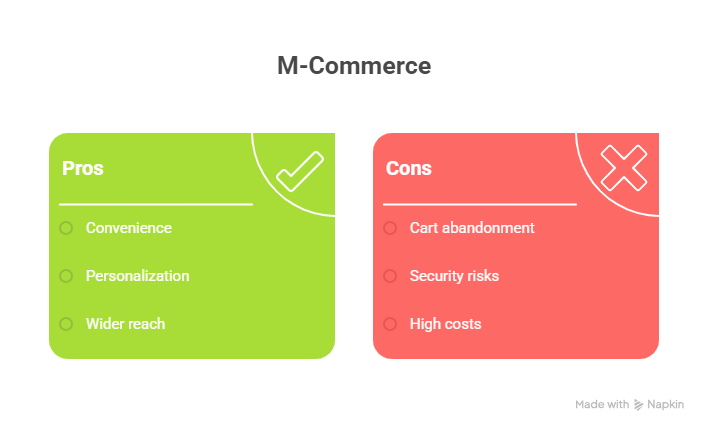
Define the denominator before reporting abandonment: cart sessions, checkout sessions and payment attempts answer different questions. Compare like-for-like periods, separate repeat events, and account for delayed purchases. Display shipping and tax information as early as feasible, then investigate observed friction instead of treating a global benchmark as your store’s result.
2. Security Concerns
Fraud-attempt share depends on the provider, population, period and definition being measured. A mobile browser is not evidence of fraud. Review suspicious activity with appropriate controls, track false positives, and minimise personal information in logs and analytics. Separate payment decline, customer cancellation and technical failure in reporting.
3. High Development Costs
Budget for maintenance and customer support as well as initial development. Improve the responsive website first when it meets the task, then evaluate whether an app or PWA adds enough value for repeat customers to justify its costs. Preserve a usable web path if an optional feature fails.
Conclusion
Mobile commerce is a way of delivering ecommerce through a mobile device. Its value depends on a usable customer journey, suitable payments, reliable fulfilment and trustworthy measurement. The practical priority is to remove a verified obstacle to completing an order.
Measure before scaling. Compare matched customer journeys, reconcile completed orders with the transaction system and account for returns and costs. Keep permissions, accessibility and failure recovery in the acceptance criteria rather than treating them as optional additions.
For a wider planning framework, read our review of ten ecommerce trends and how to test them.
Leave a Reply