

Most teams attempt to build a ecommerce sales forecast, but the outcome frequently falls short. The problem typically lies not with the method, but with the data that drives it.
When you switch to working with real-time ecommerce datasets gathered directly from marketplaces, rather than internal reports or fragmented data, the difference is noticeable. Forecasting evolves from an uncertain process to one grounded in data, making it a more trustworthy basis for decision-making.
What Is Ecommerce Sales Forecasting
An ecommerce sales forecast is the process of estimating future sales by combining historical performance, market trends, and external data signals.
In practice, every forecast influences critical decisions: how much inventory to prepare, when to scale advertising, and which products deserve more investment. That’s why a reliable ecommerce sales forecast isn’t just a report; it’s a foundation for how a business operates.
The limitation is that many teams still rely mostly on past performance. And in a fast-moving ecommerce environment, looking only at what has already happened often means reacting too late.
Why Real Marketplace Data Changes Everything in Forecasting
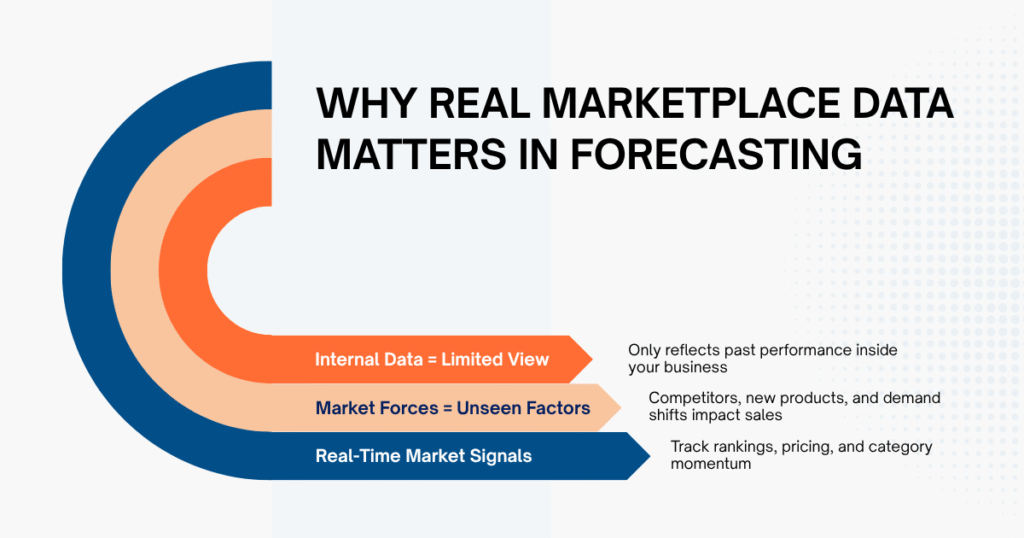
Internal data (such as past sales, website analytics, or ad performance) only tells part of the story. It reflects what is happening inside your business, but not what is shaping the market around you. And that’s exactly where forecasting starts to break down. Because future sales are influenced by factors you don’t control:
- Competitors adjusting prices
- New products gaining traction
- Demand shifting across categories
When marketplace data is introduced into the process (data from platforms like Shopee, Lazada, or TikTok Shop) the perspective changes completely. Instead of relying only on historical performance, you begin to see signals forming in real time: products climbing rankings, categories gaining momentum, pricing movements across competitors.
At that point, your ecommerce sales forecast is no longer based solely on historical data. It starts capturing real-time market movements, giving you visibility into where demand is heading, not just where it has been.
Types of Data You Need for Accurate Ecommerce Sales Forecast
The accuracy of an ecommerce sales forecast depends less on the model you choose and more on whether you are using the right data inputs. Missing even one critical layer can significantly distort the outcome. Below is how different types of data contribute to a more complete and reliable forecast:
| Data Type | What It Includes | Why It Matters for Forecasting |
| Transactional Data | Historical sales, order volume, revenue, conversion rate | Establishes baseline demand and historical patterns |
| Product & Pricing Data | Product attributes, price changes, discount cycles | Explains demand fluctuations and price sensitivity |
| Market Demand Signals | Search trends, category growth, ranking movement | Identifies emerging demand before it appears in sales |
| Competitor Data | Competitor pricing, stock levels, best-selling products | Captures external factors influencing your performance |
Each layer of data plays a different role in helping you understand demand.
- Your historical sales data shows where your business has been and what baseline performance looks like.
- Market demand signals give you visibility into what is currently gaining traction across the ecosystem.
- Competitor data helps explain sudden shifts that might otherwise seem unclear.
When these layers are combined, your ecommerce sales forecast becomes far more than a projection based on the past. It becomes a forward-looking view of how demand is evolving and where your business fits within that movement.
Step-by-Step: How to Build an Ecommerce Sales Forecast Using Real Data
Building an accurate ecommerce sales forecast is not about applying a complex model, it’s about following a process that ensures your data reflects reality as closely as possible.
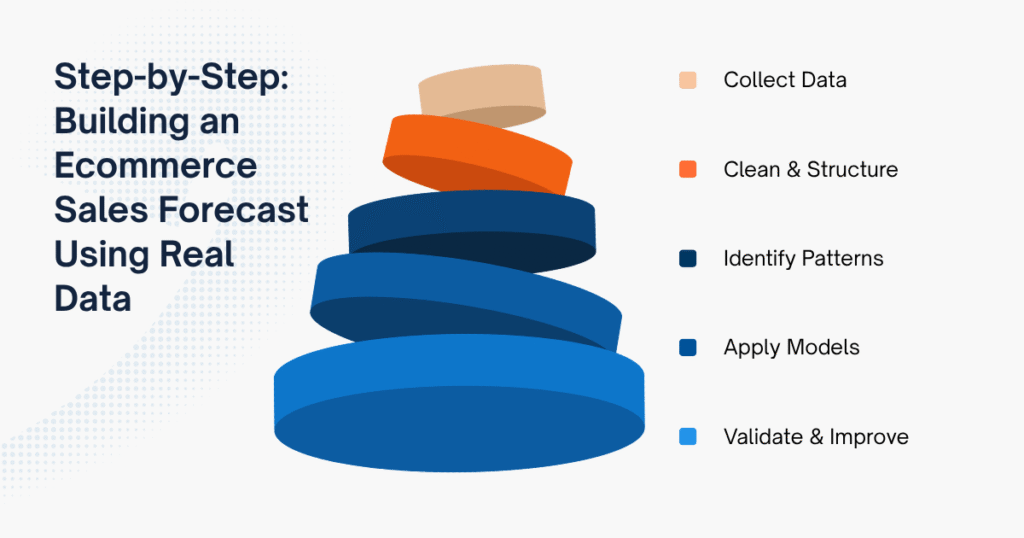
Step 1: Collect Marketplace Data
The first step is defining exactly what data you need before collecting anything. Without clarity at this stage, it’s easy to gather large amounts of data that don’t actually support forecasting. In most cases, you’ll need a combination of ecommerce product datasets (pricing, estimated sales, rankings), category-level trends, and competitor signals.
The challenge is that marketplace data is not readily available in a structured format. Teams often start with manual collection, but this quickly becomes inconsistent and difficult to scale.
That’s why many businesses move toward using an ecommerce web scraping service not as a shortcut, but as a way to ensure data is collected consistently, across multiple platforms, and updated frequently enough to be useful.
Step 2: Clean & Structure the Dataset
Once data is collected, it rarely comes in a form that can be used directly. Different sellers may list the same product under slightly different names. Pricing formats vary. Some records may be incomplete or duplicated. If these inconsistencies are not addressed, the forecast will reflect noise instead of actual patterns.
A practical approach is to standardize the dataset into a consistent structure, for example:
- Date
- Product ID
- Price
- Estimated sales
- Category
This step may seem technical, but it’s what determines whether your forecast will be reliable or misleading.
Step 3: Identify Patterns
Before applying any model, it’s important to spend time understanding how the data behaves. Patterns often emerge when you look closely:
- Recurring spikes tied to campaigns or payday cycles
- Gradual growth or decline trends
- Sudden changes linked to external factors
Visualizing the data (such as plotting sales over time or comparing similar products) helps reveal these patterns more clearly.
This stage is where forecasting becomes intuitive. Instead of relying purely on formulas, you start recognizing how demand actually moves.
Step 4: Apply Forecasting Models
Once patterns are clear, models can be used to formalize them. The choice of model should depend on the type of data available:
- Time series models work well when historical patterns are stable
- Regression models are useful when incorporating variables like price or promotions
- Machine learning approaches are more suitable for large, complex datasets
What matters is not choosing the most advanced option, but selecting a model that aligns with your data.
Step 5: Validate and Improve Accuracy
Forecasting is not a one-time process. It improves over time through continuous validation. Comparing predicted results with actual performance helps identify where the model falls short. Sometimes the issue is not the model itself, but missing or outdated data inputs.
By regularly reviewing results and adjusting accordingly, your ecommerce sales forecast gradually becomes more consistent and reliable. Over time, it evolves from a static estimate into a system that supports ongoing decision-making.
Real Use Cases: Forecasting with Marketplace Data
The value of an ecommerce sales forecast becomes much clearer when you look at how it influences real decisions.
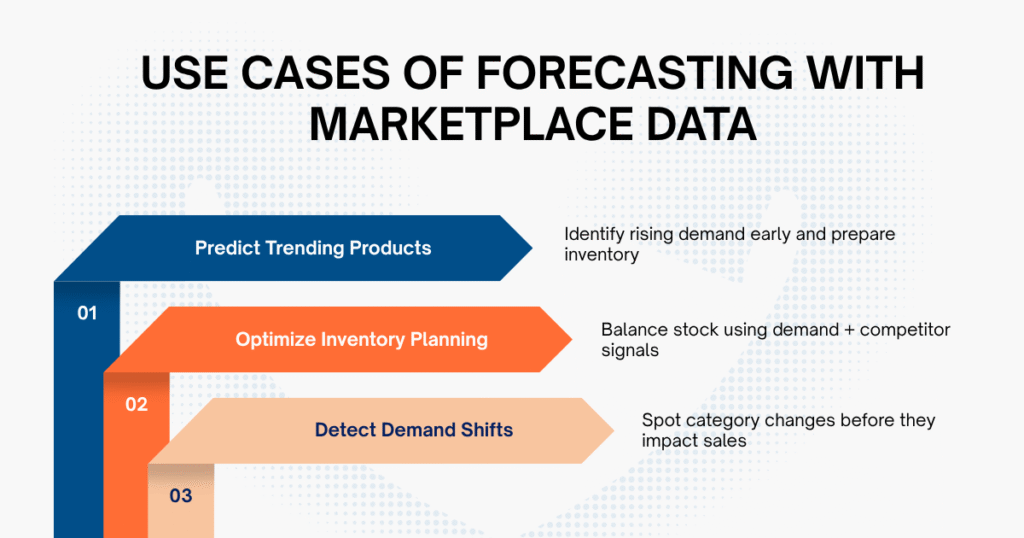
Predicting Sales for a Trending Product
When a product starts appearing more frequently in search results and climbing rankings across multiple sellers, it usually signals growing demand. With access to marketplace data, this trend can be identified early, before it fully reflects in your own sales. That allows you to prepare inventory in advance instead of reacting after demand peaks.
Inventory Planning Using Forecast Data
Relying solely on past sales often leads to overstocking or stockouts. By combining demand signals with competitor stock levels and pricing movements, inventory decisions become more balanced. The forecast reflects not just what you sold before, but what the market is likely to demand next.
Detecting Market Demand Shifts
Demand rarely disappears; it shifts. A product category may slow down while a related niche begins to grow. Without detailed marketplace data, these transitions are easy to miss.
Forecasting based on real-time signals helps you detect these shifts earlier, giving you time to adjust your product strategy accordingly.
Ecommerce Sales Forecast Methods Compared
Different forecasting methods serve different purposes depending on the data available.
| Method | Strengths | Limitations |
| Time Series | Works well with historical data | Struggles with external changes |
| Regression | Incorporates multiple factors | Requires structured datasets |
| AI / ML | Captures complex patterns | Needs large-scale data |
A common mistake is assuming that more advanced models automatically lead to better forecasts. In reality, the effectiveness of a model depends heavily on the quality of the data behind it. A simple approach built on clean, real marketplace data often produces more reliable results than a complex model trained on incomplete or outdated inputs.
In ecommerce sales forecasting, data quality consistently has a greater impact than model complexity.
How Easy Data Helps Businesses Forecast Accurately
Collecting and maintaining marketplace data at scale is one of the biggest operational challenges in forecasting. Manual methods quickly become inconsistent, especially when tracking multiple products across platforms. Keeping data updated in real time adds another layer of difficulty.
Partnering with Easy Data, businesses can access structured marketplace data without having to build their own infrastructure. Easy Data’s data scraping services for Shopee, Lazada, and TikTok Shop allow teams to work with:
- Real-time demand signals across marketplaces
- Standardized product and pricing data
- Competitor insights across categories
This doesn’t just improve the accuracy of an ecommerce sales forecast. It changes how decisions are made, allowing teams to respond faster, with greater confidence, based on what is actually happening in the market.
Conclusion
When built on reliable marketplace data, an ecommerce sales forecast becomes more than a projection; it becomes a strategic advantage.
It allows businesses to act earlier, adjust faster, and make decisions with a clearer understanding of market dynamics. In an environment where timing directly impacts performance, that difference is often what separates high-performing teams from the rest.
Leave a Reply