


A web scraping service can help when a recurring market-data task exceeds the time or maintenance capacity of an ecommerce team. It is not automatically necessary: a small manual sample, an authorized export or an existing API may already answer the question. This guide explains how to compare those options and evaluate a provider against usable data, delivery timing and ongoing cost.
What Is a Web Scraping Service?
Reviewed October 2026: This guide was first published in 2025. The evaluation checklist and fictional pilot below clarify what to verify before choosing a service; they are not Easy Data service-level commitments or customer results.
A web scraping service collects selected website information and converts it into structured records, typically delivered through files, an API or an agreed data destination. Collection frequency, covered sources, available fields and validation responsibilities depend on the project.
A managed service may take responsibility for scheduling, extraction, maintenance and delivery. In-house systems can also support recurring collection. Compare the actual scope and evidence for each option rather than assuming a paid service guarantees continuous operation or accurate output.
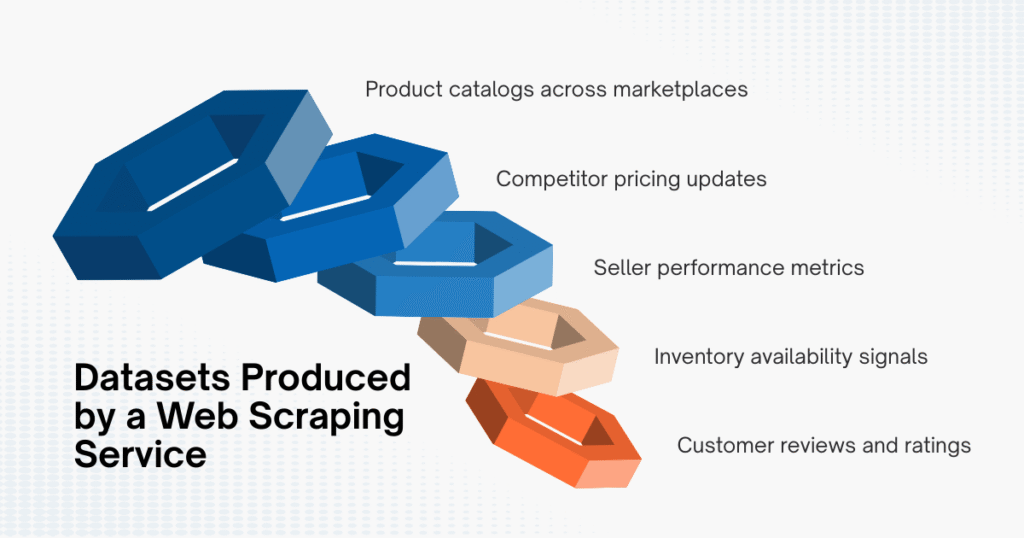
Typical datasets produced by a web scraping service may include:
- Product catalogs across marketplaces
- Competitor pricing updates
- Public seller ratings or other displayed seller signals, where available
- Displayed availability labels, not necessarily inventory quantities
- Customer reviews and ratings
These observations describe the selected sources at their collection times. Daily delivery is not real-time market visibility; require both observation and delivery timestamps. For field matching, missing-data handling and the limits of public listing signals, see our guide to web scraping for ecommerce.
Why Manual Data Collection Fails at Scale
Many businesses initially collect market data manually. Analysts visit product pages, copy pricing information into spreadsheets, and update reports periodically. This approach works when the dataset is small.
The workload depends on the number of fields, refresh frequency and checks required, not just the number of listings. As that workload grows, assess these limitations:
- Slow data collection: Measure how long the agreed sample takes to collect and validate, then compare its age at delivery with the decision deadline.
- Inconsistent formatting: Different analysts may record data differently, leading to missing fields or inconsistent structures.
- Rapid marketplace changes: A spreadsheet or automated export is a snapshot. Preserve collection times and offer conditions so an older price is not mistaken for a current one.
Automation can reduce repeated copying, but it can also repeat an extraction error across every record. Keep manual spot checks for the fields that matter, and compare the complete workflow: collection, validation, delivery and maintenance. A smaller verified sample can be more useful than a larger feed with unknown gaps.
Key Benefits of a Professional Web Scraping Service
The following uses can justify a service when the required information is available from an appropriate source. Treat them as questions to test in a pilot, not guaranteed business outcomes.
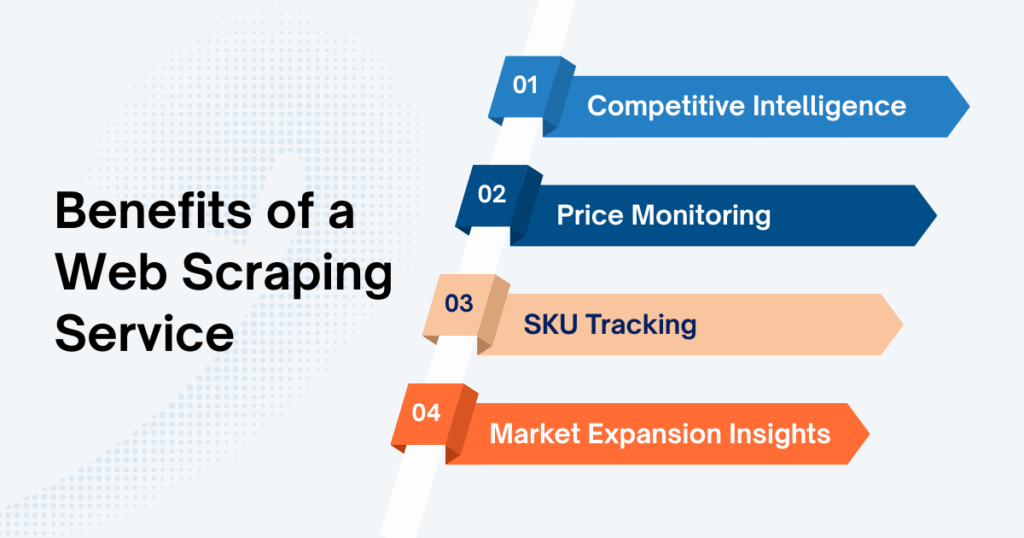
Competitive Intelligence
One of the most common reasons businesses use a web scraping service is to monitor competitor behavior. By collecting pricing, promotions, product listings, and seller activity across marketplaces, companies gain a clearer understanding of how competitors position their products. This information helps teams answer questions such as:
- Which competitors are lowering prices?
- Which products are gaining visibility in search results?
- Which categories are becoming more competitive?
Compare like-for-like offers and stable search conditions over time. A change in observed rank or price can guide a follow-up investigation, but it does not by itself reveal a competitor’s intent or prove a sales effect.
Price Monitoring
A price-monitoring brief should identify the seller, product variant, currency, quantity and delivery context being compared. Ask how vouchers, member prices and shipping are represented, and whether alerts refer to observed item prices or a comparable total. Verify the proposed scale and alert delay on a representative pilot before relying on them.
SKU Tracking
A seller SKU or marketplace listing ID is not automatically a shared identifier across platforms. Ask how the provider matches brand, model, variant, pack size and condition, and how uncertain matches are flagged. A verified match can help investigate:
- Where their products are being sold
- How pricing differs between sellers
- Whether observed sellers need checking against the brand’s authorized-reseller records
This visibility is especially valuable for brands managing large product portfolios.
Market Expansion Insights
For market-entry research, a defined sample can describe visible assortment, asking prices and seller presence in a particular country. Listings are not transactions, and an availability label is not a demand estimate. Combine those observations with appropriately sourced sales, customer or search research before making a market-size or demand claim.
The broader insight is that scraped data does not simply describe the current market; it can also inform expansion strategy.
How a Web Scraping Service Actually Works
Behind the scenes, a professional web scraping service is built on a multi-layered data pipeline. While the technical details vary between providers, most solutions follow a similar structure.
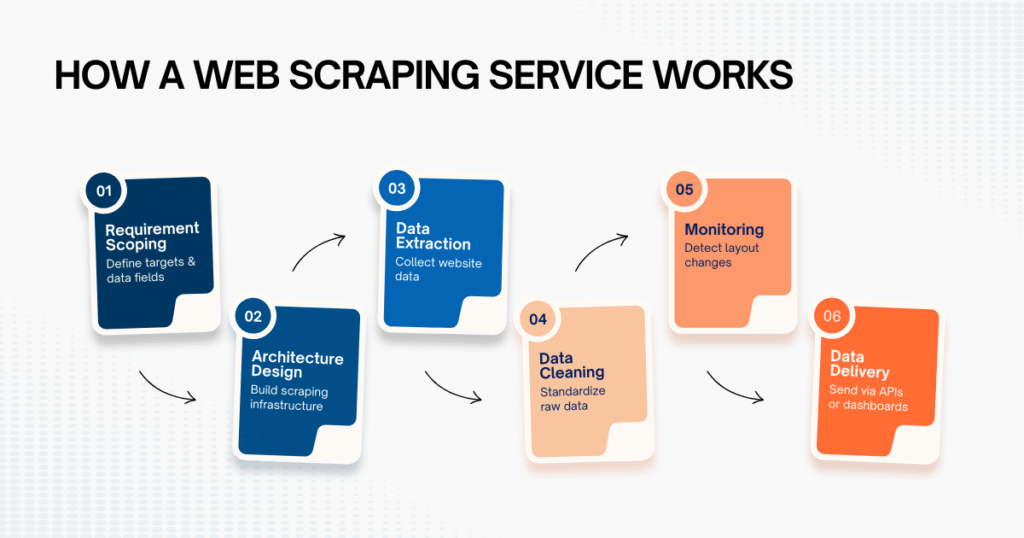
Requirement Scoping
Write a collection brief before commissioning a pilot: the decision, sources, countries, representative URLs, product variants, required fields, refresh schedule, delivery deadline and retention period. Check whether authorized APIs, exports or licensed feeds satisfy it. Confirm the access and reuse conditions for the selected source and exclude unnecessary personal information.
Architecture Design
The design should cover scheduling, source-specific request limits, validation, storage and recovery from interrupted runs. Require a way to resume or replay a batch without silently duplicating records. Agree how unavailable sources, missed deadlines and exhausted retries are reported; no architecture removes every external dependency.
Extraction Layer
Use the simplest permitted interface that exposes the required fields: an authorized data interface where available, or page parsing and browser rendering where appropriate. Record source URLs and observation times with the extracted values. Check for login, challenge and error pages before treating an HTTP response as a product record.
Cleaning & Normalization
Raw web data is rarely clean. Prices may appear in different currencies, product names may contain inconsistent formatting, and seller information may vary across pages. Data cleaning can help standardize these fields. Preserve the original values and transformation rules, keep missing values distinct from zero, and version the output schema. Formatting a price correctly does not prove that it belongs to the intended variant or seller; validate a sample against the source.
Monitoring & Alerts
Ask what is monitored: failed requests, missing required fields, duplicate records, stale timestamps and unexpected volume changes. Detection and response take time, so specify the alert destination, response window and recovery process instead of assuming immediate repair. Google’s SRE guidance separates pipeline freshness, correctness and coverage; a successful HTTP request alone does not measure all three.
Delivery Integration
Test delivery using a representative file or API response before rollout. Verify field names and types, encoding, time zones, unique keys and how corrected records are delivered. Agree who owns failed imports, schema changes and historical exports so a technically successful collection does not leave the analyst with unusable data.
Common Challenges & How Professionals Solve Them
Scraping websites at scale introduces several technical challenges that many organizations underestimate. Some of the most common obstacles include:
- Anti-bot systems that block automated requests
- Captcha protections on login or search pages
- IP rate limits imposed by large platforms
- Frequent HTML layout changes
- Geo-restricted content
These issues require different responses. A layout change calls for a parser check; an access restriction may require an approved API, a source agreement or a narrower scope. For rate limiting, HTTP 429 may include a Retry-After header; respect the stated delay and use bounded retries within the source’s limits. Do not treat proxy rotation as a universal remedy or promise access to every protected page. Our scraping troubleshooting guide separates access, extraction and validation failures.
When Should You Move from Internal Tools to a Web Scraping Service?
Internal systems can work at small or large scale when a team can maintain them. Consider a managed service when the recurring work or support requirements exceed that capacity. Useful signals to examine include:
- The required collection and validation workload exceeds the team’s available capacity
- Internal scripts break frequently when websites update
- Analysts spend significant time fixing data pipelines
- Data delivery must integrate with business systems
Compare total cost for the same scope: setup, source access, collection, validation, storage, maintenance, analyst time and incident handling. Ask whether retries, additional countries, changed fields, historical exports or support incur extra charges. Outsourcing can reduce some internal work without eliminating quality review or integration responsibility.
Provider pilot: define acceptance before comparing quotes. Agree the following evidence for the actual sources and fields you need. Set thresholds to match the business decision; the checklist is not a universal service guarantee.
| Decision | Evidence to request |
|---|---|
| Coverage | Agreed input list or sampling rule; attempted, delivered and missing records by source |
| Freshness | Observation and delivery timestamps; age of the data at the agreed deadline |
| Validation | Required-field rules, duplicate handling and a source-checked sample with mismatches reported |
| Recovery | Failure log, retry limits, alert route and handling of late or corrected records |
| Integration | A sample import, schema definition, stable keys and an export path for historical records |
| Commercial scope | Written inclusions and exclusions, usage limits, support responsibilities and change costs |
Fictional example: A pilot expects one record for each of 1,000 agreed offers by 09:00. It receives 980 successful HTTP responses, but 40 fail required-field validation. Of the remaining 940 records, 40 arrive after the deadline. The report should show a 98% HTTP success rate, 94% field-validation pass rate and 90% on-time validated coverage, each using all 1,000 expected records as the denominator. These categories account for 900 on-time validated records, 40 late validated records, 40 validation failures and 20 request failures.
Passing field rules is not proof of factual correctness. If a separately checked sample matches the source for 19 of 20 records, report 95% agreement in that checked sample, with the sampling method and mismatch documented. Do not describe the entire feed as 95% accurate from that result alone. Also define a freshness rule: an on-time file can still contain stale observations. These figures are illustrative, not a provider benchmark or an Easy Data performance claim.
Why Businesses Across SEA Work with Structured Providers
For Shopee, Lazada or TikTok Shop projects, define each country, source surface and offer context separately. A successful sample on one marketplace does not establish coverage of another. When comparing web scraping service providers with an internal implementation, use the same agreed inputs, validation rules and delivery window.
When discussing a project with providers such as Easy Data, confirm the available fields and delivery scope before planning analysis. The following service pages provide starting points for marketplace-specific discussions:
- Shopee data scraping insights
- Lazada data scraping trends
- TikTok Shop data scraping activity
Bring representative URLs and the decision you want to support, then review a sample and its missing-data report. Agree responsibilities for source changes and validation before scaling. Structured output still needs to be checked for suitability to the intended analysis.
Final Thoughts
Choose a web scraping service when a verified pilot meets a defined recurring need better than the available alternatives. Judge it on source coverage, useful fields, observation freshness, delivery reliability and total operating cost, not solely on the number of pages it can request.
Keep a named owner for data quality and record the limitations alongside the output. A useful service makes failures and uncertainty visible so the team can decide when the evidence is strong enough to act; it cannot guarantee growth, demand estimates or a competitive advantage.
Leave a Reply