


Definition of Web Scraping: What Is It and Why Is It Important?
Web scraping means extracting selected information from web pages into records that can be checked and used elsewhere. For an e-commerce project, that might mean turning a product page into a row containing its identifier, displayed price and observation time. This guide explains five practical distinctions: retrieval versus extraction, page discovery versus collection, HTML versus rendered content, observations versus conclusions, and technical access versus permitted use.
- Definition of Web Scraping: What Is It and Why Is It Important?
- What is Web Scraping?
- How Web Scraping Works
- Key Types of Web Scraping
- Applications of Web Scraping in E-commerce
- Advantages of Web Scraping
- Legal and Ethical Considerations in Web Scraping
- Conclusion: Understanding the Definition of Web Scraping and Its Benefits
What is Web Scraping?
Web scraping is the automated extraction of chosen fields from web content. A request retrieves a response; a parser identifies information within it. Browser automation may supply rendered content when a permitted interaction is needed. A successful page request does not by itself mean that the required fields were found or are correct.
The extracted data can be saved as CSV, JSON, a spreadsheet or database records. The format does not establish quality: define the unit represented by each row, retain the source and observation time, and distinguish missing values from zero. A listing, a seller offer and a product model are different counting units.
For e-commerce businesses, collected prices and reviews are observations of the selected sources. They do not automatically establish sales, demand or complete market coverage. The product-list analysis guide explains how to separate offers, variants and models before counting them.
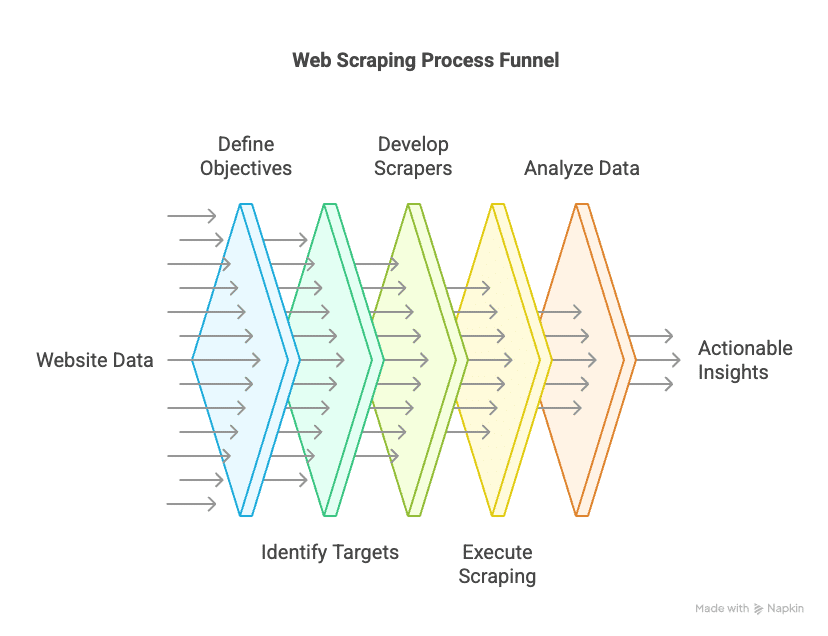
How Web Scraping Works
Web scraping typically involves the following steps. Define the intended source scope, fields and permitted use before starting; then record failures alongside the successful results:
- Retrieve a response: Request an allowed URL with an explicit timeout, then check status, content type and whether the expected page was returned. The Requests quickstart documents response handling and error checks. An error or challenge page must not be treated as product data.
- Parse the content: Build a document tree and select the relevant elements. A parser such as Cheerio does not act as a browser or execute page JavaScript. Supply the appropriate HTML before extracting fields.
- Extract and validate fields: Read the required text, attributes or table cells. Check identifiers, currency, units and absent fields against a small known sample; preserve the original value when normalization could lose meaning.
- Store records with context: Save the source URL, observation time and relevant variant or location together with the extracted fields. Keep rejected records and reasons separately so missing data is visible.
- Repeat within a defined scope: Follow permitted pagination with a stopping rule and record visited pages. Refresh on an agreed schedule and monitor changed layouts. Repeated retrieval is not a guarantee of complete coverage or immediate freshness.
Five distinctions to check: finding a page is discovery; fetching it is retrieval; reading a field is extraction; checking the field is validation; interpreting the collection is analysis. A failure at an earlier step limits what later conclusions can support. Keep these stages separate when estimating coverage or explaining results to a client.
Key Types of Web Scraping
-
HTML extraction
The required fields may already be present in the retrieved HTML. This describes the response being parsed, not a promise that the underlying website never changes. Inspect a sample response before adding browser automation. -
Rendered-page extraction
Some fields appear after JavaScript runs or after an interaction. Check for a suitable documented API or export first; otherwise, an authorized browser workflow must wait for the required content and validate it. A page using JavaScript does not mean every field requires browser rendering. -
Visual extraction
Reading pixels or using OCR is different from selecting HTML elements. It can introduce character and layout errors, so verify the extracted text and units against the image. A screenshot alone is not a structured dataset. -
API-based collection
A documented API supplies structured responses under its own access rules, quotas and schema. It can remove the need to parse page markup, but it still needs error handling, pagination and validation. Check that its fields and coverage fit the project rather than assuming an API is always more reliable.
Applications of Web Scraping in E-commerce
Web scraping has numerous applications across various industries, particularly in e-commerce:
- Market research: Compare dated observations from a defined set of sources. Report the countries, categories and sources included, plus missing observations; do not describe a selected sample as the entire market.
- Business research: Permitted company information can help identify organizations relevant to a project. Public visibility of a person’s contact information does not by itself authorize collection or unsolicited marketing; assess the specific use and applicable requirements.
- E-commerce price monitoring: Compare the same model, variant, currency and purchase conditions. Keep item price, delivery charges and conditional promotions separate before calculating a comparable total.
- Review analysis: Where collection and reuse are permitted, analyze the collected reviews while documenting language, time range, duplicates and selection limits. Those reviewers are not necessarily representative of all buyers, and a sentiment label is an analysis result rather than an observed sales measure.
- Published market information: Collect permitted company announcements or other published information with its source and timestamp. Scraping does not guarantee a live price feed, licensing rights or suitability for trading decisions; verify the provider’s intended use and update terms.
Advantages of Web Scraping
- Repeatability: Automation can reduce repeated manual collection. Measure successful validated records and maintenance effort; the advantage depends on the source and the workflow.
- Cost assessment: Compare development, hosting, access fees, monitoring and repair costs with a suitable licensed feed or manual process. Scraping does not automatically eliminate data-licensing or quality-control costs.
- Scheduled observations: A run records what the source returns at that time. Freshness depends on both the source’s own update delay and the collection schedule; use a documented observation timestamp instead of an unqualified real-time claim.
- Controlled scale: Expand a tested workflow within source limits and available processing capacity. More requests can also produce more missing or inconsistent records; monitor coverage and failures as the scope grows.
- Defined fields: A scraper can target the fields your project needs. Changes to source markup, available fields or business requirements still require maintenance and validation.
Fictional price-comparison example: suppose the same variant is listed at USD 19.99 plus USD 5.00 mandatory delivery by seller A, and USD 22.00 with delivery included by seller B. Assuming the same tax and purchase conditions and no other charges, the comparable totals are USD 24.99 and USD 22.00. B is USD 2.99 lower despite its higher item price. If A’s delivery cost is missing, its total is unknown; treating the missing charge as zero would give the wrong comparison.
Legal and Ethical Considerations in Web Scraping
When collecting web scraping datasets, assess the source, intended use, relevant jurisdictions and any personal information involved. The following checks help frame that review; they do not establish legal permission for every project:
- Access and reuse terms: Review the source’s applicable terms, API or data licence and restrictions on redistribution. Obtain appropriate advice where permission, copyright or contractual obligations are unclear.
- Robots.txt: Respect the crawler rules published by the site. RFC 9309 explicitly distinguishes this protocol from access authorization; an allowed path does not settle permission to collect or reuse its contents.
- Personal information: Publicly accessible personal data remains subject to privacy laws in most jurisdictions, as explained in the joint statement from data protection authorities. Review purpose, necessary fields, retention and applicable rights before collecting it.
Before collection: document the permitted source and purpose, the minimum fields needed, who may receive the output and how long it will be retained. Stop and investigate access denials or unexpected personal information rather than assuming that technical availability settles permitted use.
Conclusion: Understanding the Definition of Web Scraping and Its Benefits
The definition of web scraping describes extraction, not guaranteed business insight. A useful result has clear fields, a defined source scope, observation times and visible quality limits. For a runnable local exercise, follow our beginner scraping guide; for component selection, use the framework and tool comparison.
For more information on how Easy Data can help with your web scraping needs, visit EasyData.io.vn.
Reference and next steps
Leave a Reply