

Standard sales dashboards only reflect part of a business’s operations. To better understand marketing performance, customer behaviour and market changes, beauty brands need data analytics platforms suited to the specific characteristics of the industry.
Below are 10 notable beauty analytics platforms for ecommerce brands, ranging from tools for tracking business performance to solutions for customer analytics, media and market data.
What Is a Beauty Analytics Platform?
A beauty analytics platform is a platform that helps beauty brands collect, consolidate and analyse data to support business operations and decision-making. Data sources may come from a brand’s internal operations, such as orders, advertising, customers and website activity, or from the external market, such as selling prices, competitors’ products, category trends and activity on ecommerce marketplaces.
In the Beauty industry, data needs to be analysed in the context of product-specific characteristics and consumer behaviour. For example, a brand may need to track the profit of each lipstick shade, identify skincare customers’ repurchase cycles or understand common feedback about a product’s texture and potential to cause irritation.
One distinction worth noting is that beauty analytics platforms are not exactly the same as market intelligence platforms. Market intelligence platforms focus on external market data. Beauty analytics platforms, meanwhile, have a broader scope; depending on the platform, a tool may draw on internal data, external data or a combination of both.
Notable Beauty Analytics Platforms
The platforms below are divided into four groups based on their primary analytical purposes. This classification helps businesses identify the problems each tool is designed to address, as not all platforms provide the same types of data.
Overview of 10 beauty analytics platforms:
Platform |
Key data |
Questions the platform helps answer |
Trivas.ai |
Sales, advertising and ecommerce performance |
What factors are affecting revenue and profit? |
Triple Whale |
Store and multi-channel marketing data |
Which channels or campaigns contribute to business results? |
Polar Analytics |
Ecommerce data from multiple sources |
How can data be consolidated and monitored in one system? |
Lifetimely |
Orders and customers |
How are customer LTV and repurchase behaviour changing? |
Revieve |
AI-powered beauty interactions and analysis |
How can product consultation experiences be personalised? |
Inference Beauty |
Product data and consultation interactions |
How can customers find products that suit them? |
Marklo |
Marketing and campaign data |
Which campaigns are effective, and what should be done next? |
Easy Data |
Marketplace data |
How are competitors, selling prices and category trends changing? |
BigSeller |
Orders, inventory and multi-marketplace operations |
How can sales operations across multiple channels be managed? |
Launchmetrics |
Media, influencers and brand data |
What kind of impact are media activities generating? |
Profit and Performance Analytics Platforms
This group focuses on a brand’s operational data and business performance. These platforms help track revenue, costs, advertising and customer value, giving businesses a clearer understanding of the factors affecting financial results.
1. Trivas.ai
Best for: Ecommerce brands that want to monitor business performance and assess the factors affecting revenue, costs and profit.
Trivas.ai provides an AI-powered dashboard system that consolidates ecommerce data and helps businesses monitor their operations. The platform presents features for connecting data sources, tracking metrics such as ROAS, CAC and net margin, and using AI Wingman to help users query data and identify optimisation opportunities.
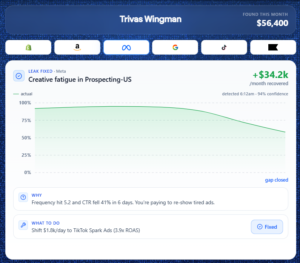
For a beauty brand, this information can help compare business performance across product lines, evaluate advertising activities and monitor the impact of costs on profit margins. This is a useful perspective for businesses seeking to identify which products or sales channels are contributing more effectively to business results.
- Data sources: Ecommerce, store, advertising and system data sources supported by the platform’s integrations.
- Limitations to consider: Trivas.ai focuses on ecommerce performance analytics in general rather than being a platform built specifically for the Beauty industry. Businesses should check its connectivity and the level of product data detail available before implementation.
- Pricing model: Based on data volume and the number of connected channels, rather than being calculated directly from advertising spend.
2. Triple Whale
Best for: DTC brands that want to consolidate ecommerce data and track multi-channel marketing performance.
Triple Whale is an analytics platform for ecommerce brands, known for consolidating business data and helping measure advertising performance. Through its attribution system, brands can examine marketing touchpoints along the purchase journey and assess each channel’s contribution to conversion results.
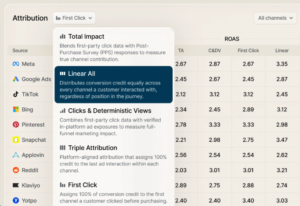
For beauty brands running multiple campaigns on Meta, Google or TikTok, Triple Whale can give marketing teams a more consolidated view of channel performance. Rather than relying only on separate reports from each advertising platform, businesses have an additional basis for comparing results and adjusting budgets.
- Data sources: Ecommerce store data, advertising data and supported marketing integrations.
- Limitations to consider: Attribution results depend on the measurement model and connected data. Different models may allocate revenue to marketing channels in different ways, so attributed revenue should not automatically be treated as incremental revenue generated by a campaign.
- Pricing model: Based on service plans, depending on business scale and usage requirements.
3. Polar Analytics
Best for: Ecommerce brands that need to consolidate data from multiple systems and build business reports tailored to their needs.
Polar Analytics helps businesses connect data from ecommerce and marketing sources to monitor business operations in one unified system. The platform provides Business Intelligence, dashboards, custom reporting and multi-touch attribution features.
For beauty brands operating across multiple channels, consolidating data makes it easier for teams to monitor sales performance, marketing and business metrics. Businesses can also build reports around their own management objectives, rather than manually compiling data from multiple systems or relying entirely on default dashboards.
- Data sources: Ecommerce, advertising and other platforms supported by Polar Analytics integrations.
- Limitations to consider: The value of the system depends on the quality of input data and how the business defines its metrics. Brands with advanced analytics needs should check its reporting customisation and integration capabilities before use.
- Pricing model: Based on online GMV and the selected products or features.
4. Lifetimely
Best for: Ecommerce brands that want to understand customer lifetime value and repeat purchasing behaviour.
Lifetimely focuses on analysing customer and order data to help businesses track Customer Lifetime Value (LTV), profitability and shopping behaviour over time.
This perspective is particularly relevant to the Beauty industry, especially for brands selling skincare, haircare or personal care products that customers need to repurchase regularly. For example, a business can observe whether customers who buy a serum for the first time return to purchase again, the time between purchases and the value generated by each customer group.
These insights help brands assess customer base quality and buyer retention performance, rather than focusing only on the number of new orders.
- Data sources: Ecommerce store, order and customer data supported by the platform’s integrations.
- Limitations to consider: LTV and repurchase behaviour analysis depends on transaction history and the ability to identify customers. Incomplete or fragmented data may affect the reliability of the results.
- Pricing model: Subscription-based, with tiers determined by monthly order volume.
Customer Experience and Marketing Analytics Platforms
This group focuses on customer experience, product discovery and marketing activities. Some platforms use AI to analyse needs or provide personalised recommendations, while others combine campaign data to support planning and performance tracking.
5. Revieve
Best for: Beauty brands and retailers that want to use AI for consultation, skin analysis and personalised shopping experiences.
Revieve develops technology solutions specifically for the Beauty industry, combining AI, computer vision and personalisation technologies. One of its notable applications is AI Skin Analysis, which allows users to take a photo to analyse certain skin characteristics and concerns, then receive recommendations for suitable products or skincare routines.
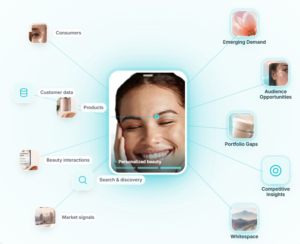
For skincare brands, this tool can create an online consultation experience that is closer to receiving advice in-store. Instead of choosing products based only on general descriptions, customers have more personalised information to help them discover products that suit their needs.
Revieve also develops solutions related to virtual try-on, personalised recommendations and conversational AI, helping brands build interactive experiences across digital channels.
- Data sources: User images and interaction data, product information and data generated during consultation and personalisation.
- Limitations to consider: Revieve focuses on experience technology and personalisation in the Beauty industry. It does not replace business systems for analysing profit, orders or advertising performance.
- Pricing model: Licensing based on requirements, depending on the modules, website traffic and implementation scope.
6. Inference Beauty
Best for: Beauty brands that want to improve product discovery and provide recommendations suited to each customer’s needs.
Inference Beauty provides AI solutions for ecommerce in the beauty industry, including tools for skin analysis, hair analysis, foundation matching, fragrance consultation and product ingredient explanations.
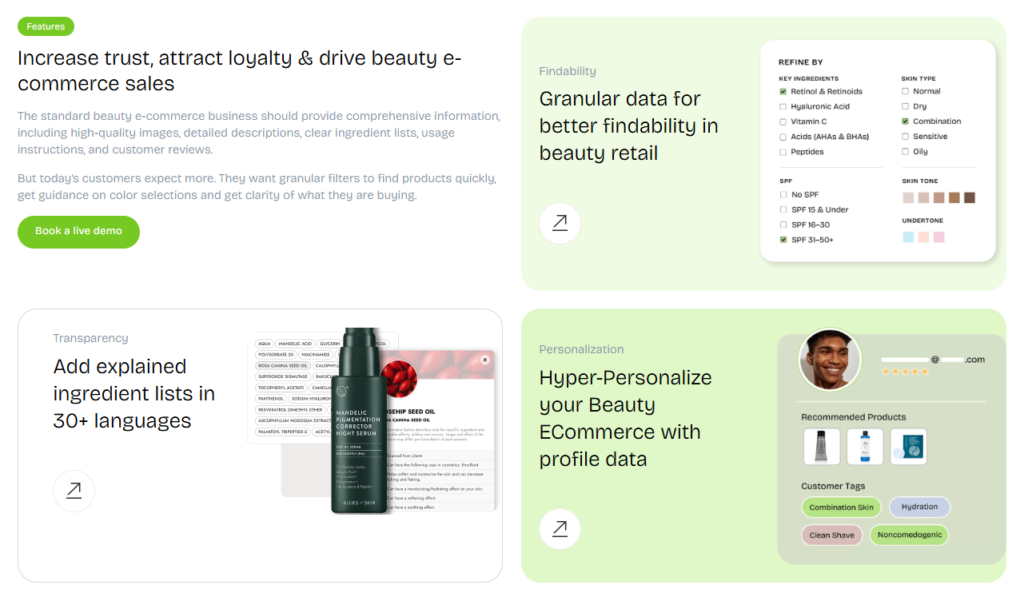
One notable aspect of the platform is its focus on the specific characteristics of Beauty products. For example, customers can search for skincare products based on skin type, skin concerns, sensitivity or ingredients they want to avoid. For makeup, a shade-finding tool can help customers identify a foundation shade that better matches their individual characteristics.
Alongside its consultation tools, Inference Beauty also provides analytics and customer insights to help brands better understand how customers interact with product-finding and recommendation solutions.
- Data sources: Product data, ingredients, consultation information and customer interactions with AI tools.
- Limitations to consider: The platform focuses on product discovery and personalisation experiences. Businesses should assess its integration capabilities with their websites, ecommerce systems and existing marketing tools.
- Pricing model: SaaS packages based on monthly session volume, catalogue size by SKU and the number of modules implemented.
7. Marklo
Best for: Shopify DTC brands that want to consolidate marketing data, plan campaigns and track multi-channel results.
Marklo is an AI-powered marketing platform that combines performance reporting, a marketing calendar and tools to support campaign planning. The platform connects data from Shopify and marketing tools to help teams track the results of sales, email, SMS, advertising and social media activities.
One notable point is that Marklo does not focus only on reporting what has already happened. The platform also uses campaign data, business results and product information to suggest the next marketing activities.
For beauty brands that regularly run seasonal campaigns, launch new products or offer promotions, consolidating campaign schedules and results makes it easier for teams to track activities across channels.
- Data sources: Shopify data and supported integrated marketing channels.
- Limitations to consider: Marklo is primarily positioned for Shopify DTC brands. Businesses whose main sales channels are Shopee, Lazada or TikTok Shop should check its support for these platforms before choosing it. Product status and integration coverage should also be confirmed at the time of implementation.
- Pricing model: Subscription through the Shopify App Store.
Marketplace Data and Operations Analytics Platforms
For Beauty brands selling on marketplaces, marketplace data is an important part of analytics. However, two needs should be distinguished: monitoring the external market to research competitors and product categories, or managing the operational data of the brand’s own stores across multiple marketplaces.
8. Easy Data
Best for: Beauty brands, sellers and market research teams that need to monitor competitors, selling prices and category trends across ecommerce marketplaces in Southeast Asia.
Easy Data provides structured ecommerce data collection solutions that help businesses monitor the market and analyse competitive activity across ecommerce marketplaces.
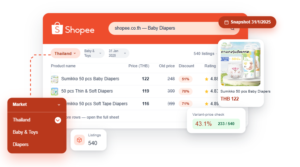
For beauty brands, marketplace data can be used to track selling prices, product catalogues, promotional activities, customer reviews and market changes. For example, a brand can observe which skincare categories competitors are focusing on, how the prices of competing products are changing or which products are attracting attention on marketplaces.
Businesses can also customize the scope and data fields to be collected according to their analytical objectives. Once organised in a consistent structure, the data can be used to build dashboards and reports or integrated into an internal BI system.
- Data sources: Public marketplace data from popular platforms in Southeast Asia, such as Shopee, Lazada and TikTok Shop.
- Limitations to consider: Easy Data provides external market data and does not replace internal data such as actual costs, net profit, advertising budgets or customer lifetime value. Businesses need to combine both data sources if they want to assess business performance and competitive positioning at the same time.
- Pricing model: Quoted based on each project’s data scope, platforms, product categories and collection requirements.
9. BigSeller
Best for: Sellers and ecommerce brands that need to manage orders, inventory and business operations across multiple marketplaces.
BigSeller is a platform that supports multi-channel sales management, particularly targeting sellers in Southeast Asia. It provides features such as product management, order processing, inventory management and sales data reporting.

For beauty brands selling on multiple marketplaces, centralised product and order management helps reduce manual work across stores. Businesses can also monitor inventory status and use operational reports to keep track of sales performance.
An important difference is that BigSeller focuses on the data and operations of the seller’s own business. Therefore, the platform is better suited to multi-channel business management than market research or monitoring external competitor data.
- Data sources: Product, order, inventory and store activity data from platforms supported by BigSeller.
- Limitations to consider: BigSeller is an ecommerce operations management solution, not a market intelligence platform specialising in external market analysis. Businesses should check which marketplaces and reporting features are supported in the markets where they operate.
- Pricing model: A free plan with usage limits and paid plans depending on operational scale.
Brand and Media Analytics Platforms
In addition to business and customer data, media performance is another important perspective for beauty brands, especially when businesses invest in PR, influencer marketing and brand awareness.
10. Launchmetrics
Best for: Beauty brands with PR, influencer marketing and multi-channel media activities that need to measure brand impact.
Launchmetrics is a platform serving the Fashion, Luxury and Beauty industries, focusing on managing and measuring media performance. One of its notable metrics is Media Impact Value® (MIV®), developed to quantify the value of content and brand mentions across multiple channels.
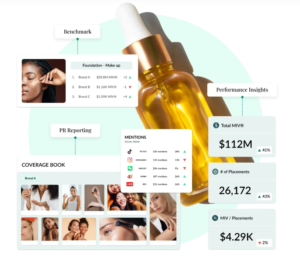
MIV is not based solely on the number of mentions. Launchmetrics’ measurement methodology considers several factors, such as engagement, the relevance of the media source, content quality and the influence of groups such as influencers, celebrities, media or owned media.
For beauty brands, this provides a useful perspective when evaluating product launch campaigns, influencer collaborations or brand presence in the media. Instead of looking only at views and engagement, marketing teams can use MIV to compare media impact across different channels and activities.
- Data sources: Data from the press, online publications, blogs, social media and the media groups monitored by Launchmetrics.
- Limitations to consider: MIV is a media measurement metric based on Launchmetrics’ own methodology. It is not equivalent to the actual revenue or profit generated by a campaign. Businesses should not use this metric as a replacement for conversion and financial performance measurements.
- Pricing model: Subscription-based, with pricing depending on the scope of use and features implemented.
Conclusion
A beauty brand cannot assess its business position solely by looking at what is happening inside its own store. Understanding customers, operational performance and the market are perspectives that need to be considered together. What matters is not using as many beauty analytics platforms as possible, but knowing what information is missing in order to make better decisions.
If your business is looking for a platform that fits its scale and business objectives, read How to Choose the Right Beauty Analytics Platform to learn about the criteria to consider before investing.
Leave a Reply