
If you work in the beauty industry, you’ve probably seen products suddenly go viral on social media and sell out across eCommerce platforms within just a few hours. The challenge is that most brands only recognize these trends after they’ve already peaked or started to fade. By then, adjusting product strategy, inventory, or marketing campaigns is often one step too late.
This is why beauty market intelligence has become an increasingly important part of how beauty brands operate. Instead of relying on intuition or market reports that are updated periodically, businesses can monitor market data in near real time to identify emerging trends earlier and make faster, more informed decisions.
Market Intelligence in the Beauty Industry
Beauty Market Intelligence is the continuous process of collecting, consolidating, and analyzing data across the beauty market, from consumer purchasing behavior and competitor activities to pricing changes and emerging consumer trends. Its goal is to help businesses monitor the market in real time rather than relying solely on historical data.
Unlike traditional market research, which provides a snapshot of the market at a specific point in time, market intelligence enables beauty brands to continuously monitor market dynamics by combining data from multiple sources, including eCommerce platforms, social media, and consumer behavior. This allows businesses to identify emerging trends more quickly, track competitor movements, and make decisions based on up-to-date, real-time insights.
How Modern Beauty Market Intelligence Works
To generate actionable insights, modern beauty market intelligence systems follow an end-to-end data processing workflow, from data collection and standardization to analysis. This enables businesses to continuously monitor the market and make decisions based on data rather than intuition.
Where Does the Data Come From?
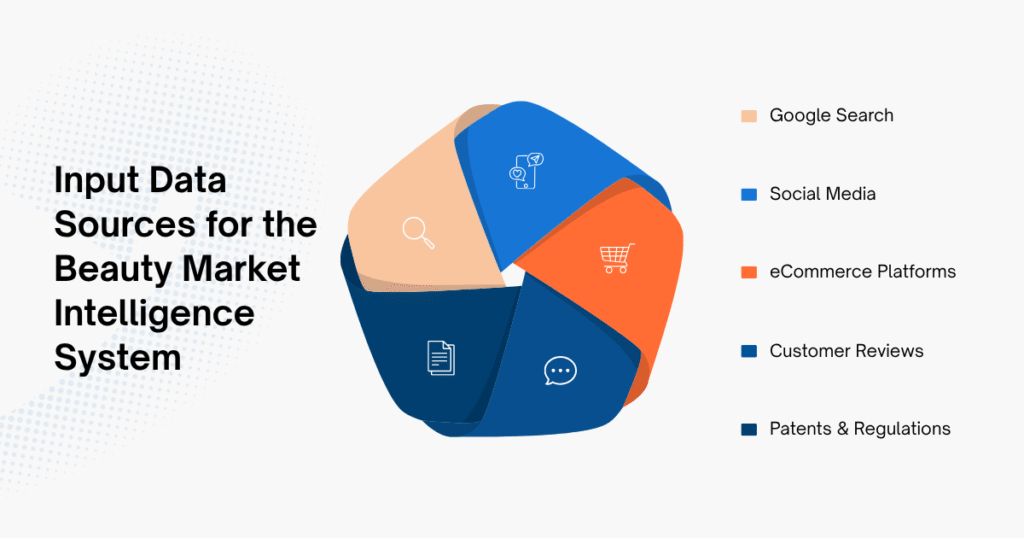
Beauty market intelligence systems typically collect data from a wide range of sources, including Google Search trends to track demand for specific ingredients or skin concerns; social media content to identify emerging trends; product data from eCommerce platforms to monitor SKUs, pricing, and inventory availability; customer reviews and ratings; as well as patent databases, new ingredient developments, and market-specific regulatory updates.
By combining data from multiple sources, businesses gain a more comprehensive view of the market instead of analyzing each channel in isolation.
The Technology Behind the Process
Once collected, the data goes through multiple processing stages before it becomes actionable insights.
Data scraping technologies automatically collect large volumes of data from websites and eCommerce platforms. Customer reviews are then analyzed using Natural Language Processing (NLP) models, allowing the system not only to determine whether a review is positive or negative but also to understand what customers are actually talking about (whether it’s fragrance, texture, packaging, or product quality).
In addition, computer vision technology analyzes images to identify emerging trends in packaging, colors, and product designs that are gaining traction on social media. Once processed, the data is consolidated into dashboards and analytical models, making it easier for marketing, eCommerce, and R&D teams to monitor market changes and make informed decisions.
Three Core Levels of Beauty Market Analysis
To make market data truly useful for business decision-making, beauty market intelligence typically analyzes the market at three different levels:
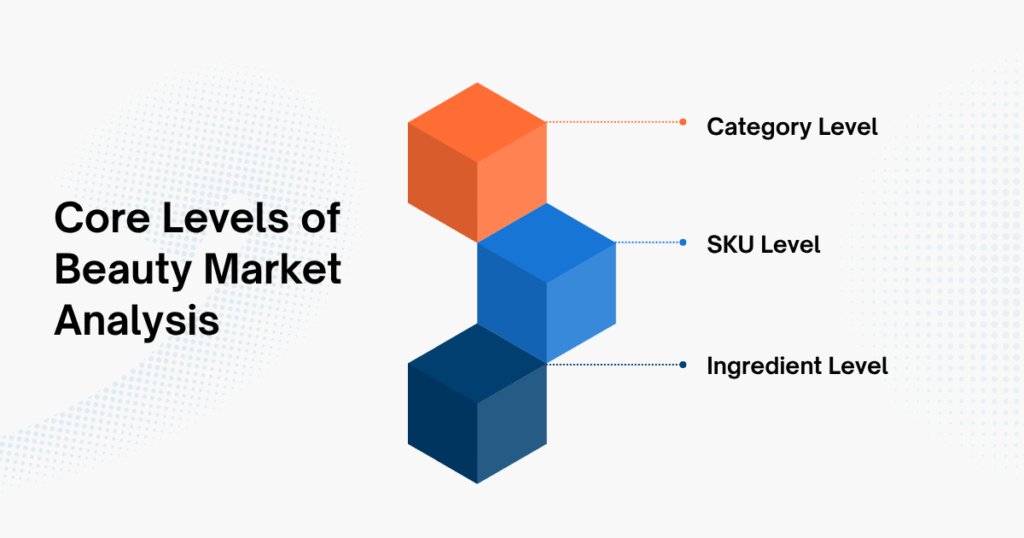
- Category Level: Businesses can monitor the size and growth rate of different product categories, such as retinol serums or spray sunscreens.
- SKU Level: The system tracks the performance of individual products or product variants, including pricing, discount levels, inventory status, and sales performance over time.
- Ingredient Level: Businesses can monitor market interest in active ingredients such as Bakuchiol, Peptides, and PDRN. This also helps R&D teams identify promising ingredients early and make more informed product development decisions.
Beauty Market Intelligence Trends in Southeast Asia 2026: Why Brands Need It
Southeast Asia’s beauty market is now worth tens of billions of dollars according to multiple industry reports, with skincare accounting for the largest share of the region’s eCommerce GMV. As the market continues to grow and consumer trends evolve at a rapid pace, beauty market intelligence is becoming an essential capability that helps brands monitor market changes and respond faster.
Here are key trends shaping how beauty brands leverage market intelligence in 2026.
1. Skincare Remains the Center of Market Intelligence
If brands had to prioritize one category for market analysis, skincare would be the obvious choice. Across Southeast Asia, the skincare market is now roughly twice the size of color cosmetics, while several subcategories are experiencing remarkable growth. For example, the sunscreen segment in Indonesia has recorded value growth of up to 70%, while men’s skincare has expanded by nearly 200%.
These shifts are also changing how brands collect and analyze customer data, as today’s beauty consumers extend far beyond the traditional demographic of young women.
2. Social Commerce Has Become the Most Valuable Data Source
The line between social media and eCommerce continues to blur. Platforms such as TikTok Shop and Shopee Live have become not only major sales channels but also some of the richest sources of market intelligence across Southeast Asia, particularly in Vietnam and the Philippines.
Leading brands are also shifting away from relying solely on celebrity influencers. Instead, they use data to identify micro-influencers with between 2,000 and 10,000 followers, as this group often delivers stronger engagement and conversion rates.
At the same time, many R&D teams are using AI to analyze millions of livestream comments and social media conversations, helping them identify emerging ingredients such as Bakuchiol and PDRN before they become mainstream.
3. Halal Certification Is Becoming a Regulatory Requirement in Indonesia
For beauty brands planning to expand into Indonesia, Halal certification is no longer something to consider later. Starting on October 17, 2026, all cosmetic products sold in the Indonesian market must obtain Halal certification (according to a regulation published in the Indonesian Post).
This means Halal is no longer a marketing advantage but a legal requirement for market entry. As a result, beauty market intelligence is evolving beyond consumer trend monitoring to include regulatory intelligence, enabling brands to prepare for compliance well before new regulations take effect.
4. The Rise of “Skinification” and Beauty Tech
Consumers across Southeast Asia are increasingly looking for products that combine makeup with skincare benefits, such as serum foundations or lip balms infused with ingredients like Hyaluronic Acid or Niacinamide. This trend, commonly known as skinification, is influencing product development strategies across the beauty industry.
Market intelligence helps R&D teams identify which active ingredients are gaining consumer attention based on real market data rather than assumptions. At the same time, technologies such as AI skin analysis and AR Virtual Try-On are generating large volumes of data on skin conditions and shopping behavior, providing insights that traditional market research would be difficult to capture at scale.
5. Every Southeast Asian Market Behaves Differently
Market intelligence data consistently shows that Southeast Asia is far from a single, homogeneous market. Each country has its own consumer behavior, competitive landscape, and growth drivers, making it difficult for brands to succeed with a one-size-fits-all strategy.
Indonesia remains the region’s largest beauty market, where local brands often outperform competitors thanks to their ability to respond quickly to changing trends. Singapore, while smaller in size, is frequently used as a testing ground for premium beauty products before regional expansion. Meanwhile, Vietnam continues to see rapid eCommerce growth, with consumers showing a strong preference for multi-step skincare routines heavily influenced by K-Beauty.
How Market Intelligence Drives Growth for Beauty Brands
For beauty brands, market intelligence is not just about understanding how the market is changing. It also supports day-to-day business decisions across product development, pricing, compliance, and marketing. Some of its most valuable applications include:
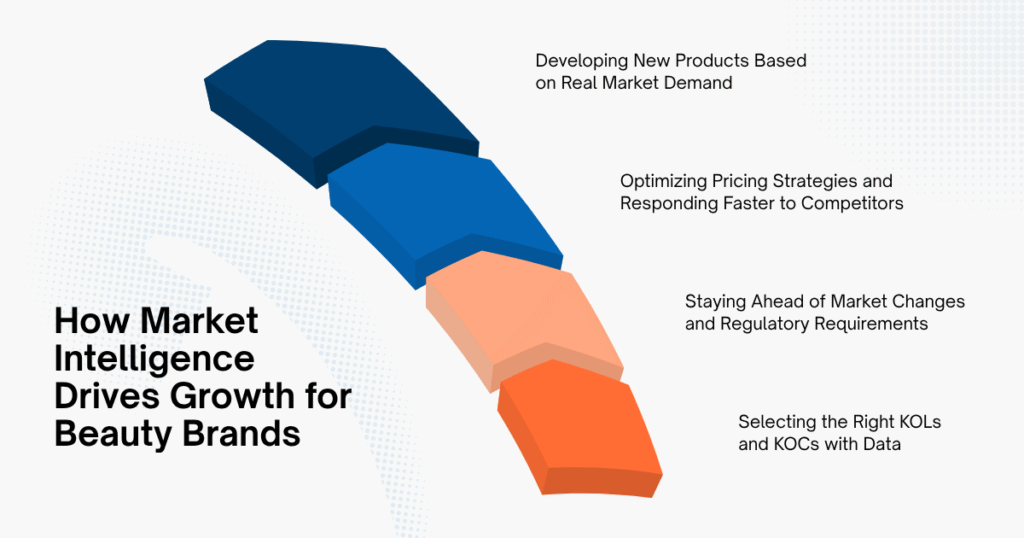
Developing New Products Based on Real Market Demand
One of the biggest advantages of market intelligence is reducing the risk of new product development. Instead of relying solely on experience or assumptions about future trends, R&D teams can use market data to identify unmet consumer needs and develop products that better match actual demand.
For example, emerging skincare ingredients such as PDRN, Peptides, and Bakuchiol, discussed earlier, can serve as early market signals to help brands evaluate new product opportunities.
Optimizing Pricing Strategies and Responding Faster to Competitors
In the beauty industry, prices can change frequently due to promotional campaigns, competitor activities, or major eCommerce events. Market intelligence enables brands to monitor these changes continuously and adjust their pricing strategies accordingly.
Rather than manually checking competitors’ product listings, brands can track pricing, promotional offers, and product performance in real time to remain competitive in a fast-moving market.
Staying Ahead of Market Changes and Regulatory Requirements
The beauty industry is constantly influenced by shifting consumer preferences, evolving regulations, and product standards across different markets. Market intelligence helps brands identify these changes early, giving them more time to prepare and adapt.
For example, regulatory requirements such as Indonesia’s mandatory Halal certification are developments that brands should monitor well in advance, rather than reacting only after the regulations take effect.
Selecting the Right KOLs and KOCs with Data
As social commerce continues to reshape the beauty industry, choosing the right KOLs and KOCs can have a significant impact on campaign performance. However, having a large following does not always translate into stronger sales or higher conversions.
Market intelligence helps brands evaluate influencers based on metrics such as engagement rates, audience relevance, and actual campaign performance, making it easier to identify partners who can deliver long-term business value.
How to Acquire Market Intelligence for Beauty Brands
To build market intelligence capabilities, beauty brands typically take one of two approaches: developing an in-house data system or leveraging Data as a Service (DaaS) platforms.
With an in-house approach, businesses need to start by collecting a large, accurate, and continuously updated data foundation. Instead of manually gathering information from multiple sources, brands often use automated tools to collect data from eCommerce platforms, websites, social media channels, and third-party data sources like Easy Data. This data is then standardized and analyzed to track market trends, competitor activities, and consumer behavior.
However, building an entire market intelligence system requires significant investment in technology, data infrastructure, and specialized talent. As a result, many businesses choose to use DaaS platforms, where data is already collected, processed, and delivered in a format ready for analysis.
This approach allows brands to quickly access reports, dashboards, and market insights without making substantial upfront investments in data infrastructure. However, it also comes with platform costs or subscription fees depending on business needs.
Depending on their goals and level of data maturity, many brands choose a hybrid approach: using their own data sources for specific business needs while leveraging DaaS platforms to expand their market monitoring and analytical capabilities.
Conclusion
In the beauty industry, where a new trend can emerge on social media today and become a sales opportunity tomorrow, the ability to identify market shifts earlier can become a significant competitive advantage. Beauty market intelligence helps businesses transform fragmented market data into valuable insights, enabling more informed decisions across product development, marketing, and growth strategies.
As eCommerce and social commerce continue to expand across Southeast Asia, the ability to effectively leverage data will become increasingly important for beauty brands looking to capture opportunities and build sustainable competitive advantages.
Leave a Reply