

For ecommerce brands, data underpins nearly every critical decision, from market research and competitor monitoring to pricing, demand forecasting, inventory, and product assortment. Each challenge, however, requires different types of data and ways of using it.
To meet these needs, more ecommerce companies are turning to Data as a Service (DaaS). Instead of building and maintaining their own data infrastructure, they can tap into standardized, ready-to-use datasets and focus on generating insights and making better decisions.
In this article, Easy Data explores the most common Data as a Service use cases for ecommerce brands and the specific business challenges each one helps solve.
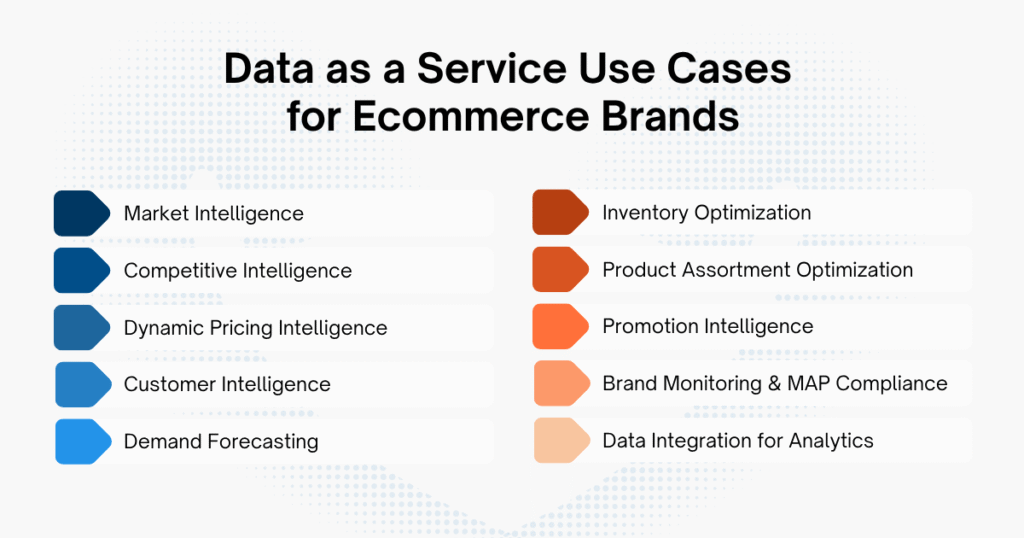
Overview of Data as a Service Use Cases for Ecommerce Brands
| DaaS Use Case | Business Goal | Typical KPIs |
| Market Intelligence | Understand market size and category trends | Market Share, Search Visibility |
| Competitive Intelligence | Monitor competitors and SKU changes | SKU Growth, Share of Voice |
| Dynamic Pricing Intelligence | Optimize pricing strategy and profit margins | Gross Margin, Average Selling Price (ASP) |
| Customer Intelligence | Personalize the omnichannel customer experience | Conversion Rate (CR), Customer Lifetime Value (LTV), Average Order Value (AOV) |
| Demand Forecasting | Forecast demand for better sales planning | Forecast Accuracy, Stockout Rate |
| Inventory Optimization | Optimize inventory and working capital | Inventory Turnover |
| Product Assortment Optimization | Identify product portfolio opportunities | New SKU Success Rate, Revenue per SKU |
| Promotion Intelligence | Build more effective promotional strategies | Promotional ROI, Gross Margin |
| Brand Monitoring & MAP Compliance | Protect pricing consistency and brand reputation | MAP Compliance Rate, Number of Violations |
| Data Integration for Analytics | Automate reporting and unify data | Pipeline Uptime, Time-to-Insight |
DaaS Use Cases to Boost E-commerce Brands’ Growth and Operational Efficiency
Every ecommerce brand will have different goals for using DaaS, but most DaaS use cases revolve around three major categories: understanding the market, maximizing revenue, and improving operational efficiency.
1. Market Intelligence: Understand the Market Before Making Decisions
Many brands rely solely on their own sales data and lack clarity on the total market size, market share, fast-growing price segments, and emerging trends. This information is scattered across marketplaces and external sources, making manual collection slow and incomplete.
DaaS delivers standardized market intelligence on category size, search rankings, brand performance, and consumer trends, giving brands a full market view rather than just internal performance.
This is one of the most valuable Data as a Service use cases for ecommerce brands, especially when evaluating category expansion opportunities, identifying fast-growing market segments, or preparing to enter new markets.
Companies like LG and Philips use DaaS-powered market intelligence to track visibility, optimize portfolios, and identify growth opportunities ahead of competitors.
2. Competitive Intelligence: Monitor Competitors in Real Time
Ecommerce competition shifts quickly: new launches, Flash Sales, and stockouts can happen within days. Manual tracking often misses these changes.
With DaaS, brands gain continuous competitive intelligence across multiple ecommerce platforms. Available data may include competitor product catalogs, inventory status, pricing changes, customer ratings and reviews, and SKU expansion over time.
With this, ecommerce and marketing teams can proactively adjust ad budgets, assortments, and campaigns, and seize opportunities when competitors are out of stock.
3. Dynamic Pricing Intelligence: Optimize Prices Without Sacrificing Margins
On marketplaces like Shopee and TikTok Shop, the final price reflects a mix of Flash Sales, vouchers, coupons, and bundled promotions.
This makes dynamic pricing intelligence one of the most widely adopted Data as a Service use cases today. Ecommerce data platforms automatically track price movements, maintain historical records, and benchmark against competitors, enabling brands to design data-driven pricing strategies rather than relying on intuition.
In many cases, the goal is not always to be cheapest; market data may show customers will pay more for stronger brands, reviews, or service. For brands selling across multiple marketplaces, real-time pricing intelligence also helps maintain pricing consistency across channels and minimize uncontrolled price discrepancies.
4. Customer Intelligence: Understand Customers to Deliver Personalized Experiences
Customer interactions span websites, marketplaces, social media, email, chatbots, and stores. However, these data sources often remain disconnected, preventing businesses from seeing the complete customer journey.
One of the most notable DaaS use cases is its ability to connect and standardize this data to build unified customer profiles, revealing not only what customers buy but also what they browse, what they engage with, and how their behavior evolves.
With a more complete customer profile, marketing becomes significantly more effective. Brands can personalize content, recommend relevant products, launch timely cross-sell and upsell campaigns, and reduce wasted advertising spend on poorly targeted audiences.
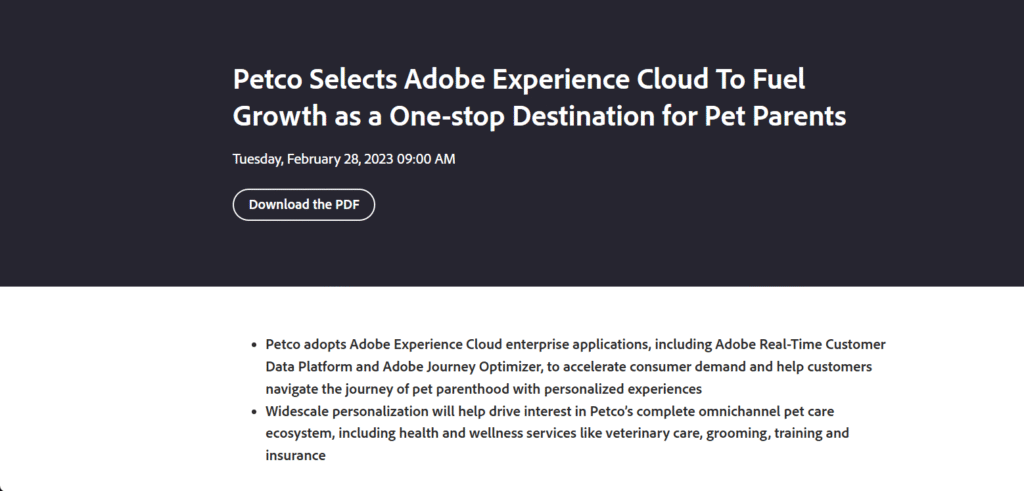
Petco, for example, integrates data from its online platform and 1,500+ stores to tailor recommendations to each pet instead of sending one-size-fits-all messages.
5. Demand Forecasting: Predict Demand Before the Market Changes
Ordering too much inventory increases storage costs, while ordering too little results in stockouts during periods of high demand. Businesses that rely solely on historical sales data often overlook important external factors influencing demand, including search trends, consumer behavior, seasonality, and special events.
DaaS expands forecasting capabilities by combining internal data with external signals such as search trends, social media, and category-level intelligence to feed more accurate forecasting models for the next 30, 60, or 90 days.
This DaaS use case is especially valuable for seasonal brands or those active in major sales events, improving production planning, inventory buying, and marketing allocation.
Real-world example: BigBasket used this approach to cut fresh food waste while maintaining healthier inventory levels and reducing stockouts.
6. Inventory Optimization: Improve Inventory Efficiency and Cash Flow
Inventory affects both service levels and working capital. Excess stock raises warehousing costs; poor regional allocation slows delivery and increases logistics expenses.
Through DaaS platforms, businesses can track regional demand, sales performance, and stock movements across warehouses so brands can allocate inventory based on real-time demand instead of guesswork.
This capability is especially valuable for brands operating multiple warehouses or selling across multiple markets. Placing inventory closer to areas with stronger demand improves delivery speed while reducing capital tied up in slow-moving inventory.
7. Product Assortment Optimization: Identify Market Gaps for New Product Development
Not every new product succeeds. In reality, many brands still make assortment decisions based on intuition or their own historical sales performance.
DaaS reveals fast-growing segments, underserved attributes, and underpenetrated price ranges, helping brands focus R&D on opportunities with real market potential. These insights help product teams reduce the risks associated with launching new products while focusing resources on opportunities with stronger market potential.
This is one of the most valuable Data as a Service use cases for companies expanding their product portfolios or entering new markets because product development decisions are driven by market evidence rather than assumptions.
A prime example is McCormick & Company, which uses consumer preference and flavor trend data to guide innovation, shorten development cycles, and improve the success rate of launches.
8. Promotion Intelligence: Design Smarter Promotional Campaigns
Major ecommerce shopping festivals have become increasingly competitive. Yet many brands still determine discount levels based on intuition or by comparing only competitors’ listed prices, without understanding the actual prices shoppers see after platform vouchers, seller coupons, Flash Sales, and bundled promotions are applied.
DaaS platforms provide a comprehensive view of promotional activities across the market. Beyond product pricing, they capture multiple promotional layers, including marketplace vouchers, seller discounts, bundle offers, and gifts with purchase, allowing businesses to understand competitors’ real promotional strategies.
With these insights, ecommerce teams can build more competitive campaigns without necessarily offering deeper discounts. In many cases, adjusting promotional mechanics or campaign timing is enough to improve conversion rates while protecting profit margins.
9. Brand Monitoring & MAP Compliance: Protect Brand Reputation and Pricing Integrity
As distribution networks expand, maintaining brand consistency across ecommerce marketplaces becomes increasingly difficult. Many brands struggle with unauthorized sellers, MAP violations, incorrect product images, or counterfeit listings.
DaaS model can help businesses automatically monitor product prices, listing content, and product images across multiple marketplaces simultaneously. The system can also detect MAP violations, counterfeit products, or unauthorized use of brand assets early, allowing teams to respond quickly.
For premium brands or companies with extensive distributor networks, this DaaS use case delivers long-term value by maintaining consistent pricing and protecting brand reputation across the entire ecommerce ecosystem.
10. Data Integration for Analytics: Automate Data to Accelerate Decision-Making
For many companies, the challenge is no longer data collection but integrating data from multiple systems into one analytics environment.
Data from Shopee, Lazada, TikTok Shop, websites, CRM systems, and ERP platforms often exist in separate environments. Whenever a marketplace changes its API or data structure, engineering teams must spend valuable time repairing data pipelines before business users can access updated information.
This is one of the key reasons companies are shifting from building in-house scraping systems to adopting Data as a Service. Instead of maintaining complex collection and processing workflows, businesses receive standardized datasets that integrate directly into their data warehouse or analytics dashboards.
With continuously updated data, teams can track performance in near real time and shrink the gap between data availability and decisions.
This also reflects the evolution of modern ecommerce data platforms: they no longer simply provide datasets but help businesses build centralized analytics systems where data from multiple sources is connected, standardized, and visualized within a single dashboard.
PepsiCo, for example, built a unified platform connecting dozens of marketing and sales sources so executives can monitor campaigns and act quickly without waiting for manual reports.
Which Data as a Service Use Case Should Ecommerce Brands Prioritize?
The right starting point depends on a company’s business objectives and data maturity. Rather than implementing everything at once, most businesses achieve better results by prioritizing the applications that address their most pressing challenges.
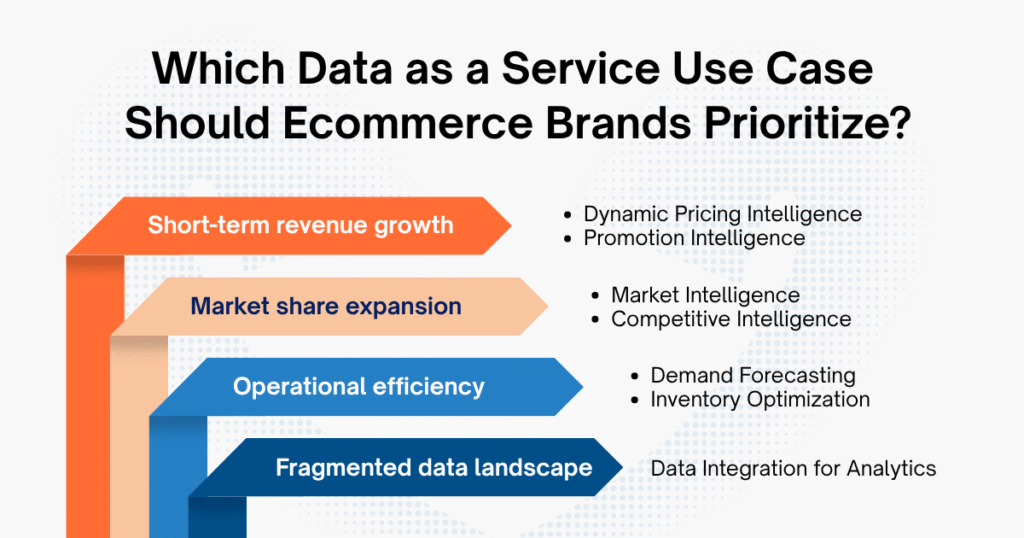
- If your goal is short-term revenue growth: Start with Dynamic Pricing Intelligence and Promotion Intelligence. These use cases directly influence pricing, conversion rates, and profit margins, often delivering measurable results quickly.
- If your priority is expanding market share: Begin with Market Intelligence and Competitive Intelligence to understand category dynamics, consumer trends, and competitor strategies before expanding into new product categories or markets.
- If operational efficiency is the focus: Demand Forecasting and Inventory Optimization typically generate the greatest value by reducing excess inventory, preventing stockouts, and improving supply chain performance.
- If your data is fragmented across multiple systems: Prioritize Data Integration for Analytics to build a unified data foundation before investing in more advanced DaaS use cases.
Conclusion
Looking across these Data as a Service use cases, one thing becomes clear: DaaS is not designed for a single department. Whether the goal is market research, competitor analysis, pricing optimization, demand forecasting, or centralized analytics, every successful use case starts with the same foundation: reliable, standardized, and readily accessible data.
This is also why many ecommerce businesses are moving beyond traditional web scraping toward modern ecommerce data platforms. The objective is no longer just collecting data, but reducing the operational burden of maintaining data pipelines so teams can spend more time uncovering insights and making faster, more confident business decisions.
Leave a Reply