

Ecommerce customer data is no longer just about tracking what customers did; it’s about understanding why they did it. On ecommerce marketplaces, customer behavior is shaped by pricing, reviews, competitors, and real-time trends. The real opportunity lies in connecting ecommerce data to uncover patterns, predict intent, and turn raw data into decisions that actually move the business forward.
What Is Ecommerce Customer Data?
Ecommerce customer data is the collection of behavioral, transactional, and interaction data that reveals how customers discover, evaluate, and purchase products across online platforms, including ecommerce websites and marketplaces.
Essentially, ecommerce customer data is less about “who the customer is” and more about how the customer behaves throughout the buying journey.
Core Types of Ecommerce Customer Data
Understanding customer behavior starts with recognizing the different data layers that capture it.
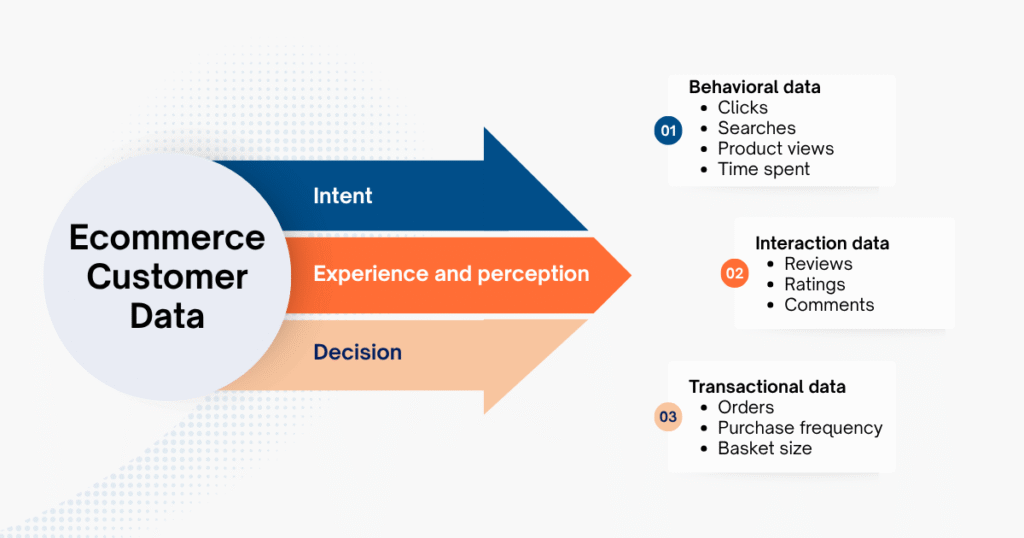
- Behavioral data: clicks, searches, product views, time spent (signals of intent)
- Interaction data: reviews, ratings, comments (signals of experience and perception)
- Transactional data: orders, purchase frequency, basket size (signals of decision)
These layers don’t exist in isolation. When connected, they form a behavioral narrative, showing not just what customers do, but how they move from awareness to purchase.
Why Ecommerce Customer Data Matters for Understanding Customer Behavior
Many businesses already collect data, but still struggle to explain why customers convert or don’t, the missing link is behavioral understanding.
- Customer journey visibility: Customers rarely follow a straight path. They browse on one platform, compare on another, and purchase somewhere else. Without connecting these touchpoints, businesses only see fragments of the journey.
- Decision-making patterns: Why does one product outperform another with similar features? Often, the answer lies in subtle behavioral cues: pricing perception, review sentiment, or positioning within a category.
- Hidden customer intent: Not all intent is explicit. A spike in product views without conversion may indicate pricing friction. A surge in reviews may signal emerging demand. These are behavioral signals that raw data alone cannot explain.
The Problem: Ecommerce Customer Data Is Fragmented
One of the biggest challenges in ecommerce customer data is not a lack of data, but a lack of connection. Data typically lives in different places:
- Website analytics tools
- Marketplace platforms (Shopee, Lazada, TikTok Shop,…)
- Customer reviews and feedback
Each source captures a part of the story, but none provides the full picture. For example, a brand might see declining conversion rates on their store, but without marketplace data, they miss the fact that competitors have adjusted pricing or improved reviews.
How to Turn Ecommerce Customer Data into Actionable Insights
Most businesses struggle not in collecting ecommerce customer data, but in transforming it into something practical. A structured approach helps bridge that gap.
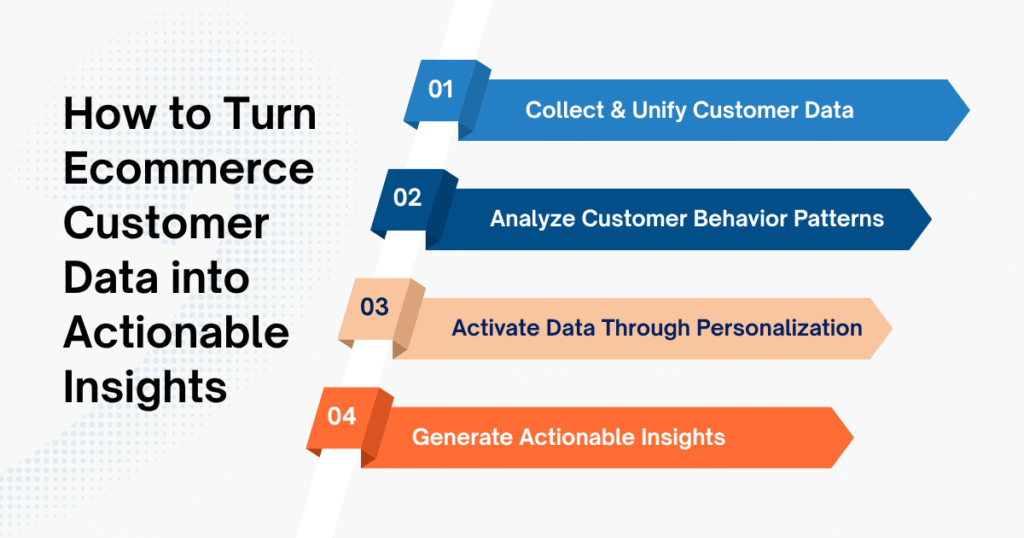
Step 1 – Collect & Unify Ecommerce Customer Data
Before analyzing behavior, you need a complete dataset. That means going beyond internal data.
- Website tracking captures direct interactions
- Marketplace data reveals real buying behavior
- Reviews provide qualitative insight into customer perception
In real life, accessing marketplace data at scale requires professional ecommerce data scraping solutions to help businesses capture real-time customer behavior data across multiple marketplaces. The key is not just collecting more data, but collecting the right data, especially from platforms where customers actually make decisions.
Step 2 – Analyze Customer Behavior Patterns
Once data is unified, patterns begin to emerge. Customer segmentation becomes more meaningful when it includes marketplace behavior. Instead of grouping users only by demographics, businesses can segment based on actual buying intent and activity.
Purchase behavior analysis also reveals trends such as:
- Which products are frequently compared
- What price ranges convert best
- How reviews influence decisions
Mapping the customer journey across platforms provides a clearer view of where customers drop off and why.
Step 3 – Activate Data Through Personalization
Insights alone don’t create value unless they are applied. Personalization is where behavioral data directly influences the customer experience:
- Product recommendations based on browsing and market trends
- Dynamic pricing aligned with competitor positioning
- Targeted campaigns that reflect real-time demand
At this stage, ecommerce customer data transitions from analytical insights to actionable information.
Step 4 – Generate Actionable Insights
At this stage, ecommerce customer data becomes a decision-making tool. Businesses can:
- Identify emerging product trends early
- Detect gaps in the market
- Optimize pricing and positioning strategies
Advanced Use Cases of Ecommerce Customer Data
Once the data system is in place, ecommerce customer data can support more advanced strategies.
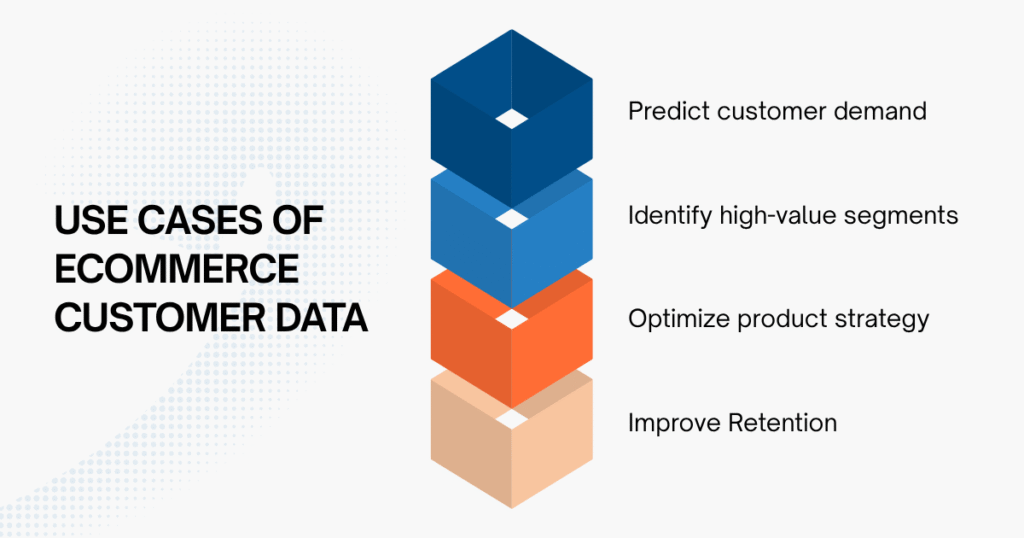
- Predict customer demand: By analyzing search trends, product views, and marketplace activity, businesses can anticipate demand before it peaks.
- Identify high-value segments: Not all customers contribute equally. Behavioral patterns help identify segments that drive long-term value.
- Optimize product strategy: Combining ecommerce product data with customer behavior reveals which products to prioritize, improve, or remove.
- Improve Retention: Insights from ecommerce sales data and repeat purchase behavior help refine retention strategies and reduce churn.
Challenges in Ecommerce Customer Data Analysis
Despite its value, working with ecommerce customer data comes with real challenges.
- Data fragmentation: As discussed earlier, data is scattered across platforms, making it difficult to unify.
- Data accuracy: Marketplace data can change rapidly, requiring constant updates to remain relevant.
- Integration issues: Combining data from different sources often requires technical infrastructure and expertise.
- Scaling problems: As data volume grows, managing and analyzing it becomes increasingly complex.
The challenge is not just collecting data, but building the infrastructure to process, unify, and analyze it continuously at scale.
Data Privacy and Compliance in Ecommerce
As businesses rely more on data, they must also ensure responsible usage.
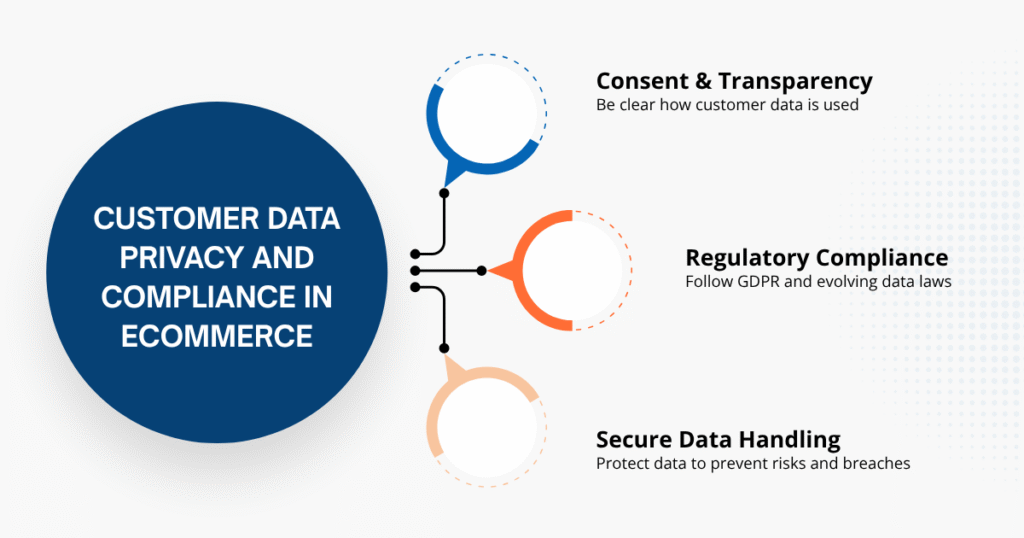
- Consent and Transparency: Customers expect clarity on how their data is used, especially for first-party data.
- Regulations (GDPR and beyond): Compliance frameworks are becoming stricter, requiring businesses to handle data carefully.
- Secure data usage: Protecting data is essential not only for compliance but also for maintaining trust.
Trust is a competitive advantage. Businesses that manage data responsibly not only avoid risk but also strengthen long-term customer relationships.
Why Web Scraping Unlocks Deeper Customer Behavior Insights
One limitation of internal data is that it only reflects what happens within your own ecosystem. It doesn’t show how customers behave across the broader market.
Web scraping changes that. By extracting data from marketplaces, businesses can:
- Analyze competitor products and pricing
- Understand customer sentiment through reviews
- Track real-time demand signals
This external layer is what completes the behavioral picture. More importantly, it enables businesses to move from reactive analysis to proactive strategy. But in reality, accessing and structuring marketplace data at scale isn’t straightforward; it requires the right data infrastructure.
Easy Data is more than your average analytics platform. We address the key issue: getting clean, organized, and scalable data from marketplaces that businesses can actually use.
With strong expertise in ecommerce data scraping across Southeast Asian marketplaces, Easy Data helps companies to tap into real-time customer behavior at scale: from pricing movements and product performance to evolving consumer demand.
For businesses operating in fast-moving markets like Southeast Asia, this is a strategic one. Because at the end of the day, the difference is simple:
- You can either rely on assumptions built from limited internal data
- Or make decisions grounded in real behavioral signals across the entire market
Conclusion
Ecommerce customer data is not just about collecting information; it’s about understanding behavior. When businesses connect data across platforms, analyze patterns, and apply insights through personalization, they move from reactive decisions to proactive strategies.
The real value lies in a simple but powerful flow: Data → Behavior → Personalization → Insight. And in a competitive ecommerce landscape, that flow is what separates brands that guess from those that grow.
Leave a Reply