

Ecommerce scraping tools have evolved from niche technical utilities into essential components for monitoring markets and tracking competition across fragmented ecommerce platforms. As data volume and complexity grow, selecting the right ecommerce scraper becomes a strategic decision that shapes how effectively market data can be collected and used. This article explores the tool from a practical perspective, focusing on use cases, trade-offs, and selection logic rather than vendor reviews.
How Are Ecommerce Scraping Tools Used for Market Visibility?
Ecommerce scraping tools are often described as software that scrapes data from ecommerce websites. In practice, their role is broader and more strategic. More accurately, these tools act as visibility layers, allowing teams to observe how products, sellers, and categories behave across marketplaces at scale.
Rather than producing insights directly, ecommerce scraping tools enable structured access to market signals to form the foundation of effective ecommerce data scraping strategies focused on business growth. They capture product attributes, pricing changes, assortment shifts, and seller activity (signals that would otherwise remain fragmented or anecdotal). The value of a scraping tool depends less on extraction itself and more on how consistently it enables this visibility over time.
Key Features to Evaluate in Ecommerce Scraping Tools (2026)
Evaluating ecommerce scraping tools based on feature lists alone is increasingly insufficient. What matters is how these features perform under real operating conditions, where platforms evolve frequently, data volumes grow quickly, and scraping becomes a recurring process rather than a one-time task.
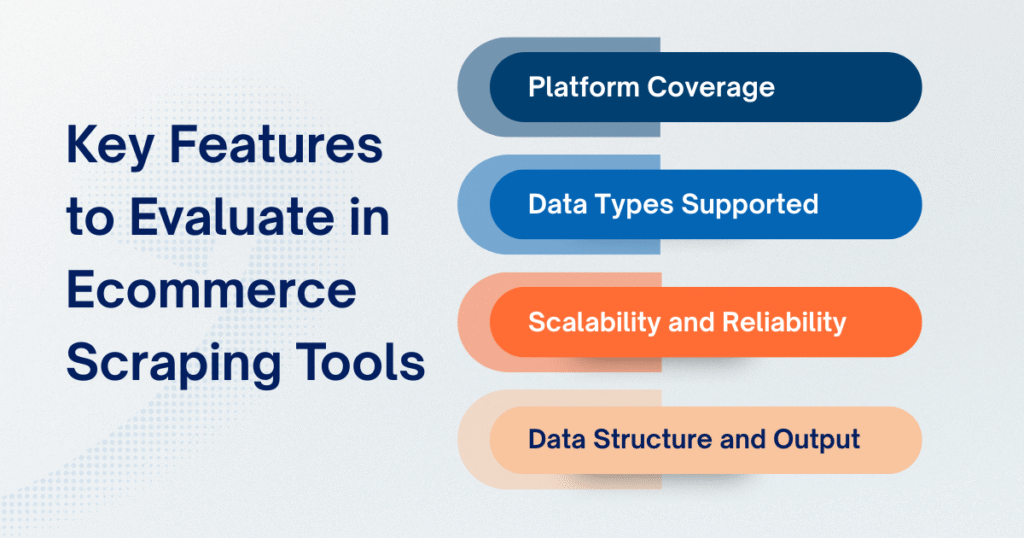
Platform Coverage and Adaptability
Platform coverage today is less about the number of supported marketplaces and more about adaptability. Tools must respond quickly to structural changes across platforms such as Shopee, Lazada, TikTok Shop, and DTC storefronts.
Tools that rely heavily on static templates often degrade as platforms change. In contrast, adaptable scraping logic supports continuity, which is critical when data is used for long-term monitoring rather than isolated research.
Data Types and Depth of Extraction
Most ecommerce scraping tools claim to extract product and price data. The difference lies in depth and consistency.
Surface-level extraction may capture visible fields but miss important signals embedded in variants, attribute hierarchies, and seller configurations. For market intelligence use cases, granular and structured product data often matters more than raw record volume.
Scalability and Operational Reliability
As scraping scales, operational reliability becomes a strategic concern. Missed schedules, partial data loss, or inconsistent refresh cycles can silently distort analysis over time.
Scalable tools are those that manage throughput, failure handling, and platform constraints predictably across repeated collection cycles, not just those that promise high volume.
Data Structure and Output Quality
Output structure determines how easily scraped data can be reused downstream, as data quality and consistency directly affect the cost of data cleaning, normalization, and long-term analytical reliability.
For teams integrating scraped data into analytics workflows, consistent structure is frequently a deciding factor when selecting a tool.
Ecommerce Scraping Tool Categories for 2026 and When to Use Them
When discussing “top” ecommerce scraping tools, focusing on individual tool names often provides limited long-term value. The long-term effectiveness of ecommerce scraping depends less on specific vendors and more on the underlying approach each tool is built on. Each tool category embeds assumptions about scale, maintenance, and flexibility, which ultimately shape how well it supports different data use cases over time.
| Tool Categories | All-in-One Ecommerce Scraping Platforms | API-First Scraping Tools | No-Code and Low-Code Scraping Tools |
|---|---|---|---|
| Example tools | – Octoparse – Import.io – ParseHub |
– Scrapy – Playwright – Puppeteer |
– Web Scraper (Chrome extension) – Simple Scraper |
| Functions | All-in-one platforms are designed to handle multiple scraping tasks within a single interface. They typically support a wide range of ecommerce sites and provide built-in scheduling, basic data structuring, and export options | API-first tools expose scraping functionality through programmable interfaces, offering technical teams greater control over data collection logic | No-code and low-code tools prioritize accessibility, enabling users to configure scraping tasks without writing code |
| Typical features | – Preconfigured templates for major marketplaces – Centralized dashboards for job management – Basic normalization of product and price data |
– Programmatic job configuration – Custom request logic – Easier integration into internal workflows |
– Visual selectors and browser-based workflows – Rapid setup for limited scopes |
| Best suited for | – Teams running recurring monitoring tasks – Business users with limited engineering support – Early-stage data initiatives prioritizing speed |
– Engineering-led teams – Custom analytics pipelines – Use cases requiring frequent logic adjustments |
– Exploratory research – One-off data collection – Small-scale projects |
| Key trade-off | Flexibility is limited when deeper customization or structural changes are required | Higher flexibility comes with increased setup and maintenance effort | These tools often struggle with scale, reliability, and long-term continuity |
Common Use Cases for Ecommerce Scraping Tools
Ecommerce scraping tools are adopted not for data collection itself, but for the questions that data helps answer.
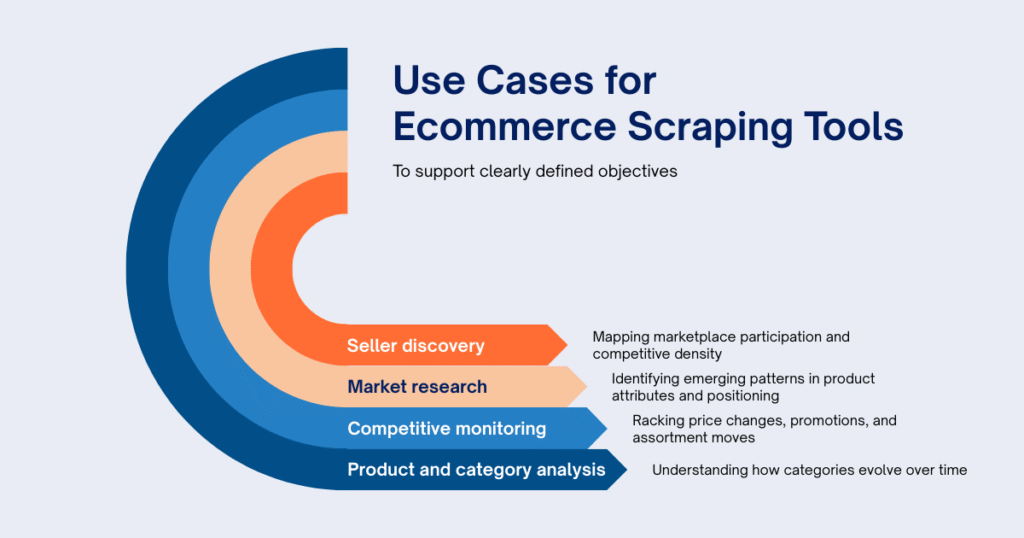
- Seller and Supply Landscape Mapping: By tracking seller participation and listing dynamics, scraping tools help organizations understand competitive density and supply-side evolution within marketplaces.
- Market Research and Early Signal Detection: Repeated scraping surfaces weak signals (such as inconsistent attributes or experimental product positioning) that often precede visible trends, capturing early signals before metrics appear. Tools are particularly valuable at this exploratory stage.
- Competitive Monitoring: Scraping enables continuous observation of competitor pricing, assortment changes, and promotional behavior. Over time, these signals reveal positioning shifts that are not immediately visible through sales metrics alone.
- Product and Category Analysis: At the category level, scraping supports analysis of how assortments expand, fragment, or consolidate. This helps teams identify emerging segments and saturation risks before they become obvious.
How to Choose the Right Ecommerce Scraping Tool
Choosing an ecommerce scraping tool is ultimately a question of alignment rather than optimization.
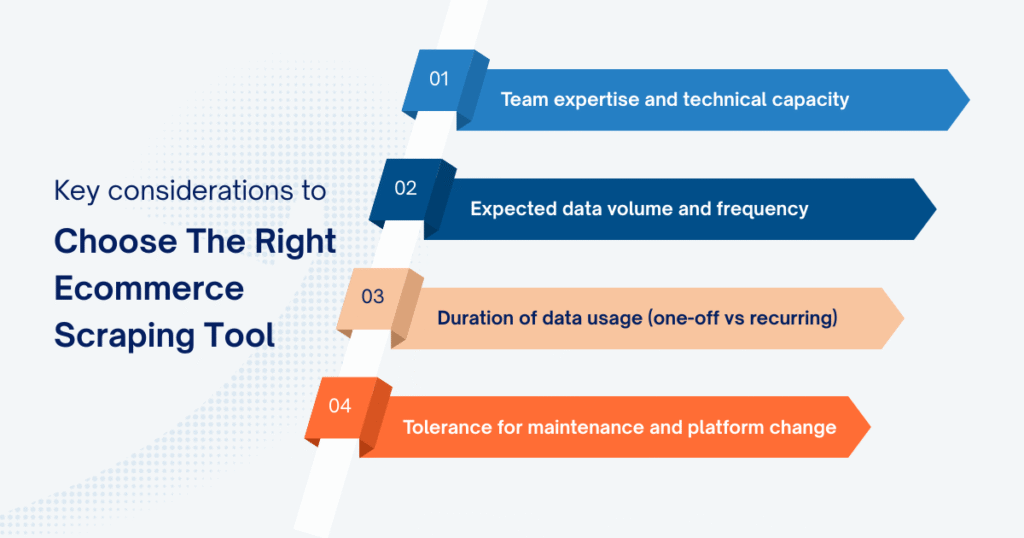
- Match Tool Complexity to Team Capability: Highly flexible tools deliver value only if teams have the capacity to operate and maintain them. Simpler tools may outperform in environments with limited technical resources.
- Align Data Scale with Usage Horizon: Short-term research tolerates imperfections that long-term monitoring cannot. Tools suitable for exploratory work may struggle when data becomes a recurring input.
- Consider Operational Cost, Not Just Licensing: Maintenance, adaptation, and data validation often outweigh licensing fees over time. Tool selection should account for total operational effort, not just feature availability
Ecommerce Scraping Tools vs. Managed Ecommerce Data
This distinction helps clarify when tools are sufficient and when additional support becomes necessary.
| Aspect | Scraping Tools | Managed Data Providers |
| Primary focus | Control and flexibility | Stability and continuity |
| Maintenance | Internal responsibility | Externalized |
| Time to insight | Slower at scale | Faster |
| Best suited for | DIY and experimentation | Long-term data usage |
Limitations of Ecommerce Scraping Tools at Scale
As scraping efforts scale, data collection can shift from an enabler to an operational constraint. Maintaining stable data flows across frequent platform changes, large product volumes, and long time horizons can gradually consume internal resources that were originally intended for analysis.
In these situations, some teams complement their scraping tools with external data sources rather than replacing them entirely. Providers such as Easy Data operate at this layer by supplying structured ecommerce datasets (generated through Shopee data scraping and other marketplaces) allowing internal teams to focus on interpretation and decision-making instead of continuous collection maintenance.
Final Thoughts
Ecommerce scraping tools remain essential for accessing market data. They provide the visibility required to observe how markets behave across platforms. However, tools alone do not define strategy.
By understanding different tool approaches, their trade-offs, and their limitations, organizations can make informed choices that align data collection with long-term objectives, rather than treating tool selection as an isolated technical decision.
Leave a Reply