

Shopee top search scraping reveals early demand signals by analyzing what users actively search for before products scale in sales. By tracking search momentum, keyword expansion, and supply gaps, teams can detect emerging trends weeks earlier than traditional sales-based analysis. This approach turns raw search behavior into a leading indicator for product and category intelligence.
What Is Shopee Top Search Data?
Shopee top search data reflects the keywords and queries that users actively input into the platform’s search bar over a given period. Unlike product or sales data, it captures intent before transaction: what shoppers are curious about, comparing, or struggling to find. From an analytical perspective, top search data represents:
- Collective user interest across categories
- Shifts in attention before supply stabilizes
- Early-stage demand that has not yet converted into sales volume
This makes it a fundamentally different signal layer from listings or performance metrics.
Learn more: Shopee Keyword Scraping – Search Trends You Can Actually Use
Why Search Behavior Signals Trends Earlier Than Sales Data
Sales data is a lagging indicator. A transaction only occurs after:
- Demand forms
- Supply responds
- Listings mature
- Pricing stabilizes
Search behavior happens before all of that. This consistently observed in large-scale consumer research on how people explore needs and intent before purchase decisions)
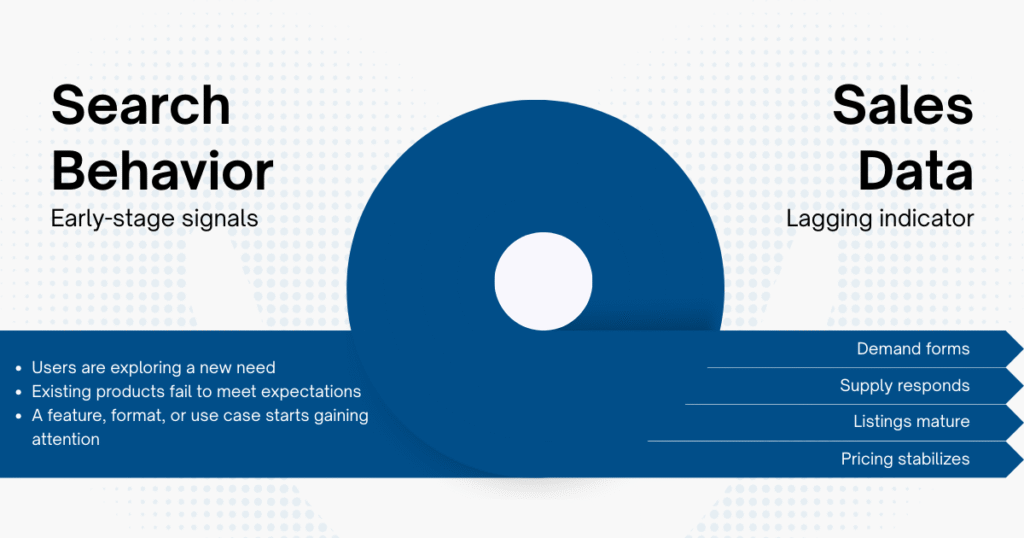
Users search when:
- They are exploring a new need
- Existing products fail to meet expectations
- A feature, format, or use case starts gaining attention
Shopee top search scraping captures this moment, when demand is visible, but outcomes are not yet fixed. This timing advantage is what enables early trend detection.
How Shopee Top Search Scraping Surfaces Early Trend Signals
Early trends often leave traces in search behavior long before they surface in sales or rankings. Through scraping Shopee top search data at scale, these traces can be translated into interpretable signals that help teams identify emerging product demand early.
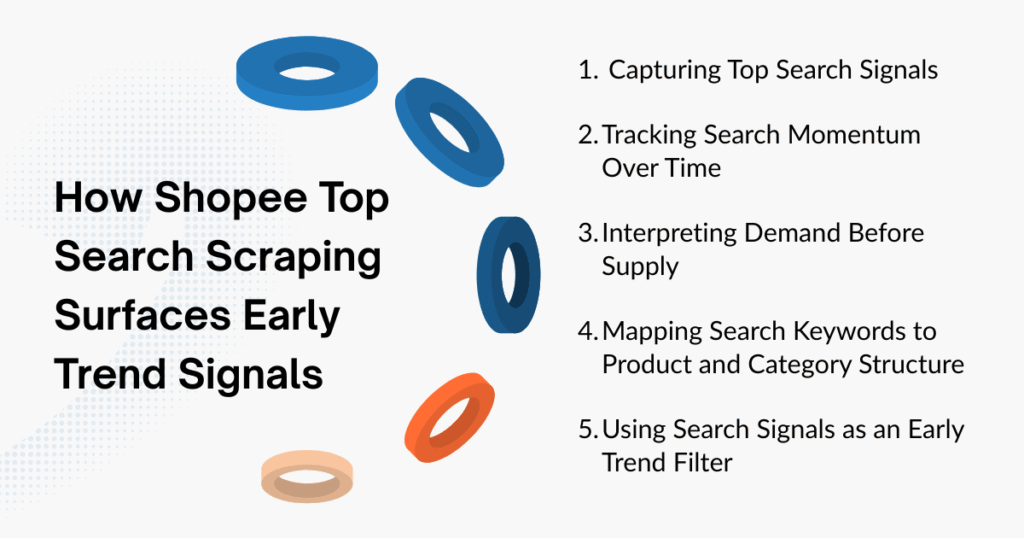
1. Capturing Top Search Signals Before Products Scale
The first mechanism lies in what is being searched, not what is being bought. Shopee top search scraping collects:
- Keywords that suddenly rise in visibility
- Repeated search intent across large user groups
- Queries with growing frequency but limited listings
At this stage, many searched-for products:
- Have fragmented or inconsistent listings
- Lack standardized attributes
- Show little or no sales history
Because scraping focuses on search rankings and frequency, it captures demand formation at its earliest observable stage (often weeks before sales data becomes meaningful), this is the earliest point where trends can be detected. At scale, this typically requires structured Shopee data scraping pipelines to ensure consistency and historical depth.
2. Tracking Search Momentum Over Time (Not Just Snapshots)
Single snapshots of top search keywords are noisy. Real insight comes from movement over time. Shopee top search scraping enables teams to:
- Collect rankings daily or weekly
- Distinguish persistent growth from short-lived spikes
- Identify acceleration patterns instead of absolute rank
Early trends typically show:
- Gradual rank improvement across multiple cycles
- Expansion into related keyword variations
- Increasing consistency rather than one-off peaks
This temporal layer explains how interest evolves, not just what happens to be popular momentarily.
3. Interpreting Search Demand Before Supply Fully Responds
One of the clearest reasons search data leads sales is supply lag. When a new product type or feature emerges:
- Consumers search first
- Sellers experiment later
- Listings, pricing, and variants stabilize only after demand is proven
Shopee top search scraping exposes this imbalance by revealing:
- High search interest paired with thin product coverage
- Repeated searches around unmet attributes
- Fragmented listings attempting to match emerging demand
This gap between search intensity and listing maturity is a strong early indicator of an upcoming trend.
4. Mapping Search Keywords to Product and Category Structure
Search data becomes actionable only when it is contextualized. In practice, teams use Shopee top search scraping to:
- Map keywords to existing categories and subcategories
- Identify demand that does not align with current taxonomy
- Detect emerging subcategories before platforms formalize them
For example, repeated searches for a specific product variation often appear long before Shopee introduces a dedicated category for it. This is how search-driven category emergence is identified early.
5. Using Search Signals as an Early Trend Filter (Not a Final Verdict)
Shopee top search scraping is not designed to predict winners on its own. Its real value lies in filtering. Effective teams use search data to:
- Narrow the universe of potential trends
- Prioritize where deeper analysis is justified
- Decide when to layer in pricing, product, or sales data
In this role, search scraping reduces analytical noise and focuses effort where momentum is forming (long before outcomes are obvious).
Who Uses Shopee Top Search Scraping and Why
Shopee top search scraping is commonly used by:
- Market research teams monitoring emerging categories
- Brands exploring early product opportunities
- Agencies producing forward-looking category reports
- Analysts seeking leading indicators beyond sales data
Across these use cases, the goal is the same: see demand forming before the market reacts.
Final Thoughts
Shopee top search scraping does not replace sales data, it precedes it. By capturing search intent, tracking momentum, and exposing supply gaps, it provides one of the earliest observable signals of emerging ecommerce trends. When used as an analytical filter rather than a prediction engine, it helps teams identify where the market is heading (before performance metrics catch up).
Leave a Reply