
Launching a new product without validating market demand carries significant risks, from excess inventory and wasted marketing spend to poor capital allocation. While traditional market research reports often lag behind market shifts, Shopee search data offers a near real-time view of what consumers are actively interested in.
By leveraging Shopee keyword scraping, businesses can track market demand, spot emerging micro-trends, and evaluate competitive intensity before launching a product. In this article, we explore how Product and R&D teams use Shopee scraping to validate product ideas and turn search signals into actionable market intelligence that supports business growth.
What Is Shopee Keyword Scraping?
Shopee keyword scraping is the process of automatically collecting data from Shopee’s search pages, including user search keywords, autocomplete suggestions, product ranking positions, and other information available on the search engine results page (SERP).
An enterprise-grade Shopee keyword scraping pipeline typically structures collected data into multiple categories that directly support market research and competitive analysis.
| Data Category | Data Collected | Description |
| Query Data | Seed keywords, long-tail keywords, autocomplete suggestions, and related searches | What users are actively searching for on Shopee |
| SERP Architecture Data | Organic positions, sponsored/ad placements, and SKU ranking positions | How products are distributed across search results |
| SKU Performance Metadata | Price, sales volume, ratings, warehouse location, and store type | Performance indicators of products appearing for target keywords |
How to Validate a Product Using Shopee Keyword Scraping
Data from Shopee keyword scraping only becomes valuable when it informs business decisions. In practice, many Product and R&D teams use the process below to assess a product’s market potential before committing resources to development or inventory.
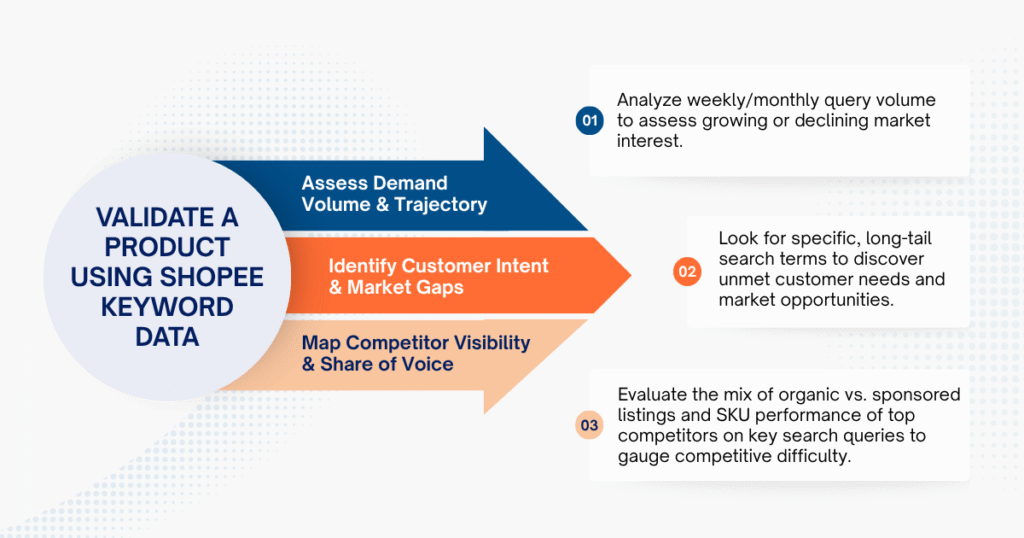
1. Assess Demand Volume and Trajectory
The goal is to answer a question: Are customers becoming more interested in this product over time?
By using Shopee keyword scraping to track search volume over time, businesses can better understand how demand evolves rather than relying on a single snapshot.
For example, if search volume grows steadily over several months, it may suggest that the market is still expanding. On the other hand, if demand starts to level off or decline, further investment should be assessed more carefully.
2. Identify Customer Intent and Market Gaps
The goal here is to answer: What are customers looking for that the market is not serving effectively today?
A common mistake is focusing only on high-volume keywords. In many cases, long-tail keywords offer stronger insights because they reveal more specific customer needs. For example, instead of analyzing only a broad keyword like “sunscreen“, businesses may find more specific searches such as:
- Sunscreen that doesn’t irritate the eyes
- Tone-up oil-control sunscreen stick
These search terms help Product and R&D teams uncover unmet needs and identify the features or attributes that should be prioritized during product development.
3. Map Competitor Visibility and Share of Voice
At this stage, the main question becomes: If we enter this market, who are we competing with, and where are the real opportunities?
Data from Shopee keyword scraping can help analyze which brands dominate target keywords, how much advertising affects search visibility, and whether the market is controlled by a small number of major players.
For example, if most top-ranking positions are held by established brands supported by sponsored placements, entering the market may require a substantial marketing budget. In contrast, keyword segments that are still fragmented or not yet dominated by a few brands often offer better opportunities for new products.
When keyword data is combined with product category data, businesses can build a fuller view of the market, including:
- Brands that dominate search results
- Visibility share of each competitor
- Common pricing levels within the category
- Sales performance and engagement metrics of leading products
Choosing the Right Shopee Keyword Scraping Approach
Not every business needs to build its own scraping infrastructure. Depending on data requirements, technical resources, and research objectives, different approaches may be more suitable.
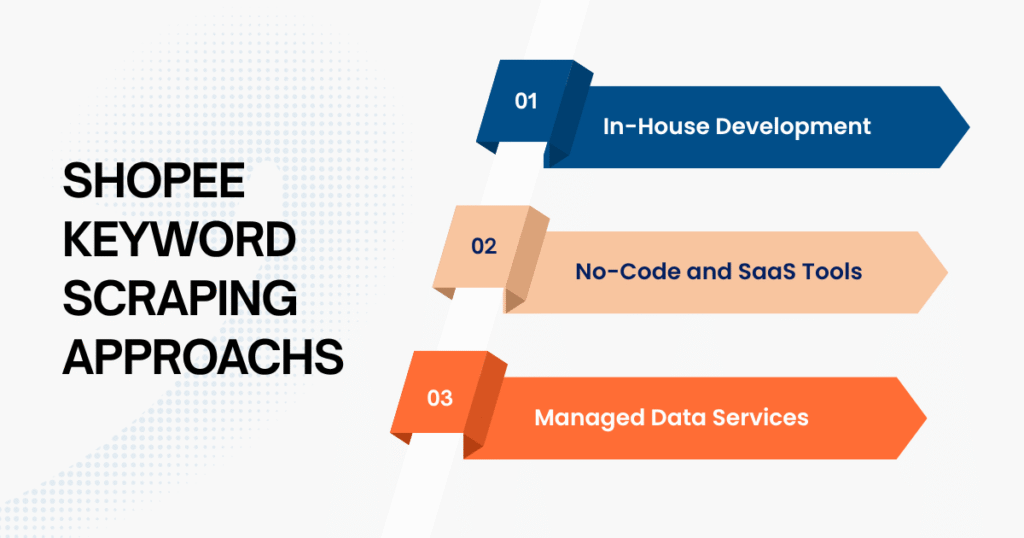
In-House Development
Some organizations choose to develop their own Shopee keyword scraping systems using Python and frameworks such as Playwright, Puppeteer, or Selenium.
Advantages
- Full control over the data collection process
- Ability to customize crawling logic for specific business needs
- Direct ownership and storage of collected data within internal infrastructure
Limitations
- Requires experienced crawling and data engineering teams
- Ongoing maintenance is necessary whenever Shopee changes its interface or APIs
- Operating costs can increase significantly as data collection scales
No-Code and SaaS Tools
These are SaaS platforms or browser extensions that allow users to scrape Shopee data without writing code.
Advantages
- Fast implementation
- Low initial investment
- Suitable for testing, exploration, or small-scale research projects
Limitations
- Difficult to scale when monitoring large keyword sets or multiple markets simultaneously
- Data granularity is often limited
- Historical storage and long-term trend tracking capabilities may be restricted
- Many tools only support web-based data collection and do not capture insights from the mobile app ecosystem
Managed Data Services
Under this model, businesses work with specialized data providers that handle data collection, processing, and delivery of structured datasets.
Advantages
- No need to build or maintain internal crawling infrastructure
- Significant reduction in raw data processing effort
- Data is standardized and ready for analysis or integration into BI systems
Limitations
- Higher upfront investment compared to generic scraping tools
- Customization depends on the capabilities of the service provider
How Easy Data Supports Shopee Keyword Scraping Projects
Every business has different market research goals, so Easy Data does not offer a one-size-fits-all dataset. Instead, our Shopee data scraping service is tailored to each client’s industry, target market, and business objectives.
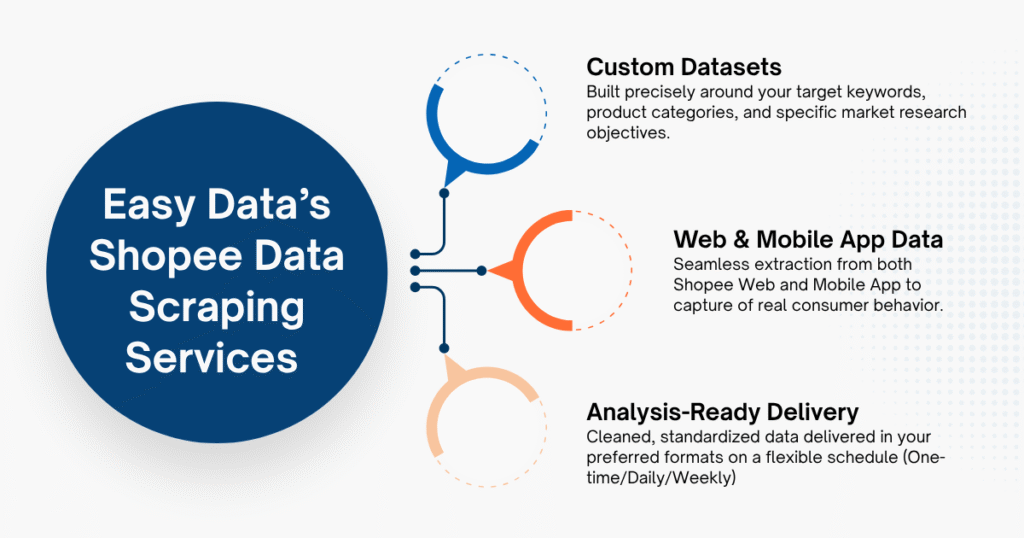
- Custom datasets built around your research goals: Easy Data can create datasets based on target keywords, product categories, and industries, brands, or competitor groups, specific Southeast Asian markets, and use cases such as product validation, market research, and competitor monitoring.
- Support for both web and mobile app data: Depending on the project, data can be collected from Shopee Web, the Shopee mobile app, or both. This gives businesses a more complete view of search behavior and market dynamics across the Shopee ecosystem.
- Analysis-ready datasets: Collected data is cleaned, standardized, and delivered in the format that best fits each client’s needs. Delivery options include: one-time extraction, daily monitoring, or weekly monitoring.
With deep expertise in Southeast Asian markets and Shopee’s data structure, Easy Data helps Product, R&D, and Market Research teams focus on identifying opportunities and making informed decisions, rather than spending resources on building and maintaining scraping infrastructure.
Final Thoughts
Many products fail not because they are poor in quality, but because they enter the market before demand is strong enough or fail to address what customers are actually searching for. Shopee keyword scraping helps businesses spot these signals early. By analyzing real search behavior, companies can measure market demand, identify emerging trends, and understand the competitive landscape before investing in a new product.
In a fast-changing market, decisions based on data rather than assumptions can make the difference between a successful launch and a costly misstep.
Leave a Reply