
To stay competitive, businesses scrape Shopee categories at scale to track the overall market landscape, competitors, and consumer trends. But as data volume grows, keeping scraping stable becomes increasingly difficult. Shopee constantly updates its anti-bot mechanisms, dynamic tokens, and request rate limits, making many crawlers prone to interruption. To maintain a reliable data pipeline, businesses must understand these technical challenges and the right approach to scrape Shopee at scale.
What Does Scrape Shopee Category Mean?
Many people confuse scraping individual product data with scraping an entire product category.
Put simply, Shopee product scraping focuses on monitoring a single product or a specific group of products. It lets you collect detailed information such as price, sales volume, and customer ratings for individual listings, making it ideal when a business wants to track a specific competitor or a selected group of SKUs.
In contrast, when you scrape Shopee category, you collect data across an entire product category on Shopee, from top-level categories (for example, Beauty & Personal Care) down to subcategories (such as Facial Skincare or Sunscreen). This can cover tens of thousands of products within the same market segment, giving businesses a complete view of the market instead of tracking only a handful of SKUs.
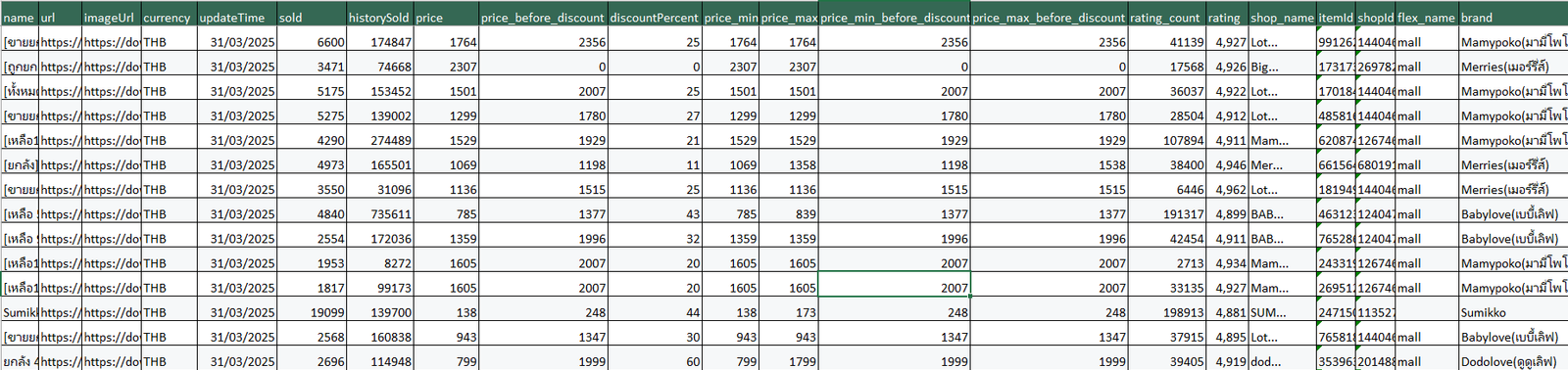
| Information Group | Data Fields |
| Product Information | Product ID, Product Name, Brand, SKU |
| Commercial Data | Original Price, Discounted Price, Monthly Sales Volume, Historical Sales |
| Reputation Metrics | Average Rating, Total Reviews, Product Likes |
| Seller Information | Seller Location (Province/City), Shop Type (Shopee Mall / Preferred Shop) |
What Are the Benefits of Scrape Shopee Category at Scale?
As businesses grow, tracking only a few SKUs is no longer enough for strategic decisions. Businesses that scrape Shopee categories at scale can monitor the broader market, competitors, and customer purchasing behavior across entire product categories.
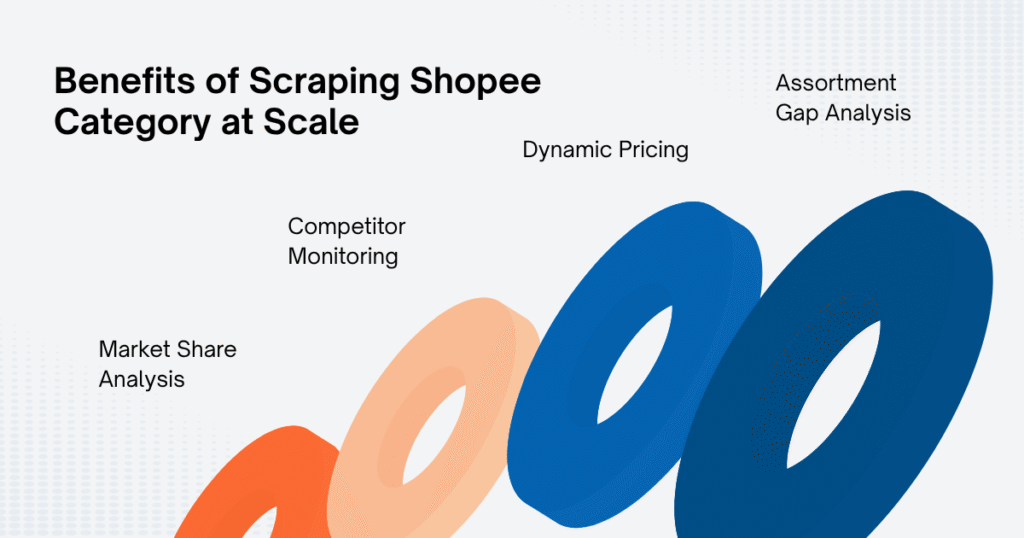
- Market Share Analysis: Estimate the overall size of a product category during a specific period, then determine your brand’s market share and measure the gap between your business and leading competitors.
- Competitor Monitoring: Regular category scraping helps businesses quickly identify emerging brands, fast-growing products, and significant changes in competitors’ strategies.
- Dynamic Pricing: Analyzing pricing across an entire category helps identify price ranges with the strongest demand, allowing businesses to build competitive pricing strategies while protecting profit margins.
- Assortment Gap Analysis: Category data reveals market segments where customer demand is high but the number of sellers remains relatively low. These gaps often represent attractive opportunities for product expansion or entry into niche markets.
The Biggest Challenge When You Scrape Shopee Category at Scale
When you scrape Shopee categories at scale, the biggest challenge is usually not collecting the data itself; it’s avoiding getting blocked by Shopee.
In practice, almost every project that attempts to scrape Shopee category at scale encounters anti-bot mechanisms designed to restrict automated access.
How Does Shopee’s Anti-Bot System Work?
To protect its platform from abnormal traffic, Shopee uses multiple layers of security. Two of the most common mechanisms are request rate limiting and dynamic authentication tokens.
- Request Rate Limiting: Shopee continuously monitors the number of requests coming from each IP address or device. If too many requests are detected within a short period, the traffic may be identified as bot activity instead of normal user behavior. As a result, requests may be throttled, additional verification may be required, or access may be blocked entirely.
- API v4 & Dynamic Tokens: Shopee uses authentication tokens that change continuously in real time. You can think of these tokens as one-time passwords (OTPs) used in online banking. A token that works for one request may become invalid for the next. If a crawler cannot handle this authentication process correctly, Shopee may return authentication errors, trigger CAPTCHA challenges, or respond with HTTP 403 Forbidden.
What Happens When Your Scrape Shopee Category Process Gets Blocked?
The biggest issue with getting blocked is not that the crawler stops running. The real problem is that missing data often goes unnoticed.
For example, imagine a crawler collecting data from the Fashion category ahead of a major Mega Sale campaign. If it successfully processes the first 50 pages but gets blocked starting from page 51, everything after that point is simply missing.
The exported dataset may still appear complete at first glance, but it actually lacks a significant portion of products and brands within the category. These data gaps can directly affect market share analysis, growth trend detection, pricing strategy, and competitor monitoring.
For businesses that rely on data for decision-making, data completeness and consistency are just as important as collecting the data itself.
How to Handle Getting Blocked When You Scrape Shopee Category
To reduce the risk of getting blocked while you scrape Shopee categories, businesses typically choose one of two common approaches. Each comes with its own trade-offs in terms of cost, technical resources, and scalability.
Coding-Based Approach (For Technical Teams)
Data Engineers or Developers build their own scraping infrastructure using Python together with browser automation frameworks such as Selenium or Playwright. To maintain stable access, the system typically relies on Rotating Residential Proxies that continuously rotate IP addresses. The crawler must also handle Shopee’s authentication mechanisms and dynamic tokens that change in real time.
Trade-off: This approach provides maximum flexibility and control but requires significant operational investment. Businesses need to maintain proxy infrastructure, servers, and technical resources. Since Shopee frequently updates its anti-bot mechanisms and API structure, the crawler also requires ongoing monitoring and maintenance to prevent data interruptions.
Using No-Code Tools
Businesses can use drag-and-drop scraping tools such as Octoparse, WebHarvy, or browser extensions to scrape Shopee categories without writing code. To reduce the likelihood of being blocked, users often need to configure additional settings such as rotating User-Agent strings, clearing cookies automatically, introducing random delays between requests, and integrating third-party proxy services.
Learn more: How to Scrape Shopee Data Without Coding
Trade-off: No-code tools are easy to deploy and accessible for users without technical backgrounds. However, as data volume increases, adding delays between requests significantly slows down data collection. In addition, eCommerce platforms like Shopee continuously introduce new dynamic token mechanisms and security layers, while most no-code tools offer only limited support for handling these protections. As a result, crawlers may stop unexpectedly, produce incomplete datasets, or require manual intervention to resume the scraping process.
Easy Data – A Fully Managed Scrape Shopee Category Solution
Instead of building your own crawler, managing proxy infrastructure, or dealing with Shopee’s complex anti-bot mechanisms, your team simply defines the data you want to monitor. Easy Data takes care of the entire workflow, from data collection and standardization to delivering datasets that are ready for analysis.
Easy Data’s Shopee data scraping service is customized around each business’s specific data requirements while maintaining a reliable and continuously updated data pipeline for long-term market analysis.
Customized for Your Business Needs
Businesses can collect data based on keywords, product categories, brand lists, or specific competitors. Our infrastructure also supports multi-country monitoring across Southeast Asia, including Vietnam, Thailand, Indonesia, and Malaysia, on both the web platform and the mobile app.
Automatically Updated Data
Instead of receiving a static dataset, businesses can schedule automatic updates daily, weekly, or monthly based on their analytical needs. During major shopping events such as Mega Campaigns or Flash Sales, the data continues to refresh so your team can monitor pricing changes, promotional activities, and competitor movements in near real time.
Whenever you need to add new data fields or adjust the update frequency, Easy Data’s engineering team will modify the data pipeline to match your requirements.
Final Thoughts
Scrape Shopee categories at scale is about much more than collecting large amounts of data. The real value lies in turning the daily changes happening across the marketplace into structured information that businesses can consistently monitor, measure, and use to make better decisions.
When your data is complete, continuously updated, and ready for analysis, your team can spend less time managing technical infrastructure and more time focusing on what truly creates a competitive advantage, understanding the market faster and acting before your competitors do.
Leave a Reply