

Shopee is currently one of the most competitive marketplaces in Southeast Asia, where selling prices, vouchers, flash sales, and search rankings can change continuously within just a few hours. In such an environment, many businesses no longer track the marketplace manually as they used to. Instead, they are turning to a Shopee scraper to monitor real-time data, allowing them to react much faster to market fluctuations.
In this article, Easy Data will analyze:
- How businesses are actually utilizing a Shopee data scraper
- Which e-commerce pain points can be optimized using Shopee marketplace data
- Why real-time marketplace intelligence is becoming increasingly critical on Shopee today
What Is a Shopee Data Scraper?
A Shopee data scraper is an automated system designed to extract data from the Shopee marketplace. This data is utilized for market research, competitor tracking, price monitoring, operational optimization, and building internal e-commerce analytics systems.
Depending on the business objective, a Shopee scraper can extract various data layers. Today, businesses no longer use Shopee data just to see “what competitors are selling.” Instead, they leverage marketplace data to optimize pricing strategy, campaign planning, inventory planning, and marketplace growth.
How Are Businesses Using a Shopee Data Scraper?
As marketplace competition grows increasingly fierce, real-time data directly impacts how e-commerce teams operate every single day. In practice, these are the core problem sets that many businesses are prioritizing for tracking via a Shopee data scraper:
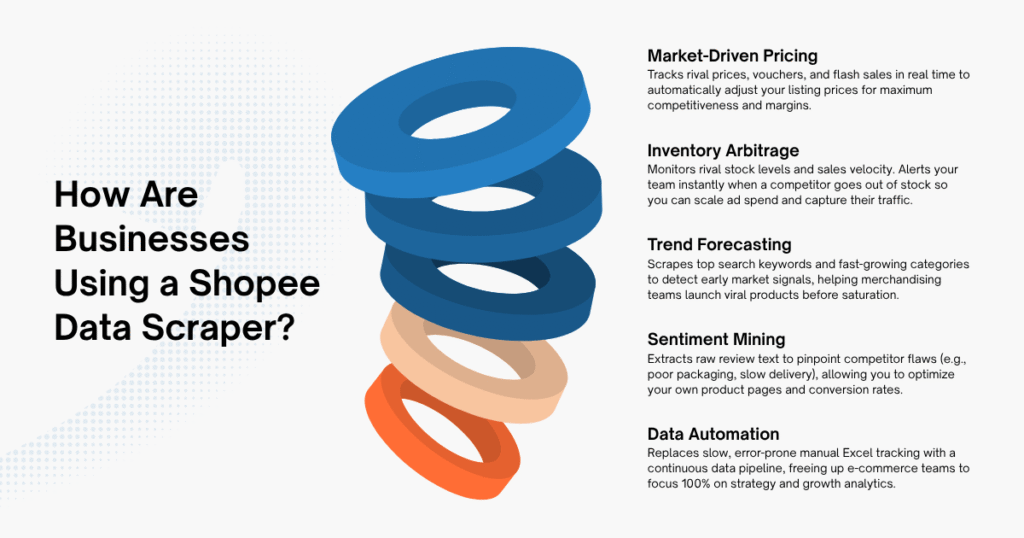
1. Real-Time Competitor Price Tracking & Dynamic Pricing
One of the biggest shifts on Shopee today is that many sellers no longer compete primarily on the product itself, but rather on pricing strategy and promotion optimization. In many categories like beauty, FMCG, or electronics, the prices displayed on Shopee change constantly based on vouchers, flash sales, free shipping, combo promotions, and campaign hours. This makes manual price tracking practically impossible.
A Shopee data scraper helps businesses continuously monitor original prices, prices after vouchers, actual discount rates, promotion frequency, and competitors’ pricing movements. From there, e-commerce teams can build a dynamic pricing strategy instead of relying on fixed pricing as before.
2. Detecting Competitor Stock-Outs & Exploiting Market Gaps
In e-commerce, a competitor’s stock-out usually creates a massive growth opportunity if a business reacts fast enough. By tracking inventory signals, stock levels, historical sales, and review velocity, a Shopee data scraper can help businesses detect early when a competitor’s SKU starts running out of stock or experiencing a sharp decline in inventory.
In the reality of the Southeast Asian marketplace, this frequently occurs during major campaigns such as payday sales and flash sale events. When this happens, e-commerce teams can scale up their Shopee Ads budget, push bidding keywords, increase visibility for alternative SKUs, and adjust pricing to capture the unfulfilled demand. From an operational standpoint, this is one of the use cases that delivers a very clear ROI for marketplace teams.
3. Monitoring Market Trends & Discovering High-Growth Products
Product discovery behavior on Shopee heavily relies on recommendation algorithms and marketplace trends. Many products can skyrocket in growth within just a few days due to keyword trends, social commerce, livestream campaigns, creator content, and recommendation feeds. This makes tracking market trends far more critical than before.
A well-configured Shopee data scraper can continuously monitor top search keywords, trending products, category growth, sales velocity, and ranking movements. This allows businesses to detect growth signals early before the market becomes overly saturated and competitive.
In many e-commerce projects across Southeast Asia, Easy Data notices that many brands now prioritize marketplace trend tracking in near real-time, rather than relying solely on monthly reports like they used to.
4. Review Analysis & Customer Sentiment from Marketplace Data
Review data is one of the most undervalued insight sources on Shopee. Most businesses only look at the average rating and total review count. However, in reality, raw review data directly reflects operational issues such as:
- Packaging quality
- Delivery speed
- Product defects
- Sizing issues
- Customer expectations
A Shopee data scraper can automatically collect review text, rating changes, review velocity, and customer feedback patterns, then sync them into BI or sentiment analysis systems for deeper insights.
Example:
- A competitor receives heavy complaints regarding packaging
- Customers frequently mention “slow delivery”
- An SKU suddenly experiences an unusual spike in review velocity
These signals help e-commerce teams instantly adjust product positioning, optimize packaging, improve delivery operations, or react sooner during campaigns that are showing signs of dropping conversion rates.
5. Automating Marketplace Intelligence & Reducing Manual Work
One of the most common issues among e-commerce teams today is that marketplace data is still processed manually. Many businesses still:
- Copy data by hand
- Track competitors using Excel
- Consolidate prices for each SKU manually
- Update dashboards hours or days late
When the marketplace scales up to tens of thousands of SKUs, this operational method becomes completely unviable.
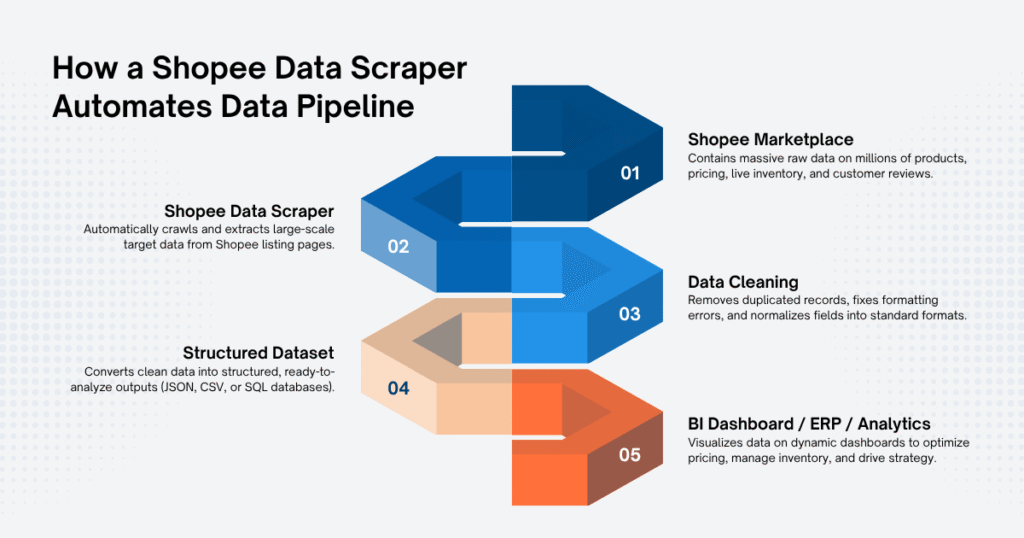
A Shopee data scraper helps businesses build an automated data pipeline: Shopee Marketplace ➔ Shopee Data Scraper ➔ Data Cleaning ➔ Structured Dataset ➔ BI Dashboard / ERP / Internal Analytics.
Instead of spending time on manual operations, e-commerce teams can focus more heavily on:
- Pricing strategy
- Campaign planning
- Inventory optimization
- Growth analytics
Why Is Shopee Scraping in Southeast Asia So Difficult?
One of the most common misunderstandings is that many businesses think Shopee scraping is simply “crawling HTML.” In reality, the marketplace infrastructure in Southeast Asia is far more complex.
Shopee currently employs anti-bot systems, dynamic rendering, behavioral detection, CAPTCHA layers, and a mobile-app-first architecture. Additionally, critical data points such as inventory mapping, livestream pricing, hidden SKU structures, and recommendation signals are often not fully displayed on the web version.
This is why generic scraping systems struggle to scale Shopee data stably over long periods.
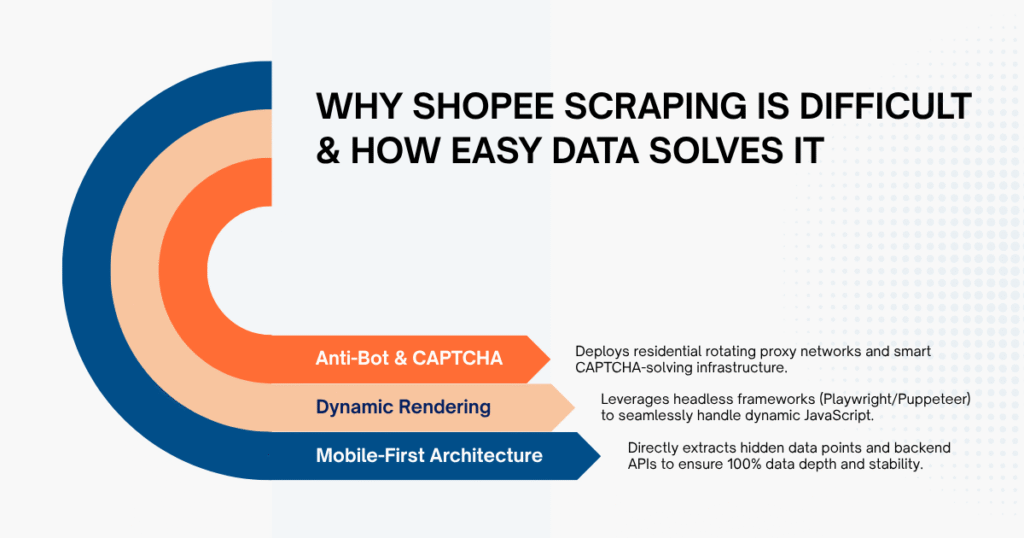
To address these challenges, Easy Data typically combines rotating proxies, browser automation, mobile app scraping, anti-bot bypass infrastructure, and dynamic API handling to maintain data stability and continuous marketplace monitoring at scale.
Best Practices When Operating a Shopee Data Scraper
Based on our experience deploying Shopee data scraping projects in Southeast Asia, Easy Data has found that an effective scraper does not just stop at collecting data; it must maintain data stability and effectively address the real-world operational needs of e-commerce teams.
Below are several critical factors that businesses should prioritize when running a Shopee data scraper:
- Align with the right business objective: Not every business needs to scrape the entire marketplace. Many teams only require pricing data, review data, keyword rankings, and campaign monitoring to serve specific use cases.
- Standardize data from the ground up: Raw marketplace data is usually quite messy (duplicate SKUs, inconsistent naming, missing fields, category mismatches). Data cleaning and SKU mapping will directly impact the quality of your downstream BI analytics.
- Prioritize real-time monitoring for high-competition industries: In fast-moving categories like beauty, electronics, FMCG, and fashion, marketplace movements happen rapidly. Delayed data significantly reduces the reaction capability of e-commerce teams.
Conclusion
On Shopee, the competitive edge no longer lies just in the product or the ad budget; it lies in the ability to track the marketplace faster, understand the data better, and react to the market sooner than your competitors. This is exactly why a Shopee data scraper is gradually becoming an essential component of the e-commerce intelligence system for many enterprises in Southeast Asia.
As marketplace competition continues to intensify in the coming years, businesses that possess real-time data and operate based on marketplace analytics will ultimately hold a massive advantage in pricing, campaign execution, and long-term e-commerce growth.
Leave a Reply