

In ecommerce analytics, ecommerce sales data and revenue data are often treated as interchangeable, even though they describe fundamentally different market signals. This distinction becomes critical when working with ecommerce data, where misinterpreting core metrics can distort insights about demand, pricing behavior, and competitive dynamics. Understanding how sales data and revenue data differ provides a more reliable foundation for market intelligence and strategic analysis.
Why Sales Data and Revenue Data Are Often Confused
In most ecommerce environments, sales and revenue metrics are presented side by side, or even merged into a single headline number. This presentation style makes the distinction feel superficial, even though the analytical implications are not.
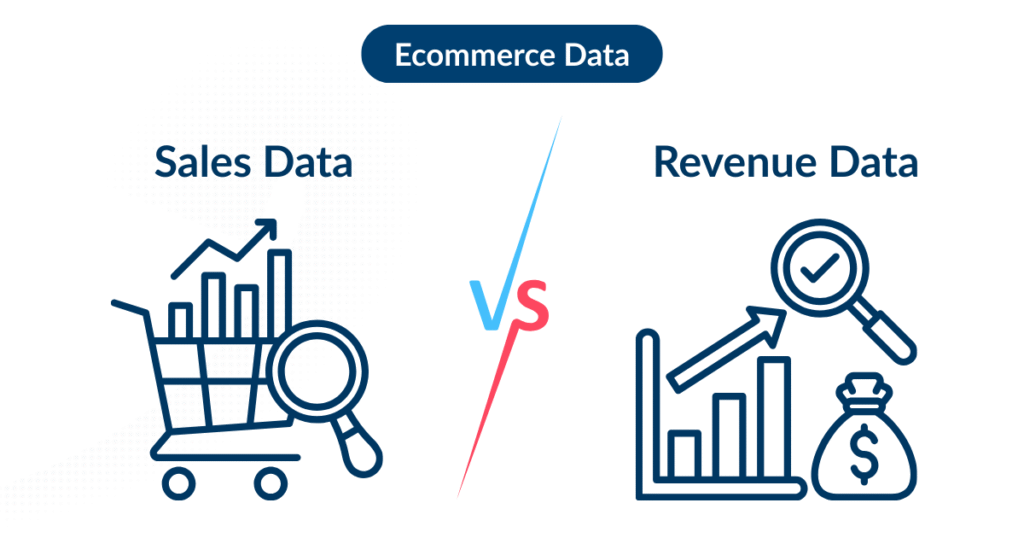
Marketplace dashboards, seller reports, and third-party tools often prioritize simplicity over conceptual clarity. As a result, analysts may rely on aggregated figures without questioning what those numbers actually represent.
- Platform Reporting Conventions: Many platforms use “sales” as a shorthand for gross merchandise value (GMV), while others label transaction volume and monetary value with similar terminology. Without explicit definitions, users are left to infer meaning from context rather than structure.
- Surface-Level Metrics vs Analytical Intent: Dashboards are designed for quick monitoring, not deep analysis. While this is useful for operational tracking, it can obscure the underlying mechanics of demand, pricing, and value creation when used for market intelligence purposes.
What Is Ecommerce Sales Data?
Ecommerce sales data describes transactional activity, not financial outcomes. At its core, it reflects how often products are purchased and in what quantities across a marketplace.
Rather than measuring value, sales data captures market movement.
Core Components of Sales Data
Typical elements of ecommerce sales data include:
- Units sold
- Order counts
- Transaction frequency
- Sales velocity over time
In some cases, sales data may be paired with estimated values, but its primary signal remains volume-driven.
What Sales Data Is Best at Explaining
Because it focuses on activity rather than price, ecommerce sales data is especially effective for:
- Measuring demand intensity
- Identifying emerging product adoption
- Detecting shifts in consumer preferences
- Understanding category expansion or contraction
Sales data reveals where attention and demand are flowing, even when pricing remains unstable or inconsistent.
What Is Ecommerce Revenue Data?
Revenue data shifts the focus from activity to economic value. It measures how much money is generated through transactions, but the way revenue is calculated can vary significantly.
Understanding these variations is critical when interpreting revenue-based insights.
Gross vs Net Revenue Distinctions
Revenue data may represent:
- Gross revenue or GMV (before discounts, returns, and fees)
- Net revenue (after promotions, refunds, and platform costs)
Without clarity on which definition is being used, revenue figures can be misleading, especially in highly promotional or price-sensitive categories.
Revenue as a Performance Signal
When properly defined, revenue data is best suited for evaluating:
- Pricing effectiveness
- Monetization strategies
- Brand or seller performance
- Market value concentration
Revenue data highlights who captures value, not just who generates activity.
Sales Data vs Revenue Data: A Structural Comparison
Looking at sales and revenue side by side clarifies why neither metric should be interpreted in isolation.
| Aspect | Ecommerce Sales Data | Ecommerce Revenue Data |
| Primary focus | Transaction volume | Monetary value |
| Sensitivity to pricing | Low | High |
| Best suited for | Demand analysis | Financial performance |
| Common pitfalls | Overestimating value | Ignoring volume dynamics |
Sales data reveals how markets move; revenue data reveals how markets monetize. Together, they provide a more complete picture of ecommerce dynamics.
When Sales Data Matters More Than Revenue Data
There are many analytical scenarios where volume matters more than value. In these cases, relying solely on revenue can obscure early market signals.
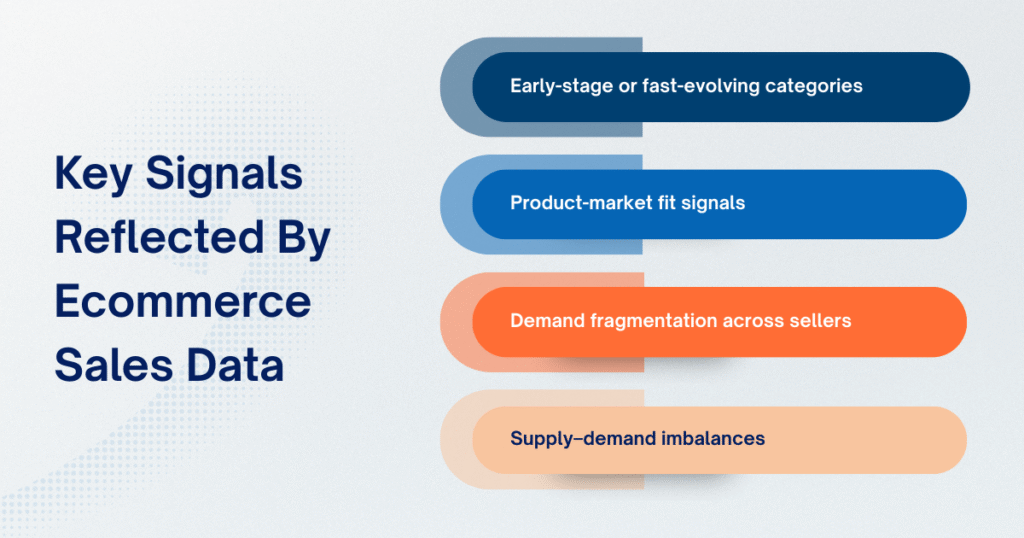
Ecommerce sales data is particularly valuable when analyzing:
- Early-stage or fast-evolving categories
- Product-market fit signals
- Demand fragmentation across sellers
- Supply–demand imbalances
High unit sales with inconsistent pricing often indicate unresolved demand (an important signal in market discovery and category development).
When Revenue Data Becomes the Priority
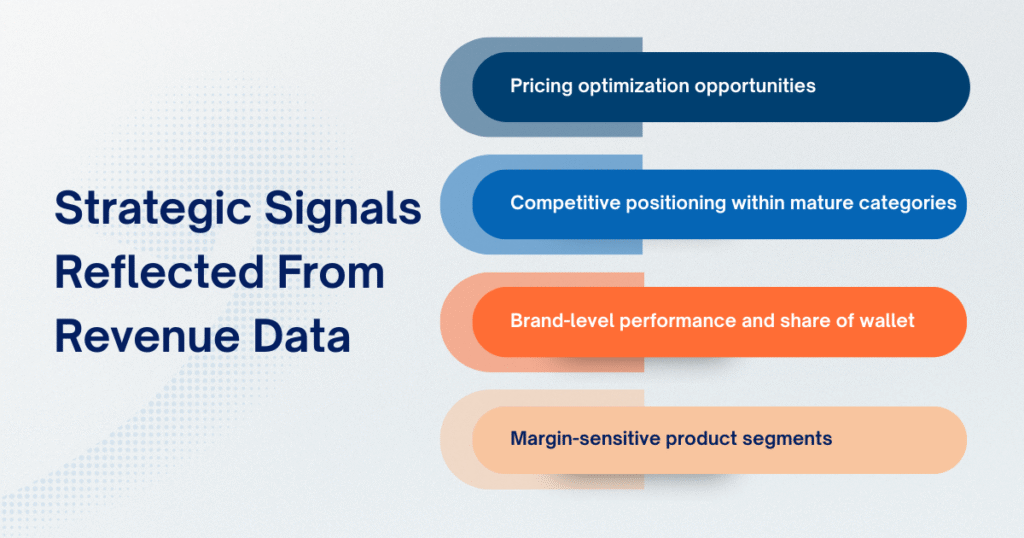
In contrast, some strategic decisions require a value-first lens. Revenue data becomes critical when assessing:
- Pricing optimization opportunities
- Competitive positioning within mature categories
- Brand-level performance and share of wallet
- Margin-sensitive product segments
Revenue-focused analysis helps distinguish between volume-driven visibility and sustainable economic advantage.
Using Sales and Revenue Data Together for Market Intelligence
The most reliable insights emerge when ecommerce sales data and revenue data are analyzed together rather than independently.
By combining sales and revenue signals with ecommerce product data, analysts can identify patterns that would otherwise remain hidden.
Identifying False Demand Signals
- High sales but low revenue may signal price-driven volume or heavy discounting
- High revenue with low sales often points to premium or niche positioning
Neither scenario is inherently good or bad, but each implies very different strategic responses.
Understanding Market Structure
Ecommerce sales data highlights fragmentation and activity distribution, while revenue data reveals concentration and value capture. Together, they help explain how markets are structured beneath surface-level rankings.
Data Availability and Interpretation Challenges
Despite their importance, ecommerce sales data and revenue data are not always equally accessible or consistent across platforms.
Differences in reporting standards, estimation methods, and marketplace transparency can complicate analysis, especially in cross-market or regional studies.
This is where raw ecommerce data becomes particularly valuable. Instead of relying on fixed interpretations, structured datasets allow teams to define their own metrics, align definitions across markets, and adapt analysis as questions evolve. Providers like Easy Data operate at the data layer by generating large-scale ecommerce datasets through Lazada, TikTok Shop and Shopee data scraping, enabling consistent access to transactional and product-level signals across multiple marketplaces. This raw-data-first approach supports flexible interpretation of sales and revenue metrics without being constrained by pre-defined reporting logic.
Final Thoughts
There is no universally “correct” metric in ecommerce analysis.
- Ecommerce sales data answers questions about demand and market momentum
- Ecommerce revenue data explains value capture and pricing outcomes
The key is understanding which question each metric is designed to answer. When used correctly and in combination, sales and revenue data provide a powerful foundation for market intelligence and strategic decision-making.
Leave a Reply