

If you’ve ever struggled to choose the right product to sell, you already know this: product research in ecommerce is not just difficult, it’s risky. One wrong decision can cost inventory, marketing budget, and months of effort. This is usually the point where an ecommerce product scraper becomes relevant: turning scattered product data into actionable insights.
Why Product Research Is Hard in Ecommerce
On the surface, product research sounds simple. You browse marketplaces, check competitors, look at pricing, and try to spot trends. But in reality, it rarely works that cleanly.
The biggest problem is that ecommerce markets don’t stay still. A product that looks promising today might be saturated tomorrow. Prices fluctuate constantly, rankings shift, and new competitors appear faster than most teams can track.
At the same time, the data you need is fragmented. Product listings, reviews, pricing, and rankings all live in different places. Trying to piece them together manually often leads to incomplete or outdated insights.
That’s why many teams feel like they’re always reacting instead of making confident decisions. And that’s exactly the gap an ecommerce product scraper is designed to fill.
What Is an Ecommerce Product Scraper?
An ecommerce product scraper is a tool or system that automatically collects product-level data from ecommerce platforms and turns it into structured, usable datasets.
Unlike a general ecommerce scraper, which typically extracts large volumes of data across a website, a product scraper is designed specifically for product intelligence. It’s not about collecting all data, it’s about collecting the right data around products. In practice, that means capturing details like product attributes, pricing, reviews, and rankings in a way that helps you understand how a product performs in the market.
The distinction is subtle but important. A general scraper gives you data. An ecommerce product scraper gives you context on products, which makes it valuable for research.
How an Ecommerce Product Scraper Works
At a high level, the process behind an ecommerce product scraper is simpler than most people expect.
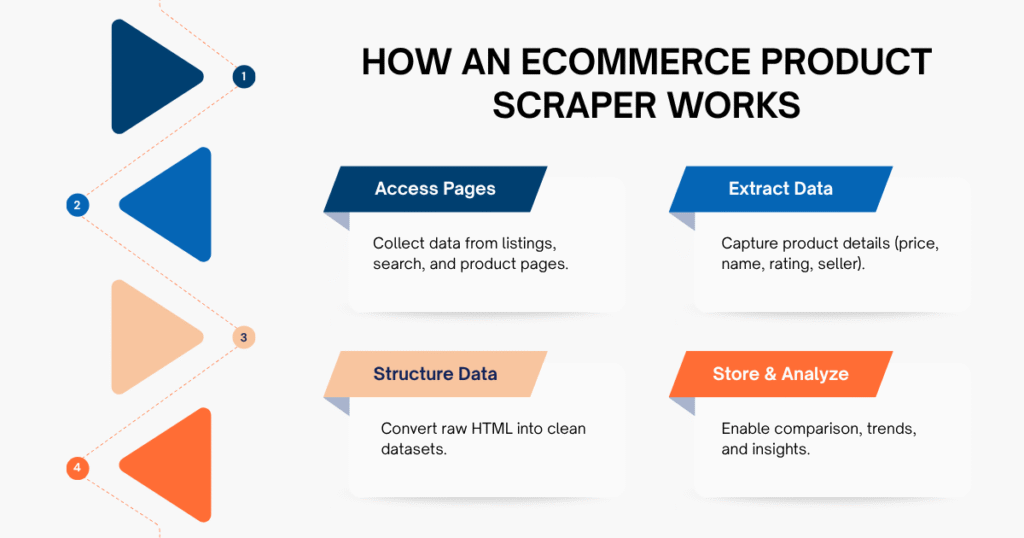
First, it accesses product pages or listing pages across marketplaces (these could be category pages, search results, or individual product listings). Then it extracts structured data from those pages, such as product names, prices, ratings, and seller information. Instead of raw HTML, the data is organized into clean formats like tables or datasets.
Finally, the data is stored and processed so it can be analyzed. This is where the real value begins, because once the data is structured, you can compare products, track trends, and identify patterns.
You don’t need to understand the technical details to benefit from this. What matters is the outcome: consistent, structured product data that reflects what’s happening in the market.
What Data Can a Product Scraper Extract?
When you use an ecommerce product scraper, you’re not just pulling random information; you’re building multiple layers of product insights. Here’s a simplified view:
| Data Type | What It Includes | Why It Matters |
| Product Attributes | Name, category, variations, descriptions | Understand positioning and differentiation |
| Pricing Data | Current price, discounts, changes over time | Identify pricing strategies and trends |
| Reviews & Ratings | Customer feedback, sentiment signals | Reveal product quality and demand signals |
| Sales & Ranking Data | Popularity, visibility, listing position | Measure performance in the marketplace |
Individually, each layer is useful. But the real value appears when they are combined. A product with strong reviews but declining ranking tells a different story than one with rising visibility and aggressive pricing. That’s the kind of insight you only get when multiple data points come together, and that’s exactly what an ecommerce product scraper enables.
How Product Scrapers Improve Product Research
Scraping data is only the first step. The real impact shows up in how that data changes the way you evaluate products, competitors, and market demand.
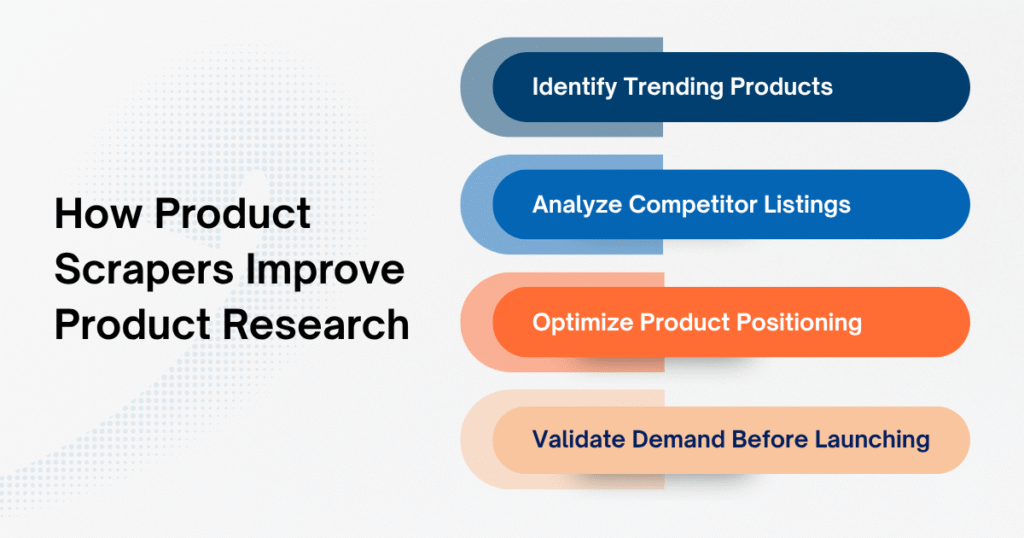
Identify Trending Products
One of the hardest parts of product research is spotting trends early. By the time something becomes obvious, it’s often too late.
An ecommerce product scraper helps surface patterns before they become visible manually. When you track changes in rankings, reviews, and product listings over time, you start to see which products are gaining momentum. It’s not about guessing trends, it’s about detecting them as they form.
Analyze Competitor Listings
Competitor analysis is often shallow when done manually. You might check a few listings, but you rarely see the full picture.
With an ecommerce product scraper, you can analyze competitor products at scale. You can compare pricing strategies, product titles, category placement, and review performance across hundreds or thousands of listings. This gives you a much clearer understanding of how competitors position themselves and where opportunities exist.
Optimize Product Positioning
Product research isn’t just about choosing what to sell. It’s also about how you present it. By looking at aggregated product data, you can identify patterns in high-performing listings. This includes pricing ranges, keyword usage in titles, and category placement.
An ecommerce product scraper turns these patterns into actionable insights, helping you position your product more effectively from the start.
Validate Demand Before Launching
Launching a product without validation is one of the biggest risks in ecommerce.
Instead of relying on assumptions, an ecommerce product scraper lets you evaluate demand based on real data. You can analyze how similar products perform, how often they are reviewed, and how their rankings change over time. This doesn’t eliminate risk, but it significantly reduces guesswork.
Ecommerce Product Scraper Tools
The market already offers a wide range of ecommerce scraping tools, from simple no-code options to more advanced platforms. Octoparse, ParseHub, Browse AI, WebHarvy, and Data Miner are commonly used to extract product-level data from marketplaces.
The market already offers a wide range of tools that can be adapted for ecommerce product scraping, from simple no-code solutions to more advanced platforms. Tools like Octoparse, ParseHub, Browse AI, WebHarvy, and Data Miner are commonly used to extract product-level data from marketplaces.
For small to mid-scale use cases, these tools can be surprisingly effective. They allow teams to collect product data quickly without building systems from scratch, which is often enough for early-stage research or testing ideas.
The challenge arises when the scope expands. As datasets grow and requirements become more complex, issues around scale, consistency, and reliability become harder to ignore, and that’s typically when teams begin to feel the limitations of tool-based setups.
Limitations of Ecommerce Product Scrapers
At a small scale, an ecommerce product scraper can feel incredibly powerful. But as your needs grow, certain limitations start to become more visible.
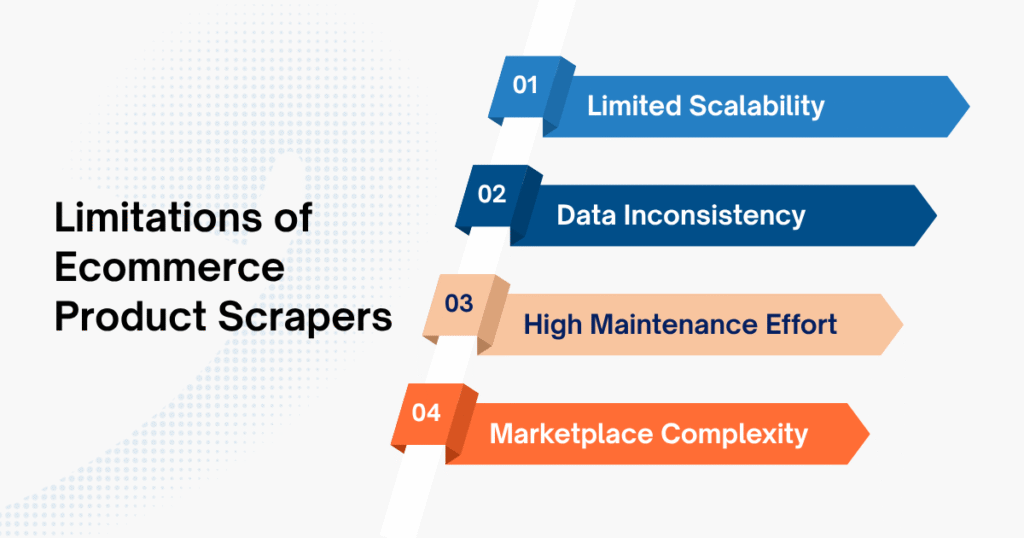
- Limited Scalability: What works for a few hundred products doesn’t always scale to thousands or millions. As data volume increases, scraping workflows become harder to manage and maintain.
- Data Inconsistency: Ecommerce platforms change constantly. Even small layout updates can affect how data is extracted, leading to gaps or inconsistencies in your dataset.
- High Maintenance Effort: Scraping isn’t a “set it and forget it” system. It requires continuous monitoring, updates, and troubleshooting, especially when working across multiple marketplaces.
- Marketplace Complexity: Platforms like Shopee, TikTok Shop, and Lazada are not easy to work with at scale. They use dynamic content, anti-bot systems, and localized structures that make data extraction more complex.
These issues don’t stay at the technical level for long. As they accumulate, they start affecting the consistency of your data, which directly impacts how reliable your product research becomes.
When to Use an Ecommerce Product Data Service
At some point, the challenge in product research stops being how to collect data and becomes how to trust and use that data consistently. This shift usually happens when your product analysis goes beyond a few listings. You’re no longer looking at individual products; you’re comparing hundreds, tracking changes over time, and trying to understand patterns across entire categories.
That’s where basic ecommerce product scrapers start to break down. It’s not just about scraping product pages anymore. It’s about maintaining a stable flow of product-level data: pricing changes, review velocity, ranking movement (across different marketplaces, updated continuously).
Instead of working with fragmented snapshots, teams begin to need something more structured. Ecommerce data scraping services like Easy Data are built specifically to handle this level of complexity. Rather than focusing on raw extraction, we provide datasets organized specifically for product research use cases.
For example, tracking competitor pricing on Shopee isn’t just about collecting prices; it’s about seeing how those prices evolve across similar products, categories, and sellers. The same applies when analyzing product performance on TikTok Shop or identifying category trends on Lazada.
What changes here is not just the scale, but the usability of the data. Instead of manually exporting and cleaning data, you’re working with structured, continuously updated datasets that reflect how products actually perform in the market. That makes it much easier to move from observation to decision, whether that’s validating a product idea, adjusting pricing, or repositioning a listing.
And when product research becomes a continuous process rather than a one-time task, that consistency starts to matter more than the scraping itself.
Conclusion
An ecommerce product scraper is not just a tool for collecting data; it’s a way to make better product decisions. It helps you move beyond assumptions, giving you a clearer view of how products perform, how competitors operate, and how markets evolve.
For many teams, it starts as a simple tool. But as data becomes more critical, the focus naturally shifts toward reliability, scalability, and real-world application. And in ecommerce, that shift is often what separates reactive decisions from strategic ones.
Leave a Reply