

The Southeast Asia ecommerce landscape is no longer just expanding; it’s shifting so quickly that traditional reports often lag behind reality. Many businesses are still reacting to outdated insights, while others are already moving ahead by leveraging real-time ecommerce data to anticipate demand.
If you’re planning for 2026, the real question isn’t whether you need ecommerce market data; it’s whether your data is fast and actionable enough to give you a real edge.
Why Ecommerce Market Data Matters in Southeast Asia
Southeast Asia has become one of the most dynamic ecommerce regions globally, driven by mobile-first consumers, fragmented marketplaces, and rapidly shifting purchasing behavior. But with opportunity comes complexity.
What makes ecommerce market data particularly valuable in this region is not just visibility into market size, but also the ability to decode micro-trends across platforms like Shopee, Lazada, and TikTok Shop. A product category can surge in Vietnam while stagnating in Indonesia, and pricing strategies that work in Thailand might fail in the Philippines.
Without reliable ecommerce market data, businesses are essentially operating on assumptions. With it, they can:
- Identify demand shifts before competitors
- Adjust pricing dynamically
- Spot emerging product trends early
The difference is subtle but critical: one approach reacts to the market, the other anticipates it.
Types of Ecommerce Market Data You Need
Before choosing data sources, it’s important to understand what “ecommerce market data” actually includes. Many businesses assume it’s just revenue or GMV figures, but that’s only the surface. At a deeper level, ecommerce market data is a combination of multiple data layers that, when connected, reveal how the market truly behaves.
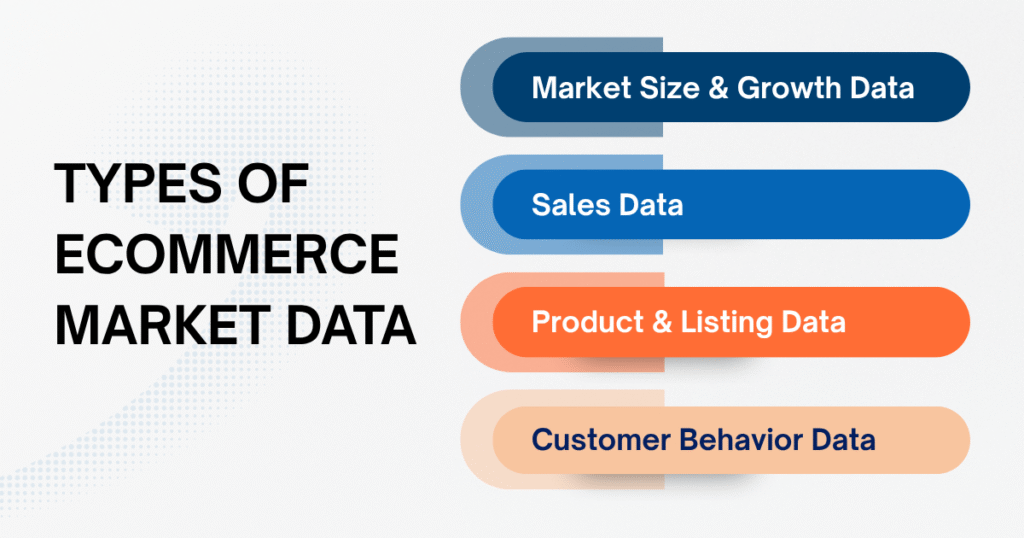
Market Size & Growth Data
This is the most traditional layer: market value, growth rate, and forecasts. It’s useful for high-level strategy but often lacks granularity.
Sales Data
Ecommerce sales data goes beyond revenue; it shows transaction volume, category performance, and seasonality patterns. Understanding the nuance between sales and revenue is critical, especially when analyzing platform performance or product traction.
Product & Listing Data
Competitive visibility really begins at the product level. With ecommerce product data, you can observe how competitors position their products, which SKUs are gaining traction, and how listings evolve.
More importantly, this layer helps uncover gaps, those early signals where demand is rising but supply hasn’t caught up yet. That’s often where the biggest opportunities sit.
Customer Behavior Data
Understanding what users click, search, and buy gives you a better sense of their behavior than just looking at numbers. Ecommerce customer data shows you how people search, what catches their eye, and how they navigate the buying journey. Once you start connecting behavior to product and sales data, patterns become much clearer and decisions less speculative.
Best Sources of Ecommerce Market Data in SEA
Not all data sources are created equal. In fact, most companies still rely on a mix of outdated reports and incomplete datasets, which leads to blind spots in decision-making. To understand where the real advantage lies, it helps to break down the main data sources available today.
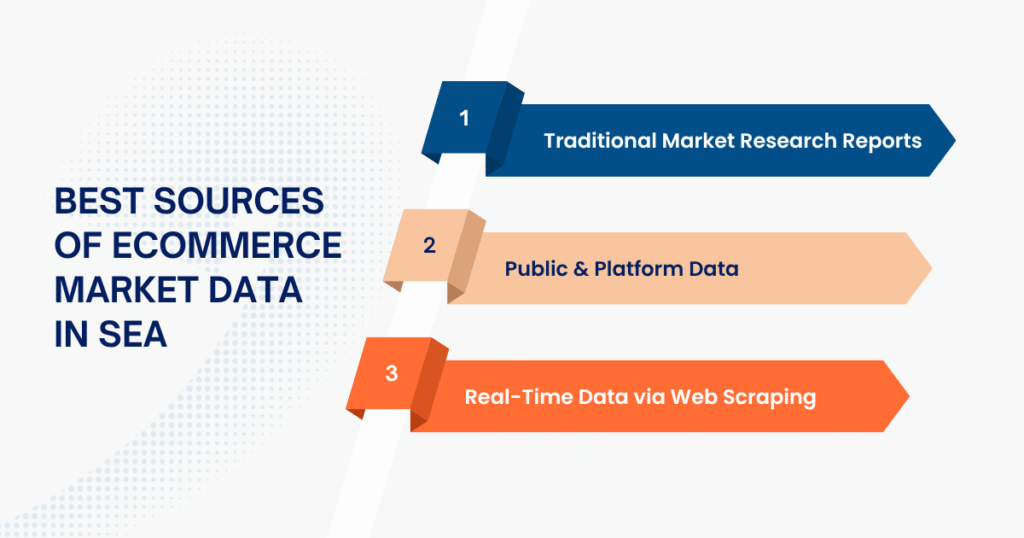
Traditional Market Research Reports
These reports are still widely used, especially for high-level strategy. They typically cover market size, forecasts, segmentation, and key players in a structured format. For investor decks or market entry planning, they can be helpful.
But when you move closer to execution, their limitations start to show:
- Data is often outdated by the time it’s published
- Reports are expensive and not customizable
- Lack of SKU-level or real-time insights
If you’re trying to understand what’s happening right now (at the SKU level or within a specific platform), these reports simply don’t go far enough.
Public & Platform Data
Public datasets, government statistics, and marketplace dashboards offer another layer of visibility. They’re more accessible and sometimes free, which makes them attractive as a starting point. However, they tend to be scattered across different platforms, inconsistent in format, and limited in depth. Pulling them together into something usable often requires significant manual effort.
For businesses operating across multiple SEA markets, this quickly becomes inefficient. You spend more time cleaning and aligning data than actually using it. In reality, public data can support analysis, but it rarely gives you a meaningful advantage over competitors who are looking at the same sources.
Real-Time Data via Ecommerce Web Scraping
What’s changing the game is working with live data instead of pre-packaged datasets. Now, businesses can extract information directly from ecommerce platforms. This method, called “ecommerce web scraping”, gives companies more control over their data collection and usage.
This flexibility is more important than it seems. It lets teams monitor competitors closely, test ideas faster, and react while trends are still forming.
How Businesses Use Ecommerce Market Data in SEA
Having data is one thing. Knowing how to use it is where the real advantage lies. In practice, leading ecommerce players in Southeast Asia are not just collecting ecommerce market data, they are operationalizing it across multiple functions.
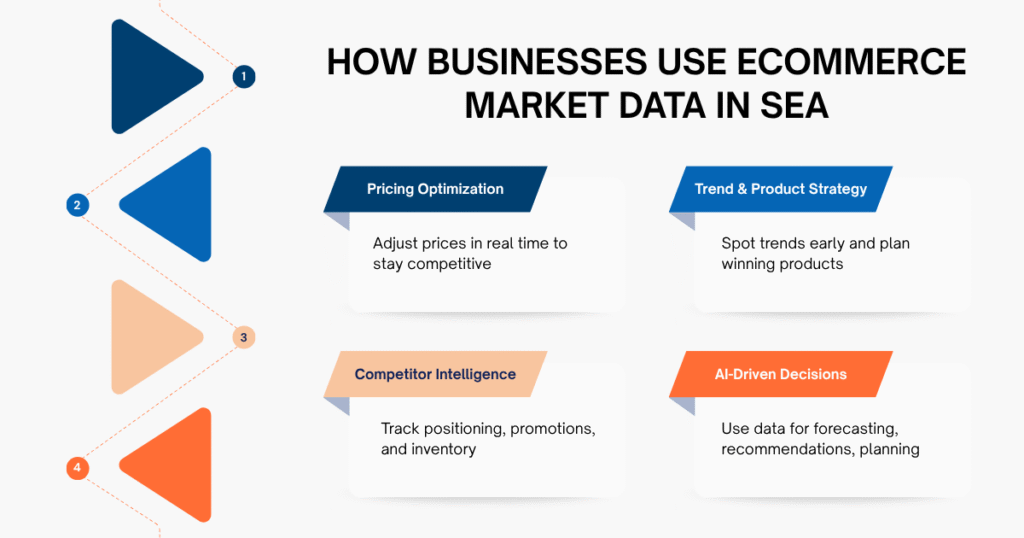
- Pricing optimization: By tracking competitor pricing in real time, businesses can adjust their own pricing strategies dynamically, staying competitive without sacrificing margins.
- Trend detection & product strategy: Monitoring product performance across marketplaces allows companies to identify rising trends before they go mainstream. This is particularly valuable in fast-moving categories like beauty, fashion, and electronics.
- Competitor intelligence: Understanding how competitors position products, run promotions, and manage inventory provides a level of insight that traditional research simply cannot offer.
- AI-driven decision making: As automation becomes more prevalent, businesses increasingly incorporate data pipelines into AI systems. This integration enhances demand forecasting, improves recommendation engines, and streamlines inventory planning.
The common thread across all these use cases is speed. The faster you can access and act on ecommerce market data, the more leverage you gain in a highly competitive environment.
How to Access Real-Time Ecommerce Market Data in 2026
Real-time data is becoming the standard, but accessing it efficiently is still a challenge for many businesses.
Manual tracking is often the first step. You check competitor listings or export marketplace data. It works in the early stages, but quickly becomes unsustainable as scale increases.
APIs provide a more organized method, but they have their downsides. Data access can be limited, coverage varies between platforms, and rate limits may slow progress. For deeper analysis, APIs usually fall short.
That’s why ecommerce data scraping service from outsourced providers is becoming popular. It helps businesses gather the precise data they need, as often as they need it, from various platforms.
The trade-off is in the implementation. Building and maintaining a scraping system means handling changing website structures, bypassing anti-bot protections, managing infrastructure, and turning raw data into usable insights.
For many teams, this process is resource-intensive. It often distracts from core business tasks. Thus, working with providers like Easy Data is often more practical. This is especially true for accessing clean, ready-to-use ecommerce market data without starting from scratch.
The real advantage lies not just in having data. It’s about how quickly that data translates into decisions that impact the business.
Conclusion
Ecommerce market data in Southeast Asia is no longer just a supporting asset; it’s the foundation of competitive strategy. While traditional reports still serve a purpose, they are increasingly insufficient in a market defined by speed and fragmentation. Public data fills some gaps, but it’s real-time, granular data that ultimately drives better decisions.
Businesses that embrace this shift (especially through approaches like custom data scraping) are not just keeping up with the market; they are staying ahead of it. And in a region where trends can change in weeks, that difference is what defines market leaders in 2026.
Leave a Reply