


Ecommerce growth in Vietnam creates opportunities, but a national trend does not tell an individual seller which channel will be profitable. This article was first published as five predictions for 2025. The revised guide keeps those five themes—social commerce, mobile shopping, personalization, cross-border selling and automation—and turns them into checks you can use with current platform requirements and your own operating data.
Treat forecasts, platform features and your business results as three different kinds of evidence. For regional context, Google’s November 2025 e-Conomy SEA summary expected video commerce to represent 25% of Southeast Asian ecommerce GMV in 2025. That is a regional projection, not a measured Vietnam-only share, mobile-shopping share or prediction of your store’s growth.

- 1. Test Social Commerce Against Your Product and Market
- 2. Validate the Mobile Shopping Journey
- 3. Test Personalization With Clear Outcomes
- 4. Check Cross-Border Readiness by Market
- 5. Pilot Automation With Human Review
- Decide Whether TikTok Shop Fits Your Business
- Conclusion: Make the Next Decision From Evidence
1. Test Social Commerce Against Your Product and Market
Social commerce connects product discovery with a route to purchase. Check the actual buying route on each platform instead of assuming every social app offers the same checkout in Vietnam. TikTok’s Shop and Showcase documentation describes selling through in-feed videos, LIVE and Showcase, and lists Vietnam among supported markets. Availability does not guarantee account approval, product eligibility or sales.
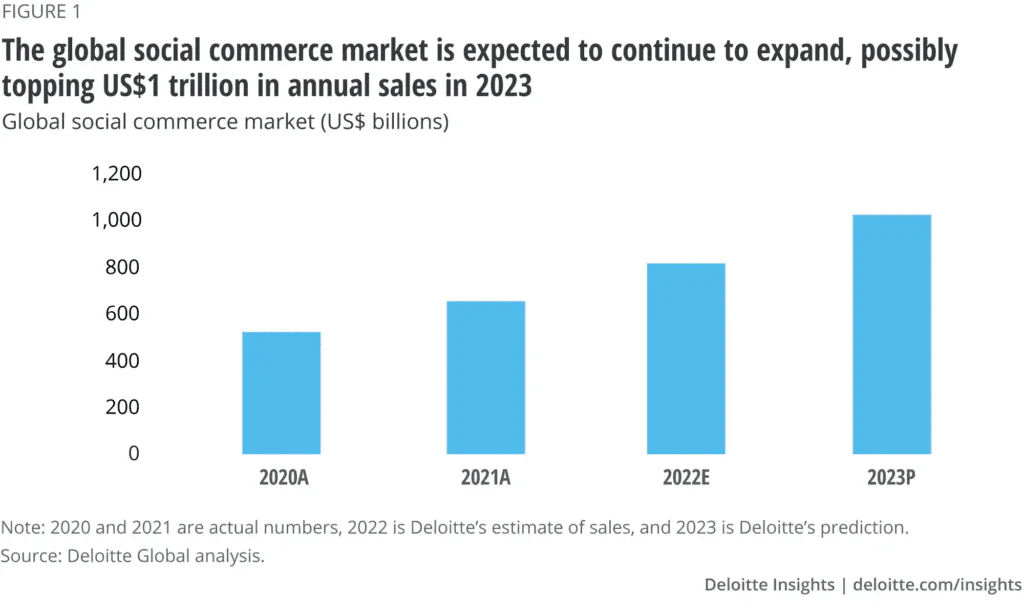
Historical context: Deloitte’s 2023 social-commerce forecast projected more than US$1 trillion globally. The chart labels 2020–2021 as actual values, 2022 as an estimate and 2023 as a prediction. It is not a Vietnam market-size measurement or evidence that the forecast was achieved.
What Social Commerce Can Help You Test
Short video and live demonstrations are options to test when they help explain your product. Start with a specific customer question, a relevant item and a fulfilment plan. Compare completed orders and contribution after costs; views or engagement alone do not establish channel fit.
Action Steps for Businesses
- Check seller readiness: use TikTok’s Seller Centre setup guide to review verification, business/banking information, pickup and return addresses. Confirm the Vietnam-specific requirements in your account before listing products.
- Test relevant content: choose a demonstration or question that matches your product. Record the creative, audience, dates and offer so results can be compared; a trending hashtag is not a guarantee of visibility.
- Prepare a live session: define the products, available stock, host responsibilities and customer-support handoff. Check the account’s current LIVE and selling eligibility before scheduling it.
For a broader launch checklist, use our social-commerce planning worksheet. Keep the platform’s current setup instructions as the authority for registration steps.
Illustrative Easy Data seller-tracking artwork. Product prices and counters shown in the image are not current observations. Discuss sample availability, market, fields and collection period through our TikTok Shop data service; this image does not establish a weekly delivery commitment.
2. Validate the Mobile Shopping Journey
A mobile-shopping plan should start with your own device mix and purchase funnel. The earlier version cited 80% smartphone penetration and a 65% mobile share of Vietnamese ecommerce sales without a verified matching source; those figures should not guide a budget decision. Separate mobile access, mobile payment and completed mobile orders when choosing a measure.
Check the Full Mobile Purchase Path
Test the path a customer actually follows on a representative phone: product information, variant selection, address entry, delivery charges, payment and order confirmation. On a marketplace, work within the controls that its seller tools provide. On your own store, you can assess the checkout implementation and payment integrations you manage.
How to Adapt
- Check small-screen clarity: make product details and delivery conditions readable. Test video captions, text size, variant selection and error messages; do not rely only on a desktop preview.
- Test the complete journey: include slow connections, returning from a payment app and unsuccessful payment attempts. Record what happened and fix the specific failure before increasing campaign traffic.
- Separate payment responsibilities: review payment options offered by the marketplace. Do not assume that a TikTok Shop seller can install arbitrary wallets into its checkout. For a store you operate, evaluate supported providers and verify the complete integration before launch.
For your own instrumented website, our GA4 ecommerce validation guide explains why a checkout step, successful purchase and refund need distinct definitions. Those website events do not reveal purchases completed inside a separate marketplace.
3. Test Personalization With Clear Outcomes
Personalization is a hypothesis to test: does a more relevant explanation or message help a defined group of customers? Begin with information people have provided for the agreed purpose and a simple rule, rather than assuming an automated recommendation system is required.
The Role of Personalization in Ecommerce Growth in Vietnam
Choose one useful outcome, such as fewer unanswered product questions or a second completed order within a fixed period. Compare like-for-like groups and costs. More engagement or a higher return rate among existing loyal customers alone does not prove that personalization caused the difference.
Steps to Implement Personalization
- Review available account reports: use the dimensions and metrics your account actually exposes. Record each definition and time window; audience reports are not a complete record of individual customers or their purchases elsewhere.
- Customize around a need: test a clear product-use explanation, size guide or replenishment reminder with an appropriate group. Keep message timing and the offer consistent enough to interpret the result.
- Respond to recurring questions: use comments and live sessions to learn what needs clarification. Obtain permission before reusing customer contributions and provide a support route for order-specific issues.
Use our Vietnam repeat-purchase test worksheet to define eligibility, equal follow-up windows and the denominator before interpreting a retention result. External marketplace observations provide context; they do not replace your own customer and order records.
4. Check Cross-Border Readiness by Market
Cross-border selling adds a market decision and an operating commitment. Assess the destination, seller eligibility, product restrictions, delivery, returns and total costs before advertising international availability. Do not assume a domestic shop automatically gains access to every country where a platform operates.
Market Access Is Separate From Audience Reach
TikTok Shop’s Vietnam seller FAQ describes shops operating locally by market and separate regional signup. Confirm the route available to your business in the relevant seller portal; a supported destination or an international audience does not by itself establish permission to sell there.
Tips for Going Global
- Localize the actual offer: review language, sizing, currency display and customer support for the intended market. Use the features supported by that shop; do not promise a currency converter or checkout control that has not been verified.
- Separate advertising from selling eligibility: being able to reach an audience through ads does not mean your shop can fulfil orders in that market. Confirm the sales destination and delivery route before launching a campaign.
- Document fulfilment: specify eligible destinations, delivery estimates, charges, returns and the party responsible for each step. Check those details against the selected carrier and marketplace requirements.
Write down the landed-cost assumptions for the specific product and destination, and obtain the appropriate tax or import guidance where needed. Recheck these assumptions when a platform rule, carrier rate or product category changes.
5. Pilot Automation With Human Review
Automation can assist with repetitive tasks, but its value depends on the task and the cost of errors. Start with a bounded use case such as drafting answers from an approved FAQ, then compare it with the existing manual workflow.
AI’s Impact on Ecommerce Growth in Vietnam
Keep approved information, escalation rules and a human owner for exceptions. Review a representative sample of outputs for accuracy, unsupported promises and disclosure of customer information. Faster replies are useful only if they resolve the issue correctly.
How to Leverage AI on TikTok Shop
- Pilot assisted replies: use approved product and service information, and escalate refunds, unusual orders and uncertain answers. Check which native or integrated tools your account supports before promising an automated service.
- Validate trend summaries: retain the source, market and observation date behind a generated summary. Check a sample against the underlying records; an AI-generated explanation is not evidence of a market change.
- Review campaign controls: use the audience and optimization options currently available in your account. Do not assume an arbitrary abandoned-cart retargeting workflow exists for every TikTok Shop, or that it will increase conversions.
TikTok’s Shop Ads guidance states that GMV Max became the default and only supported TikTok Shop Ads campaign type from July 2025. Check current account controls and official guidance rather than copying an older campaign tutorial unchanged.
Decide Whether TikTok Shop Fits Your Business
Treat TikTok Shop as one candidate channel alongside the routes your customers use. Decide whether it fits your product, margins and operational capacity by checking three things:
- Reach: can you reach a relevant audience with a clear, accurate product demonstration? Use account-level evidence rather than assuming the platform is ideal for every age group or category.
- Engagement: are questions being answered and shoppers moving toward a supported buying route? Creative quality matters, but no algorithm guarantees that a particular post reaches the right customers.
- Orders and costs: reconcile completed orders, cancellations and refunds with seller records. Include advertising, creator, platform, product, fulfilment and support costs before judging profitability.
Before expanding a pilot, document the following choices. The worksheet is a planning aid, not evidence that any channel or trend has already produced growth for your business.
A Vietnam channel-test worksheet
| Decision | Record before the pilot |
|---|---|
| Scope | One market, buying route, product group and observation period; document seller and product eligibility. |
| Customer journey | Devices, product information, checkout ownership, delivery promise and support handoff. |
| Main outcome | Define a completed order and how cancellations, refunds and repeat buyers are counted. |
| Costs | Record media, creator, platform, product, shipping, returns and support costs separately. |
| Decision rule | Choose the review date, comparison basis and conditions to fix, stop or extend the test. |
Fictional example: a pilot records 300 measured visits to the selected buying route and 12 completed orders after the agreed cancellation/refund window. The observed order-per-visit rate is 12 ÷ 300 = 4%. If media spend is VND900,000, media cost per completed order is VND900,000 ÷ 12 = VND75,000. This is not total acquisition cost or profit: other costs are excluded, visits are not necessarily unique people, and attribution or missing measurement can affect the denominator. These invented values are a calculation example, not a Vietnam benchmark or a forecast.
Conclusion: Make the Next Decision From Evidence
The five original predictions are best treated as questions to investigate, not outcomes that every Vietnamese seller should expect. Separate historical forecasts from current platform capabilities and from results you have measured yourself.
If TikTok Shop fits the test, follow the official seller setup process and validate a limited product scope. For external marketplace research, discuss the required fields, market and observation period with Easy Data’s TikTok Shop data service. Keep competitor research separate from your own transaction and customer records.
Choose the next action from the evidence: fix a failed journey, refine a product explanation or stop a test whose costs do not support expansion. Record what remains uncertain so the next review can compare the same definitions.
Leave a Reply