

Ecommerce growth in the Philippines is useful market context, but it does not tell a seller which products, buying routes or delivery promises will work. This guide separates audience measures, market estimates and operating decisions, then provides a checklist for a limited market test. Reviewed October 3, 2026: the original January 2025 article has been revised with dated sources published later in 2025 and current platform checks. Historical figures below are not presented as current 2026 measurements.
Market Overview
2025 Audience Evidence
DataReportal’s Digital 2025 Philippines report, published in February 2025 with support from We Are Social and Meltwater, gives the following January 2025 context:
- Internet audience: 97.5 million people used the internet, equivalent to 83.8% of the population.
- Social media: 90.8 million user identities were reported. These are not necessarily unique people or paying customers.
- Mobile connections: 142 million connections were active. A person may have multiple connections; this is not a smartphone-ownership percentage or a count of online shoppers.
- Interpretation: these measures describe access and audience size. They do not establish a 60% increase in ecommerce adoption, a mobile share of sales, or a conversion rate for your business.
2025 Market-Size Context
The 2025 Philippines e-Conomy SEA country report from Google, Temasek and Bain shows estimated ecommerce gross merchandise value (GMV) of US$17 billion in 2023, US$20 billion in 2024 and US$24 billion in 2025 on page 3. The same chart puts the broader digital economy at US$36 billion in 2025. Keep these scopes separate: ecommerce GMV is not the revenue or profit earned by a platform, an individual seller, or Easy Data. These dated market estimates do not demonstrate that a specific category is underserved.
How to Read These Measures
- Audience: specify people, accounts or connections, the observation date and the country. Do not treat these units as interchangeable.
- Shopping behaviour: measure your own visits, checkout attempts and completed orders by device. The earlier claim that mobile accounts for more than 70% of shopping traffic has no matching verified source in this article and should not guide a budget.
- Market value: record the report edition, currency and sector definition. Do not combine a digital-economy total with ecommerce-only figures or calculate growth from rounded chart labels as if they were exact values.
For external marketplace research, define a product group, market, collection date and required fields before ordering data. Our Shopee data scraping service can be discussed against that brief. Listing observations provide competitive context; they do not reveal every seller’s audited sales or profit.
Key Drivers of Ecommerce Growth
Official Platform Setup
Start with the platform’s own instructions. TikTok’s Seller Centre setup guide describes account verification, business details, pickup and return addresses, and bank-account setup. Confirm the Philippines requirements and product eligibility shown in your account before planning a launch.
1. Digital Transformation and Internet Connectivity
Internet access expands the possible audience, while the buying experience still depends on a shopper’s device, connection and location. Test your actual product and checkout pages on representative phones and slower connections. A national penetration figure is not evidence that a particular rural route or customer segment is easy to serve.
2. Social Media’s Influence on Shopping
Social media can connect product discovery with a buying route, but checkout features differ by platform and market. TikTok’s Shop and Showcase documentation, updated in June 2026, lists the Philippines and describes selling through in-feed videos, LIVE and Showcase. Do not assume Facebook, Instagram and TikTok provide identical checkout options or that every account qualifies. Verify the route available to your own business.
3. Adoption of Digital Payment Solutions
The Bangko Sentral ng Pilipinas 2024 payments report records digital payments at 57.4% of total monthly retail payment volume and 59.0% of value, compared with 52.8% and 55.3% in 2023. These are broad retail-payment measures, not ecommerce-only checkout statistics. For your store, check supported payment methods, payment failures, settlement and refunds rather than assuming digital adoption has removed trust or cash-on-delivery concerns.
4. Improved Logistics and Delivery Services
Delivery coverage needs a route-level check. For example, Lalamove publishes a Philippines serviceable-area list; the presence of a carrier in the country is not a guarantee of every remote destination, vehicle type or delivery deadline. Check the pickup and destination addresses, parcel restrictions, available service, price and return route before promising delivery.
Keep a delivery log during a pilot: promised date, actual completion, failed attempts, customer contact and total cost. Compare similar routes and products. Marketplace listings alone cannot establish the operational quality of a carrier or competitor.
Opportunities in the Philippine Ecommerce Market
Turn Context Into a Pilot
Use the dated audience, GMV and payments sources above as background for the Philippines market pilot worksheet below. The worksheet turns an opportunity claim into a product, channel and operating test; it does not assume the national trend will carry every business.
1. Untapped Consumer Demand
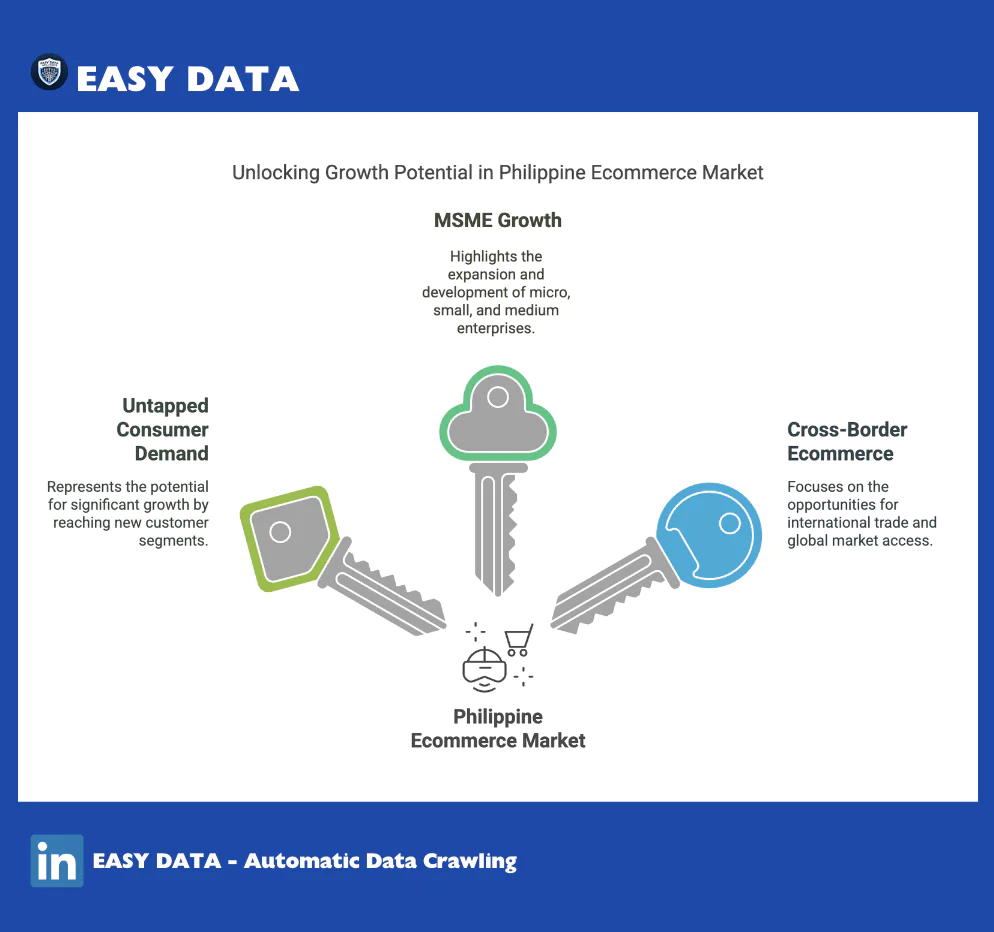
Treat untapped demand as a hypothesis. Compare a defined set of products and sellers, observed price ranges, recurring review themes and delivery conditions. Test whether you can solve a specific customer problem at an acceptable cost. This article does not establish that groceries, electronics or fashion are less penetrated than in Singapore or Malaysia.
2. MSME Growth
For a micro, small or medium enterprise, begin with a manageable assortment and clear stock, support and fulfilment ownership. Research can help identify what to test, but add-on tools should solve a demonstrated operating problem. Agree the fields and sample validation before expanding a data-collection brief.
3. Cross-Border Ecommerce
Cross-border ecommerce adds a separate eligibility and fulfilment decision. Check the platform route available to your business, product restrictions, destination requirements, landed costs and returns before offering international delivery. An audience abroad or a platform’s presence in another country does not by itself establish permission or ability to sell there.
Challenges Facing Ecommerce in the Philippines
Operational Checks
Combine official account and carrier guidance with your own support and order records. The checks below are operational planning questions; they are not a legal determination or a guarantee that every platform, payment method or route will be available.
1. Payment and Trust Issues
Review payment attempts, confirmed payments, cash-on-delivery completions, cancellations and refunds separately. Show customers the total price, expected delivery and support route before purchase. Diagnose where a transaction failed instead of treating every abandoned checkout as a lack of trust.
2. Infrastructure Limitations
Compare delivery performance by the routes you actually serve. Record transit time, failed attempts, returns and customer-support effort; do not extrapolate an urban pilot to all islands or remote destinations. Reconfirm service availability and charges when expanding coverage.
3. Competition Among Platforms
Compare like-for-like offers: product variant, seller, shipping charge, eligibility for promotions and observation time. A lower headline price may not be the lower delivered price. Differentiate through a specific product or service benefit that you can substantiate.
Our Lazada data-brief guide explains how to define comparable fields and collection assumptions. Use external observations alongside your own orders and costs rather than treating public counters as complete transaction records.
Future Trends in Philippine Ecommerce
Trends to Test
The original quick-commerce, livestream, sustainability and AI themes remain useful questions to test. They should not be presented as outcomes that every Philippine seller will experience. Choose a bounded experiment, a review date and a measurable decision rule.
1. Rise of Quick Commerce
Test faster delivery where the product, stock location and available carrier service make it feasible. Compare additional fulfilment cost with completed orders and customer outcomes. Do not promise delivery within hours without a verified route and operating plan.
2. Growth of Livestream Shopping
A live demonstration can help answer product questions. Confirm account and product eligibility, prepare stock and support, and record the offer and dates. Compare completed orders and costs after cancellations and refunds; views alone do not show profitable demand.
3. Sustainable Ecommerce Practices
Evaluate a specific packaging or fulfilment change rather than assuming every sustainability message will increase sales. Record material use, damage, returns and cost, and substantiate any environmental claim before using it in marketing.
4. Integration of AI and Automation
Pilot automation on a bounded task, such as drafting replies from an approved product FAQ. Keep a human owner for exceptions and compare accuracy, resolution and operating effort with the existing workflow. Faster or more personalized output is not automatically better customer service.
For channel planning, use our social-commerce launch worksheet. Treat it as a planning aid and use the selected platform’s official instructions for registration and feature availability.
A Practical Seller Checklist
1. Build a Strong Online Presence
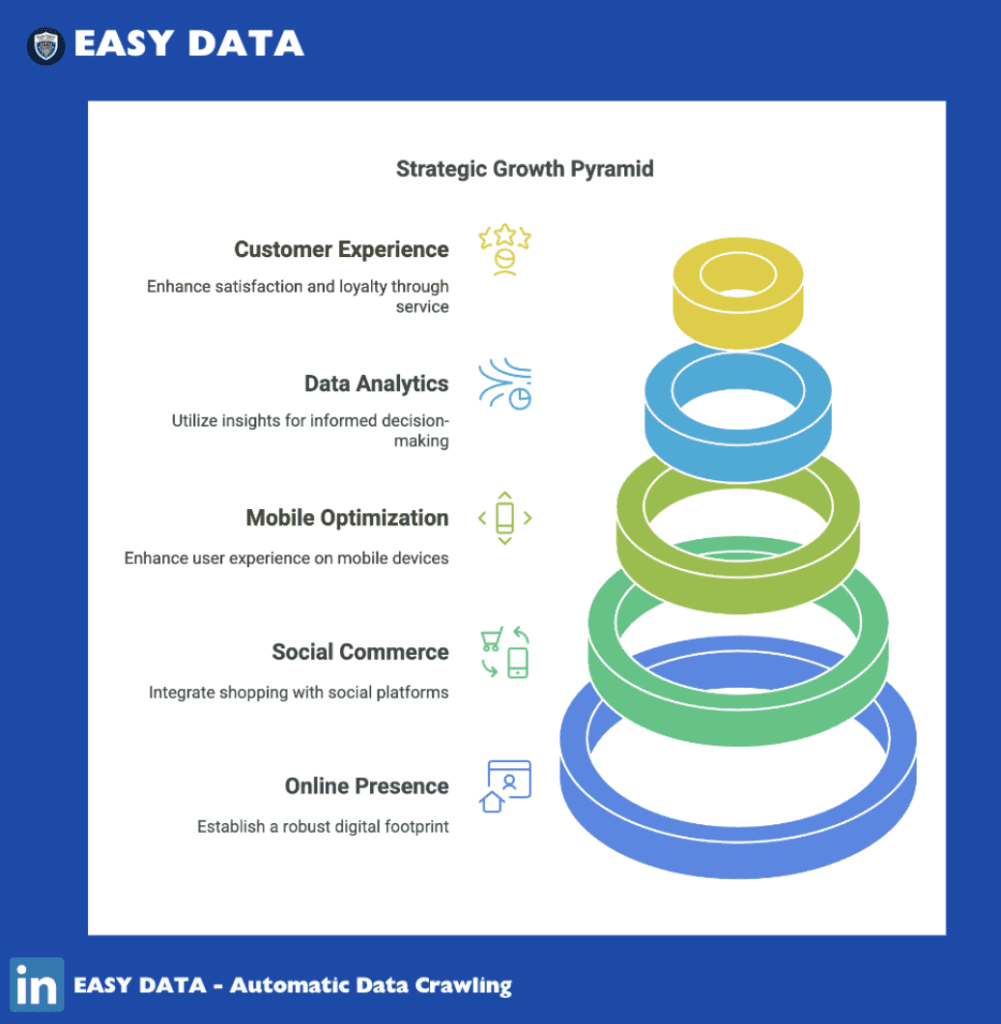
Choose the buying route your team can operate reliably: your own store, an eligible marketplace account, or another supported channel. Make product details, stock, delivered price and support information consistent before expanding traffic.
2. Focus on Social Commerce
Build a demonstration around a real customer question, and provide a clear route to purchase or support. Record the audience, creative, offer and observation window so the result can be compared with another test.
3. Optimize for Mobile
Test product selection, text readability, address entry, payment-app handoff, errors and confirmation on representative phones. Use your measured device mix rather than an unsupported national mobile-shopping percentage.
4. Embrace Data Analytics
For a website you operate, our GA4 ecommerce validation guide separates checkout steps, purchases and refunds. Website analytics does not automatically observe orders completed inside a separate marketplace; reconcile those with the seller’s order records.
5. Prioritize Customer Experience
Set achievable delivery and support expectations, record recurring problems, and check completed orders after the agreed cancellation and return window. Use the worksheet below to decide what to fix, stop or extend.
Philippines market pilot worksheet
Record these choices before the pilot. This is a planning aid, not a forecast or a claim about a particular dataset.
| Decision | What to record |
|---|---|
| Scope | Product group, Philippine destination areas, buying route and dates; confirm account and product eligibility. |
| Comparable offers | Product variant, seller, observed price, shipping, promotion conditions and observation time. |
| Fulfilment | Pickup and delivery coverage, promised times, failed delivery and return handling, and responsible person. |
| Order outcome | Define completed orders and the cancellation/refund window; reconcile payments and marketplace records. |
| Costs | Separate product, platform, payment, advertising, creator, shipping, returns and support costs. |
| Decision rule | Set the review date and conditions to fix, stop or expand the test before seeing its result. |
Fictional calculation: a pilot records 240 eligible visits and 12 completed orders after its agreed cancellation/refund window. The observed order-per-visit rate is 12 ÷ 240 = 5%. Advertising spend of PHP3,600 gives an advertising cost per completed order of PHP3,600 ÷ 12 = PHP300. These invented values are not Philippine benchmarks. Visits may not be unique people, attribution may be incomplete, and other operating costs are excluded, so the example does not establish total acquisition cost or profit.
Conclusion
Philippine ecommerce market estimates and audience measures provide context for a test, not a promise of business growth. Keep the original themes—connectivity, social commerce, payments, logistics, smaller businesses and cross-border selling—but evaluate each against a defined product and operating scope.
If external marketplace observations would help that decision, discuss your market, fields, collection period and sample checks with Easy Data’s data services team. Keep competitive observations separate from your own sales, costs and customer records, and expand only when the pilot evidence supports the next step.
Leave a Reply