

As online shopping continues to expand at a rapid pace, businesses need reliable data to make fast, accurate, and cost-efficient decisions. But should you rely on ecommerce data (real-time datasets from ecommerce platforms) or traditional market research (surveys, interviews, or focus groups)? This article provides an in-depth comparison to help you determine which method delivers higher-quality insights for your growth strategy.
What Is Ecommerce Data?
Ecommerce data refers to all information collected from sales activities, products, customers, markets, and logistics on ecommerce platforms. This is real-time data with high granularity and large volume.
Because it is objective and based on real buyer behavior, ecommerce data helps businesses make decisions much faster than traditional methods.
Sources of ecommerce data include:
- SKU-level sales data
- Product data (pricing, rating, inventory)
- Customer data (purchase behavior, frequency, order value)
- Market data (market share, segmentation, trends)
- Shipping data (shipping cost, lead time, fulfillment)
Key Types of Ecommerce Data
These are the main datasets businesses typically use when analyzing markets and optimizing ecommerce operations. Each type of ecommerce data provides a unique perspective on market dynamics, shopping behavior, and operational performance.
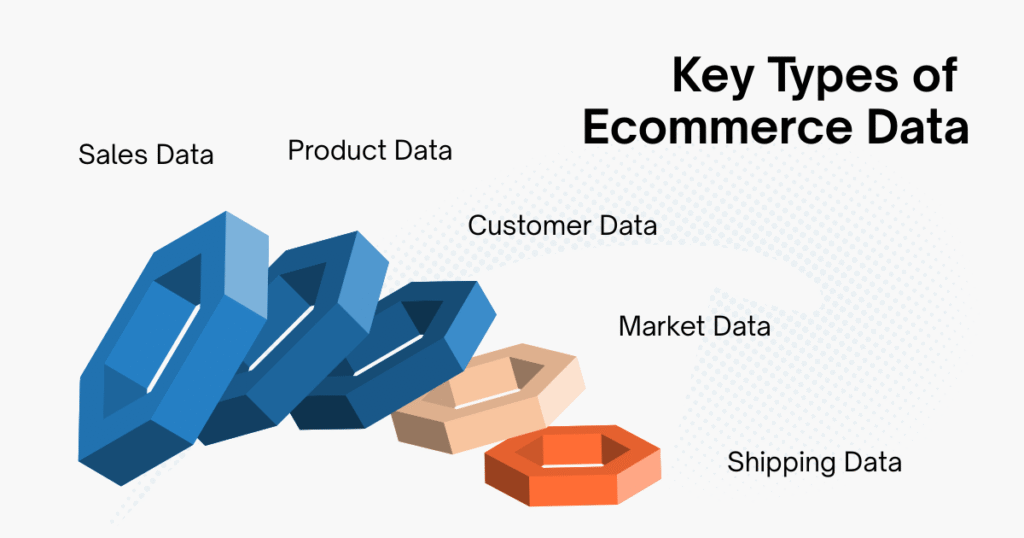
• Ecommerce Sales Data: Includes sales volume by day, week, or month, by SKU, or by category. This type of ecommerce data helps businesses understand consumption trends, forecast demand, and identify best-selling products.
• Ecommerce Product Data: Contains detailed product information such as pricing, inventory, descriptions, images, ratings, and customer reviews. This enables companies to track price changes, optimize product portfolios, and quickly detect competitors’ strategies.
• Ecommerce Customer Data: Focuses on customer behavior and purchase habits (average order value, buying frequency, loyalty segments). This dataset is especially useful for improving conversion rates or personalizing marketing campaigns.
• Ecommerce Market Data: Reflects the market’s overall picture, including market share, category growth, search trends, and general consumer behavior. Ecommerce data in this category helps businesses identify expansion opportunities or explore niche markets.
• Ecommerce Shipping Data: Includes delivery time, shipping costs, and logistics performance. This information supports evaluating supply chain efficiency, shortening delivery time, and enhancing customer experience.
What Is Traditional Market Research?
Traditional market research is a method based on surveys, interviews, focus groups, and behavioral studies conducted on small samples. These depend on direct questioning and were widely used long before digital data scaled.

Traditional research takes more time, costs more, and is prone to bias because results rely on subjective answers. However, it remains useful for studying emotions, unmet needs, or testing new concepts.
Ecommerce Data vs. Traditional Market Research – A Practical Comparison
When choosing between ecommerce data and traditional market research, it’s essential not only to understand each method but also to see how they differ in real operational scenarios. Ecommerce markets shift by the hour, making speed, accuracy, and actionability critical. Below is a detailed comparison to help businesses determine when each approach is most suitable.
| Criteria | Ecommerce Data | Traditional Market Research |
| Speed & Real-Time Capability | Continuously updated hourly or daily, reflecting market changes as they happen. | Slow collection; surveys and analysis may take weeks or months. |
| Accuracy & Sample Size | Based on real transactions from thousands or millions of users; minimal bias. | Small samples (200-500 respondents) with high risk of subjective bias. |
| Cost Efficiency | Automated, cost-effective via scraping or API; suitable even for small businesses. | High cost: agencies, surveys, interviews, research teams. |
| Actionability | Highly actionable: price tracking, trend detection, inventory optimization, SKU-level competitor analysis. | Useful for emotional insights or brand perception but not detailed enough for daily operational optimization. |
| Use Cases | Pricing intelligence, competitor monitoring, niche markets, sales forecasting, logistics analytics. | Brand insight, concept testing, perception studies, unmet-needs research. |
From this analysis, it’s clear that each method has its strengths and limitations.
Ecommerce data stands out with near real-time updates, high accuracy based on actual shopping behavior, and large-scale market coverage. This helps businesses optimize operations, track competitors, and make decisions quickly. However, ecommerce data has limitations such as lack of emotional insights, dependency on platform data structures, and limited usefulness for testing completely new product concepts.
Meanwhile, traditional market research excels at revealing psychological motives and emotional drivers. It is suitable for testing product concepts before launch and for studying highly specific customer segments. Yet its greatest weaknesses include long execution time, high cost, subjective bias, and limited sample size that may not fully represent the real market.
When Ecommerce Data Is the Better Choice
Ecommerce data is especially effective in situations requiring speed, objectivity, and immediate actionability. Typical scenarios include:
- Large-scale industry-level analysis
- SKU-level market monitoring rather than sample-based analysis
- Building AI/ML models or recommendation systems
- Market-wide competitor benchmarking
- Trend forecasting or detecting emerging trends early
- Building BI dashboards or internal analytics systems
In short, when businesses need quick insights based on real behavior and real-time data, they almost always turn to e-commerce data collection methods (especially e-commerce data scraping) because market research can no longer keep up.
Real-World Applications of Ecommerce Data
Based on extensive Lazada/TikTok Shop/Shopee data-scraping experience across major Southeast Asian markets, Easy Data has observed that companies frequently leverage ecommerce data for strategic activities such as:
- Category-level market analysis
- Tracking top-selling items
- Detecting trending products before the market peaks
- Competitor analysis via pricing, sales, and reviews
- Optimizing flash sales and advertising strategies
- Evaluating logistics performance by seller or category
When Market Research Is Still Needed
Traditional market research remains important when businesses require emotional, perceptual, or conceptual insights that ecommerce data cannot capture, such as:
- Brand awareness surveys
- Exploring emotional needs or latent motivations not visible through purchase behavior
- Testing entirely new product concepts
- Understanding psychological drivers behind decisions (read the analysis by Harvard Business Review)
Although it’s slower than ecommerce data, traditional research offers the depth and human nuance that digital data cannot provide, making it essential for many strategic brand and behavioral studies.
Conclusion
The question “Ecommerce Data vs. Traditional Market Research: Which One Wins?” may seem complex, but the answer is clear in today’s digital commerce environment.
- If you need speed, accuracy, real behavior, and immediate action → Ecommerce data is the clear winner.
- If you need emotional insights or concept testing → Traditional market research remains valuable.
For most ecommerce businesses (especially brands selling on Shopee, Lazada, or TikTok Shop) ecommerce data is currently the most powerful source of insights, enabling decisions based on objective, real-time, and cost-efficient data.
Leave a Reply