


Introduction: Why Understanding the Purpose of Web Scraping is Essential for Your Business
The purpose of web scraping is to turn information displayed on websites into structured observations that can answer a business question. For an e-commerce team, that might mean checking whether the same product variant has changed price, or identifying recurring complaints in a defined set of reviews. Automation can reduce repeated manual collection, but it does not guarantee complete, accurate or real-time data. Start with the decision you need to make, then choose the source, fields, collection schedule and checks that support it.
What is Web Scraping?
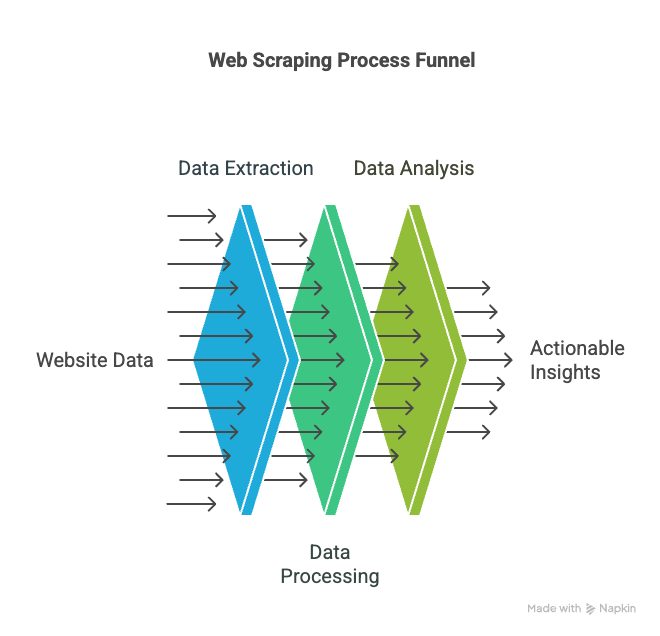
Web scraping extracts information from web pages into a structured form, such as a spreadsheet or database. A collection might contain product listings, displayed prices or review text. Extraction is only one step: identifying the right pages, interpreting fields, checking missing values and comparing observations require separate work. A listing is evidence of what the source displayed at a particular time, not automatic proof of sales, demand or inventory.
Use scraping when repeated page observations are needed and the access and reuse conditions fit the project. First check whether an authorized export, documented API or licensed dataset already supplies the required information. Those alternatives can avoid maintaining page selectors. For a small one-off question, a manually checked sample may be sufficient; for a recurring project, budget for failed requests, validation and source changes as well as collection. The practical e-commerce collection workflow shows how to define the required fields, validate observations and compare prices including shipping.
Key Purposes of Web Scraping
-
Market Research and Analysis
Collect a defined sample of product categories, sellers, prices and visible review counts to describe an observed market segment. Record the marketplace, geography, filters, collection date and included pages. Search ranking, unavailable listings and pagination limits can change the sample. Treat the result as coverage of that sample, not a census of the entire market.
Useful output: A category comparison with the number of unique listings observed, missing-field counts and a repeatable sampling rule. Validate claims about demand against an appropriate sales source; listing and review counts alone do not establish units sold.
-
Competitive Analysis
Track comparable product variants, advertised promotions and delivery terms across a fixed set of competitors. Preserve seller and product identifiers, pack size, currency and observation time so that a new bundle or a different seller is not mistaken for a price change. A changed public offer does not reveal the competitor’s internal strategy or profit margin.
Useful output: A review queue showing which matched offers changed, which became unavailable and which failed to load. Keep collection failures separate from commercial changes, and verify an important alert against the source before acting.
-
Lead Generation
Company directories and published job openings can help identify organizations that fit a business research brief. Define company-level fields such as sector, location and website before collecting personal contact details. A public email address or profile does not by itself establish permission for reuse or outreach. Collection and contact decisions need their own applicable privacy and marketing checks.
Useful output: A deduplicated company shortlist with source URLs and the reason each organization fits the brief. Hiring signals can be explored through the job-listing data guide; a job posting is an observation, not proof of a company’s budget or willingness to buy.
-
Price Monitoring and Dynamic Pricing
Repeated observations can reveal changes in comparable advertised offers. Keep the listed price, shipping charge and conditional discount separate; voucher eligibility, membership, location and selected variant can affect the payable total. A scheduled crawl is a snapshot at its observation time. Use validated changes as input to pricing review, with your own cost and margin constraints, rather than automatically copying the lowest visible price.
Useful output: A matched-offer change report with timestamps, currency and discount conditions. It can support a pricing decision, but cannot guarantee profitability. For marketplace-specific fields and coverage limits, see the Shopee collection scope guide.
-
Sentiment Analysis and Customer Feedback
Group observed reviews by a clear topic, such as packaging damage or sizing, while preserving rating, date and product context where available. Define whether the sample includes all accessible reviews or only a sorted or filtered subset. Reviews are self-selected, and sorting, language, duplicate content and moderation affect what you see. An automated sentiment label is an interpretation that needs a manually checked sample.
Useful output: Topic counts and anonymized examples from the stated sample, with uncertain classifications flagged. The customer-review analysis guide explains coverage and validation. Do not describe the sample as the opinions of all customers or infer a retention improvement from review counts alone.
-
Data Aggregation
Combine compatible observations from several sources using a documented field mapping. Normalize currencies, units, time zones and identifiers before comparing records; keep original values and source URLs so a reviewer can trace the result. The same product may appear under several sellers or URLs, so decide explicitly whether a row represents a product, an offer or an observation.
Useful output: A dataset with a stable row key, duplicate rules, field definitions and a change log. Adding sources increases potential coverage but can also add conflicting definitions and duplicated observations. More rows alone do not demonstrate better evidence.
-
Financial Market Data Collection
Public filings and company announcements can support research when publication dates, reporting periods and amendments are preserved. For example, the SEC provides documented ways to access EDGAR filings and structured data. Delayed web-page quotes should not be presented as a guaranteed real-time market feed; use a suitable licensed feed when timeliness and permitted redistribution are requirements.
Useful output: A filing or announcement register linked to its original source, with the reporting period distinguished from the collection timestamp. Follow the provider’s access guidance; SEC EDGAR access documentation describes its data access options and fair-access requirements.
How Web Scraping Benefits Different Industries
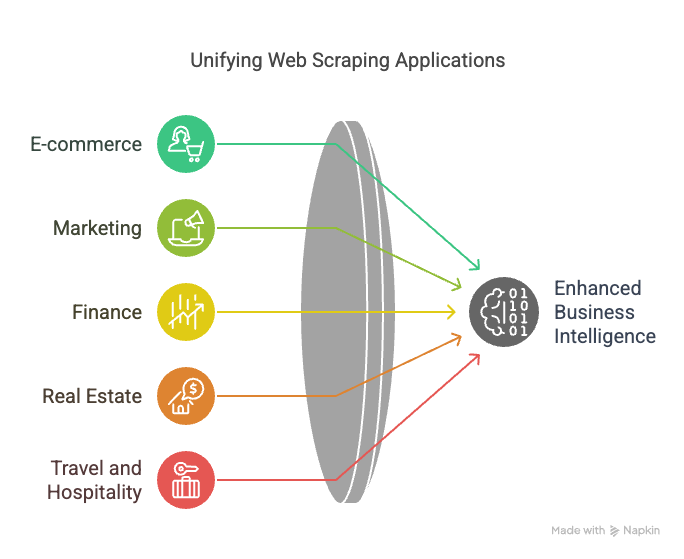
Web scraping can support different industries, but each needs a specific observation and a defined decision:
Illustrative pilot: deciding which offers need a price review. Suppose a team selects 100 product-seller-variant combinations for two daily snapshots in one marketplace and currency. The second run has 92 successful observations and 8 failed requests. Of the 92, only 85 have a valid like-for-like match to the first snapshot; 7 need a variant or field review. Report collection success as 92/100 = 92% and comparison coverage as 85/100 = 85%. Do not call the 8 request failures delistings or calculate price changes across unmatched variants. These numbers are fictional and demonstrate the method, not an Easy Data customer result.
Decision rule for that pilot. On one matched offer, an advertised price of 100 falls to 90 in the same currency: (90 − 100) / 100 × 100 = −10%. That flags a price review, not an automatic reduction: confirm pack size, shipping and discount conditions, then check your own margin constraint. Preserve the URL, seller/product/variant key, observation time, raw price and normalized price. Record missing values as missing rather than zero, retain failed-request counts, and have a reviewer check a sample against the source before relying on the report.
Accept or stop the pilot. Agree on required fields, freshness, match coverage and an error tolerance before collection. Measure time spent on validation and maintenance as well as time saved on manual copying. If the source cannot reliably provide the needed fields, use an authorized export or another suitable source, or narrow the business question. A larger scrape is not the remedy for an unsuitable source.
- E-commerce: Compare matched offers and product availability signals; use authorized sales records for actual orders and revenue.
- Marketing: Review defined feedback samples and public campaign messages; do not treat a scrape as complete audience analytics.
- Finance: Organize public filings and announcements with reporting periods and amendment history.
- Real Estate: Compare advertised properties after deduplication; asking prices are not completed transaction prices.
- Travel and Hospitality: Compare offers for the same dates, occupancy and cancellation terms. The hotel-price monitoring guide explains why room and tax conditions matter.
Legal and Ethical Considerations in Web Scraping
Review access, reuse and privacy requirements for the specific sources and jurisdictions before collection. Technical accessibility alone does not settle permission. For a project involving personal data, unclear licensing or restricted access, obtain appropriate advice before proceeding.
- Check Website Terms of Service: Review the source’s terms, available API or export agreement and any limits on reuse. Obtain the permissions the project requires; do not bypass logins, paywalls or other access controls.
- Respect Robots.txt: Honor the source’s crawler rules and request limits. RFC 9309 explains that robots.txt rules are not access authorization, so following them is not a guarantee of legal permission. For HTTP 429 responses, pause and respect any Retry-After instruction; stop persistent failures for review.
- Data Privacy: Collect only the information needed for the defined purpose and establish appropriate retention and access controls. The joint statement from privacy authorities explains that publicly accessible personal information remains subject to privacy laws in most jurisdictions. Requirements for collection, reuse and outreach depend on the actual project; a public page is not a blanket exemption.
Conclusion: The Purpose of Web Scraping for Business Growth
The purpose of web scraping is to supply a decision with traceable observations. A useful project has a defined sample, comparable fields, an acceptable observation age and a clear response to missing or changed data. Start with a small checked pilot, measure the work it saves and the errors it introduces, then decide whether recurring collection is justified.
To discuss a marketplace collection project, bring the target sources, country, required fields, expected volume and refresh schedule to the Easy Data service overview. Agree on what the source can actually supply before committing to a delivery or coverage claim.
Technical references
Leave a Reply