


Introduction: Why You Need a Web Scraping Agent for Your E-commerce Business
A web scraping agent can repeat a defined collection task: visit selected pages, extract agreed fields and deliver observations for review. Its value depends on what happens when pages change, prices are missing or a scheduled run fails. This guide explains five potential benefits for e-commerce teams and the evidence to request before relying on an agent for pricing or catalog decisions.
- Introduction: Why You Need a Web Scraping Agent for Your E-commerce Business
- What is a Web Scraping Agent?
- 5 Key Benefits of Using a Web Scraping Agent for Your E-commerce Business
- How to Choose the Right Web Scraping Agent for Your E-commerce Business
- Legal and Ethical Considerations for Web Scraping Agents
- Conclusion: How a Web Scraping Agent Can Enhance Your E-commerce Strategy
What is a Web Scraping Agent?
In this guide, a web scraping agent means software or a managed service that executes a collection workflow. It may use fixed parsing rules, a browser or AI-assisted extraction; the label alone does not establish which approach it uses. Ask how it chooses targets, records observation times, validates fields and reports failures. A page’s displayed availability or reviews are observations, not direct evidence of stock levels or sales.
A scheduler can start repeated runs, but the interval between runs is different from the age of delivered data. Record both the observation timestamp and delivery timestamp, and define an acceptable delay for the decision you need to make. The web scraping process guide explains the collection, validation and delivery stages that an agent must coordinate.
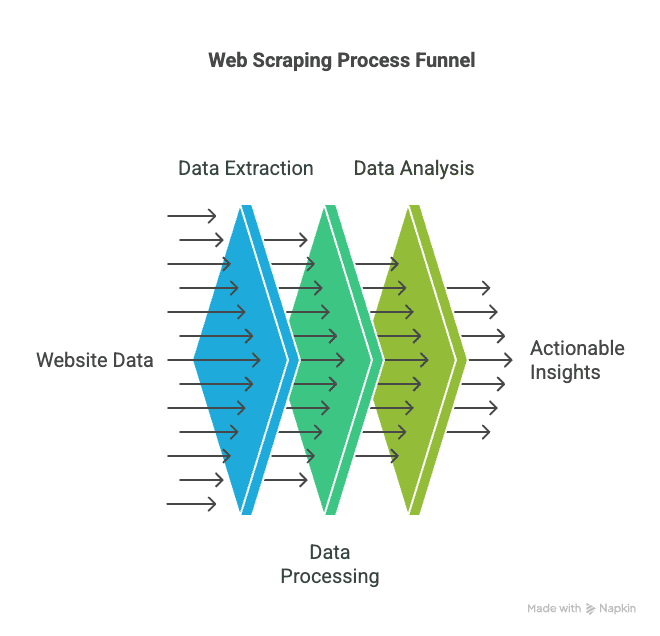
5 Key Benefits of Using a Web Scraping Agent for Your E-commerce Business
-
Repeatable collection
An agent can execute the same target list and extraction rules on a schedule, reducing repeated manual copying. It still needs an owner for exceptions, source changes and sample checks. Keep a run identifier, target list, parser version and failure log so a partial run cannot be mistaken for a complete delivery. -
Measured update frequency
Repeated snapshots can support price-change monitoring when the same seller, listing, variant and market are compared. Set a maximum acceptable observation age and measure it at delivery. An hourly schedule does not guarantee an hourly observation for every target, and observations can become outdated after collection. -
More efficient research preparation
Collection can assemble product or business information for a team to review. Measure time spent configuring, checking and maintaining it against the manual task it replaces. Extracted contact details are neither verified leads nor permission to contact someone; assess the intended use and applicable privacy and marketing rules separately. -
Comparable competitor observations
Record currency, pack size, shipping treatment and promotion conditions before comparing offers. Keep missing observations visible and check apparent changes against their source. A ranking or price change does not reveal a competitor’s revenue, margin or reason for changing it. -
Controlled expansion
Reusable workflows can make it easier to add targets, but browser sessions, requests, storage and maintenance consume resources. Increase a bounded pilot gradually and measure completion time and usable records. As one implementation example, Scrapy AutoThrottle adjusts request delays using latency while respecting configured concurrency and minimum-delay limits. It does not remove source limits or guarantee throughput.
Worked example: reviewing price-change alerts. This fictional pilot generates 20 alerts. Manual checks confirm 16 are genuine price changes for the same seller, listing, variant and comparable price basis. The other 4 compare different pack sizes. Observed alert precision is 16 ÷ 20 = 80%, and 4 ÷ 20 = 20% of reviewed alerts are false positives. These are invented inputs, not Easy Data performance results.
If the team had chosen a 95% precision threshold for this pilot, this result would fail that threshold. Fix the product-matching rule and review a new sample before expanding use. The sample does not show recall: without an independent set of all genuine changes, you do not know how many changes the agent missed. Nor does 80% in this small sample establish future performance.
How to Choose the Right Web Scraping Agent for Your E-commerce Business
Select an agent against a written pilot brief: target pages, fields, permitted scope, observation schedule, delivery format and failure behavior. The five checks below help distinguish a convincing demonstration from a workflow your team can operate.
1. Customization
Give the provider representative pages, including variants, unavailable offers and missing fields. Define the identity of an observation and ask for raw source references alongside normalized values. Test that an error or login page is reported as a failure rather than exported as product data.
2. Ease of Use
Have the intended operator configure a small job, inspect a failure and export a sample without help. Check whether they can see which targets were attempted, which produced usable records and which need review. A clear dashboard helps operation, but it is not evidence that the extracted values are correct.
3. Legal and Ethical Compliance
Review the specific source and planned use, not only the provider’s compliance claim. Establish who owns access review, personal-data decisions, retention and deletion. A product feature or vendor statement cannot by itself establish that your collection and reuse are permitted.
4. Data Output Formats
Test a sample import into the system that will use it. Agree on field names, data types, null handling, currency, timezone and versioning as well as the file extension. Scrapy’s feed-export documentation, for example, lists JSON, JSON Lines, CSV and XML and explains fixed CSV field order. That does not mean every agent supports every format.
5. Support and Maintenance
Ask who investigates missing targets, changes parsing rules and communicates delivery incidents. Agree on response expectations, change logs and a way to pause the job. Track technical counters and business acceptance separately: Scrapy’s stats collector can record requests, responses and items, but your own validation rules determine whether those items are useful.
| Decision | Evidence to request |
|---|---|
| Scope | A fixed pilot target list, requested fields and explicit exclusions. |
| Freshness | Observation and delivery timestamps, plus a chosen maximum acceptable age. |
| Quality | Matched identifiers, missing-field counts and manual checks of a defined sample. |
| Failures | A target-level log, bounded retries, stop conditions and an incident owner. |
| Delivery | A sample that imports correctly, with documented types, units and schema version. |
Legal and Ethical Considerations for Web Scraping Agents
Before collection, review source terms, access requirements, privacy obligations and the intended reuse. Prefer an authorized API or export when it meets the need. The following points are a technical planning checklist, not legal clearance for a particular project.
- Respect crawler instructions: Follow applicable robots.txt directives, but do not treat an allowed path as authorization. RFC 9309 distinguishes these instructions from access authorization. Do not bypass authentication or access controls.
- Bound the workload: Set request and concurrency limits, use a limited retry policy, and stop or investigate when errors rise. Successful access is not a reason to continually increase the request rate.
- Review collection and reuse separately: Check relevant terms, licences and rights for the intended access, storage, analysis and redistribution. Document the decision for the actual source and use; a generic scraper configuration cannot answer these questions.
- Limit personal information: Public visibility does not remove privacy obligations. A joint statement from privacy regulators explains that publicly accessible personal information remains protected in most jurisdictions. Assess the applicable basis and purpose, minimize collection and define retention and sharing controls.
Conclusion: How a Web Scraping Agent Can Enhance Your E-commerce Strategy
A web scraping agent is useful when it repeatedly delivers observations that meet a defined decision need. Start with a small pilot, measure freshness and quality, assign maintenance ownership and compare total operating effort with the manual alternative. Expand only after the evidence supports the chosen criteria; automation alone does not guarantee accurate data, lower costs or better commercial results.
For a scoped e-commerce collection, review Easy Data’s services and agree on targets, sample output and acceptance criteria. The dataset validation guide shows how coverage and missing values affect the usefulness of a delivery.
Related guide
Leave a Reply