


Real-time competitor tracking helps marketing teams quickly identify changes made by competing brands. In the beauty industry, this information appears in various places, such as product listings, brand stores, livestreams, ads, and customer reviews. As the number of competitors and SKUs to monitor increases, manually checking each source becomes time-consuming and difficult to maintain consistently.
This article guides beauty marketing teams on how to build and operate a real-time competitor tracking process on marketplaces from data collection to setting up alerts and incorporating the information into daily marketing activities.
What Real-Time Competitor Tracking Means on Marketplaces
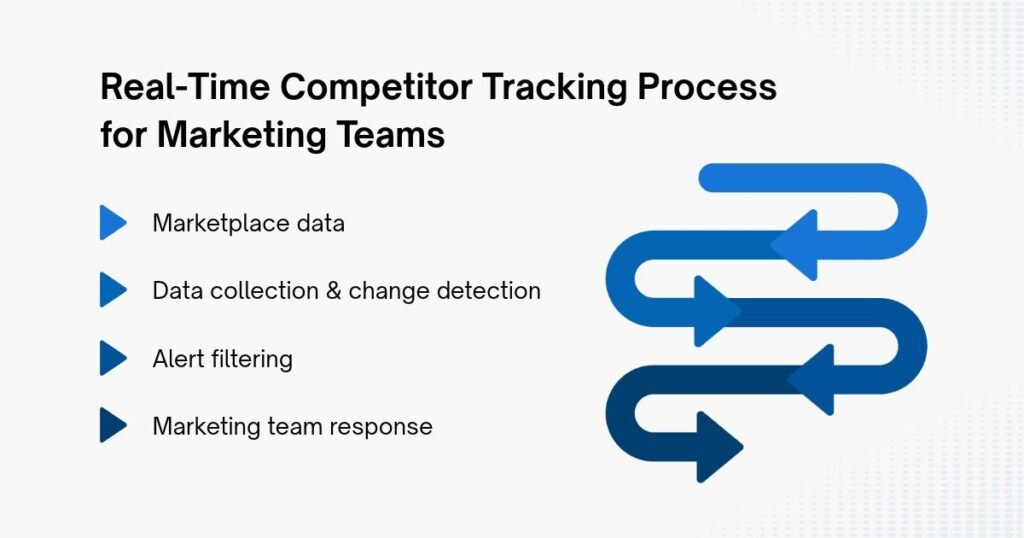
Real-time competitor tracking does not necessarily mean updating every piece of data the moment a competitor makes a change. On marketplaces, each type of signal has a different rate of change and visibility, so it must be monitored at an appropriate frequency.
The table below summarizes common groups of competitive signals and recommended monitoring frequencies.
Competitor Signals |
Public Visibility |
Typical Change Pattern |
Suggested Monitoring Frequency |
Prices and vouchers on listings and store pages |
Public |
May change throughout the day, especially around sales events |
Daily; increase frequency around major sales events |
New products and new product lines |
Public |
Based on launch cycles or category changes |
Weekly |
Claims, ingredients, and positioning on listings |
Public |
Infrequent, depending on update activity |
Weekly or monthly |
Livestreams |
Only observable while streaming |
Per session |
Sample based on a fixed schedule |
Active ads |
Partially, depending on the ad library |
By campaign |
Scheduled checks, with evidence retained |
Ratings and customer reviews |
Public based on the platform’s visibility scope |
Vary based on the number of new reviews |
Weekly or monthly |
Non-public business information (ad budgets, profit margins, exclusive offers) |
Not publicly available |
Cannot be determined from external data |
Cannot be tracked directly |
The update frequency and tracking intervals in the table are for reference only. Businesses should adjust these based on product characteristics, the number of competitors, and the activities of each brand group.
How to Build a Competitor Tracking Plan for a Beauty Marketing Team
A competitor tracking plan must define four elements: competitors to track, competitive signals to monitor, data sources, and the person in charge. The marketing team can develop this plan by following these four steps.
1. Create a Focused Competitor Watchlist
The watchlist should focus on two groups: direct competitors and market-leading brands selected as benchmarks.
- Direct competitors should share similarities in product segment, customer base, price point, and target market. For example, a skincare brand focused on skin-repair products should prioritize brands that also target this need within a comparable segment.
- Market-leading brands provide the marketing team with insights into how to develop a product portfolio, run promotions, and position the brand (even if they aren’t direct competitors).
For more on how to categorize competitors, see the Guide to Benchmarking Your Beauty Brand Against Competitors.
2. Define What to Monitor Across Four Signal Categories
After identifying competitors, the marketing team needs to select signals directly related to competitive activities. For the beauty industry on marketplaces, these can be divided into four groups:
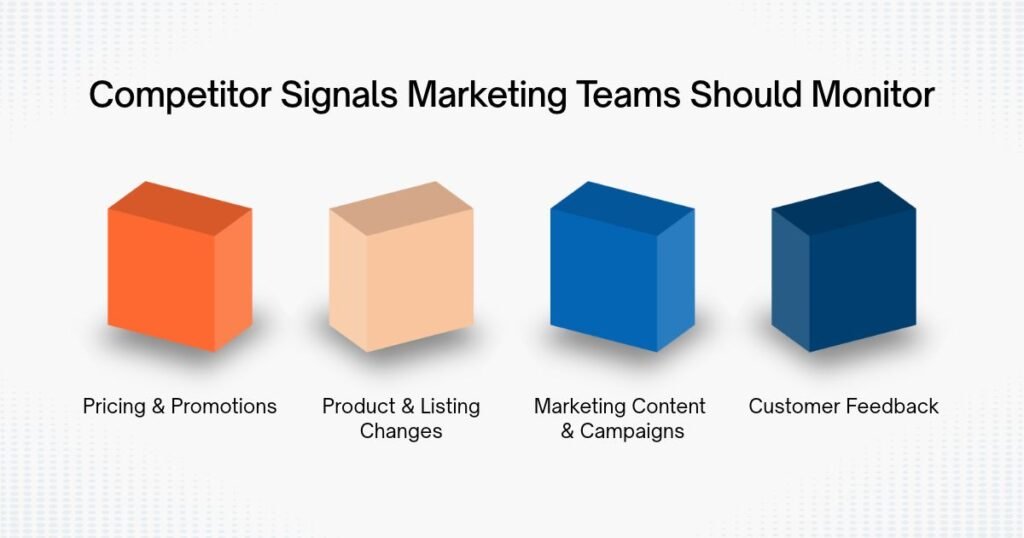
- Pricing & Promotions: Monitor list prices, vouchers, bundles, flash sales, and discount rates of directly competing products.
- Product & Listing Changes: Monitor new products, new SKUs, category changes, and updates to product listings.
- Marketing Content & Campaigns: Monitor competitors’ public advertising content, livestreams, and promotional messages.
- Customer Feedback: Monitor ratings, reviews, and topics frequently mentioned by customers.
Learn more: Guide to Using Competitor Data for Smarter Beauty Marketing
3. Define Data Sources and Monitoring Boundaries
Each signal group must have a corresponding data source. Prices and vouchers can be recorded from product listings and store pages; new products can be identified through store catalogs and search results; ads can be observed through public ad libraries such as the Meta Ad Library. Customer reviews and livestreams must be checked on their respective sources.
It is important to clearly distinguish between observable information and data that cannot be determined from external sources. Displayed prices and vouchers can be recorded at the time of inspection, but advertising budgets, profit margins, or competitors’ exclusive offers cannot be accurately inferred solely from marketplace data.
Data collection must also comply with marketplace terms and permitted access limits. Do not use fake accounts or methods that circumvent these restrictions to access competitors’ private information.
4. Turn Your Monitoring Priorities into a Tracking Plan
Compile the identified information into a competitor tracking plan spreadsheet. The basic spreadsheet should include the following fields: competitor or store, data category, observation source, monitoring frequency, and person in charge.
Monitoring Area |
Data Source |
Frequency |
Responsible Role |
Prices and vouchers |
Product listings, store page |
Daily; increase frequency around major sales events |
Promotion Owner |
New products and categories |
Store page, search results |
Weekly |
Product Owner |
Claims and listing changes |
Product listings |
Weekly or monthly |
Content Owner |
Livestreams and ads |
Livestreams, ad libraries |
Sampling based on a fixed schedule |
Content / KOL Owner |
Customer feedback |
Product reviews |
Weekly or monthly |
Content Owner |
The table above is an illustrative example. The marketing team can adjust the frequency and assignments based on team size, the number of competitors, and the characteristics of each product group.
How to Turn Competitor Signals into Actionable Alerts
If every fluctuation triggered an alert, the marketing team would quickly become overwhelmed. The team needs rules to determine which signals are noteworthy, how to prioritize them, and who should receive that information.
Set Clear Rules for Actionable Competitor Alerts
Not every change from a competitor requires an alert. A signal should be prioritized when it involves a direct competitor, has the potential to impact business operations, and needs to be reviewed within a specific timeframe.
Each signal can be evaluated based on three criteria:
- Relevance: Does the competitor or product directly compete with your brand?
- Business Impact: Could the change significantly affect pricing, sales, or campaign goals?
- Response Window: How long does the marketing team need to evaluate the information to still be able to adjust operations in time?
For example, a direct competitor slashing prices right before a sale may require a same-day alert. Meanwhile, a minor change in a product description can be noted for monitoring in periodic reports.
Alert thresholds should be set based on each product group and business objective. A price reduction might put significant pressure on a product with a low profit margin, but it may not be a cause for concern for other products.
Filter Out Platform-Wide Events and False Alerts
When monitoring competitors on a marketplace, it’s important to distinguish between changes specific to individual brands and general platform-wide fluctuations.
During major sales events, many brands adjust their prices and promotions simultaneously. Instead of flagging every change, the marketing team should focus on moves that stand out from the competition, such as a brand offering significantly deeper discounts than its competitors in the same segment.
Another source of false alerts is mismatched products during comparisons. Differences in volume, quantity, or bundle configurations can cause the system to misreport price changes. Therefore, it is essential to standardize product information and correctly identify equivalent SKUs before setting up alert rules.
Keep Human Oversight in the Decision Process
Competitor alerts provide information for the marketing team to evaluate; they are not automatic instructions to change prices or adjust campaigns.
Businesses should predefine the limits they must adhere to, such as minimum profit margins or products that should not compete on price. If an alert involves significant changes to selling prices, budgets, or campaigns, an authorized decision-maker must review it before the team takes action.
Depending on the level of impact, the marketing team can categorize monitoring results into three groups (adapted from Google’s Reliability Engineering Book):
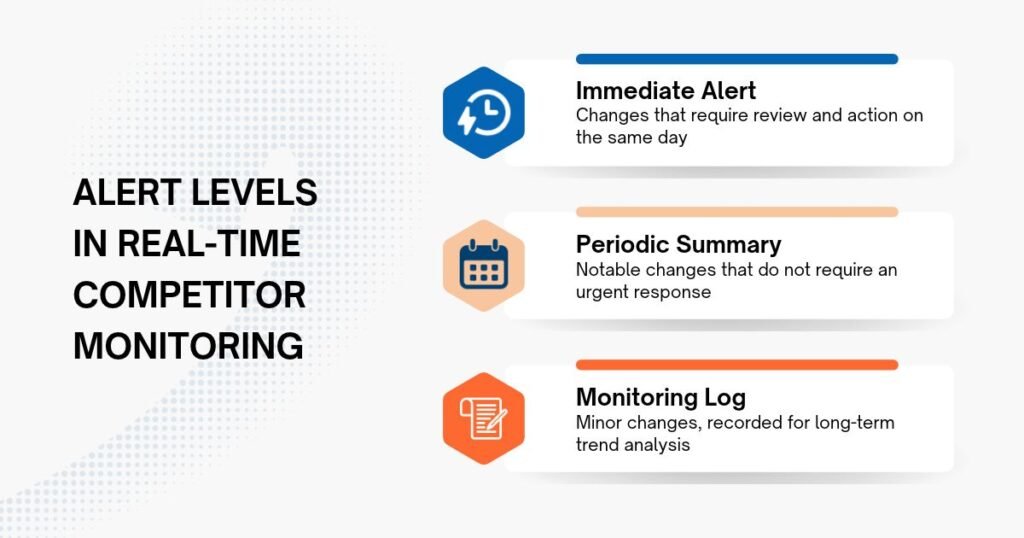
Alert Level |
When to Use |
Example |
Immediate Alert |
Changes require same-day review |
A competitor significantly lowers prices on a directly competing product ahead of a major sale |
Periodic Summary |
Changes warrant attention but do not require an immediate response |
A competitor launches a new product line or changes its key claim |
Monitoring Log |
Minor changes to be recorded for trend analysis |
A competitor edits product images or descriptions |
Choose the Right Level of Automation
As the number of competitors, stores, and SKUs increases, manual checks become time-consuming and difficult to maintain at a consistent frequency. Businesses can choose an implementation approach based on the scale of their data and available technical resources:
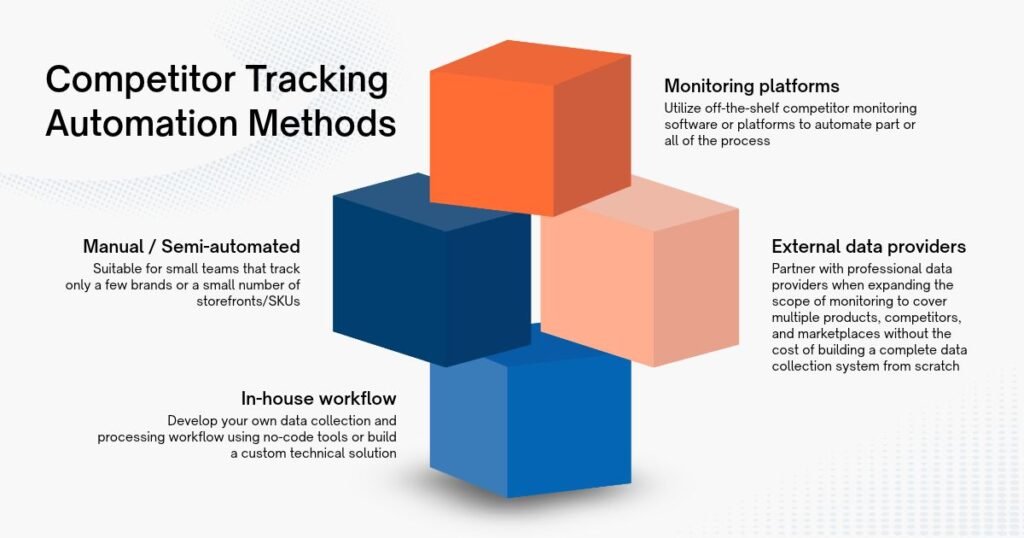
- Build an in-house workflow: Develop your own data collection and processing workflow using no-code tools or custom technical solutions.
- Use monitoring platforms: Utilize competitor monitoring tools to automate some or all monitoring activities.
- Work with external data providers: Partner with data providers like Easy Data when you need to expand your monitoring scope to include multiple products, competitors, or marketplaces without having to build an entire data collection system from scratch.
A team monitoring only a few brands can maintain a manual or semi-automated process. However, when monitoring multiple stores and SKUs across multiple marketplaces, a business will need a solution capable of collecting and processing data at a larger scale.
Before making a choice, determine the required update frequency, the scope of data, and your team’s capacity to handle alerts. A system may automatically generate a flood of notifications, but without sufficient staff to evaluate and act on them, that volume of information will be difficult to translate into concrete action.
How to Run Competitor Tracking as a Daily, Weekly, and Event-Driven Routine
A competitor tracking plan only delivers value when maintained consistently. Without someone designated to receive alerts and a specific review schedule, the collected data can easily be overlooked after the initial implementation phase.
The marketing team needs to clearly assign responsibilities and agree on a monitoring frequency that aligns with the company’s actual operations.
Assign Clear Ownership Across the Team
A competitor monitoring process typically requires three roles:
- Monitoring Owner: Manages the watchlist, data sources, monitoring rules, and monitoring logs.
- Signal Owner: Receives, reviews, and evaluates signals within their area of responsibility, such as pricing, products, or marketing content.
- Decision Owner: Assesses the impact and approves necessary changes (typically the marketing manager or brand manager).
In a small team, one person may take on multiple roles. However, it’s essential to clearly designate who receives information, who evaluates it, and who has decision-making authority to ensure alerts aren’t overlooked.
Establish a Daily, Weekly, and Event-Driven Rhythm
The frequency of monitoring should align with the intended use of the data. The marketing team can divide activities into three cycles:
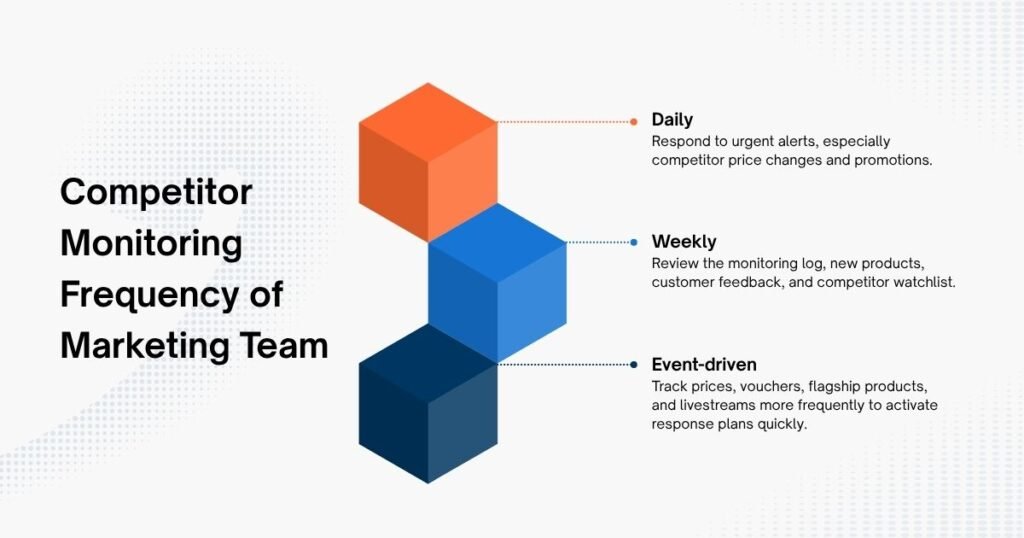
- Daily monitoring: Review alerts requiring same-day action, particularly changes in pricing and promotions by direct competitors. The person in charge verifies the information before escalating issues requiring a decision to the appropriate authority.
- Weekly review: Review the monitoring log to identify notable changes, assess the quality of alerts, and update the watchlist as needed. This is also when the team reviews unhelpful alerts or missed signals to adjust monitoring methods.
- Event-driven monitoring: Ahead of major sales events or key campaigns, increase the monitoring frequency for relevant signals such as prices, vouchers, featured products, and livestream activities. The marketing team should also agree in advance on approved response plans. After the campaign, document competitors’ notable moves for reference in future implementations.
The monitoring frequency should align with the team’s capacity. If staff can only review and assess alerts at specific times during the day, sending continuous notifications for every minor change is unnecessary.
Final Thoughts
Real-time competitor tracking isn’t a race to see which brand can spot every competitor’s change faster. Monitoring too much information without clearly defined objectives only wastes the marketing team’s time and budget on signals that aren’t truly necessary.
The advantage lies in knowing which changes are worth paying attention to, when to take action, and which information can be ignored. When the process is set up correctly, the marketing team doesn’t need to monitor everything to make better decisions. They just need to focus on the data that’s truly valuable to the business.
Leave a Reply