

Web scraping involves more than writing a script to extract data. A script can finish without errors while returning the wrong price, missing variants, or an incomplete set of pages. A useful workflow checks access, extraction, record quality, and coverage separately.
This guide follows a scraping project from its collection brief to analysis. It explains where requests, browser rendering, parsing, validation, and storage fit, with a fictional record example you can use to check your own pipeline.
What is Web Scraping and Why Does the “Process” Matter?
Web scraping automatically extracts selected information from web content. The source may be public or available through access you are authorized to use; that distinction does not by itself establish permission to collect, retain, or reuse the data.
It sounds simple. But if you’ve ever tried web scraping for e-commerce, you’ll quickly realize it’s not that “straightforward.” Each website has a different structure, some store data directly in HTML, others load data dynamically using JavaScript. On top of that, there are anti-bot systems, request limits, and even legal or policy-related constraints.
And that’s not even mentioning the common technical issues:
- Your scraper suddenly fails while running normally
- Your IP gets blocked without a clear reason
- Data comes back incomplete or in the wrong format
This is why many scraping systems may “seem to work” but are not actually usable in practice.
Understanding the workflow helps you:
- Build a more stable system from the beginning
- Quickly identify where issues occur
- Know how to fix problems correctly instead of guessing
In other words, understanding the process of web scraping helps you stay in control of your entire system.
What is the Process of Web Scraping?
The process of web scraping is the sequence of steps used to extract data from a website and turn it into something usable. A basic flow looks like this:
Define scope → retrieve permitted content → render if needed → extract → validate → store accepted records → analyze with coverage limits.
Rendering is a branch, not a mandatory extra step after extraction. If the required values are absent from the initial response but available through an authorized browser session, wait for the relevant content before parsing it. Keep a failure log alongside accepted records.
Which means:
- Write down the permitted source, required fields, record identity, and collection schedule.
- Retrieve the content and classify the response; render the page only when the selected data requires it.
- Extract fields, check required values and types, and quarantine incomplete or conflicting records.
- Store accepted records with their source and observation time, then report findings together with missing coverage.
7 Steps in the Process of Web Scraping
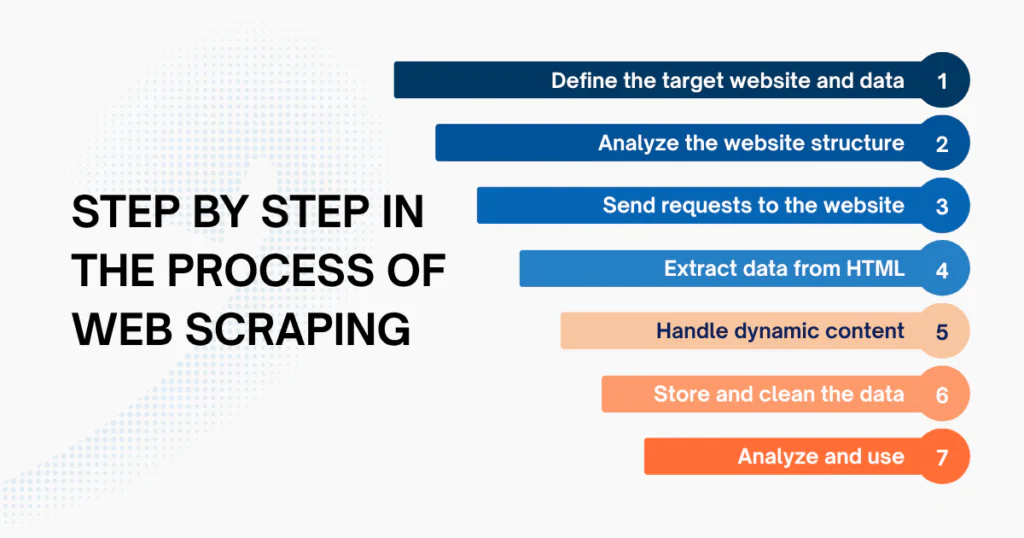
Step 1 – Define the target website and data
Everything starts with one simple question: what data do you need, and where is it? If you choose the wrong source, even a perfect implementation of the process of web scraping won’t give you useful results.
For example, if you want to track product prices on Shopee, you need to decide:
- Search page?
- Category page?
- Product detail page?
Write a collection brief before choosing a tool: country or marketplace, page types, required fields, seller/item/variant identity, currency and price basis, observation timezone, schedule, and permitted access. Define a small pilot and what would count as a usable record. A search result can answer a query-rank question; a product detail page can answer a variant-detail question. Neither automatically covers the whole market.
Step 2 – Analyze the website structure
Once you know what you need, the next step in the process of web scraping is understanding where that data lives. This usually involves:
- Inspecting elements with DevTools
- Exploring HTML structure
- Identifying where data is stored
Compare the initial HTML with the rendered page. Required values may appear in HTML, embedded JSON, or an official API. Prefer a documented API when its permissions, fields, and quotas meet the brief; discovering a request in DevTools does not establish permission to reuse that endpoint.
Selectors based on generated class names can fail after a layout change. Prefer stable attributes where available, keep representative sample responses, and test that the selected value is the intended field. A selector returning a value is not proof that it still extracts the right value.
Step 3 – Send requests to the website
Both HTTP clients and browsers use network requests. Choose the simplest authorized method that supplies the required content. Record the final URL, status, content type, observation time, and any failure reason before parsing. A 200 response can still contain a login screen or an empty result.
Use explicit timeouts and bounded retries for transient failures, respect published rate limits, and stop to review access denials rather than retrying indefinitely. Keep authorized sessions and credentials secure. The Requests timeout documentation explains that its timeout is an inactivity limit, not an overall download deadline; its status handling can surface unsuccessful HTTP responses. Headers alone do not make a collector reliable or authorized.
Step 4 – Extract data from HTML
Once the relevant content is available, extract fields using a parser such as Beautiful Soup or Cheerio. HTML parsing does not itself execute the page’s JavaScript. Check missing elements, numeric formats, and the meaning of each price or rating before accepting the record.
A practical tip from Easy Data: select page types by the question you need to answer. Preserve the search query and result position for ranking observations; preserve the selected variant and seller for offer comparisons. Test each template instead of assuming product pages are always more stable.
Step 5 – Handle dynamic content (JavaScript)
Some pages populate required fields with JavaScript after the initial response. If permitted access requires a rendered page, browser tools such as Selenium, Playwright, or Puppeteer may help. Perform this rendering before extracting those fields, even though this guide discusses it as a separate step.
Wait for a specific required element or value with a bounded timeout, then validate it. A fixed delay can be too short or unnecessarily long. Record a timeout as a failed observation rather than substituting an empty value and reporting success.
Step 6 – Store and clean the data
Keep permitted raw observations separately from normalized outputs, subject to your retention and privacy requirements. CSV, spreadsheets, databases, and object storage serve different delivery needs. Save the source URL, observation time, schema version, and processing decisions so a result can be traced back.
Define duplicates before removing them. For an offer history, a key might include marketplace, seller, item, variant, and scheduled snapshot. A later observation of the same offer is history, not automatically a duplicate. Preserve missing values as missing rather than converting them to zero; validate currency, units, and required fields. For a worked example of target coverage and price completeness, see the dataset validation guide.
Worked example: validating a small offer history. These four rows are fictional, not a Shopee dataset. Assume marketplace VN, seller S7, item P10, and currency VND; the collection key includes variant and scheduled snapshot. The raw response is retained for review.
| Observed record | Decision |
|---|---|
| 09:00, 500 g, price 120,000 VND | Accept: required identity, price, currency, and snapshot are present. |
| 09:00, 500 g, price 120,000 VND; identical retry | Deduplicate within this snapshot; retain the retry in the run log. |
| 09:00, 1 kg, price 230,000; currency missing | Quarantine for source verification. Do not infer currency merely from the marketplace. |
| 10:00, 500 g, price 125,000 VND | Accept as a later observation, not a duplicate of 09:00. |
The four raw rows yield two accepted observations, one identical retry, and one quarantined row: 4 = 2 + 1 + 1. For the same 500 g variant, the observed price change is (125,000 − 120,000) ÷ 120,000 × 100 = 4.17% after rounding. This comparison excludes shipping and discounts and does not show sales or demand. To calculate coverage, also record how many observations were scheduled; a raw-row count is not that denominator.
Step 7 – Analyze and use the data
Use validated observations for questions such as:
- Track competitor pricing
- Compare observed listing ranks or review counts over time, without treating them as sales
- Describe patterns within the measured sample and collection period
An incomplete sample may still answer a limited question if you report what is missing. State the planned and accepted observations, refresh dates, exclusions, and comparison basis. Do not describe an unavailable page as an out-of-stock product or infer market-wide demand from the collected sample alone. See our web scraping applications guide for field definitions and interpretation limits across price monitoring, job-market analysis and research discovery.
Real-World Problems in Web Scraping
If you’ve worked with web scraping for a while, you’ve likely experienced situations like:
- Everything runs fine, then suddenly no data is returned
- Your scraper gets blocked without any clear signal
- Data comes back incomplete, incorrect, or unusable
The most frustrating part is: your code still runs, but the results are no longer correct.
More frequent runs and additional page templates increase the amount of behavior you need to monitor. The web scraping problems guide separates access, rendering, extraction, and validation failures so you can investigate the stage that actually failed.
Build Your Own Pipeline vs Use a Service
When getting into web scraping, many teams struggle with one question: Should you build your own system or use an external service?
In reality, both approaches have trade-offs, and the right choice depends on your stage:
- Build your own: You control the implementation and storage, while taking responsibility for access, maintenance, testing, and incident handling. Check engineering capacity and ongoing cost, not just the effort to produce the first sample.
- Using a service: A provider may take on collection and maintenance, but delivery quality depends on the agreed scope. Evaluate a web scraping service provider with a pilot, required fields, accepted-record coverage, delivery timing, failure reporting, and cost per usable delivery.
If you need recurring e-commerce observations from Shopee, Lazada, or TikTok Shop, discuss the exact source, market, fields, and delivery requirements with Easy Data before choosing an implementation.
Our Shopee data scraping service is a starting point for a scoped discussion. Confirm the supported market and source, achievable schedule, access constraints, and validation rules in a sample or pilot. An hourly or daily refresh should be an agreed requirement, not an assumption.
Review a sample against your own acceptance rules, including variants, currencies, missing fields, and required joins. A standardized export can still need business-specific processing before analysis.
Is Web Scraping Legal?
There is no universal rule that makes scraping legal simply because data is public or requests are slow. The source, access method, data, purpose, terms, and applicable jurisdictions matter. Before collection:
- Confirm the access and reuse rights needed for your intended purpose.
- Respect applicable access restrictions and rate limits; minimize load on the source.
- Assess privacy obligations, minimize personal data, and define retention and deletion rules where relevant.
Read the site’s terms and robots.txt directives, but do not treat either the absence of a block or a robots rule as authorization. RFC 9309 explicitly distinguishes robots directives from access authorization. The joint privacy-regulator statement on data scraping also explains that publicly accessible personal information remains subject to privacy laws in most jurisdictions. Obtain case-specific advice when the rights or obligations are unclear.
An official API can provide a documented route, but still has permissions, quotas, licensing, and coverage limits. Confirm that its allowed use and returned fields meet the collection brief.
Final Thought
A useful pipeline has explicit handoffs: a collection brief, a retrievable source, validated records, and an output with documented limits. With those in place:
- You know how your system works
- You understand why it encounters errors
- And you can proactively improve or expand it
Start with a small permitted sample, record failures as well as successes, and validate the result before increasing scope. Keep a maintenance owner and a way to detect when the source or its field meanings change.
What are the main steps in the process of web scraping?
Define the target and permitted source, inspect the content, retrieve it, render if needed, extract fields, validate and store records, then analyze with coverage limits. Dynamic rendering must happen before extraction of values that require it.
How can you make web scraping more stable?
Use explicit request limits and timeouts, bounded retries, tests against representative responses, required-field validation, and failure alerts. Check accepted-record coverage as well as HTTP success. Pause and review access denials instead of assuming different headers will solve them.
What tools are used in the process of web scraping?
HTTP clients retrieve responses; HTML parsers such as Beautiful Soup or Cheerio extract fields; browser automation can render permitted dynamic pages; and frameworks such as Scrapy organize collection workflows. An official API is an alternative source when its allowed use and coverage fit. Storage and validation are separate parts of the pipeline.
Should you build your own scraper or use a service?
Compare internal engineering and maintenance capacity with a provider’s demonstrated pilot results, agreed coverage, delivery schedule, and total cost. A service may reduce operational work, but speed, scale, and data quality must be verified rather than assumed.
Leave a Reply