

When a product has already landed on the Bestseller list on Shopee or TikTok Shop, many new sellers only start paying attention to it then. In categories with short trend cycles like Beauty, though, the market has usually already drawn in plenty of competitors by that point, and the early advantage has largely narrowed.
In this article, Easy Data shares the process for finding trending Beauty products across Southeast Asia, telling short-lived fads apart from genuine market demand, and using data to make more confident decisions.
Speed Determines Profit Margins When Finding Trending Beauty Products in SEA
Beauty in Southeast Asia moves faster than most other categories. A new trend can emerge, grow, and start cooling off within just a few weeks to a few months. The rise of TikTok, Reels, and Shopee Live has only shortened the gap between when a product first gets noticed and when the market moves on to the next thing.
This creates a familiar challenge for many Beauty sellers. By the time a product lands on an e-commerce Bestseller list (usually right when most new sellers start noticing it), the market has typically already entered a more competitive phase. More sellers jumping in push prices down, drive up advertising costs, and raise inventory risk once demand starts to cool.
Businesses that catch a trend early, on the other hand, usually get more time to secure supply, optimize product content, build search rankings, and accumulate reviews before the market gets crowded.
The Lifecycle of a Trending Beauty Product in Southeast Asia
A beauty trend in Southeast Asia typically moves through four fairly distinct stages. Knowing which stage a trend is in matters more than knowing whether it’s currently “hot.”
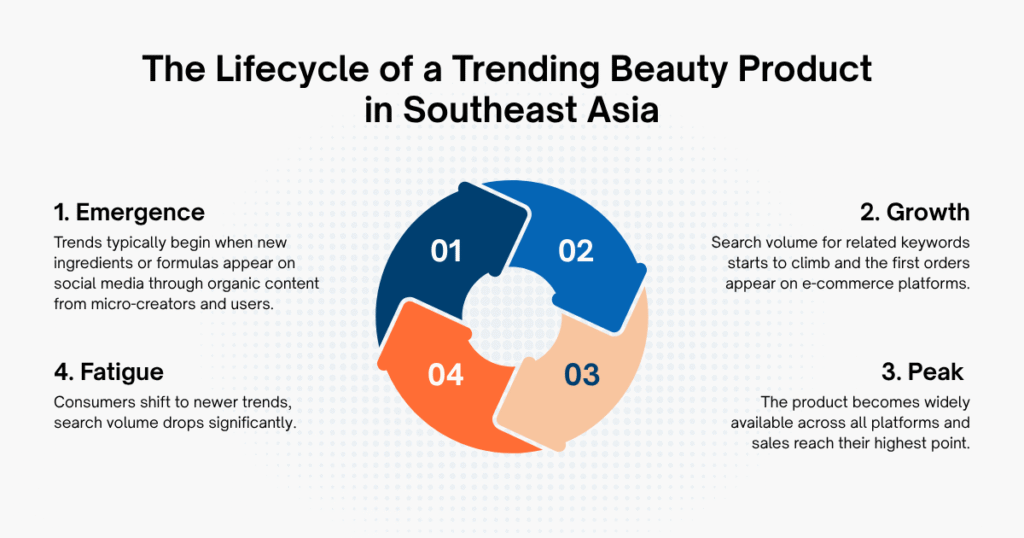
- Emergence: A new ingredient or formula starts appearing on social media, usually through content from smaller creators or organic mentions from users and KOLs. At this stage, e-commerce data is still very limited.
- Growth: Search volume for related keywords starts climbing, and the first orders appear on Shopee or Lazada. This is usually the right window to enter, demand has started to be confirmed, but competition is still low.
- Peak: The product shows up widely across platforms and sales reach their highest point, with more sellers capitalizing on it. This is also when the market starts showing signs of slowing down, even as the trend still feels very much alive.
- Fatigue: Consumers gradually shift to newer trends, search volume drops, and sellers who joined late are often left facing inventory pressure.
How Regional Markets Signal the Next Trending Beauty Product
Emergence-stage signals for a trending Beauty product rarely show up first in Southeast Asia. Instead, these products tend to reach the region only after the trend has already taken shape in a few leading markets.
China, through Douyin, has long stood out as one of the biggest trend-generating markets. For much of 2025, Beauty on Douyin saw strong growth, with GMV at times reaching around 20 billion RMB a month (up more than 30% year-over-year). Product types like peptide masks and concentrated serums have often appeared there before spreading to Southeast Asia a few weeks later. Recent data, however, shows Douyin’s growth rate has started to slow, a reminder that even a leading market has its own development cycle.
South Korea is the second major signal source, driven largely by the reach of #KBeauty on TikTok and Instagram. On TikTok Shop, K-Beauty sales have grown more than 130% in some major markets outside Southeast Asia, far outpacing the platform’s overall growth. That points to strong, still-accelerating demand, and many K-Beauty trends go on to reach Southeast Asian markets as well, though how fast they spread can vary.
Thailand plays a different role, acting more as a transitional market. Makeup and skincare trends from Korea or China are often adapted there first, to better fit the region’s climate and consumer needs, before spreading on to other countries in Southeast Asia.
Real Trend or Just Hype? Confirming a Trending Beauty Product With Data
Not everything that goes viral reflects a trend worth investing in. Telling a genuine trend apart from a short-lived spike in attention helps a business judge market opportunity more accurately. Below are some signs commonly used to tell the two apart.
| Criteria | “Real” Trend (worth investing in) | “Fake” Trend (worth reconsidering) |
| Where it spreads from | Starts with organic content (UGC) from micro-KOCs and real users | Mostly driven by paid ads or celebrity PR pushes |
| Nature of the demand | Solves a real need (acne treatment, oil control, skin repair…) | Relies on novelty, with little lasting usefulness |
| Growth pattern | Grows steadily over time and appears across multiple platforms | Spikes very fast over a short period, then drops sharply |
Alongside this comparison, three groups of indicators help show whether a trend has genuinely moved from social media onto e-commerce platforms.
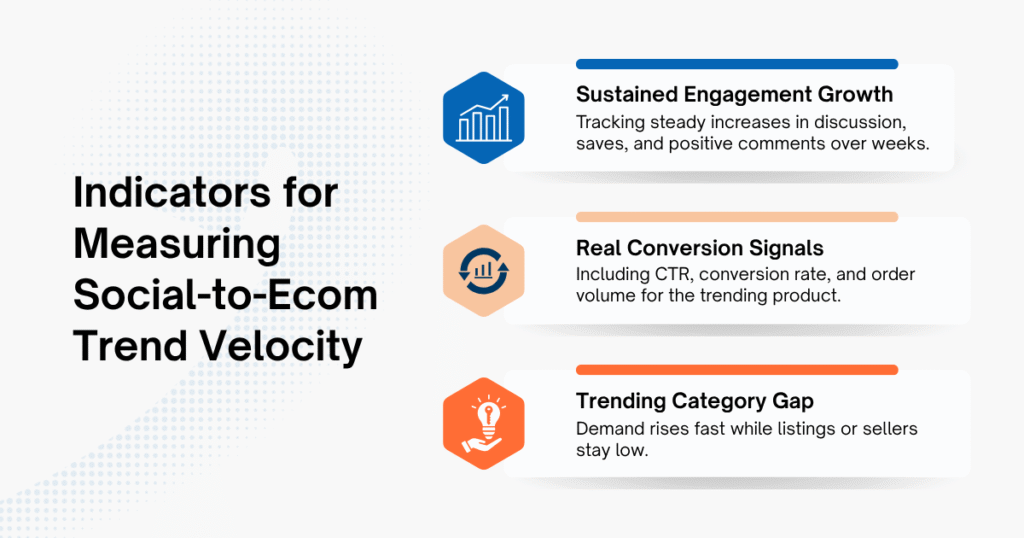
- Sustained engagement growth: Discussion volume, saves, and positive comments climb steadily over several weeks, rather than spiking for a few days and quickly fading. The quality of the discussion matters as much as the quantity, comments like “where can I buy this”, duets or stitches from real users, and threads on communities like Reddit (r/AsianBeauty), Female Daily, or Clozette tend to reflect genuine demand better than views driven by a handful of sponsored KOLs.
- Real conversion signals: Click-through rate, conversion rate, and order volume for shops selling the product or samples start to climb. That signals user interest is turning into actual purchasing behavior, not just engagement.
- Trending Category Gap: This is one of the most worth watching. Search demand on Shopee or Lazada rises quickly, while the number of listings or sellers offering the product stays relatively low. That gap often creates an opening for businesses that move early, before competition picks up.
If you want to evaluate these opportunities more systematically, you can refer to the Guide to Identifying Beauty Market Opportunities Using Data by Easy Data.
A Step-by-Step Process for Finding Trending Beauty Products Early
Once you know how to read these signals, the next step is turning them into a repeatable process for finding trending Beauty products before they peak.
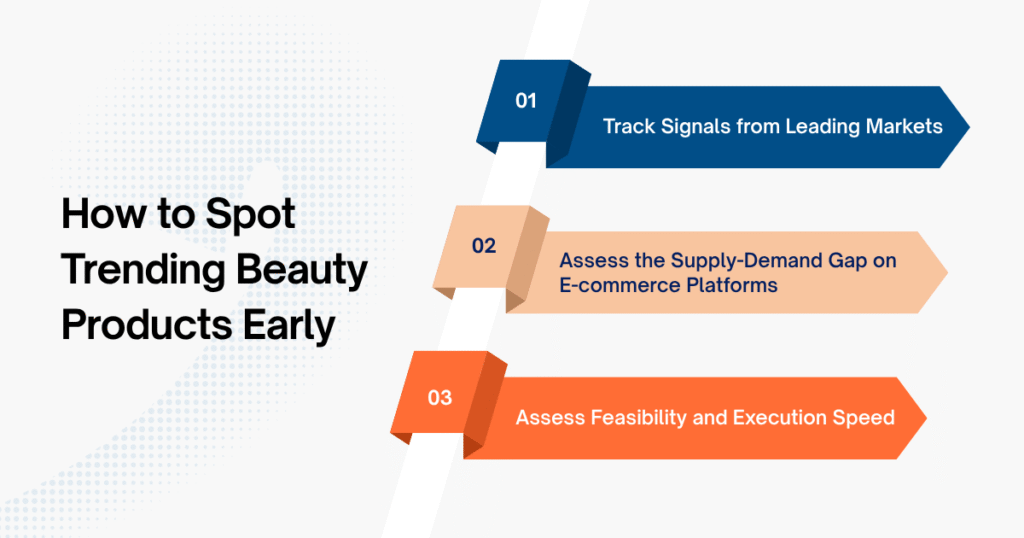
Step 1 – Track signals from leading markets
Start with free, easy-to-use trend-tracking tools:
- Google Trends to follow search interest
- TikTok Creative Center to filter trending hashtags within Beauty & Cosmetics
- Exploding Topics to catch emerging topics early
Alongside these, keep an eye on hashtags across TikTok and Instagram, products gaining attention on Facebook and YouTube, and the beauty-focused communities mentioned earlier. This is often where user interest shows up before it’s reflected in sales data.
Step 2 – Assess the supply-demand gap on e-commerce platforms
Use the keyword suggestion features in Shopee Ads or Lazada Trends to check monthly search volume for the product or ingredient identified in Step 1.
To speed up the analysis, Beauty Market Intelligence systems enable automatic tracking of an entire Beauty product category and flagging of items with unusually fast sales growth over the past 14-30 days. This helps quickly identify products where demand is already building, but seller participation is still low.
Step 3 – Assess feasibility before deciding
A promising trend can still be the wrong fit if a business can’t act on it in time. Two questions need answers:
- Can the supply be sourced or produced via OEM/ODM within 7-14 days?
- Does the product fall under a category that requires regulatory registration, or face legal requirements that could delay launch?
Skipping this step can turn a promising opportunity into something that simply can’t be executed in practice.
Refer to the Guide to Validating a Beauty Product Before Launching on Shopee to understand the validation process before making a decision.
Tip From Easy Data: An Action Plan for Affiliates and Sellers
From working with many businesses in the Beauty industry, Easy Data has found that spotting a new trend is only the first step. What makes the real difference is how quickly a business moves before the market becomes more competitive.
For Affiliate Content Creators
Affiliate remains a channel with strong potential in Southeast Asia. According to surveys, around 83% of consumers in the region have purchased through an affiliate link, and Beauty consistently ranks among the categories with the highest conversion rates.
When a trend is just starting to take shape, prioritize content that shares a genuine experience rather than direct product promotion. Pair it with a trackable affiliate link, and optimize titles, descriptions, or captions using the exact product or ingredient name people are searching for. This helps content capture organic search traffic from the earliest stage of the trend.
For Sellers / Dropshippers
Once an opportunity is confirmed, list the product on the marketplace as quickly as possible and optimize titles and descriptions to match how people actually search on social media, not just industry terminology.
As the trend enters its growth phase, shift more focus toward livestreams, Flash Sales, and in-platform ads to scale sales. At the same time, don’t overlook an exit plan. Keep monitoring search data on a monthly basis; if demand starts to decline, proactively stop restocking and roll out combo deals or clearance promotions before the trend cools off completely.
In many cases, the biggest risk isn’t entering late; it’s failing to recognize the right moment to stop.
Conclusion
No one in the Beauty industry can predict exactly what the next trend will be. Even major brands get it wrong sometimes. Trends, however, rarely appear out of nowhere. Most move through identifiable stages and leave signals in both search and sales data. What matters is whether you catch those signals early enough.
In Easy Data’s experience tracking trends across the Beauty industry, the advantage rarely comes from simply being first to find a trending product; it comes from correctly confirming the signal, acting early enough, and knowing when to stop as demand starts to fade. Monitoring data consistently, rather than waiting until a product shows up on a Bestseller list to start analyzing, remains the most practical way to make better decisions in Southeast Asia’s Beauty market.
Leave a Reply