

The moment a trend is noticeable, it is already too late to take action on it. Ecommerce sales trends move at such a quick pace and are changing faster than businesses are able to respond to within the dynamic world of digital commerce. In 2026, this means that companies leveraging reliable ecommerce datasets have a significant advantage.
- Ecommerce sales trends in 2026 are shifting rapidly, driven by AI, social commerce, and marketplace ecosystems.
- Southeast Asia leads growth, where platforms like Shopee and TikTok Shop shape demand in real time.
- The key shift: from reacting to trends → predicting them early with data.
- Marketplace data gives businesses the clearest signals to act before trends peak.
- Those leveraging structured data can track ecommerce sales trends earlier and move faster than competitors.
What Are E-commerce Sales Trends?
Being aware of ecommerce sales trends has gone beyond being an asset and has become a necessity for businesses. These trends reflect how consumer demand evolves over time, shaped by technology, behavior, and market dynamics.
Not every spike in demand is meaningful. A key distinction businesses often overlook is the difference between a trend and a fad. A fad will cause you some additional income from one-time buyers, but a trend is something that tells how people purchase goods.
Knowing such ecommerce sales trends in 2026 can play a role in determining how your pricing strategy should change, what kind of goods should be available in your online shop, and how well you can perform marketing activities.
The key point that sets 2026 apart from other periods of time is the speed of change. Every trend develops much faster while remaining unnoticed without data analysis.
E-commerce Growth Overview (2024–2026): Global Trends & Southeast Asia Insights
The broader context behind ecommerce sales trends reveals not just growth, but structural shifts in how digital commerce operates globally and regionally.
Global Ecommerce Growth Trends
Global ecommerce continues to expand steadily, with the market size projected to surpass $7 trillion by 2026. Growth rates remain strong at around 10–12% CAGR, but what’s more important is how that growth is happening.
Mobile commerce now accounts for nearly 70% of total transactions, reflecting a permanent shift in consumer behavior. At the same time, cross-border ecommerce is growing at nearly double the rate of domestic trade, driven by improved logistics and global marketplace integration.
This trend highlights that e-commerce sales trends are evolving toward optimization.
Southeast Asia Ecommerce Boom
While global growth is steady, Southeast Asia is where ecommerce sales trends are accelerating the fastest.
Platforms like Shopee dominate through aggressive pricing strategies and deep seller ecosystems. Meanwhile, TikTok Shop has reshaped how products are discovered and purchased, blending entertainment with commerce in a way that traditional platforms struggle to match. Lazada, on the other hand, continues to compete through logistics infrastructure and brand positioning.
Markets like Indonesia, Thailand, and Vietnam are seeing double-digit growth, fueled by mobile-first consumers and high engagement with social commerce.
Southeast Asia operates differently from global markets. It is heavily marketplace-driven, highly price-sensitive, and far more influenced by social platforms. Any business analyzing ecommerce sales trends without separating SEA from global data will miss critical signals.
10 Key E-commerce Sales Trends in 2026
The most impactful ecommerce sales trends in 2026 are not isolated developments; they are interconnected shifts driven by data, technology, and changing consumer expectations.
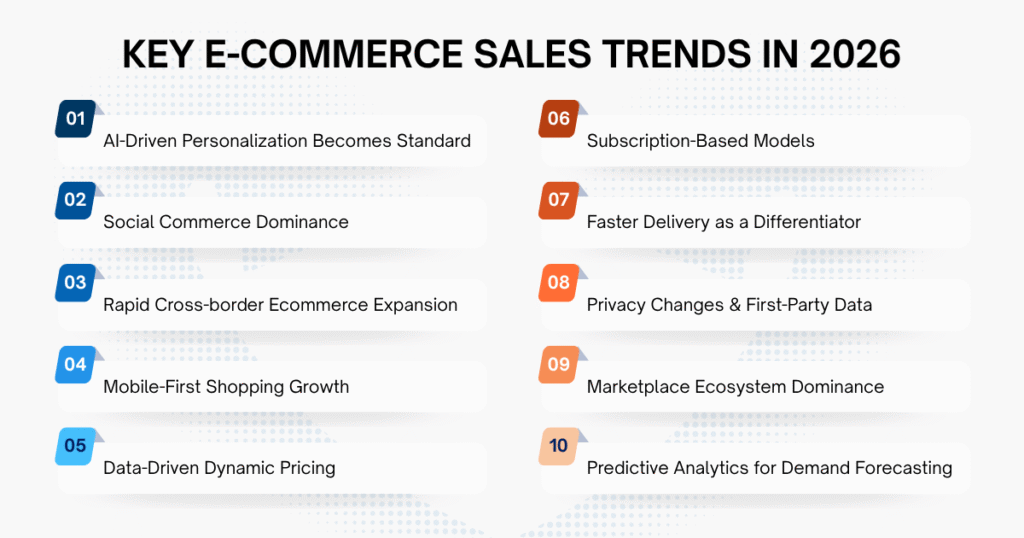
1. AI-Driven Personalization Becomes Standard
Personalization used to be a unique advantage; today, it has become an expectation. By leveraging AI, recommendation engines can track the consumer’s journey (by browsing behavior, purchase history, and real-time interactions) and create a personalized experience at each touchpoint.
This shift is redefining ecommerce sales trends by increasing conversion rates and customer retention. Businesses that fail to personalize will see engagement drop significantly.
2. Social Commerce Dominates Online Sales
There is no longer any distinction between content consumption and buying. TikTok Shop and Shopee live streams, for example, have made impulse purchases a common phenomenon on social media.
This trend highlights a deeper behavioral shift: consumers no longer search, they discover. As a result, social platforms are becoming central to modern ecommerce sales trends.
3. Cross-border Ecommerce Expands Rapidly
It is easier than ever to sell internationally with better logistics and integrated payments. Now, even small online sellers can access global markets easily. One of the ecommerce sales trends to look out for is that competition has taken on a global scale.
4. Mobile-First Shopping Continues to Grow
In 2026, the whole ecommerce experience is built around mobile-first buyers. From browsing to checkout, every interaction is optimized for these users. A poor user experience for mobile buyers makes you irrelevant to the changes in ecommerce sales trends.
5. Data-Driven Pricing & Competitor Monitoring
Dynamic pricing is becoming commonplace, especially for marketplace businesses. More and more players are tracking prices and making price adjustments accordingly. That’s why traditional pricing strategies will cease to work against the ecommerce sales trends in 2026.
6. Subscription-Based Ecommerce Models Grow
Recurring revenue models are gaining traction, particularly in categories like beauty, food, and digital products. The predictability of revenue streams that recurring payments provide is extremely valuable in the rapidly-changing ecommerce landscape.
7. Faster Delivery Becomes a Key Differentiator
Fast delivery is no longer a feature of luxury; it has become a requirement for many customers. Same-day and next-day shipping has become expected. This is what makes shipping logistics an important factor that impacts competitiveness within the current ecommerce sales trends.
8. Privacy Changes Increase Customer Acquisition Costs
As new laws regulating personal data processing take effect, it becomes more complicated to track consumer activity. Consequently, the costs of acquiring leads through paid ads continue to rise. In order to navigate changing ecommerce sales trends effectively, you need to rely primarily on your first-party data.
9. Marketplace Dominance Continues to Grow
In 2026, there will not only be a need for companies to have their own web store, but e-commerce marketplaces like Shopee, TikTok Shop, Amazon, … will become a platform for controlling traffic, prices, and even visibility of the brand. To fully understand how the market functions, brands should learn about marketplace data signals.
10. Predictive Analytics for Demand Forecasting
Predictive analytics allows ecommerce retailers to forecast the demand for their products. With the right method, they can predict future trending items. This is the next step of the changes in ecommerce sales trends from reaction to prediction.
How Data Helps You Spot E-commerce Trends Early
Understanding ecommerce sales trends is important, but acting on them early is what really makes the difference. That’s where data becomes a powerful advantage.
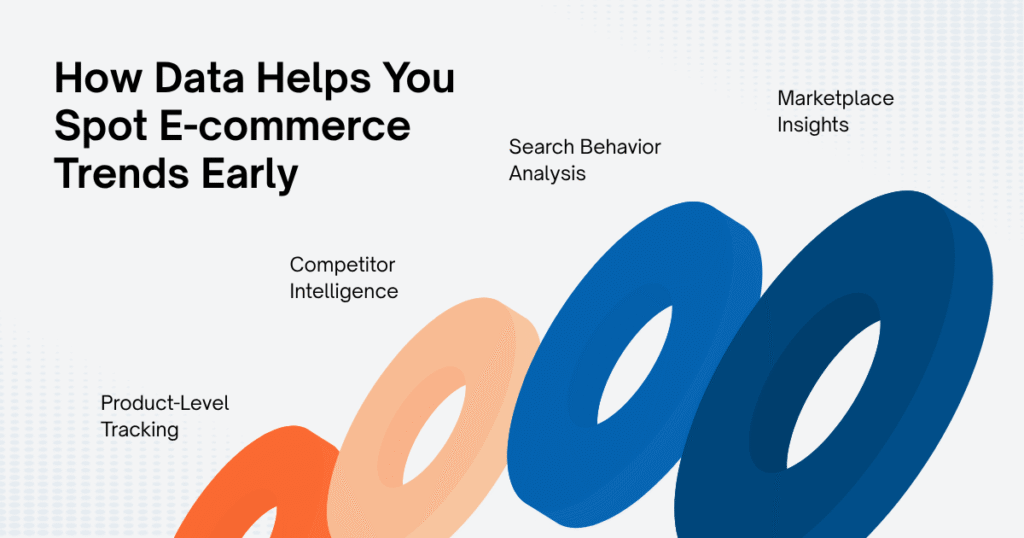
- Tracking product-level data in ecommerce: When you track how individual products are performing (like bestseller rankings or fast-growing categories), you can spot demand building before it becomes obvious.
- Monitoring competitor activity: Your competitors often reveal where the market is heading. Changes in pricing, promotions, or inventory can signal shifts early. If you’re watching closely, you can adapt faster than most.
- Analyzing ecommerce search trends: Search behavior shows what customers want in real time. When certain keywords start gaining traction, it usually means demand is rising, even before sales numbers reflect it.
- Leveraging marketplace data: Marketplace platforms offer some of the clearest signals of real buying behavior. Metrics like sales speed, rankings, and engagement give you a much more accurate picture than guesswork. With structured data, you can go deeper and forecast better.
Imagine a seller noticing a steady increase in demand for portable cooling products. Search interest ticks up, more competitors enter the space, and inventory starts shifting. Instead of waiting, the seller moves early (adjusts pricing, secures stock, and launches ahead of the curve). While others are still reacting, this seller is already leading. That’s the difference data makes: turning trends into real opportunities, sooner.
How Easy Data Helps Businesses Stay Ahead of Market Trends
These days, very few businesses face problems related to unawareness of ecommerce sales trends. Rather, what holds businesses back from growing is their inability to collect structured data.
Easy Data offers a solution to make businesses analyze the existing trends proactively instead of using outdated reporting tools. With the help of our service for custom data scraping in ecommerce, you will be able to:
- Observe SKU-level dynamics on different marketplaces
- Track demand fluctuations before seeing the same reflected in your sales report
- Keep tabs on competitor pricing strategies
- Discover new trending categories based on listings’ speed and engagement
In other words, Easy Data doesn’t just give you raw numbers; we help you make sense of them. You can spot patterns and connections that aren’t immediately obvious, so you can make smarter, more informed decisions. And especially important when speaking about markets like Southeast Asia with such dynamic platforms as Shopee and TikTok Shop, providing tremendous volumes of data on consumer behavior.
Get the free sample dataset from Easy Data to to unlock the latest e-commerce sales trends.
Conclusion
The pace at which ecommerce sales trends evolve by 2026 will make reacting irrelevant. Those who wait to see trends develop will always be playing catch-up. It is those who have spent their resources on real-time data collection, analysis, and action that will be dictating trends and setting the rules of the game.
What are ecommerce sales trends in 2026?
Ecommerce sales trends in 2026 refer to emerging patterns in how consumers discover, evaluate, and purchase products online. These trends are heavily influenced by AI personalization, social commerce platforms, and marketplace ecosystems, making them faster and more data-driven than in previous years.
How can businesses identify ecommerce sales trends early?
Businesses can identify ecommerce sales trends early by tracking product-level performance, monitoring competitor activity, and analyzing search demand. Marketplace data (such as rankings, pricing, and sales velocity) provides the most accurate early signals.
What is the biggest ecommerce sales trend in 2026?
The biggest ecommerce sales trend in 2026 is the shift toward predictive analytics. Businesses are no longer just analyzing past data, they are using real-time signals to forecast demand and act before trends fully emerge.
How can businesses stay ahead of ecommerce sales trends?
To stay ahead of ecommerce sales trends, businesses need real-time visibility into what’s changing in the market and the ability to act before those changes become obvious.
Easy Data’s e-commerce data scraping service helps teams continuously monitor product demand, price fluctuations, and competitor activity. This means identifying trends earlier, responding faster, and making decisions based on real-world signals (not assumptions).
Leave a Reply