

For data-driven businesses, having a clean, complete dataset plays a crucial role in product development and data innovation. An e-commerce scraper is a key tool that helps collect large-scale raw e-commerce data from platforms like Shopee, Lazada, TikTok Shop, Amazon, or eBay with high granularity. This article breaks down the most important data fields enterprises should gather using an e-commerce scraper to build AI models, analytical dashboards, or commercial data products.
What Is an E-Commerce Scraper?
An e-commerce scraper is a data scraping tool or system designed to automatically collect data from e-commerce platforms such as Shopee, Lazada, TikTok Shop, Amazon, or eBay. Instead of manually collecting data page by page, scrapers simulate user browsing behavior and extract important information such as selling price, price history, inventory, sales volume, ratings, product attributes, and seller data. Thanks to automation, businesses can collect large amounts of data continuously.
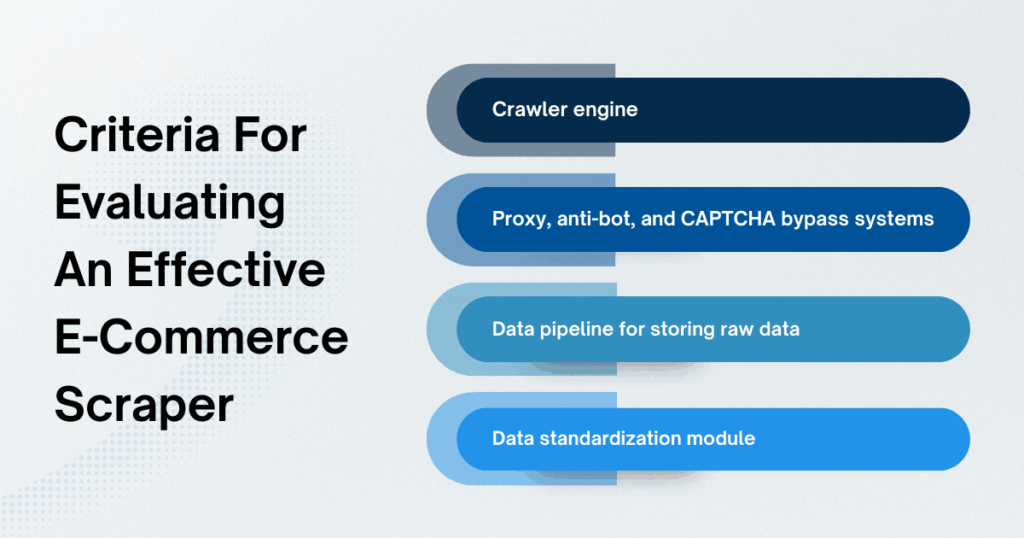
An e-commerce scraper is considered effective when it integrates proxies, IP rotation, CAPTCHA recognition, and dynamic rendering processing to ensure data is not missing or distorted. This is why scrapers are often designed as stable and scalable pipelines, including crawlers, data filters, and standardization systems.
Why Data-Driven Businesses Should Use an E-Commerce Scraper
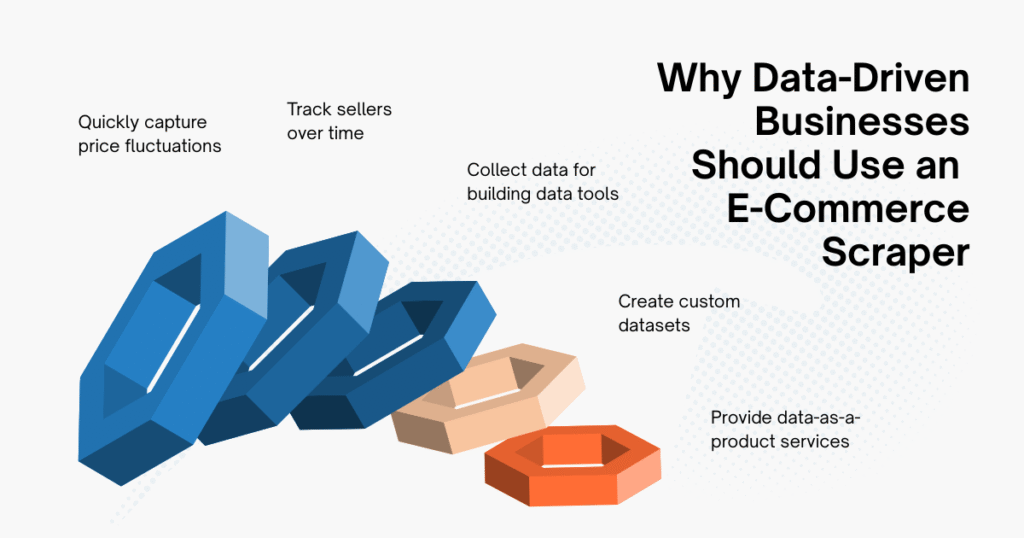
Using an e-commerce scraper offers significant advantages for businesses developing e-commerce data, as this tool provides the ability to collect data at scale, in real-time, and in a customizable structure. While available datasets are often limited in scope or depth, scrapers allow businesses to collect the exact data fields needed for AI models, price analysis, product optimization, or building custom tools for customers.
Thanks to this flexibility, scrapers help businesses quickly capture price fluctuations in the market and make it easier to track sellers over time. At the same time, the ability to collect data on demand is also extremely helpful for technical teams building and refining internal analysis tools or responding to specific customer projects. Moreover, businesses can build custom e-commerce solutions to train AI models or expand specialized data products. This opens up opportunities to offer data services as products, generating additional revenue and enhancing high-value offerings.
Learn more: Ecommerce Data Scraping: Skyrocketing Your Business in 2025
Essential Data Categories To Collect by an E-Commerce Scraper
An effective e-commerce scraper not only collects surface data, but also must collect all data fields that reflect the entire activity of the product, shop, and market. Below are the core data groups that businesses really need:
| Data Categories | Detailed Data |
|---|---|
| Product Information | – Product name – Images, videos, description – Attributes (color, size, variations) – Category mapping |
| Pricing Data | – Original price – Sale price – Price history – Promotion and flash sale signals |
| Seller Information | – Shop details – Shop rating – Response rate, shipping speed – Number of followers |
| Sales & Performance Metrics | – Sold count – Revenue signals – Views, likes – Conversion metrics over time |
| Logistics & Fulfillment Data | – Shipping fees – Delivery SLA – Warehouse locations – Availability signals |
| Ads & SEO Data on E-Commerce Platforms | – Keyword appearance – Ads placements – Search suggestions – Organic ranking signals |
These data sets all reflect the actual activity of the product on the marketplace, helping data businesses build more accurate evaluation, prediction, reporting, or analysis models.
Advanced Data Fields for Companies Building Data Tools & AI Models
Companies building data tools and AI models need to collect deeper and more accurate data to understand context and gain superior analytical power. E-commerce scrapers can fully meet these requirements with their ability to collect the following in-depth data fields:
| Data Categories | Detailed Data |
| Product Clustering & Vector Signals | – Product embeddings – Similarity vectors – Behavioral price clusters – Attribute-based grouping – Semantic description vectors – Relevance scores |
| Knowledge Graph Signals | – Relationships among product–category–seller–brand – Node attributes – Edge weights – Hierarchical mapping – Semantic links – Structural graph data |
| Behavior-Based Metrics | – View-to-purchase ratio – Cart abandonment – Engagement time – Heatmaps – Session flow – Exit signals – Real user interaction metrics |
| Crawler Metadata | – Crawler ID – Crawl depth – HTTP status – DOM parsing structure – Response time – Data quality indicators – Metadata for verifying crawl accuracy. |
| API Timestamp & Sync Signals | – API access times – Versioning data – Incremental timestamps – Refresh intervals – Metadata ensuring dataset consistency for AI modeling |
Collecting Data by E-Commerce Scraper – Important Considerations
When collecting data using an e-commerce scraper, the most important thing is not to collect as much data as possible, but to collect the right data fields. These data fields are key variables that directly impact AI models and data tools. If the scraper misses data, has incorrect structures, or lacks standard timestamps, the entire analysis model behind it will be skewed, causing price forecasts and market insights to lose accuracy. Therefore, collecting the right data fields from the outset is the only way for businesses to build truly valuable datasets.
Learn more: A Complete Guide to Ecommerce Data Scraping: Techniques and Tools
However, operating an e-commerce scraper to accurately collect these data fields is not straightforward. E-commerce platforms constantly change their structure, enhance anti-bot measures, require high collection frequency, and demand stable data standardization systems. Handling all these steps in-house requires significant costs and a specialized technical team. Therefore, many businesses turn to e-commerce scraping services from third-party providers to save time and operational effort.
Easy Data is one of the perfect choices to partner with. It is a company specializing in providing large-scale raw e-commerce data from Shopee, Lazada, and TikTok Shop with stable, clean data sources and flexible customization options according to requirements, ensuring that the data is complete, free of duplication, and accurate, allowing businesses to focus on the most important part: building high-value commercial data products.
Conclusion
An e-commerce scraper is an essential tool that helps businesses collect highly detailed e-commerce data suitable for various needs and purposes. Understanding important data groups will help businesses optimize their scraping strategy, save costs, and accelerate product development based on data.
Leave a Reply