

When building an effective price prediction AI model for modern e-commerce, the biggest challenge for engineers is no longer the algorithm itself, it is the quality of the e-commerce dataset powering the model. In this article, Easy Data breaks down the real-world data standards that directly impact AI model performance, while comparing the four most common data sourcing approaches for price prediction use cases across Southeast Asia.
Why Do Price Prediction Models Often Produce Inaccurate Results?
When deploying machine learning models for price prediction on major Southeast Asian marketplaces like Shopee, Lazada, or TikTok Shop, many technical teams encounter significant forecasting errors. The issue usually does not come from the algorithm or hyperparameter tuning, but from the structure of the input data itself.
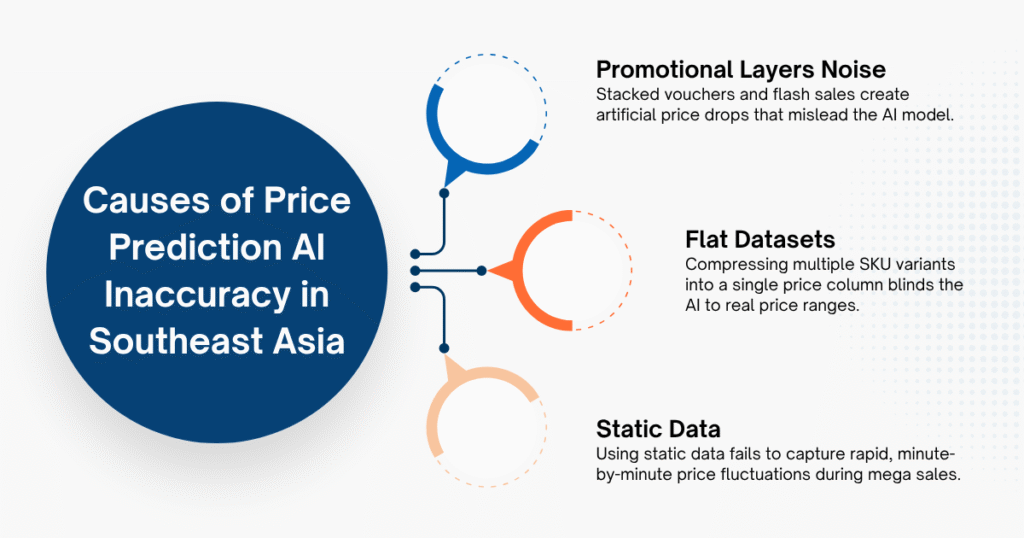
“Promotional Layers Noise”
On Shopee, Lazada, and TikTok Shop, the displayed price is often influenced simultaneously by Flash Sales, platform vouchers, shop vouchers, free shipping subsidies, combo promotions, and mega campaign pricing.
As a result, the final price users see rarely reflects the product’s actual base pricing structure.
If the AI model only captures the final displayed price without separating these promotional layers, the algorithm can easily be misled by artificial price drops. This causes the model to incorrectly estimate the product’s normal pricing behavior during non-campaign periods.
Using “Flat Datasets” Without Structural Depth
Many teams today still rely on flat datasets sourced from public repositories or data marketplaces, where all information is compressed into a single two-dimensional table with almost no relational structure between data fields.
In Southeast Asian e-commerce, a single product URL often contains multiple SKU variants with different pricing and attributes. However, when all this information is flattened into one row, the AI model loses the ability to understand the real pricing structure behind each product variation.
Static Data Makes AI “Blind” to Market Dynamics
Pricing on marketplaces like Shopee, Lazada, and TikTok Shop now changes almost in real time under the influence of Flash Sales, livestream campaigns, voucher stacking, competitor dynamic pricing, and Mega Sale time slots, etc.
Yet many e-commerce datasets are still updated only weekly or monthly. This creates massive temporal gaps between what the AI model sees and what is actually happening in the marketplace.
As a result, the model cannot react quickly enough to short-term pricing strategies from competitors during critical sales windows, reducing both pricing accuracy and responsiveness in automated pricing decisions.
What Makes an E-commerce Dataset Optimized for Price Prediction AI?
For a machine learning model to accurately recognize pricing trends and predict market behavior, the input e-commerce dataset must be structured deeply enough to preserve meaningful relationships between data fields.
Based on real-world price prediction AI projects across Southeast Asia, each e-commerce dataset extracted through Easy Data’s infrastructure is typically standardized around the following core data groups:
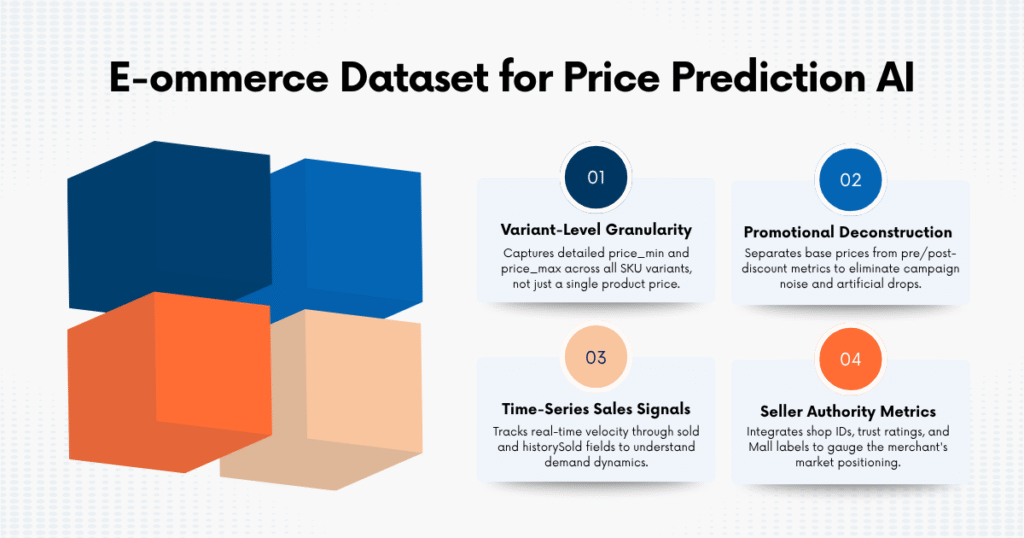
Variant-Level Price Range Granularity
Instead of storing only a single price column, Easy Data’s data extraction system separates pricing into multiple fields, such as:
price-
price_before_discount discountPercentprice_minprice_maxprice_min_before_discountprice_max_before_discount
This min-max pricing separation helps AI models understand the pricing spread across all SKU variants inside the same product listing, allowing the model to recognize how sellers structure pricing across product categories and variations.
Sales Velocity Signals
An intelligent price prediction model must understand the relationship between pricing changes and product demand (price elasticity of demand). Therefore, the e-commerce dataset structure must clearly separate:
-
sold→ products sold during the current snapshot period -
historySold→ cumulative lifetime sales
Combining these two metrics allows the AI system to accurately estimate real sales velocity and predict whether a discount campaign genuinely drives demand.
Seller Authority Signals
AI models cannot treat a small discount-driven seller the same way they treat an official brand store. Fields such as: shop_name, shopId, seller rating, rating_count, and marketplace segmentation labels (flex_name values like mall for Shopee Mall or LazMall), all function as important classification variables.
Machine learning models use these signals to evaluate seller credibility, helping predict which products are likely to maintain stable pricing and which are more prone to short-term price wars.
Example of a Data Structure Optimized for Price Prediction AI by Easy Data
Copied!{ "product_id": "item_24715056594", "shop_id": "shop_1135271452", "shop_name": "SUMIKKO.th", "shop_type": "mall", "brand": "Sumikko", "country": "Thailand", "currency": "THB", "update_time": "2025-01-31T00:00:00Z", "pricing_metrics": { "current_price": 122, "price_before_discount": 248, "discount_percent": 51, "price_min": 122, "price_max": 176, "price_min_before_discount": 248, "price_max_before_discount": 248 }, "sales_velocity": { "current_period_sold": 18454, "historical_lifetime_sold": 121580 }, "authority_metrics": { "rating_score": 4.8792, "rating_count": 184107 } }
4 Best E-commerce Dataset Sources for Price Prediction AI Models in 2026
Depending on project scale, operational budget, and internal data engineering capabilities, businesses can consider the following four data sourcing strategies for training their price prediction AI systems.
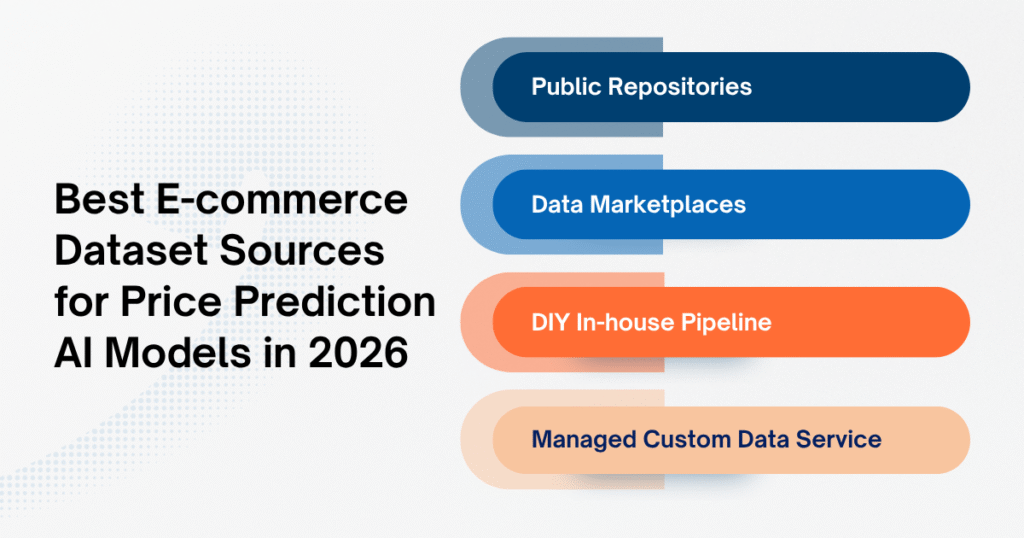
Approach 1: Public Repositories
The fastest and most cost-effective way to access an e-commerce dataset is through community-driven platforms such as Kaggle, GitHub, or the UCI Machine Learning Repository.
- When you should use it: Ideal for initial research and development (R&D), prototyping, or proof-of-concept (PoC) testing to assess the feasibility of basic price prediction algorithms or to train demo models.
- Biggest limitation: These are static datasets packaged years ago. In Southeast Asia’s fast-moving e-commerce market, using outdated data to train AI models often leads to predictions that no longer reflect real marketplace behavior.
Approach 2: Data Marketplaces
Businesses can purchase e-commerce datasets as subscriptions from major data marketplaces such as AWS Marketplace, Snowflake Data Cloud, Google Cloud Marketplace, etc.
- When you should use it: When your AI model requires large-scale global e-commerce datasets, such as aggregated data from Amazon, eBay, or Walmart with pre-standardized structures.
- Biggest limitation: Lack of local depth. Most global data marketplaces do not provide sufficiently deep coverage for Southeast Asian marketplaces. Especially for platforms like Shopee, Lazada, or TikTok Shop, the e-commerce datasets are rarely structured down to SKU-variant level or capable of reflecting the unique pricing behavior of regional marketplaces.
Approach 3: DIY In-house Pipeline
Some companies build their entire data collection infrastructure internally by hiring data engineers, investing in servers, deploying proxies, and developing crawlers using frameworks like Scrapy or Selenium.
- When you should use it: Suitable for companies that want full control over their data pipeline, only need data collection at smaller scale, and focus on relatively narrow product categories.
- Biggest limitation: Infrastructure operations and anti-bot systems. Large e-commerce platforms continuously upgrade their anti-scraping protections using systems like Cloudflare, Akamai, and behavioral CAPTCHA detection. As crawling volume increases, costs for rotating proxies, CAPTCHA solving, and server infrastructure can scale rapidly. Additionally, pipelines can easily break whenever marketplaces update frontend structures or internal API encryption mechanisms.
Approach 4: Managed Custom Data Scraping Service
Across Southeast Asia, many businesses now work with specialized e-commerce data providers like Easy Data to build custom data feeds specifically designed for AI models. Processed data can then be delivered directly through APIs or storage systems such as Amazon S3 based on custom schemas defined by the client.
- When you should use it: This is often the optimal approach for tech startups, AI enterprises, teams that want to focus most resources on optimizing price prediction algorithms or businesses needing high-quality raw data with continuous updates and data SLA commitments.
- Biggest limitation: Choosing the right partner. Businesses should carefully evaluate whether a provider can scrape data at the API or mobile app level instead of relying solely on traditional web scraping. This is critical for capturing hidden data fields such as SKU-level pricing ranges, real-time sales signals and marketplace pricing behavior at variant level.
Explore Easy Data’s E-commerce Data Services
Click to discover real-time crawling solutions for Shopee, TikTok Shop, and Lazada.
Comparison Table: E-commerce Dataset Sourcing Approaches for Price Prediction AI
| Criteria | Public Repositories | Global Data Marketplaces | DIY In-house Pipeline | Managed Custom Service |
| Freshness | Static data | Monthly / Quarterly | Realtime (self-managed) | Realtime (custom) |
| SEA Marketplace Coverage | Very low | Low | Medium | High |
| Operational Cost | Low | High | Very high | Flexible by scale |
| Deployment Speed | Fast | Fast | Slow | Fast |
| Data Depth | Missing SKU structure | Macro-level | Depends on pipeline | Full AI-ready structure |
| Scalability | Limited | Moderate | Hard to maintain | Optimized for scale |
Final Thoughts
In price prediction AI systems, the quality of the e-commerce dataset often directly determines model accuracy. An e-commerce dataset with deep SKU-level structure, complete pricing signals, sales signals, and real-time data enables AI models to reflect actual marketplace dynamics much more accurately.
There are many different approaches to sourcing e-commerce datasets, each with its own trade-offs depending on business goals, system scale, and operational capabilities. Before choosing the right strategy, companies should carefully evaluate the characteristics of each approach alongside the practical needs of their AI/data teams to balance data quality, deployment speed, and long-term operational costs.
Leave a Reply