


Introduction: The Role of AI in Web Scraping
AI-assisted web scraping can help identify fields, classify pages or draft extraction logic. It does not make every result correct or remove the need to retrieve the right page. This guide separates AI extraction from browser automation, compares the roles of five tools and gives you a small acceptance test before committing to a larger collection.
- Introduction: The Role of AI in Web Scraping
- What Are Web Scraping Tools AI?
- Key Benefits of Web Scraping Tools AI
- Popular Web Scraping Tools AI
- How to Choose the Right Web Scraping Tools AI for Your Business
- Legal and Ethical Considerations in AI-Powered Web Scraping
- Conclusion: Leveraging AI to Optimize Web Scraping for Your Business
What Are Web Scraping Tools AI?
AI-assisted web scraping tools use learned models for some part of a collection workflow, such as recognising a product page, mapping content to fields or generating a scraper. The term covers different systems: a visual extraction model, a natural-language code assistant and a hosted browser are not interchangeable. Ask which step uses AI and which steps still depend on rules, configuration or human review.
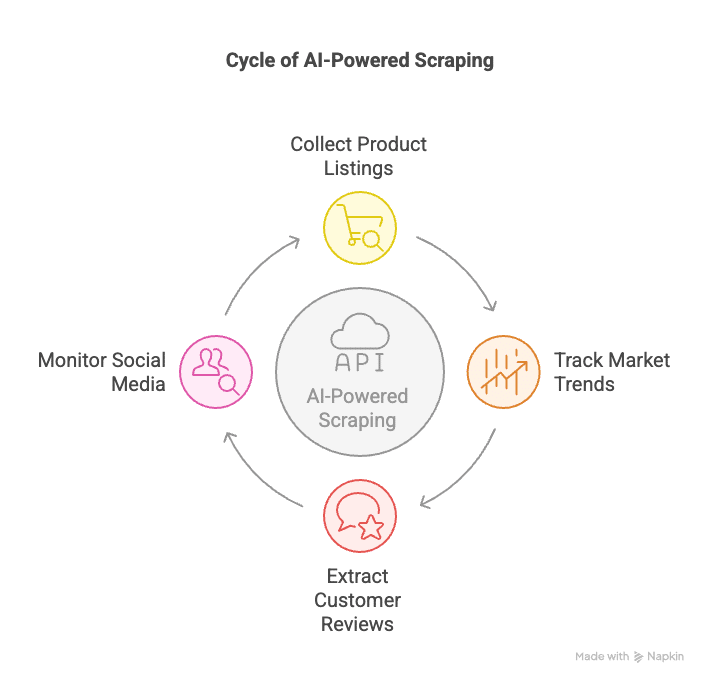
AI-powered scraping tools can be used for a variety of purposes, including:
- Collecting product listings and prices
- Tracking market trends and competitor data
- Extracting customer reviews and sentiment
- Monitoring social media and news sites for updates
Separate three jobs: retrieve permitted source content, extract fields from that content, and validate the output. JavaScript rendering belongs to retrieval; it does not by itself require AI. An access challenge is also different from a parsing error. Diagnose the actual failure rather than assuming an AI feature will solve every layer.
Key Benefits of Web Scraping Tools AI
-
Field recognition, with validation
A model can help map varied page layouts to a shared schema. Check its output against source evidence: the product title, selected variant, currency and price must refer to the same offer. Keep missing values explicit rather than filling them with guesses. For a worked comparison of variant identity, shipping and unknown costs, see the product-price example. -
Handling dynamic content
First check whether the required data is in the received HTML or an available data response. If rendering or interaction is needed, configure a browser step and verify that it reaches the intended state. Scrapy’s dynamic-content guide explains this distinction; pagination and infinite scrolling still need collection logic. -
Maintenance assistance
AI may help propose a new selector or revise a scraper after a layout change. Keep regression examples and review the changed output before relying on it. For example, Bright Data documents self-healing as a triggered workflow, not an automatic response to every page change. -
Measurable scaling
Test throughput, failures, retries and total cost with a representative workload. Browser execution and model calls add resource costs. Compare cost per accepted record, not just advertised request capacity; a fast batch of unusable rows does not meet the brief. -
Reduced setup work
Automatic field detection or generated code may shorten initial setup. Teams still need a defined schema, exception handling, a source-change review and an owner for failed runs. Measure the review time as part of the trial.
Popular Web Scraping Tools AI
These tools serve different roles. The descriptions below reflect vendor documentation checked on 3 October 2026; they are not an independent accuracy ranking or a claim that each product uses the same kind of AI.
-
Scrapy: a programmable collection framework
Scrapy gives developers control over requests, parsing and processing. AI classification or extraction must be added deliberately; there is no single generic “AI extension” that guarantees dynamic-page handling or maintenance. Its official guide recommends finding the underlying data source and discusses a headless browser when needed. -
ParseHub: visual project configuration
ParseHub describes point-and-click selection assisted by machine learning and support for JavaScript, AJAX and pagination in its developer overview. Evaluate whether your team can configure and maintain the selection and navigation steps for the actual target pages. Support for dynamic pages is not a promise of complete or error-free results. -
Diffbot: automatic page classification and extraction
The Analyze API identifies supported page types and selects an extractor. Its documentation acknowledges possible misclassification. Check the returned schema and missing fields on your sample; custom rules can extend or correct extraction where needed. -
Sequentum Enterprise, formerly Content Grabber Enterprise
The vendor’s licensing guide distinguishes Desktop for developing and maintaining extraction agents from Server for production runs. Compare the edition and agent workflow you would actually use. The former product name alone does not substantiate a claim that every agent automatically adapts to layout changes. -
Bright Data: choose the specific product
Scraper Studio offers an AI agent for generating a scraper and an IDE for writing JavaScript. Its Browser and Code workers address different retrieval needs. The separate Browser API provides managed browser rendering and interactions while your workflow supplies the collection logic. Test the intended product, schema and delivery format rather than treating the whole platform as one AI extractor.
How to Choose the Right Web Scraping Tools AI for Your Business
Start with the output you need and the pages you are permitted to collect. Use the same URL sample and field definitions for every candidate. Include different layouts, missing values, variants and pages that require interaction so an easy demo does not stand in for your production workload.
- Data complexity: Determine whether the problem is retrieval, field selection or interpretation. Try a straightforward selector or supported data feed as a baseline; add model-based extraction only where it solves an observed problem.
- Ease of use: Include setup and review time. Have the person who will maintain the workflow change a field, inspect a failed record and rerun a small batch during the trial.
- Scale and cost: Record requested URLs, returned rows, unique records, accepted records, retries and elapsed time. Check current plan limits and include model, browser and review costs.
- Integration: Test the actual CSV, JSON, spreadsheet or API output. Preserve stable identifiers as strings, use explicit currencies and timestamps, and make failed or missing records visible to the downstream system.
- Source and data handling: Check the collection scope and access terms, where source content is processed, who can access it, retention and any use for model training. Choosing a vendor does not settle these questions for your use case.
A small acceptance worksheet
| Check | Evidence to retain | Decision |
|---|---|---|
| Coverage | Requested URLs and a result or recorded failure for each | Investigate missing pages before scaling |
| Field fidelity | Source value beside extracted value for reviewed records | Reject invented or mismatched values |
| Offer identity | Product, seller, variant, quantity and currency | Compare like-for-like offers |
| Duplicates | Stable record key and duplicate count | Deduplicate without hiding missing inputs |
| Change handling | Saved examples, extraction version and rerun results | Approve changes only after regression checks |
| Operational cost | Run costs, review time and accepted record count | Use cost per accepted record |
Worked example — fictional numbers: You request 100 distinct product URLs. The output contains 94 rows, but two are duplicates, leaving 92 unique records and eight missing inputs. Manual review quarantines six of those unique records for wrong variants or unsupported prices. That leaves 86 accepted records: 92% input coverage and 86% usable coverage. If the run costs $12, its collection cost is about $0.14 per accepted record ($12 ÷ 86), before review time. These figures describe the example only; they are not an AI accuracy rate or a vendor benchmark.
Retain the eight missing inputs and six rejected records with reasons, then test the failures again after a scoped correction. For a wider comparison of coding and visual workflows, see our web scraping tools evaluation guide.
Legal and Ethical Considerations in AI-Powered Web Scraping
Assess the proposed source, fields and use before collection. These are planning checks, not a legal determination for a particular website or jurisdiction. Prefer an authorised feed or API where it meets the brief.
- Source terms and access: Review the applicable terms, licence and collection permissions. An AI feature does not grant access rights. If the required source is unavailable or access is refused, resolve that dependency before promising coverage.
- Robots directives: Honour applicable crawler directives, but do not treat them as a licence to collect or reuse content. RFC 9309 explicitly distinguishes robots rules from access authorisation.
- Personal data: Public visibility does not remove privacy obligations. The August 2023 joint statement from privacy regulators explains that publicly accessible personal information remains subject to applicable data-protection laws. Define a necessary field set, purpose, retention and access controls, and obtain qualified advice when needed.
Conclusion: Leveraging AI to Optimize Web Scraping for Your Business
AI can assist a specific part of an extraction workflow, but the useful result is a verified dataset that meets your brief. Start with representative pages, compare the same fields, retain source evidence and measure accepted records after review. Choose a tool based on that trial rather than an assurance of automatic accuracy or uninterrupted scraping.
If you need a delivered dataset rather than a tool to maintain, our guide to scraping services, APIs and tools explains those operating models. For more information on Easy Data, visit EasyData.io.vn or use the contact link below.
External Links
Leave a Reply