
In 2026, collecting Shopee data with self-built scripts, such as Python crawlers or Selenium-based automation, has become increasingly difficult as marketplace anti-bot systems continue to evolve. This article highlights some of the most notable no-code Shopee data scrapers currently available, helping e-commerce market analysts reduce technical overhead and focus more on extracting insights for market share analysis, competitor monitoring, and pricing optimization.
What Makes a Good Shopee Data Scraper?
A Shopee data scraper is a software tool designed to automatically collect product information, pricing, sales metrics, seller details, and customer reviews from Shopee. These datasets help businesses monitor competitors, analyze market trends, track pricing fluctuations, forecast sales performance, and build dashboards that support strategic decision-making.
However, an effective Shopee scraper is not defined solely by its ability to collect data. A truly reliable solution must also be capable of overcoming anti-bot mechanisms, maintaining stable crawling performance at scale, and delivering structured datasets that are ready for analytics, business intelligence, or AI systems.
The Edge of No-Code Shopee Data Scrapers in E-Commerce Market Analysis
In 2026, businesses have multiple approaches to collecting Shopee data, ranging from self-built crawlers to enterprise-grade data pipelines. However, more market intelligence teams are gradually shifting toward no-code Shopee data scrapers for several practical reasons.
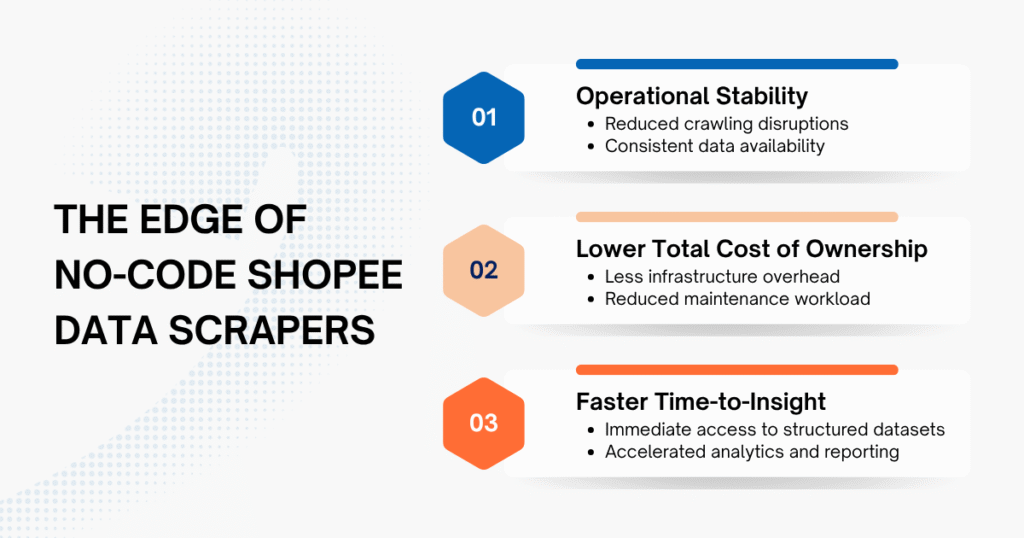
- Reduced anti-scraping complexity: Shopee’s browser fingerprinting, IP detection, and anti-bot mechanisms are becoming increasingly sophisticated. Self-built scripts are often restricted or blocked after running for some time. Meanwhile, many no-code Shopee data scrapers come with built-in proxy rotation and anti-blocking infrastructure, helping maintain a more stable data collection process.
- Lower infrastructure and maintenance burden: Users do not need to manage servers or databases, or continually update their crawlers whenever Shopee changes its HTML structure or API.
- More time spent on analysis: Instead of spending days or even weeks troubleshooting crawler errors and configuring the system, analysts can quickly access pre-structured datasets to build reports in Power BI, Tableau, or other business intelligence tools.
What Data Can a No-Code Shopee Data Scraper Provide?
The greatest value of a no-code Shopee data scraper lies in its ability to transform scattered platform data into structured datasets that can be used directly for analysis.
| Data Group | Schema Field | Data Type | Data Details | Utility for E-Commerce Market Analysis |
| Product Information | title |
VARCHAR VARCHAR TEXT TEXT INTEGER |
Product title, multi-level category taxonomy, detailed product description, image URL list, and available inventory quantity for each SKU. | Supports Market Clustering, Text Mining for keyword discovery and optimization, as well as competitor Stock Turnover Rate analysis. |
| Pricing & Promotions | price_before_discount |
NUMERIC NUMERIC BOOLEAN VARCHAR |
Original listed price, actual selling price after discounts, Flash Sale status, and marketplace or seller promotional campaign names. | Used to calculate Price Index, monitor Anchor Pricing strategies, and measure Promotion Intensity (promotion frequency and discount depth) for dynamic pricing optimization. |
| Seller Details | shop_rating |
NUMERIC INTEGER INTEGER BIGINT |
Seller rating score, total active SKUs, average chat response time (seconds), and total store sales volume. | Supports Competitor Benchmarking, Operational Efficiency Analysis, and store-level Market Share Allocation. |
| Customer Reviews | rating_star |
INTEGER TEXT NUMERIC |
Customer rating score (1–5 stars), textual review content, and sentiment score generated through Easy Data’s NLP models. | Enables Sentiment Analysis, rapid identification of competitor product or operational issues, and discovery of market gaps for Product Validation. |
| Sales Insights | historical_sold |
BIGINT NUMERIC NUMERIC |
Total cumulative units sold since listing creation, sales growth velocity over time (daily/weekly), and estimated product GMV. | Helps identify Best-Selling Products, estimate Price Elasticity of Demand, and power Market Demand Forecasting models. |
Top 5 No-Code Shopee Data Scrapers for E-Commerce Market Analysts in 2026
Here are the 5 best no-code Shopee data scrapers for 2026, evaluated based on three key criteria: practical value, ease of implementation, and long-term reliability.
1. Easy Data
Easy Data offers Shopee data scraping as a fully managed service. Businesses simply specify the data they want to track, and Easy Data handles the entire process of data collection, processing, and delivery.
- How it works: Businesses provide a list of product categories, brands, or shops to monitor. Easy Data then takes care of collecting, processing, and standardizing the data before delivering it according to the specified data schema and preferred update frequency.
- Best for: Large brands, e-commerce enablers, market intelligence teams, and e-commerce market analysts who need large-scale, continuously updated, and well-structured data to support competitive analysis, market share tracking, or predictive modeling.
- Biggest limitation: Because the service is designed for enterprise-level data needs, it is better suited to organizations that require frequent, high-volume data collection rather than small-scale or short-term testing.
2. Octoparse
Octoparse is a desktop-based data scraper with a visual workflow interface that lets users build data collection workflows through point-and-click actions to define extraction rules.
- How it works: Users install the application, open the built-in browser, and select the data fields they want to collect from Shopee. The system then automatically generates a workflow that includes page navigation, data looping, and result file export.
- Best for: Analysts who want greater control over the crawling process but have limited programming experience.
- Biggest limitation: Data collection performance depends on the computer resources or cloud plan being used. When Shopee updates its anti-bot mechanisms, users still need to manually reconfigure wait steps, such as cookies and timeouts.
3. Outscraper
Outscraper is a fully cloud-based data collection platform that offers a range of data extraction modules for the global e-commerce market.
- How it works: Users enter keywords or the URL of the product category they want to scrape. The system then processes the data on its cloud infrastructure and exports it as an Excel or CSV file.
- Best for: It is ideal for quick data collection for reporting or short-term research.
- Biggest limitation: Costs increase with the volume of data collected. For large product categories or recurring crawling needs, total expenses can rise significantly over time.
4. Apify
Apify is a well-known cloud scraping platform with a rich ecosystem of actors that supports a wide variety of data collection workflows. Its marketplace includes several Shopee data collection templates that are continuously optimized by a global community of developers.
- How it works: Users select an appropriate Shopee actor template, configure parameters such as country and product category, and launch the collection process.
- Best for: Technical Analysts and Growth Teams that require automation capabilities and flexible API integrations.
- Biggest limitation: The platform can still feel relatively technical for business-oriented users. In addition, community-maintained templates may occasionally require updates when Shopee changes its underlying platform structure.
5. Bright Data
Bright Data is one of the largest web scraping and proxy infrastructure providers in the world and has expanded into AI-powered web data collection solutions.
- How it works: The platform uses AI-assisted page structure recognition combined with a large-scale proxy network to reduce blocking rates during data collection.
- Best for: Large enterprises that require highly scalable data collection operations and strict reliability standards.
- Biggest limitation: Costs can be relatively high, and implementation complexity may present challenges for teams without strong technical expertise.
How to Choose the Right No-Code Shopee Data Scraper for Your Business
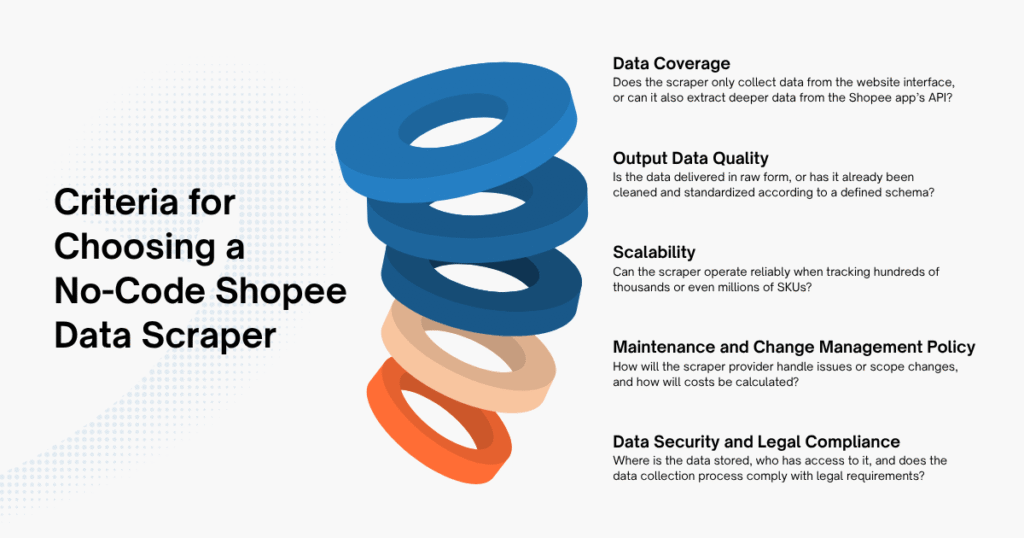
When choosing the right Shopee data scraper, businesses should look beyond cost and the number of advertised features. For market analysis teams, what matters more is data quality, stable performance, and the total cost of ownership over time. Below are five key criteria to consider before making a decision.
1. Data Coverage
Key question: Does the scraper only collect data from the website interface, or can it also extract deeper data from the Shopee app’s API?
By 2026, much of Shopee’s critical data may no longer be fully visible on the web interface at all times. Information such as pricing, inventory, product variants, and sales signals may be spread across multiple data layers. If a Shopee data scraper can only collect data from the visible interface layer, the resulting dataset may be incomplete or may fail to accurately reflect market realities. This can directly affect analyses of market share, pricing, and competitive performance.
2. Output Data Quality
Key question: Is the data delivered in raw form, or has it already been cleaned and standardized according to a defined schema?
In many market analysis projects, data preparation often takes more time than the analysis itself. As a result, output data quality can directly affect a company’s decision-making speed. A low-cost Shopee data scraper that only returns raw data may force the team to spend additional hours or even days processing the data before it can be loaded into Power BI or internal BI systems.
3. Scalability
Key question: Can the Shopee data scraper operate reliably when tracking hundreds of thousands or even millions of SKUs?
Collecting a few hundred products for testing is relatively straightforward. However, when a business needs to monitor an entire product category or multiple countries at the same time, it should prioritize solutions that can operate reliably at scale and offer a clear commitment to data quality.
4. Maintenance and Change Management Policy
Key questions: If an issue arises or the data scope needs to be expanded, how will the Shopee data scraper provider handle it, and how will the costs be calculated?
In long-term data collection projects, it is almost inevitable that the scraper system will need to be updated or adjusted. Therefore, before deployment, businesses should clarify which aspects the provider is responsible for maintaining and which additional requirements will incur extra costs.
- Free of charge: Objective platform changes, such as updates to the HTML structure, API changes, or anti-bot mechanism updates. A professional scraper provider should have monitoring and response mechanisms in place to handle these changes and ensure a stable data flow throughout the project lifecycle.
- Reasonable additional fees: When a business proactively requests changes outside the scope of the initial agreement, such as adding new data fields, increasing the update frequency, expanding into new product categories, or entering new markets. These requests broaden the project scope and are typically handled as part of a service upgrade.
5. Data Security and Legal Compliance
Key questions: Where is the data stored, who has access to it, and does the data collection process comply with legal requirements?
For many market research projects, data is not only an analytical asset but also a source of competitive advantage. When evaluating a Shopee data scraper, businesses should consider:
- Whether an NDA is required
- Which system the data is stored on
- Whether the provider supports direct data delivery to AWS, BigQuery, or a private cloud environment
- What the data retention and deletion policies are after delivery
In addition, it is important to distinguish between public data and personal data. Shopee data scrapers for legitimate market research should collect only publicly available information, such as product names, prices, sales volume, public reviews, and store details; not buyers’ personal data like phone numbers, addresses, or payment information. This helps ensure user privacy is respected and the user experience is not affected.
Final Thoughts
Choosing the right Shopee data scraper is not just about selecting a data collection tool. For market intelligence teams, the broader goal is to build a stable, scalable, and analysis-ready data source that supports long-term decision-making.
When data is collected comprehensively, standardized effectively, and updated continuously, businesses gain a meaningful advantage in monitoring market share, tracking competitors, identifying market shifts, and responding to emerging opportunities ahead of the competition.
Leave a Reply