

Shopee Business Insights is a widely used Shopee analytics tool that helps sellers track internal performance. However, since this tool only shows first-party data, many businesses become “market blind,” missing competitor insights, category shifts, and broader trends. This makes external Shopee data critical for growth.
What Is Shopee Business Insights?
Shopee Business Insights (Shopee BI) is a first-party analytics tool provided by Shopee for sellers. It displays key metrics related exclusively to your own store’s performance on the platform, including:
- Visitor data (traffic volume)
- Sales & revenue
- Conversion rate
- Product-level performance
- Buyer demographics (limited scope)
With Shopee Business Insights, sellers can optimize listings, improve advertising performance, adjust pricing strategies, and monitor sales results over time. This helps businesses make more effective internal decisions, maintain stable operations, and respond quickly to changes in customer purchasing behavior.
Limitations of Shopee Business Insights You Should Know
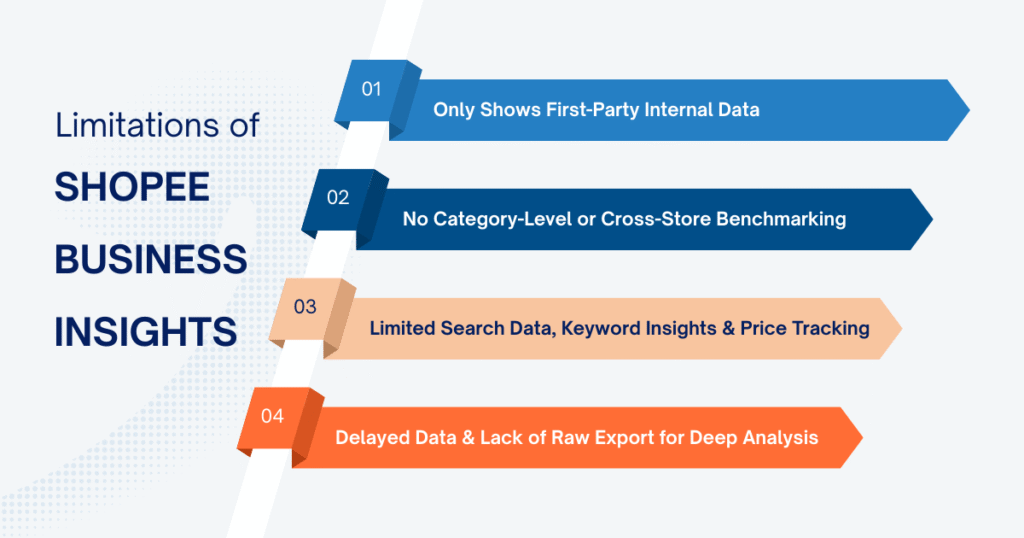
Although Shopee Business Insights delivers significant value for monitoring internal performance, it still carries inherent limitations typical of first-party data analytics tools. As a result, it poses challenges for businesses aiming to scale aggressively, expand into new categories, or compete head-to-head with major brands in the market. These limitations stem from the fact that Shopee BI only reflects store-specific data and does not provide a comprehensive view of the industry, competitors, or broader market trends.
Only Shows First-Party Internal Data
Shopee Business Insights only provides data from your own store. You cannot access industry-wide information, see what competitors are selling, their pricing strategies, or their estimated revenue. By reflecting only a small slice of the overall market, this limitation can leave businesses under-informed when building competitive strategies or predicting market shifts.
No Category-Level or Cross-Store Benchmarking
Shopee Business Insights does not support category-level analysis or cross-store benchmarking. Sellers cannot assess competition intensity, identify category leaders, or understand how an industry is growing. Without benchmarking, it becomes difficult to position a brand strategically or align decisions with broader market dynamics.
Limited Search Data, Keyword Insights & Price Tracking
Shopee Business Insights lacks detailed search and keyword insights – critical elements for understanding demand and optimizing visibility. Metrics such as search volume, keyword rankings, and price fluctuation history are not available. The absence of a Shopee search & category dataset and historical price tracking makes it harder for sellers to evaluate trends or competitor pricing strategies.
Delayed Data & Lack of Raw Export for Deep Analysis
Data updates in Shopee Business Insights often come with delays, making it difficult to react quickly to fast-moving market changes, especially during short-term campaigns or in highly competitive categories. Additionally, Shopee BI does not allow raw data exports, preventing BI teams, data analysts, or data scientists from performing deep analysis, building advanced models, or integrating data into internal analytics systems. This lack of flexibility limits its usefulness for scaling businesses.
Why External E-Commerce Data Gives You a Competitive Edge
Full Market Transparency
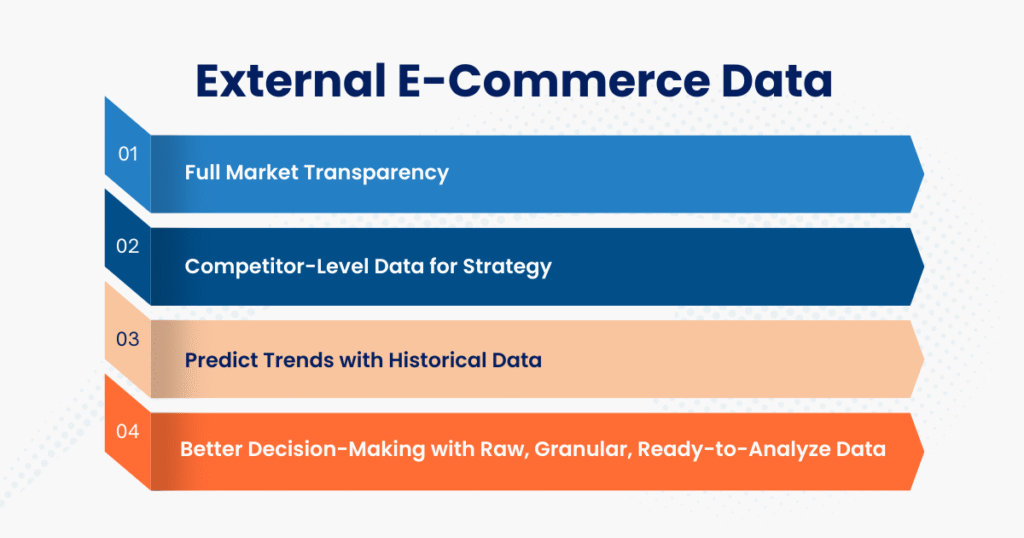
Unlike Shopee Business Insights, which focuses solely on internal data, Shopee marketplace analytics powered by external data provide a full-market view. Businesses can analyze entire categories, market size, competition levels, and fast-growing segments. This transparency helps brands understand their true market position and avoid decisions based on incomplete information.
Competitor-Level Data for Strategy
One of the biggest advantages of Shopee external data is access to competitor-level insights. Businesses can track top-selling products, pricing, estimated revenue, traffic, and growth rates of competing stores. This enables informed decisions around pricing, product assortment, and positioning, rather than reacting blindly to internal performance metrics from Shopee Business Insights alone.
Predict Trends with Historical Data
External datasets typically include historical time-series data, allowing businesses to analyze long-term patterns instead of short-term snapshots. By tracking changes in sales, rankings, pricing, and demand across months or seasons, brands can anticipate emerging trends, identify saturation points, and prepare for peak periods. This is critical for businesses seeking to lead the market rather than follow it.
Better Decision-Making with Raw, Granular, Ready-to-Analyze Data
External data is usually delivered as raw, highly granular datasets. This allows BI, analytics, growth, and marketing teams to build custom dashboards, forecasting models, and internal analytics systems. With flexible and detailed data, decisions around category expansion, product investment, and marketing budgets rely on real analysis, not just standard Shopee analytics tools for sellers.
Shopee Business Insights vs External Data: A Side-by-Side Comparison
| Attribute | Shopee Business Insights | External Data Provider |
| Data scope | Store-level only | Full market |
| Competitor analysis | No | Yes (comprehensive) |
| Category tracking | No | Full category dataset |
| Price & ranking history | No | Yes |
| AI/ML usage | Limited | Raw dataset supported |
| Long-term strategy | Insufficient | Optimized |
Shopee Business Insights is suitable for monitoring and optimizing internal store performance, but it lacks essential components for long-term strategic analysis. In contrast, external data provides a comprehensive view of the market, competitors, and trends, while enabling deeper analysis through raw datasets. This difference makes external e-commerce data a critical foundation for scalable growth and sustainable competitive advantage, something Shopee Business Insights alone cannot replace.
What External Shopee Data Typically Includes
External Shopee data is commonly delivered as raw datasets covering the entire marketplace with high granularity. These datasets enable deep analysis across products, sellers, categories, and search behavior. Below are typical data groups provided by a Shopee data provider.
| Data Group | Detailed Content | Business Value |
| Product-Level Data | Price, inventory, estimated revenue, rankings, category classification | Identify best-sellers, track price movements, monitor SKU performance |
| Seller-Level Data | Store revenue, product count, main categories, growth rate | Competitor analysis, shop-level benchmarking |
| Category & Subcategory Dataset | Market size, product volume, competition level, growth over time | Understand category dynamics and expansion opportunities |
| Search & Keyword Dataset | Search keywords, search volume, CTR, keyword-level rankings | Analyze demand and optimize product visibility |
| Historical Time-Series Data | Daily/weekly/monthly price, revenue, and ranking history | Predict trends, seasonality, and long-term buying behavior |
How to Pick the Right Shopee Data Provider
When Shopee Business Insights no longer meets advanced analytics needs, choosing the right data provider becomes critical. The quality of the provider directly impacts data accuracy and long-term strategic decisions.
- Data Coverage & Freshness: Broad coverage across categories, products, and sellers with frequent updates to reflect real market movements.
- Data Accuracy & Collection Method: Reliable scraping and crawling methods with strict quality controls to minimize errors and duplication.
- Availability of Historical Data: Essential for trend analysis, seasonality detection, and predictive modeling.
- API Support & Scalability: Seamless API integration and scalable infrastructure for BI and analytics teams.
- Sample Dataset Transparency: Reputable providers offer sample datasets to evaluate structure, granularity, and relevance before full deployment.
From this perspective, many businesses turn to Easy Data’s Shopee data scraping service as a complementary source alongside Shopee BI. The service focuses on large-scale Shopee data collection, followed by cleaning, normalization, and structuring to make datasets analysis-ready. With customizable data scope, update frequency, and output formats, businesses can align Shopee data usage precisely with their analytical objectives – without being constrained by predefined reports.
Conclusion
Shopee Business Insights is an essential tool for monitoring and optimizing internal performance. However, on its own, it is not enough to create a competitive edge in today’s e-commerce landscape – where “whoever owns more data, wins.” Combining Shopee BI with Shopee external data unlocks a broader market perspective, completes the data picture, and empowers businesses to make confident, long-term strategic decisions.
Leave a Reply